

Appeals court agrees lighting person on fire counts as arson

Colorado’s second-highest court has weighed in for the first time on whether it is arson to light fire to a person’s clothes while they are wearing them – and the answer is yes.
John Anthony Vasquez is serving a lifetime sentence after a jury found him guilty of murder for setting fire to Christina Archuleta-Blasier at a campsite in Clear Creek County, rejecting Vasquez’s claim the fire was an accident. Vasquez appealed his convictions for arson and murder, arguing arson is a crime against property, not against a person.
Vasquez pointed to the wording of Colorado law, which provides that a person commits arson by starting a fire “on his own property or that of another” and places anyone else in danger of death or serious injury. All parties to the case, including the prosecution and the trial judge, believed the question was whether Archuleta-Blasier’s clothes counted as “property.”
“Every instance of fire-related death where the victim is clothed would constitute felony murder predicated on arson. But if the same victim was not clothed during the fatal fire, then the same defendant would not be guilty,” public defender Kamela Maktabi argued to the Court of Appeals on behalf of Vasquez.
But the three-judge appellate panel reviewing Vasquez’s case disagreed with everyone that “property” referred to the victim’s clothes. Instead, it meant the geographic location of the fire – in this case, a campsite.
“To put it another way,” wrote Judge Steve Bernard in the Sept. 8 opinion, “fourth degree arson criminalizes knowingly or recklessly starting or maintaining a fire on property situated anywhere in Colorado, and by doing so endangering a person, a building, or an occupied structure.”
Because the prosecution presented evidence that Vasquez had started a fire on property in Colorado and placed Archuleta-Blasier in danger of death or serious bodily injury, the panel upheld Vasquez’s arson conviction.
Vasquez separately contended it was not possible for the jury to convict him of second-degree murder as well as felony murder, which involves the death of a person during the commission of another crime, including arson. If Vasquez set Achuleta-Blasier on fire, he argued, that was simply murder, and not arson resulting in murder.
The Court of Appeals disagreed, explaining the legislature had specifically included arson as one of the offenses that can trigger a felony murder charge. The appellate judges conceded that Vasquez’s two murder convictions, however, should merge together into the felony murder offense only.
Achuleta-Blasier died on July 20, 2016, with burns on 60% of her body. She and Vasquez had taken a camping trip with her two young sons the previous month. The two adults began arguing and Archuleta-Blasier reportedly smashed a beer bottle from which Vasquez had been drinking. Vasquez then picked up a canister of gasoline, poured it on Archuleta-Blasier, and lit her clothing on fire with his lighter.
Reportedly, police never questioned her about her injuries before her death.
Authorities first arrested Vasquez for drinking alcohol, which violated a condition of his protection order, and added several more charges related to Archuleta-Blasier’s killing. Vasquez stated Archuleta-Blasier sustained burns when she tried to start a fire. At trial, some experts testified the fire appeared set intentionally, while the defense’s expert believed an insufficient investigation made the exact nature of the fire unknown.
The Court of Appeals panel did agree with Vasquez that some of the prosecutor’s comments at trial were improper. During closing arguments, the prosecutor began to tell a story about his own childhood experience playing with matches in a shed, which the panel deemed unrelated to the evidence.
The prosecutor also told the jury that the trial was a “public reckoning” and jurors were “the conscience of our community.” Vasquez claimed the statements improperly appealed to the passions of the jury.
“We agree that the prosecutor went too far with those comments,” wrote Bernard, a retired judge who sat on the panel at the chief justice’s assignment. “Still, the comments played a small role in the argument as a whole, and given the strong evidence of defendant’s guilt, we cannot say there is a reasonable probability that they contributed to his conviction.”
The case is People v. Vasquez.


Overdose deaths from opioids dip in America — but not in Colorado, study says
Jacob Mauk
jacob.mauk@denvergazette.com
Updated 1 hour ago
Overdose deaths from opioids rose in Colorado, diverging from the national trend, which has been decreasing, according to a new study from a think tank. In its new report, the Common Sense Institute said synthetic opioid overdose deaths in Colorado...
Error-prone Douglas County judge triggers another reversal of criminal convictions
Michael Karlik
michael.karlik@coloradopolitics.com
Updated 5 hours ago
Colorado’s second-highest court overturned a defendant’s Douglas County convictions on Thursday due to the error of a judge whose actions have triggered a disproportionate number of reversals to convictions and sentences in recent years. Since 2021, the Court of Appeals...

Federal judge formalizes injunction blocking USDA’s ‘pilot project’ for Colorado food assistance
Michael Karlik
michael.karlik@coloradopolitics.com
Updated 4 hours ago
A federal judge formalized his order on Monday to prevent the U.S. Department of Agriculture from requiring Colorado to participate in a food assistance “pilot project,” finding that it violates the law, the U.S. Constitution, and “the bounds of reasoned...

Colorado justices speak about inner workings of court, analysis of appellate opinions | COURT CRAWL
Michael Karlik
michael.karlik@coloradopolitics.com
Updated 9 hours ago
Welcome to Court Crawl, Colorado Politics’ roundup of news from the third branch of government. Members of the state Supreme Court provided an inside look at the workings of their institution, and a Colorado Politics analysis found that some appellate...
Appeals court finds no requirement for different judge to handle attorney-client conflict hearings
Michael Karlik
michael.karlik@coloradopolitics.com
Updated 10 hours ago
Colorado’s second-highest court rejected a defendant’s argument on Thursday that a judge improperly heard about a potential conflict between himself and his lawyer right before sentencing, and the man’s reaction could have “tainted” the sentencing decision. In September 2023, Anthony...
The influencers? Some Colorado appeals judges outpace colleagues in setting legal precedent
Michael Karlik
michael.karlik@coloradopolitics.com
Updated 10 hours ago
A handful of judges on Colorado’s second-highest court are producing substantially more precedent-setting opinions than their colleagues, which create binding interpretations of the law that reach beyond individual cases. The Court of Appeals issues approximately 1,700 opinions each year. A...
Colorado justices weigh fairness concerns after defendant prevailed despite ghosting case
Michael Karlik
michael.karlik@coloradopolitics.com
Updated 1 day ago
Members of the Colorado Supreme Court struggled on Tuesday to balance the need for one defendant to shield itself against a plaintiff’s claim that its employee sexually assaulted her child, and the fact that the employee legally admitted the allegations...
Colorado justices skeptical of appellate court’s limitation on prosecution’s appeal
Michael Karlik
michael.karlik@coloradopolitics.com
Updated 4 days ago
The Colorado Supreme Court seemed skeptical on Tuesday that Denver prosecutors should be barred from appealing a trial judge’s permanent dismissal of a criminal case, based upon the sequence of events after the original ruling. Prosecutors charged Quinn M. Jebe...

Federal judge: Government violated order shielding man from deportation in ‘one-off mistake’
Michael Karlik
michael.karlik@coloradopolitics.com
Updated 2 days ago
A federal judge acknowledged on Thursday that the government violated his order by deporting a man in immigration detention during his pending court case, but it “serves nobody’s interests” to require the government to return him. On Feb. 18, Tesfami...
Colorado Supreme Court lifts curtain on decision-making at legal event
Michael Karlik
michael.karlik@coloradopolitics.com
Updated 4 days ago
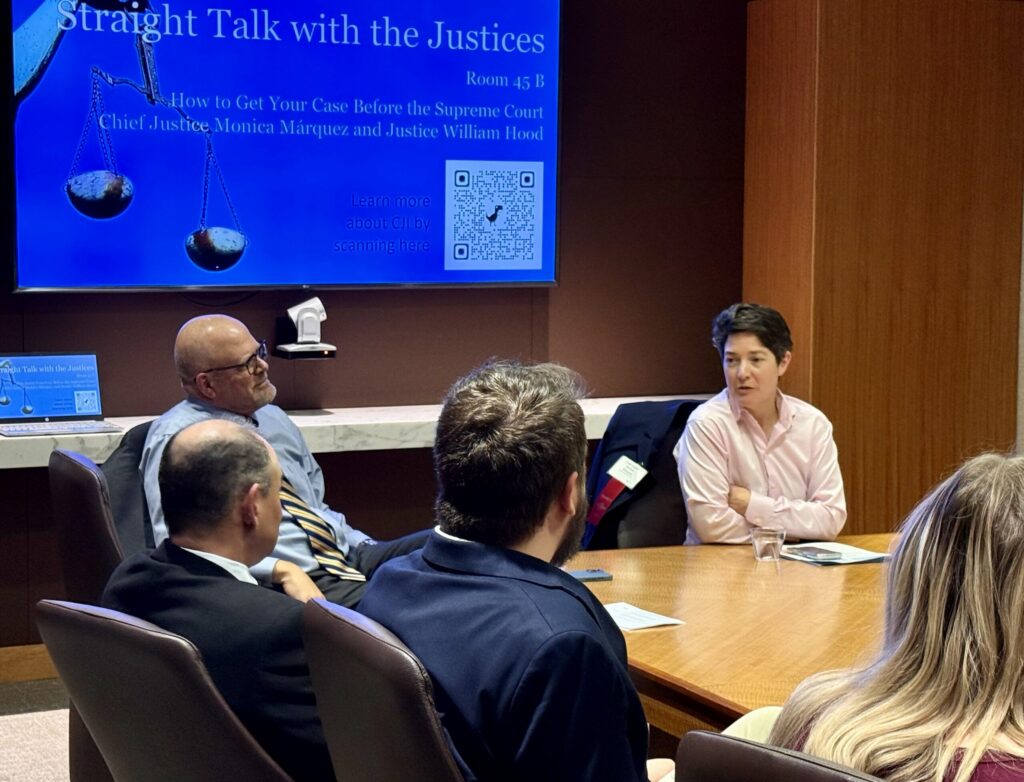
Members of the Colorado Supreme Court sat down with lawyers on Wednesday to answer questions about behind-the-scenes topics, including what happens immediately after an appeal is argued, why they might intervene in an ongoing case, and the consequence of a...
PREV
PREVIOUS

Colorado Democrats cheer climate, health care bill at White House as GOP brandishes inflation report
Colorado Democrats joined President Joe Biden on the White House lawn Tuesday to celebrate the Inflation Reduction Act, a climate, health care and tax package passed last month on a part-line vote, even as Republicans trumpeted a fresh report that showed inflation remained higher than expected last month. “Today offers proof that the soul of […]

National Democrats, Republicans go on the attack in Colorado's new, toss-up congressional district
Along with the first hints of autumn, the air in Colorado is thick with mud this week as national campaign committees unleash a pair of attack ads aimed at the other parties’ nominees in the state’s new congressional district. “Too extreme for Colorado,” says the narrator of one ad, while the other describes a “radical politician” with […]