

Colorado Supreme Court justices publicly back more independent judicial discipline process

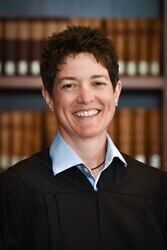
Colorado Supreme Court Chief Justice Brian Boatright and his successor, Justice Monica Márquez, on Thursday repeatedly reiterated to lawmakers their willingness to divest judicial discipline from the court’s control, saying it is important in rebuilding the public’s trust in the judiciary.
Following nearly five hours of testimony, the Senate Judiciary Committee delayed until next week any vote on a bill that would independently fund the Colorado Commission on Judicial Discipline and create a committee to study further changes, including an amendment to the state Constitution to make it fully independent.
In a rare appearance before legislators outside of typical annual budget hearings, the justices testified they welcomed a “really independent office of judicial discipline” and lauded the creation of a committee to study further changes.
“We might have some disagreements with judicial discipline (legislation) but we have no disagreement for its importance,” Boatright told members of the the Senate Judiciary Committee, which heard Senate Bill 22-201.
But the justices remained measured in their praise, pointing to a number of concerns they had about the bill. One solution is to broaden the membership of the study committee, allowing Colorado to be a frontrunner among other states, they said.
“We have an opportunity, a really unique opportunity to make Colorado great, to make Colorado a national leader in this area,” Márquez testified.
The bill aims to create an independent Office of Judicial Discipline within the Judicial Department – essentially moving it out from under the Supreme Court – so it can be funded with taxpayer dollars.
The Colorado Commission on Judicial Discipline is currently funded with about $300,000 in attorney registration fees paid to the Office of Attorney Regulation Counsel, which also sits beneath the Supreme Court.
Members of the commission gave several examples of how their efforts to conduct investigations have at times been stalled by a less-than-cooperative Judicial Department, in some cases with additional harm to the public.
“Right now, the commission cannot do it’s job because, right now, it must ask for permission to do its job,” said Chris Gregory, its executive director. “The commission right now has to ask for its financial resources and that’s not what was intended by the Constitution.”
The bill also creates an eight-member interim commission equally composed of senators and representatives that, over a year, will look at other potential changes, including a constitutional amendment that would make the disciplinary office wholly independent.
Boatright has said he wants its membership to be broader, reflecting more stakeholders, such as judges, lawyers and the public.
“The interim summer study is exactly what is needed,” Boatright said. “We need to be very deliberative, transparent and inclusive. We can’t just change a word here and there and have an easy answer.”
Colorado Bar Association member Letitia Maxfield testified that the committee should reflect ethnic and racial diversity.
Commission chairperson Elizabeth Krupa testified that waiting on the committee’s findings means “we’re not allowed to do our job.”
The Colorado Constitution not only creates the discipline commission, but requires the Supreme Court to come up with the rules under which it must operate.
Boatright and Márquez have privately told lawmakers and attorneys they hoped several ongoing investigations looking into allegations of undisciplined judicial misconduct could be finished before any legislation is passed.
Those investigations were launched following disclosure that a former Judicial Department official who faced firing instead received a lucrative $2.5 million contract. The official, former State Court Administrator’s Office Chief of Staff Mindy Masias, threatened a tell-all sex-discrimination lawsuit, in which she would disclose several instances of judicial misconduct that had gone unpunished over the years. The contract was allegedly awarded to her to prevent the lawsuit.
The information Masias would allegedly reveal in a lawsuit was contained in a two-page memo that was read to then-Chief Justice Nathan “Ben” Coats in a January 2019 meeting, in which it was decided to award the contract, according to former State Court Administrator Christopher Ryan, who was at the meeting.
Masias is one of four people who were referred to the Denver district attorney’s office for additional investigation into possible criminal charges following an inquiry by the Colorado Auditor’s Office. The others are Ryan and former department Human Resources director Eric Brown, who allegedly authored the memo. The fourth person has not been publicly identified.
Ryan and Brown both resigned after the Masias contract was canceled because of a newspaper investigation into the deal.
“The revelations of the last year and a half have been profoundly demoralizing to our members,” said Emma Garrison, secretary of the Colorado Women’s Bar Association, which was neutral on the bill. “In a town hall meeting, the overwhelming consensus was a judicial discipline process that was independent.”
Krupa said the discipline commission has not been able to begin its inquiry because of the funding problems.
“None of the investigations is looking at judicial misconduct,” Krupa said. “And when they say let’s wait, the timing to do something is now. Let us fulfill our mandate, which is to restore the integrity of the judiciary and the public trust in it.”
Boatright testified Thursday that he intentionally hasn’t made any internal changes while the investigations were ongoing.
“Consciously, what we have not done is get ahead of the independent investigations and know they’ve taken longer than any of us hoped they would,” Boatright said. “We know they will make a number of investigations, because they’ve asked questions.”
The committee’s vice chair, Sen. Julie Gonzales, D-Denver, on Thursday reflected on the importance of the legislation before them.
“I find myself in this fascinating position where we are trying to set forth, as we come out of some really complicated and trying times, that have really shaken the publics’ trust in this institution, we’re trying to find a path forward,” Gonzales said. “This is what we’ve got to do, we’ve got to figure this out.”
In an email Wednesday to the state’s 350 judges, Boatright said he objected to a requirement he believed the legislation unfairly made on the Judicial Department – that it must investigate any complaint of judicial misconduct it receives and turn the findings over to the discipline commission. But the bill actually only requires the department to turn over documents from any inquiry it chooses to do and does not make one mandatory.
“To have us come in to do initial investigation to gather witnesses, then there’s the appearance of whether we really turned over all the names,” Boatright said.
How the judicial discipline commission is funded has been a key issue for months, with commission members in January telling legislators how its efforts to pay the lawyers it hired to look into the contract scandal were stalled.
Correspondence between the discipline commission and the Office of Attorney Regulation Counsel shows the stalemate had been going on for several months prior.
The bulk of the concern lies with OARC’s insistence, as part of its fiduciary duty to keep track of public funds, to review billing records the investigators submit to the commission for reimbursement.
The commission worried that unredacted billing records would show OARC – and potentially the Supreme Court – the direction of its investigation and who was being interviewed. The commission by rule conducts all its business in secret.
“The Commission will also need confirmation that the payment process will not be used as a means of attempting to direct the scope, substance, or outcome of the Commission’s work to fulfill its constitutional mandate on these matters,” Krupa wrote ARC Jessica Yates on Oct. 8, 2021, according to a copy of the letter obtained by The Denver Gazette through an open-records request.
OARC also had concerns that the law firm the commission hired to do the investigation – Rathod Mohamedbhai LLC – was given too broad a reach that wouldn’t cause later conflicts.
The commission told Yates the scope of Rathod’s work covered two areas.
“The first category includes the allegations of misconduct by individual judicial officers, allegations that certain judicial officers violated the Colorado Code of Judicial Conduct,” Krupa told Yates in the October letter. “The second category includes allegations of an extended coverup effort relating to the relevant facts. As we explained, Special Counsel has been engaged to assist the Commission to examine both of these categories.”
The most problematic to OARC, according to the correspondence, is the second category, which Krupa said includes an analysis of the commission’s approach to information sharing with other offices that handle other aspects of judicial evaluation, including the performance review commission that decides whether a judge is recommended for retention by voters.
Discipline commission vice chairman David Prince, a district judge in El Paso County, said there have been occasions where the performance commission received serious allegations of misconduct but did not share that with the disciplinary commission, and vice-versa.
“Because everyone has their head down in the silo, and no rules allow for the sharing of that information,” Prince said. “The information sharing systems we have in place are not working. We need something more robust hoping it will be respected.”
The discipline commission in the past frequently used investigators from OARC, but the Masias-contract inquiry posed enough conflicts that OARC chose to hire its own investigators to look into the scandal.
That left the discipline commission looking to the state Attorney General’s office for help, but that agency was also heavily tied into the events surrounding the scandal and was forced to excuse itself. The commission chose to hire its own special counsel.

D-49 board repeals policy separating facilities based on biological sex
Eric Young
eric.young@gazette.com
Updated 1 hour ago
Less than six months after passing a policy segregating the use of district facilities based on biological sex, School District 49’s board of education voted to repeal it during a contentious special meeting Tuesday night. Policy JBAA was adopted by...

Tax bill shock: Colorado homeowners could see property taxes surge by as much as 40%
Marianne Goodland
marianne.goodland@coloradopolitics.com
Updated 3 hours ago
Mike Fitz, 76, who lives in Centennial in a single-family home he has owned since 2001, paid $3,876.98 in property taxes to Arapahoe County two years ago. Fitz just learned after checking the website of the Arapahoe County Assessor’s Office...

Federal judge blocks USDA ‘pilot project’ affecting Colorado food assistance
Michael Karlik
michael.karlik@coloradopolitics.com
Updated 5 hours ago
A federal judge blocked the U.S. Department of Agriculture on Wednesday from proceeding further with a “pilot project” that would require five Colorado counties to rapidly recertify more than 100,000 households for food assistance. In a brief ruling from the...
Colorado’s Democratic delegation calls for Noem’s removal, ICE overhaul
Ernest Luning
ernest.luning@coloradopolitics.com
Updated 5 hours ago
The Democratic members of Colorado’s congressional delegation on Tuesday called for Department of Homeland Security Secretary Kristi Noem to resign or be impeached in the wake of the second fatal shooting by federal immigration agents in Minnesota this month amid...
Colorado’s lack of snow pack hurting outdoor industry; could spell drought conditions this summer
Kyla Pearce
kyla.pearce@gazette.com
Updated 1 hour ago
A snowy weekend forecast in January was a relief to skiers, hydrologists, fire officials and ski resort staff in Colorado, as the state continues to see record high temperatures and record low snowfall. A USDA map showed the average statewide...
Colorado lawmakers hear about increased judicial discipline complaints, fallout from Missy Woods misconduct
Michael Karlik
michael.karlik@coloradopolitics.com
Updated 9 hours ago
Members of the Colorado legislature’s judiciary committees heard about a large increase in complaints against judges and additional forensic misconduct that has come to light, during three days of oversight hearings last week. Leaders of several judicial-related agencies appeared between...
Federal judge warns DOJ against raising repeatedly rejected arguments in immigration detention cases
Michael Karlik
michael.karlik@coloradopolitics.com
Updated 9 hours ago
A federal judge in Colorado warned the U.S. Department of Justice on Monday against raising arguments that she and other judges have repeatedly rejected in cases challenging the lawfulness of immigration detentions. In a Jan. 26 order finding the government...

Will Denver see stepped-up immigration enforcement next? | ANALYSIS
Nico Brambila
nico.brambila@denvergazette.com
Updated 22 hours ago
Two years ago — as Denver grappled with a sharp influx of immigrants, many who arrived in the city after illegally crossing America’s borders — Mayor Mike Johnston joined the mayors of Chicago and New York City in criticizing Texas...

$200M in federal funds to be deployed in Denver area for heat pumps aimed at reducing emissions
Sage Kelley
sage.kelley@denvergazette.com
Updated 8 hours ago
The Denver Regional Council of Governments (DRCOG) has officially launched a $200 million program to help reduce carbon emissions with heat pumps. The regional organization announced its new initiative, “Power Ahead Colorado,” which also includes partnerships with the Colorado Energy...
Holocaust survivors, DU officials announce endowed antisemitism professorship
Michael Braithwaite
michael.braithwaite@gazette.com
Updated 1 day ago
Eighty-one years after Auschwitz’s liberation, the University of Denver announced a new endowed role to help keep the Holocaust’s memory alive. In the space west of the Capitol’s rotunda, and under the gaze of portraits of former state leaders on...
PREV
PREVIOUS

Omicron subvariant accounts for most new Colorado infections
A subvariant of the coronavirus’s omicron strain now accounts for a majority of the new COVID-19 infections in Colorado, sending cases ticking upward slightly. But the state Department of Public Health and Environment says Coloradans as a whole still have population-level immunity, widespread in the wake of omicron’s emergence earlier this year. COVID-19 hospitalizations have […]

State Supreme Court to scrutinize trial of man found responsible for 1991 double killing
Although Timothy John Kennedy reportedly had no motive, left no conclusive DNA evidence at the crime scene, and could point to another suspect who was indisputably hatching a murder plot, an El Paso County jury convicted Kennedy in 2014 for an execution-style double homicide. But that trial, which took place after a judge overturned a […]