

As Ketanji Brown Jackson undergoes confirmation hearings, Colorado tackles judicial diversity problems

As confirmation hearings get underway this week to possibly select the first Black woman to sit on the U.S. Supreme Court, trailblazers in Colorado’s legal community are taking this moment to magnify what some say is a disturbing lack of diversity among the state’s judges.
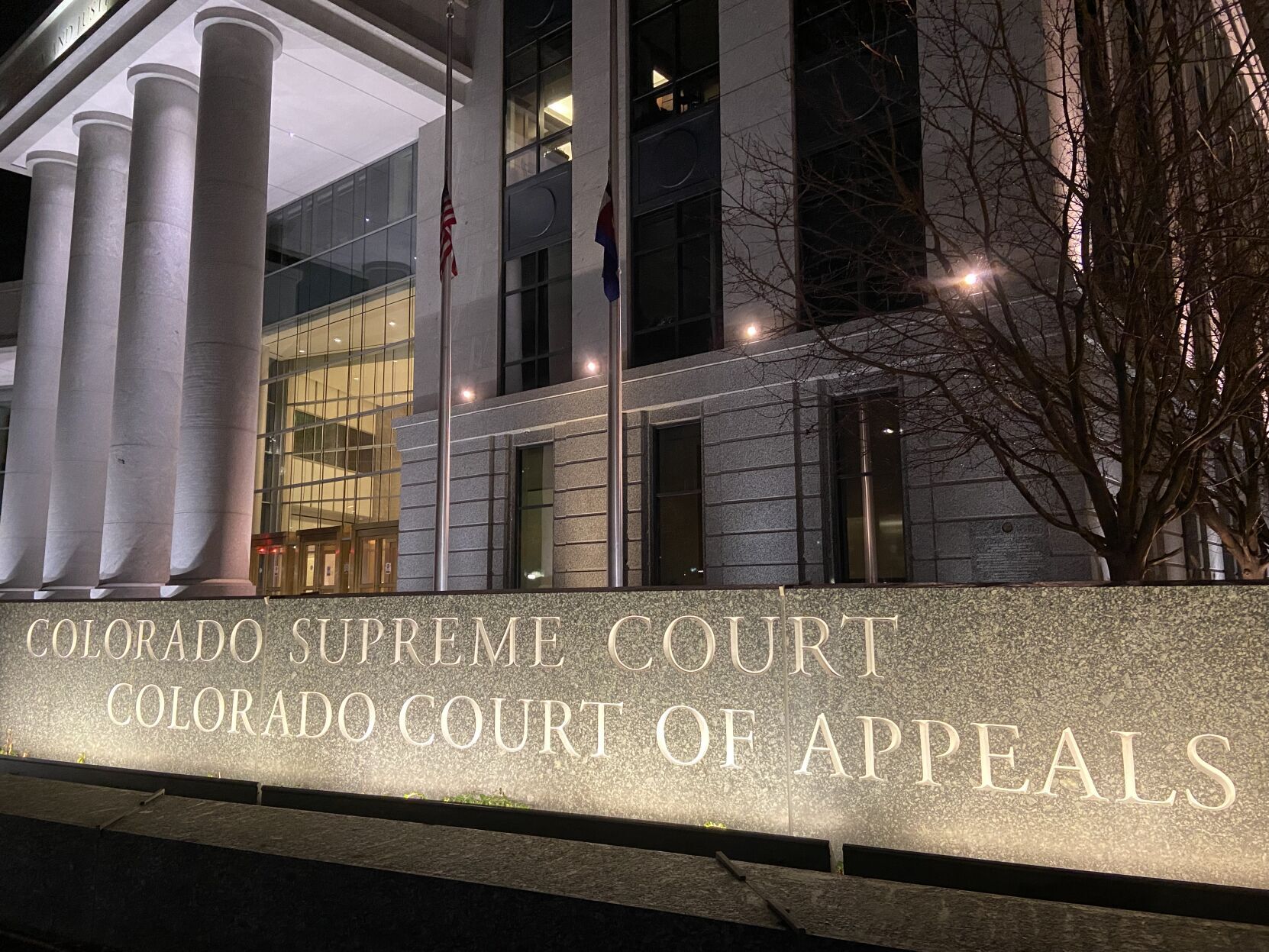
There are no Black justices on the Colorado Supreme Court or the Court of Appeals even though African Americans represent nearly 5% of the state’s population.
But the biggest disparity is among Hispanics, who represent 22% of the state’s citizens but only 9% of its judges. Still, thanks to a huge push to bring diversity to Colorado’s judicial system, more Black women have been appointed to the bench in the last two years than in the last 25 years.
“I think having a bench that reflects the community it serves breeds confidence in the decisions being made,” said Justice Monica Marquez, who in 2010 was the first Latina appointed to the Colorado Supreme Court. “I can tell you that speaking with applicants, speaking with law students and attorneys, it leads to people saying, ‘Maybe this could happen for me.'”
In a recent Zoom interview, Marquez said she will watch Jackson’s hearings with some sense of PTSD. “I know what it’s like to be a first. I have a lot of sympathy for the courage that Ketanji Brown Jackson needs to have right now. There will be a lot of laser-focused attention (on) every aspect of her life. It’s a very brave thing to undertake.”
“It’s about time!” said Senior Judge Gary Jackson. “She will bring a different perspective to the Court.”
Jackson, who is no relation to Ketanji Brown Jackson, has focused on the lack of diversity in Colorado’s judicial system his entire career.
“It is incomprehensible that there have only been two Black Court of Appeals judges in the history of Colorado,” said Jackson. Raymond Jones was Colorado’s first Black Court of Appeals judge and the second was Karen Ashby. Both are retired.
Jackson knows what it’s like to be a pioneer. In 1970, he became Colorado’s only Black deputy district attorney, when he was hired in the Denver office. In 2013, he was appointed to the Denver County Court. Last month, he was inducted into the Denver Public Library’s Blacks in Colorado Hall of Fame.
Jackson described a traumatizing moment that illustrated to him that Black people are not treated the same as white people. He was 7 years old and sitting in the back seat of the family car when his father was stopped, ordered out of the car and handcuffed for making a rolling stop in Cherry Creek, where they lived.
“It was frightening to see your dad forced up against the car like that,” Jackson said, adding that they were one of only a few Black families who lived in Cherry Creek at the time.
If not for Jackson’s fight for inclusion, Colorado’s bench may not be as diverse as it has gotten in the last two and a half years. An effort he led to get people of color on the bench resulted in the Colorado legislature creating a position within the State Court Administrator’s Office in 2019 to provide outreach and education to people of color to encourage them to apply for judicial vacancies.
Since Sumi Lee stepped into that job, 35 new judges have been seated. Of those, five are Black, four are Hispanic, two are multiracial and 24 are white; 51% are women. Three are openly LGBTQ including one on the Court of Appeals.
“We do what we can, which is to encourage and groom applicants to apply for the bench and provide outreach to tell them what the job is really like,” Lee said.
Lee has started several programs, including “Java with Judges,” a coffee house setting where diverse law students get a chance to connect with judges, and Dream Team 2.0, a one-on-one coaching program for diverse judicial applicants.
In Colorado’s rural areas, there are almost no judges of color, a problem Lee called the “legal desert.” The Colorado Bar Association and other legal organizations will sponsor a pilot program this summer that places law students of color into two rural communities, providing them with housing and contacts for six weeks.
“We want to break the stereotypes about what working in a rural community is like. It’s more robust and fulfilling than students realize,” said Lee.
Neither Marquez nor Lee have influence when it comes to judicial selections. That part is handled by judicial nominating committees that are dotted across the state. Volunteer lawyer and citizen volunteers in each district make nominations that are sent to the governor, who makes the final appointments.
“This governor has shown that he is very interested in making those kinds of selections,” Lee said of Gov. Jared Polis.
Though Lee is chipping away at getting qualified diverse candidates interested in judgeships, she understands that there are what she calls “leaks” in the pipeline. Youngsters of color who may be interested in a legal career today won’t show up in the demographics for years to come. Many are in high school, college or law school, and in most cases, attorneys must have five years of experience before they are considered for a judicial appointment.
“We need to more than double the number of Hispanic and Latino judges on the bench today in order to keep up with the growing communities of color,” said Marquez. “The largest group of diversity is under the age of 18. That’s where the potential is.”
Marquez’s role models were at the dinner table every night. Her father Lorenzo was the first Latino appointed to the Colorado Court of Appeals, where he served for 20 years before retiring. Her mother was a school teacher.
“I swore to them both as a kid that the two things I’d never do was to become a school teacher and a lawyer. And that’s exactly what I did. I did both.”


Appeals court overturns Douglas County vehicular homicide conviction due to faulty jury instructions
Michael Karlik
michael.karlik@coloradopolitics.com
Updated 3 hours ago
Colorado’s second-highest court overturned a defendant’s vehicular homicide conviction and 12-year prison sentence on Thursday after determining a Douglas County judge omitted key language from the jury instructions that could have resulted in a different outcome. James Paul McDonald was...

Federal judge dismisses malicious prosecution claim against former Denver prosecutor
Michael Karlik
michael.karlik@coloradopolitics.com
Updated 1 day ago
A federal judge concluded on Monday that a former Denver prosecutor could not be sued for allegedly causing the arrests of two plaintiffs after they failed to appear for trial on the scheduled date, even though the trial had been...
Judicial discipline commission reports increased transparency, increased submissions
Michael Karlik
michael.karlik@coloradopolitics.com
Updated 1 day ago
The Colorado Commission on Judicial Discipline received 473 misconduct complaints about judges in 2025, which was nearly 29% higher than in 2024 and substantially greater than any time in the past decade. However, only 31 complaints were referred to the commission...
Colorado Gov. Jared Polis ignites fierce debate after raising clemency questions in Tina Peters case
Marianne Goodland
marianne.goodland@coloradopolitics.com
Updated 21 hours ago
Gov. Jared Polis ignited a political firestorm Tuesday night after weighing in on the prison sentences of two former Colorado officials — a Democrat and a Republican — convicted of attempting to influence a public servant. The comments quickly fueled...

Colorado Supreme Court signals intervention in dispute over treatment for trans children
Michael Karlik
michael.karlik@coloradopolitics.com
Updated 2 days ago
The Colorado Supreme Court ordered Children’s Hospital Colorado on Tuesday to explain why it should not direct the organization to resume providing certain types of services to transgender children in compliance with the state’s non-discrimination law. Last month, a Denver...

Judge nixes latest policy requiring 7 days’ notice for Congress members to visit ICE facilities
Michael Kunzelman
michael.kunzelman@associatedpress.com
Updated 2 days ago
WASHINGTON (AP) — A federal judge agreed on Monday to temporarily suspend the latest version of a Trump administration policy that requires members of Congress to provide a week’s notice before they can visit immigration detention facilities. U.S. District Judge...
Judge nixes latest policy requiring 7 days’ notice for Congress members to visit ICE facilities
Michael Kunzelman
michael.kunzelman@associatedpress.com
Updated 2 days ago
WASHINGTON • A federal judge agreed on Monday to temporarily suspend the latest version of a Trump administration policy that requires members of Congress to provide a week’s notice before they can visit immigration detention facilities. U.S. District Judge Jia...
Colorado Supreme Court clarifies restraining order violations can always support burglary charge
Michael Karlik
michael.karlik@coloradopolitics.com
Updated 21 hours ago
The Colorado Supreme Court’s majority ruled on Monday that a violation of a restraining order can also serve as a basis for finding a defendant guilty of burglary. Under state law, a person commits second-degree burglary by unlawfully entering or...

10th Circuit judge creates vacancy, district court gets new chief judge | COURT CRAWL
Michael Karlik
michael.karlik@coloradopolitics.com
Updated 2 days ago
Welcome to Court Crawl, Colorado Politics’ roundup of news from the third branch of government. A longtime member of the Denver-based federal appeals court will give the president a vacancy to fill, plus Colorado’s federal trial court will see a...

Morgan County man accused of killing wife, staging her suicide charged with first-degree murder
Kyla Pearce
kyla.pearce@gazette.com
Updated 2 days ago
A grand jury announced the indictment of 52-year-old Ronald Lowry, who is accused of killing his wife in October 2023 and staging the crime scene to look like a suicide. Lowry, who was arrested Friday in Morgan County, was charged...
PREV
PREVIOUS

Senate sends bill banning firearms at polling places to governor
The state Senate on Monday signed off on a bill that would prohibit firearms from being openly carried at polling places or within 100 feet of a ballot drop box. House Bill 1086, known as the Vote Without Fear Act, passed on a party-line 20-13 vote on Monday. HB 1086 sponsor Sen. Sonya Jaquez Lewis, D-Longmont, […]

ENDORSEMENT WATCH | Dave Williams wins support from conservative pundit Michelle Malkin
State Rep. Dave Williams, one of four Republicans challenging eight-term U.S. Rep. Doug Lamborn’s bid for reelection in a primary, has been endorsed by conservative author and commentator Michelle Malkin, his campaign said. Malkin, a Colorado Springs resident, called Williams “exactly the kind of proven conservative warrior we need in Congress” in a statement that […]