

Judge greenlights lawsuit against health care contractor for Fremont County jail death

A medical corporation and its employees may be held liable for the 2020 suicide of a man in custody at the Fremont County Detention Center, after a federal judge declined to dismiss the claims against them.
NatCore Healthcare Industries, Inc. formerly provided health care services to detainees in Fremont County, and its employees were reportedly aware that 47-year-old Clint Long was experiencing mental health struggles and self-harm while at the jail. Long’s son, Gage Long, has alleged NatCore showed deliberate indifference to his father’s serious medical needs, which culminated in Clint Long hanging himself on April 2 of last year.
On Dec. 15, U.S. District Court Judge Christine M. Arguello rejected NatCore’s request to dismiss certain allegations against the company and its employees. Gage Long is seeking a jury trial for his claims as well as monetary damages if he prevails.
Leading up to Clint Long’s death, the lawsuit alleged a long string of red flags that NatCore failed to address. Throughout his incarceration in 2018 and 2019, Long reportedly submitted multiple requests to NatCore staff seeking mental health treatment. On one such occasion, he said he heard “men talking in my head again.”
In August 2019, Fremont County jail employees allegedly tried to contact NatCore after finding Long bleeding from his face, but were unable to immediately reach anyone. Later that month, jail staff also encountered Long vomiting blood in his cell. Their call to NatCore went to voicemail.
On other occasions, NatCore allegedly placed Long on a medical watch, requiring a check on him every thirty minutes. According to the lawsuit, that did not happen in multiple instances. When Long harmed himself by sticking something in his ear, a NatCore employee offered him an ice pack and time alone to “calm down,” rather than provide mental health care.
Less than two weeks before Long’s suicide, Adam Beaty, a NatCore worker, allegedly reviewed jail footage after Long was found bleeding. Beaty reportedly discovered that Long had injured himself, but Beaty did not place Long on suicide watch or provide mental health care.
On March 24, 2020, Daniel Vaught, the chief executive of NatCore and a nurse practitioner, testified in Fremont County District Court that Long was bipolar. He also said that even though he wanted Long to see a psychiatrist the week earlier, that had not happened because the “psychiatrist had to leave early and … so forth.”
Four days before his suicide, Long submitted a note to NatCore staff indicating he needed to see a psychiatrist immediately. “i am and have been seeing dead people when I wake up in my cell at night. They aren’t dangerous but knowing they are not real is quite disturbing,” he wrote.
Long hung himself on April 2, 2020. Reportedly, he sent an email to a member of his criminal defense team minutes before with the subject line, “my mindnismgone and im sick.” Despite a video camera in his isolation unit with a live feed, jail officials allegedly failed to notice him for over 30 minutes.
At the time Long was jailed, he was facing charges for assault and harassment.
Long’s son sued NatCore, the individual employees and Fremont County for his father’s death. The lawsuit alleged a pattern among NatCore of failing to provide adequate mental care to detainees at Fremont County Detention Center. Lawyers for Gage Long portrayed his father as begging for psychiatric help in the lead-up to his death.
“Unsurprisingly, NatCore proved incapable of providing constitutionally-adequate medical care to people in FCDC custody. During 2020, NatCore was short staffed at least 74% of the time,” the lawsuit claimed.
NatCore argued that there was no plausible constitutional violation alleged in the complaint. Knowing that Clint Long had a history of mental health issues did not necessarily mean he was at risk of suicide.
“An inmate himself causing a bloody nose or ear may very well be attempting to provide a reason for transport to the hospital, or engaged in drug seeking behavior, and not suicidal,” attorneys for the company wrote. “The Constitution does not require a healthcare entity providing services to a jail to have someone with specific credentials available to evaluate inmates for potential suicide risk.”
In September, U.S. Magistrate Judge Michael E. Hegarty recommended against dismissal of the claims involving NatCore, Beaty and Vaught. He found the allegations were plausible enough to show that the defendants knew Long faced a substantial risk of suicide and disregarded it.
“Here, Defendant Beaty witnessed and recorded on two separate occasions the harm Mr. Long inflicted on himself,” Hegarty wrote. “Further, they followed years of kites [communications] indicating Mr. Long’s mental health battles, including hearing voices in his head. Defendant Beaty did not connect Mr. Long with a mental health care professional or otherwise place him on suicide watch.”
As for Vaught, Hegarty pointed out Vaught had not only heard about Long’s self-harming behavior, but also allegedly took Long off of medical watch. The magistrate judge credited the lawsuit’s allegations that understaffing at NatCore could have been a contributor to Long’s suicide.
“Due to that practice, NatCore was unable to adequately monitor Mr. Long or provide him with mental health care. Failing to do so was a direct causal link,” Hegarty wrote.
Arguello adopted Hegarty’s recommendation entirely. The ruling also dismissed the claims of deliberate indifference against the NatCore employee who received Long’s note shortly before his death about seeing dead people. Arguello conceded that the employee’s alleged failure to act after receiving the note may constitute negligence, but was not enough for a constitutional violation.
Beginning in January 2021, Fremont County contracted with a different health care provider for people in the jail.
“Our current health care provider, NatCore, was struggling to meet their contractual obligations,” said Sheriff Allen Cooper at the time, according to The Cañon City Daily Record. “Due to the size of their organization and the impact of the pandemic, they were only able to staff our facility 75% of the time and some of those staff were only EMTs.”
The lawsuit over Long’s suicide also claims Fremont County jail staff were liable for failing to intervene and obtain adequate medical care for Long.
Months prior to Long’s death, a jury in federal court found Fremont County and its former sheriff were not liable for another recent detainee death in the jail: that of John Patrick Walter in 2014, who died from withdrawal after staff withheld his prescription medication.
The case is Estate of Clint Long v. NatCore Healthcare Industries et al.


10th Circuit oral arguments to feature trial judges for first time in 12 years
Michael Karlik
michael.karlik@coloradopolitics.com
Updated 2 days ago
When the Denver-based federal appeals court convenes next week to hear oral arguments, six new faces will be staring down from the bench. No, the U.S. Court of Appeals for the 10th Circuit has not added six new members. It...

Federal judge says ICE cannot impose monitoring conditions beyond immigration judge’s order
Michael Karlik
michael.karlik@coloradopolitics.com
Updated 2 days ago
A federal judge told U.S. Immigration and Customs Enforcement on Thursday that it cannot impose additional restrictions or monitoring conditions beyond those ordered by an immigration judge when releasing a person on bond. In November, U.S. District Court Judge Gordon...
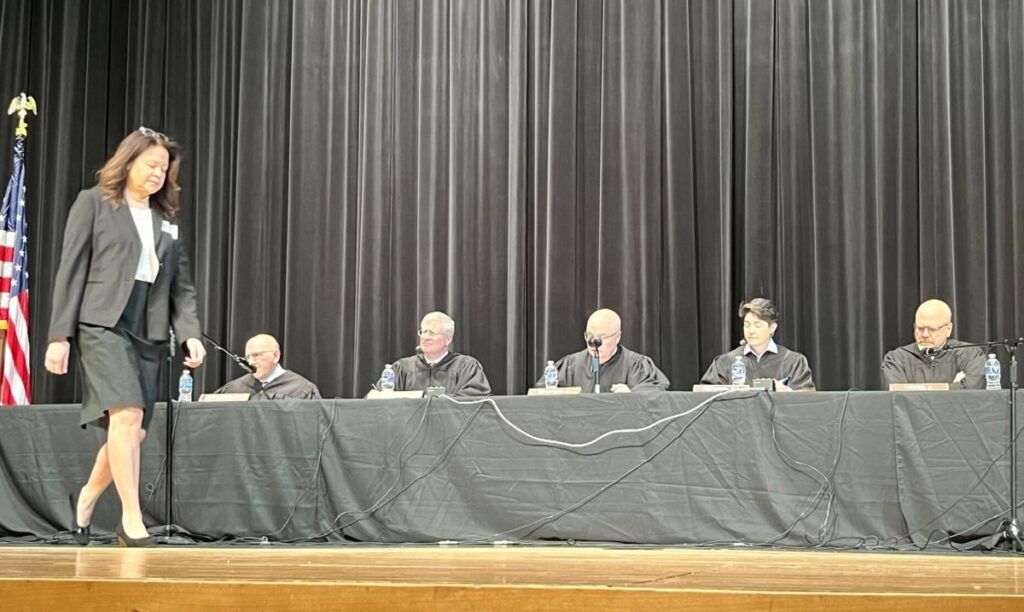
Colorado justices weigh constitutionality of student backpack search based on confidential tip
Michael Karlik
michael.karlik@coloradopolitics.com
Updated 1 day ago
The Colorado Supreme Court considered on Wednesday whether a tip submitted through the state’s confidential school safety system provided a Douglas County administrator with reasonable suspicion to search a student’s backpack for drugs. A trial judge blocked evidence from the...

10th Circuit rebuffs Jeffco’s attempt to expand immunity footprint
Michael Karlik
michael.karlik@coloradopolitics.com
Updated 3 days ago
The Denver-based federal appeals court confirmed on Wednesday that it would not treat a judge’s decision to move a civil case forward as the automatic equivalent of denying immunity to governmental officials. The order from the U.S. Court of Appeals...

Colorado Supreme Court to hear cases on witness retaliation, slip-and-fall
Michael Karlik
michael.karlik@coloradopolitics.com
Updated 11 hours ago
The Colorado Supreme Court announced on Monday that it will decide whether defendants can be convicted of retaliating against a victim or witness when that person has not yet testified and is not scheduled to testify. At least three of...
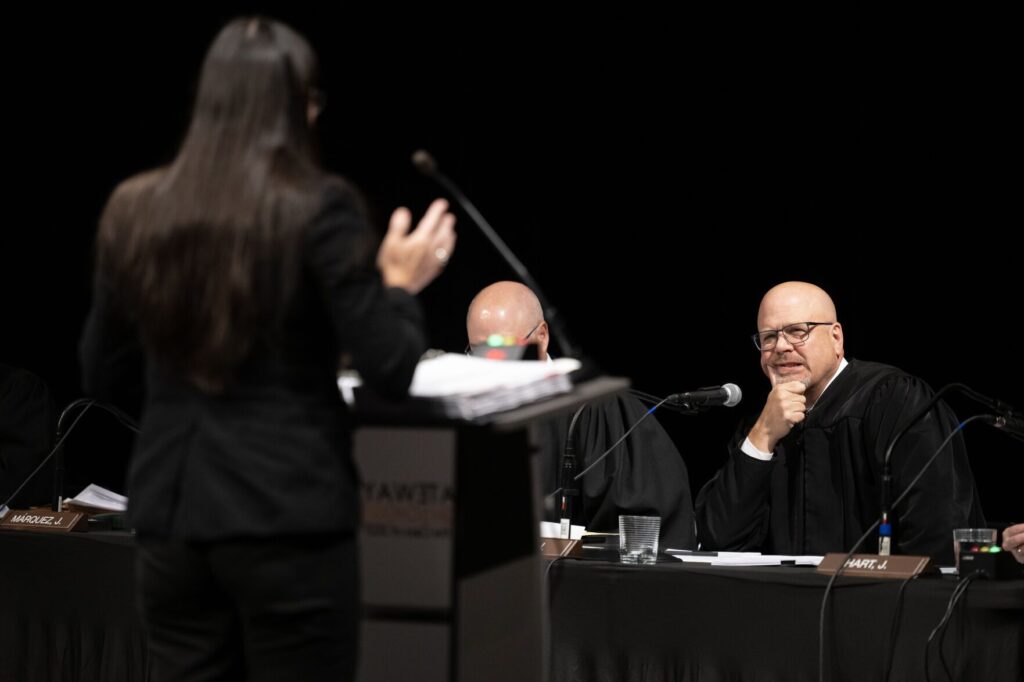
Colorado Supreme Court struggles with rubric for significant reductions in parenting time
Michael Karlik
michael.karlik@coloradopolitics.com
Updated 3 days ago
The Colorado Supreme Court attempted to identify on Wednesday the circumstances under which judges may reduce the number of days a parent spends with their child post-divorce without it rising to the level of a “restriction” that requires more rigorous...

Douglas County Sheriff, DA sue Polis administration over immigration policy
Marissa Ventrelli
marissa.ventrelli@coloradopolitics.com
Updated 3 days ago
Douglas County Sheriff Darren Weekly and District Attorney George Brauchler filed a lawsuit against Colorado Gov. Jared Polis, challenging the constitutionality of a state statute on immigration visas. Filed on Wednesday, the suit also named Colorado Attorney General Phil Weiser,...

Colorado justices wary of expanding rezoning by ballot initiative
Michael Karlik
michael.karlik@coloradopolitics.com
Updated 1 day ago
The Colorado Supreme Court appeared wary on Wednesday of allowing rezonings of planned-unit developments to occur through a vote at the ballot box, rather than a municipality’s detailed review process that accounts for specific factors. In contrast to traditional, or...

In Tina Peters appeal, judges telegraph some degree of reversal | ANALYSIS
Michael Karlik
michael.karlik@coloradopolitics.com
Updated 4 days ago
Former Mesa County clerk Tina Peters seems poised to walk away from the state’s Court of Appeals with her criminal convictions largely intact, even as a three-judge appellate panel raised concerns about her sentence and one specific conviction. Peters, a...

Judge warns against expansive use of post-9/11 rule in immigration detentions
Michael Karlik
michael.karlik@coloradopolitics.com
Updated 5 days ago
A federal judge concluded on Monday that the government applied a 9/11-era regulation to a man in immigration detention in violation of his constitutional rights, in seemingly the first decision out of Colorado addressing the increased use of the “automatic...
PREV
PREVIOUS

Tancredo sticks with Imer as GOP field of Perlmutter challengers grows
Tom Tancredo says Republican congressional candidate Laurel Imer can count on his continued support even as another candidate also recently endorsed by the former five-term congressman in another race jumps into the GOP primary in Colorado’s 7th Congressional District. First-time candidate Erik Aadland on Monday announced he was withdrawing from the crowded U.S. Senate primary […]

Gov. Jared Polis announces launch of tax credit to help employee-owned businesses
Gov. Jared Polis, joined by some of the employee-owners of Hercules Industries in Denver, announced the state’s Office of Economic Development and International Trade will start accepting applications for a new tax credit in the new year. The credit is intended to help Colorado-headquartered businesses that want to convert to an employee ownership model cover […]