

COURT CRAWL | Students hear from state Supreme Court, SCOTUS takes Colorado case

Welcome to Court Crawl, Colorado Politics’ roundup of news from the third branch of government. High school students quizzed state Supreme Court justices and lawyers after the judicial branch took a pair of cases on the road, and the U.S. Supreme Court has agreed to hear one appeal from Colorado – with possibly more on the way.
Supreme Court resumes its ‘field trips’
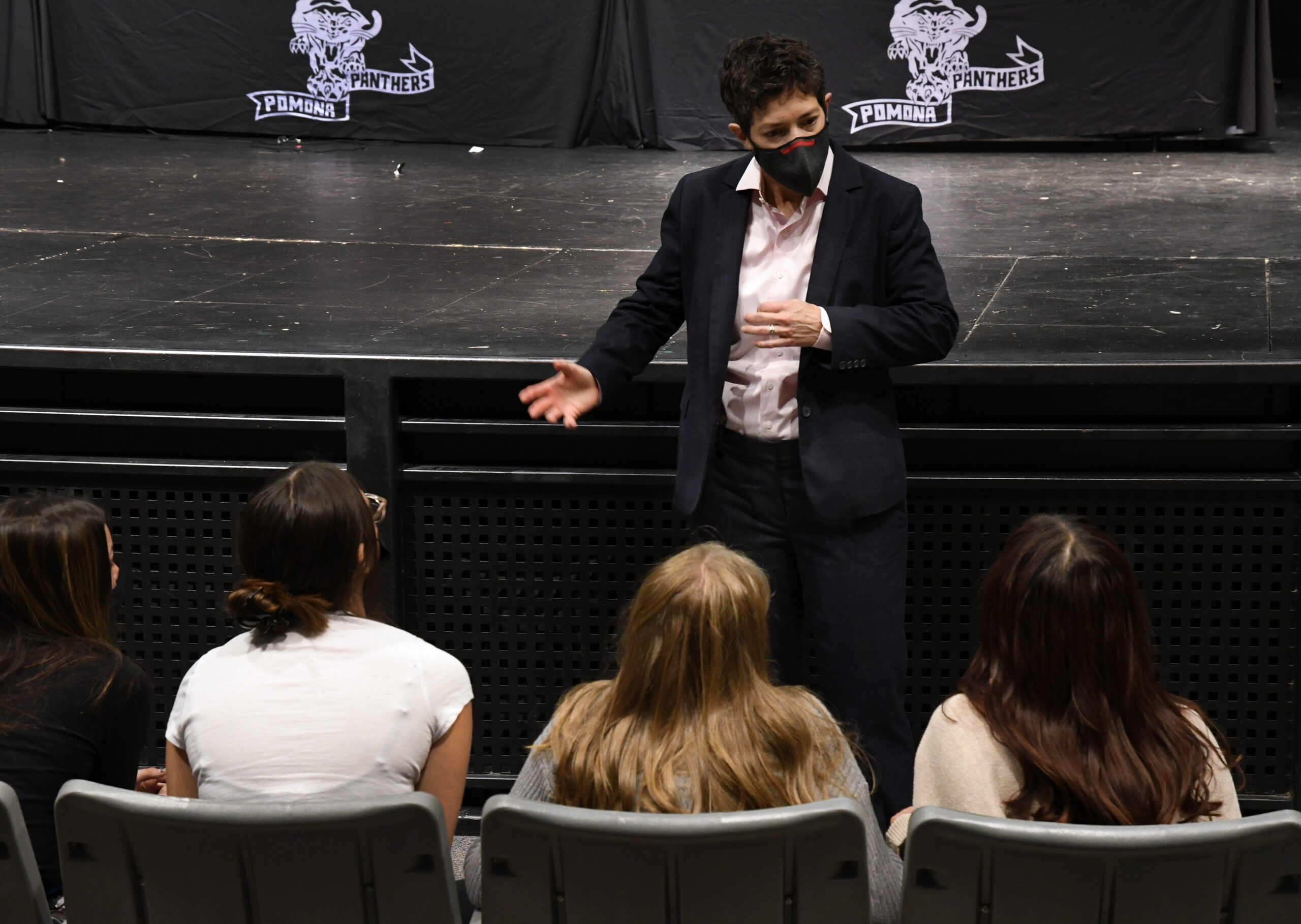
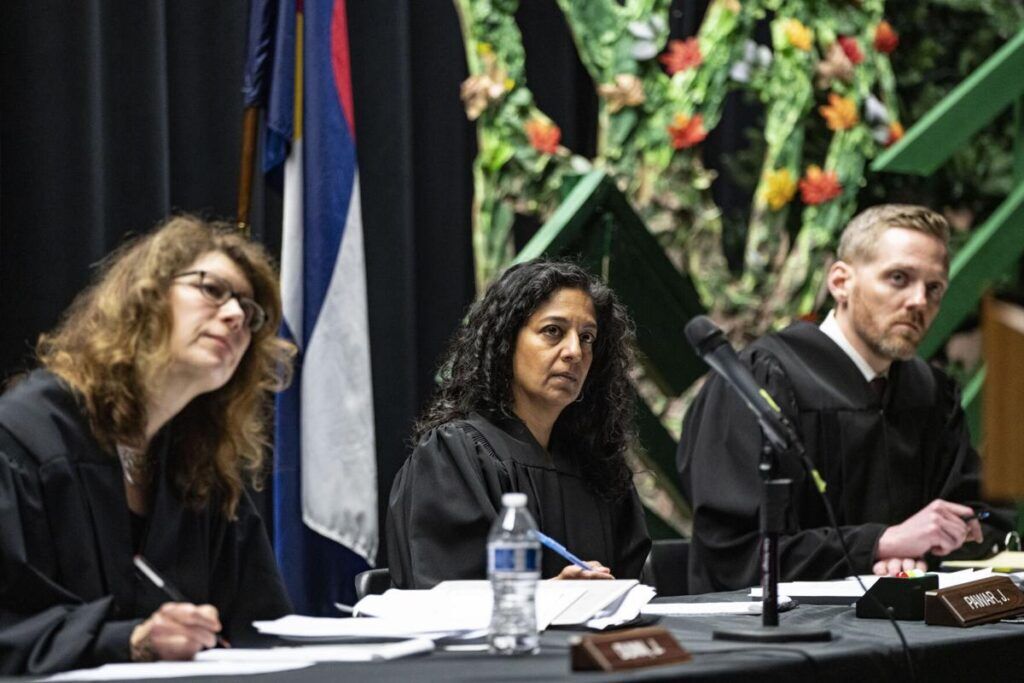
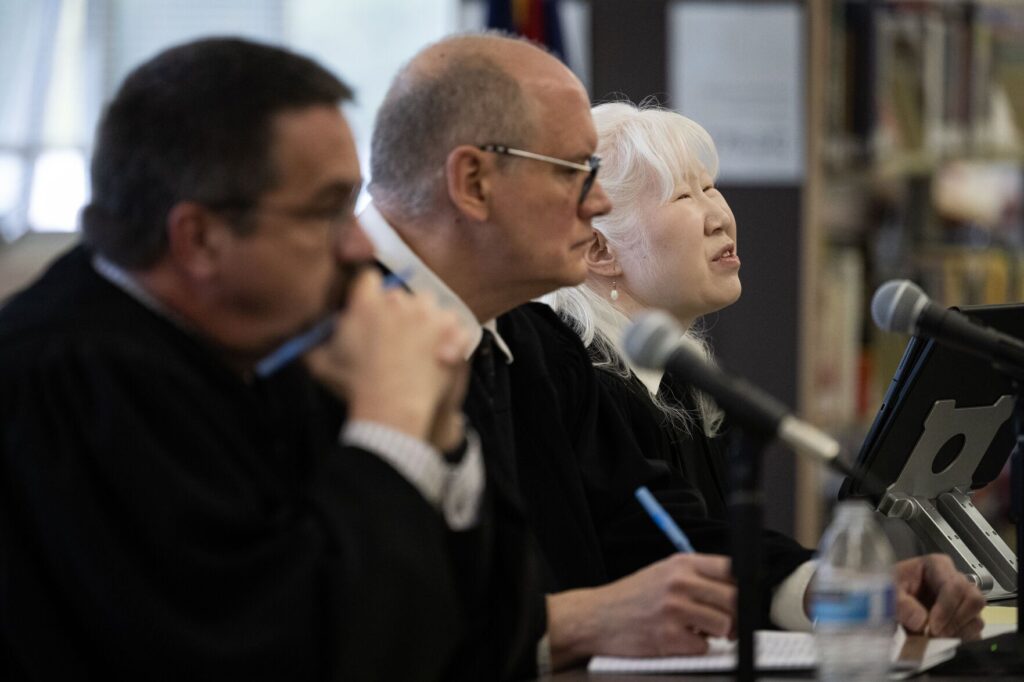
? After being consigned to virtual interactions during much of the pandemic, the Colorado Supreme Court resumed its 35-year-old Courts in the Community program last week, venturing to Pomona High School in Arvada to hold two oral arguments in front of an in-person audience of students and teachers. Chief Justice Brian D. Boatright summed up the mood of the court: “Remember when you were little and got to go on field trips to the zoo or someplace cool? That’s how we feel.”
? First, the cases: the city of Boulder tried to fend off a lawsuit from a woman who tripped and severely injured herself due to a large gap in the sidewalk that the city knew about. Then, a man convicted of attempted murder argued that a police investigator used “junk science” to determine whether the defendant likely shot his gun on purpose or accidentally.
? Planning for the event started before the pandemic, said civics teacher Barbara Taylor. She added that kids “need to do things to remember that school is cool.” The oral arguments certainly seemed to make an impression on ninth-grade student Adin Anderson: “I was really surprised at how welcoming the environment was. People were laughing at jokes and there wasn’t any yelling. The two sides were pretty respectful.”

? The seven members of the court also met with students in small groups. Here is some of what Colorado Politics overheard:
From Justice William W. Hood III, asked whether they base their decisions on the personalities of lawyers: “We already have a pretty good sense of how [the cases] are likely to come out beforehand. So the opportunity to move the needle might not as significant as you might think. We’re so driven by the logic of the case that the ability to be swayed probably happens more at the trial court.”
From Boatright, asked if it’s hard to accept being in the minority in a decision: “I joke that it’s a forced marriage with six people … We really like each other but we don’t have an obligation to each other. Our obligation is to do justice. We don’t take it personally.”
From Justice Maria E. Berkenkotter, who asked her student group how many wanted to be lawyers, judges or justices: “How about, how many want to be reporters, an incredibly important job?” (In a terrible miscarriage of justice, no students raised their hand.)
SCOTUS update
? From the state’s highest court to the nation’s: the U.S. Supreme Court announced that it would hear an appeal from Colorado in which a Navajo man was prosecuted first in the Ute Mountain Ute tribe’s justice system, then the federal justice system for the same act. The defendant argues this violated the constitutional prohibition on double jeopardy, but the government says the federally-established court used by the tribe and the regular federal district court are two sovereign entities to which double jeopardy does not apply.
? Support is also building for the Supreme Court to hear the appeal of Lorie Smith, the Christian website designer who refuses to create same-sex wedding websites due to her religious beliefs. As of Friday, there were 13 briefs filed from conservatives and free speech advocates asking the justices to take up Smith’s case. An appeals court in July found Colorado’s anti-discrimination law compelled her to create content for same-sex and opposite-sex weddings alike.
Speaking of the Constitution
? A nearly monthlong saga in Colorado’s U.S. District Court ended on Oct. 28, when Judge William J. Martínez tossed the lawsuit of a white business owner who challenged Colorado’s program to give COVID-19 relief grants to minority-owned business (among others). Earlier in the month, the judge seemed sympathetic to plaintiff Stephen E. Collins‘ argument that awarding grants on the basis of race disadvantaged him and was an unconstitutional practice. But Martínez learned that the program was actually undersubscribed and Collins would get the money he asked for – as would all of the applicants who were qualified.
? “Plaintiffs never competed with other applicants, nor were the minority-owned business preferences applied at all, much less applied to Plaintiffs’ detriment,” the judge wrote in dismissing the case.
? In other news, U.S. District Court Judge Raymond P. Moore declined to halt the University of Colorado’s policy for granting religious exemptions to its vaccine mandate. A physician and medical student had sued, saying the Anschutz Medical Campus had discriminated against their beliefs after they refused to get vaccinated. But CU changed its policy shortly before they filed suit, so Moore opted not to make a decision until the plaintiffs challenged the new policy specifically.
Vacancies and appointments
? A citizen-led commission has recommended three candidates to replace retiring Court of Appeals Chief Judge Steve Bernard. The governor will choose between Adams County District Court Judge Priscilla J. Loew, Assistant U.S. Attorney Karl Schock and El Paso County District Court Judge Timothy Schutz. Loew was also a finalist for the previous appellate court vacancy.
? The two finalists to succeed Saguache County Court Judge Anna Ulrich are Kaeden Johns and Craig Schuenemann. The position is part time.
? The governor has appointed Yolanda M. Fennick, a lawyer specializing in family and juvenile matters, to the El Paso County Court. She succeeds Judge Samuel Evig.
? There is a district court vacancy in the 13th Judicial District, which covers a large swath of northeastern Colorado (Kit Carson, Logan, Morgan, Phillips, Sedgwick, Washington and Yuma counties). Judge Michael K. Singer is retiring at the end of the year, and applications are due by Nov. 5.
Miscellaneous decisions
? The Court of Appeals was concerned that a La Plata County judge didn’t investigate three jurors’ allegations that they saw the defense lawyer take a picture of them with her phone, instead telling jurors that “there must have been some misunderstanding.”
? A search warrant was lawful, even if Denver police officers didn’t ensure 100% that the informant they were using for a drug bust was reliable, the Supreme Court said.
? Adams County is suing its own treasurer, alleging she is failing to perform her duties under the law.
? Even though the Supreme Court declared certain types of sentences illegal, a man who violated a protection order while they were serving an illegal sentence was properly convicted because he didn’t seek to clear the protection order himself, the Court of Appeals decided.


10th Circuit provides guidance on police searches of cloud-based data
Michael Karlik
michael.karlik@coloradopolitics.com
Updated 6 hours ago
The Denver-based federal appeals court provided guidance to law enforcement agencies on Monday for ensuring that searches of cloud-based accounts comply with the Fourth Amendment’s requirements. A three-judge panel of the U.S. Court of Appeals for the 10th Circuit noted...
Federal judge releases man after 2 immigration judges disobey order
Michael Karlik
michael.karlik@coloradopolitics.com
Updated 10 hours ago
A federal judge released a man from immigration detention on Thursday after two different immigration judges disobeyed his order in the same case. “At this point, the Court has granted Respondents two bites at the apple to prove detention of...
New rules for private judges in Colorado include discipline oversight, campaign contributions
David Migoya
david.migoya@gazette.com
Updated 1 day ago
The Colorado Supreme Court recently determined the state’s private judges — retired jurists appointed to oversee civil cases that rarely get public scrutiny — can now make political contributions freely and without reserve, overruling a prohibition that had been in...
Appeals court finds Prowers County judge incorrectly analyzed firetruck collision lawsuit
Michael Karlik
michael.karlik@coloradopolitics.com
Updated 1 day ago
Colorado’s second-highest court directed a Prowers County judge last month to take a second look at whether a firetruck operator and the county itself can be held liable for a collision with a motorist. Donald Williamson was driving through a...
Appeals court reverses assault convictions after jury received no definition of ‘harm’
Michael Karlik
michael.karlik@coloradopolitics.com
Updated 1 day ago
Colorado’s second-highest court reversed an Arapahoe County defendant’s assault convictions last week, concluding the trial judge neglected to define a key, ambiguous term for jurors. Police officers arrested David Cristobal Aragon at a house party for allegedly violating a restraining...
Colorado counties cannot challenge state law restricting immigration contracts, appeals court says
Michael Karlik
michael.karlik@coloradopolitics.com
Updated 1 day ago
Colorado’s second-highest court ruled on Thursday that counties lack standing to challenge a 2023 state law that restricts their ability to contract with the federal government or private entities for immigration detention. A three-judge Court of Appeals panel agreed with...
Colorado lawmakers propose changes to family court procedures | Bills in Brief
Marissa Ventrelli
marissa.ventrelli@coloradopolitics.com
Updated 2 days ago
Colorado lawmakers introduce hundreds of bills each year. Bills in brief cuts through the noise by explaining which proposals matter, what’s at stake, and how decisions at the Capitol could affect everyday life across the state. Colorado lawmakers from both parties are...
Federal judge partially allows second World Cup trafficking lawsuit to move forward
Michael Karlik
michael.karlik@coloradopolitics.com
Updated 2 days ago
A federal judge allowed some claims to move forward last month against companies operating out of Colorado that allegedly participated in a human trafficking venture involving Filipino laborers who constructed facilities for the 2022 World Cup in Qatar. There are...
Federal judge dismisses lawsuit seeking to force Colorado secretary of state to screen out scam filings
Michael Karlik
michael.karlik@coloradopolitics.com
Updated 2 days ago
A federal judge dismissed a lawsuit last week that sought to require Colorado’s secretary of state to verify corporate filings in the state’s database to reduce the risk of future fraud. Bernard Butts of Florida, who was 83 when he...
Federal judge finds no constitutional violation by Huerfano County well inspectors
Michael Karlik
michael.karlik@coloradopolitics.com
Updated 2 days ago
A federal judge concluded last month that two Huerfano County employees did not engage in an unconstitutional search when they approached the plaintiffs’ camper within 40 feet to investigate a potential code violation. In July 2021, the county’s building inspector,...
PREV
PREVIOUS

Colorado Supreme Court approves independent congressional redistricting commissioners’ map
The Colorado Supreme Court has approved the eight-district congressional map crafted by the state’s inaugural independent congressional redistricting commission, setting up the new map to be used for the next 10 years. The Monday ruling largely concludes the state’s congressional redistricting process, save for administrative work by state and county election officials who will begin […]

Esgar knocks SCOTUS as justices take up Texas law banning most abortions
As the U.S. Supreme Court on Monday takes up challenges to a Texas law banning abortions after six weeks of pregnancy, Colorado House Majority Leader Daneya Esgar slammed the justices for failing to block the legislation’s implementation. “I was outraged by the Supreme Court’s failure to block this law from taking effect, and I urge the […]