

Aurora mayor to propose camping ban to address homelessness in city
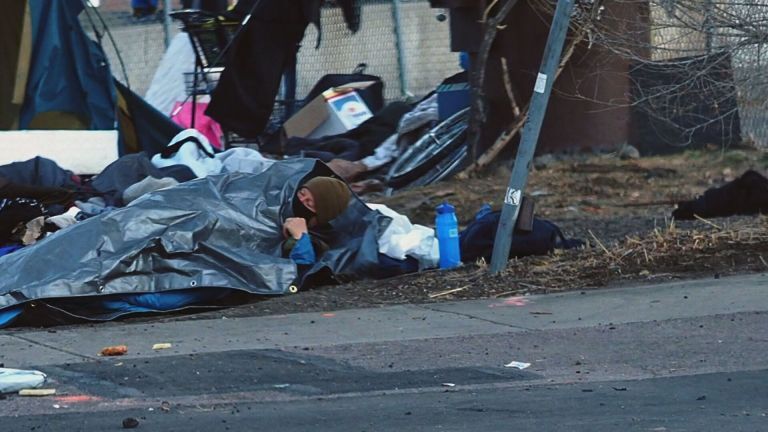
Aurora Mayor Mike Coffman announced Monday that he plans to introduce an ordinance to the City Council this week that would ban camping within the city.
The ordinance, to be introduced Thursday, would attempt to address the city’s growing homeless population, similar to Denver’s urban camping ban passed in 2012. Coffman said the ordinance is already drafted but he will work on edits prior to its introduction.
“I want to work with our city attorney’s office to make sure the proposed camping ban is compliant with the CDC guidelines,” Coffman said. “I also want to make sure the proposed camping ban meets the conditions spelled out in court decisions where camping bans have been challenged and were upheld.”
This announcement came as a surprise for many City Council members as, just last week, city officials announced outreach efforts to gather community input on how Aurora should address homelessness.
The city is hosting an open house Wednesday to present residents with various alternative sheltering options including pallet homes, tiny homes, safe camping sites, safe parking sites and a shower and restroom trailer. Residents were invited to submit feedback on the sheltering options through May 31.
Councilwoman Nicole Johnston, chair of the Housing Redevelopment and Neighborhood Services Committee, said the timing of Coffman’s proposal undermines the city’s public outreach efforts.
“I don’t understand the mayor introducing an urban camping ban ordinance before the community open house,” Johnston said. “The purpose of the open house and Engage Aurora’s online system is to receive feedback from the community and look at evidence-based policies before proceeding with policy.”
Johnston said she will be attending the open house and researching outreach results before “jumping on Mayor Coffman’s latest attempt of claiming he knows what is best for people experiencing homelessness and our community.”
Councilman Curtis Gardner said he wants to know how the city would pay for enforcement for the camping ban and what resources exist for the people currently living in unsanctioned homeless encampments.
“A camping ban, by itself, isn’t a solution to all homelessness — if it was, we would see the results of that in other cities,” Gardner said. “We need to address veterans’ issues, drug abuse, economic distress, mental health and more. I hope we can have a robust conversation around all these issues.”
Council members Alison Coombs and Juan Marcano also expressed concern for the ordinance via Twitter, with Coombs calling it “inhumane and ineffective” and Marcano saying camping bans are generally “costly, ineffective, and a waste of law enforcement’s time.”
After it is introduced in committee Thursday, committee members will be able to recommend amendments before the ordinance goes to study session to be discussed by the full council. Finally, it would be voted on in a formal City Council meeting.
If it makes it to a formal vote, Coffman’s ordinance will need support from at least five of the 10 City Council members. As mayor, Coffman does not vote on ordinances except as a tiebreaker.
“The mayor is once again out of his lane,” Johnston said. “The City Council sets policy direction, not the mayor. He is supposed to be an ambassador of the city not someone who introduces legislation where he can’t even vote.”
Councilman Dave Gruber said he would not express support or opposition for the ordinance until he can formally discuss and modify it on council; however, he said action is necessary.
“The number of unauthorized camps are growing in Aurora,” Gruber said. “Many of the people in the camps have chosen not to obtain help from nonprofits or governments because of the rules they impose on the campers. Our residents are demanding council and the city find a way to deal with this issue.”
In the most recent count from 2020, there were 427 homeless residents in Aurora. Of those, 61 were unsheltered and living in spaces like unauthorized encampments.
In 2020, the number of Aurora residents experiencing homelessness was up from 389 in 2019 and has undoubtedly increased since the count was conducted. For reference, in Denver, there were 4,171 homeless residents in 2020, according to the count.
Camping is banned in Denver; however, large encampments regularly form throughout the city. This has led to frequent homeless sweeps in which camps are broken up, fenced off and residents are forced to move.
These sweeps have been especially controversial in the last year as the Centers for Disease Control and Prevention recommended that cities stop sweeps during the COVID-19 pandemic to avoid spreading the disease. Denver’s continuation of the sweeps has prompted an ongoing lawsuit.
Coffman acknowledged in January that Denver’s camping ban hasn’t been effective, when he said he was halting work toward establishing a citywide camping ban because he needed to “better understand what its impact will be on Aurora.”
“I think the question that I have to answer is whether or not a camping ban actually aggravates the problem,” Coffman said in January. “Denver has a camping ban and it has a significant encampment problem while Aurora does not have a camping ban and only has a modest problem.”
In January, Denver City Council member Candi CdeBaca said each sweep costs the city of Denver around $10,000 to conduct.
“All a camping ban means is that campers have to go deeper into hiding away from enforcement into neighborhoods and places farthest from services,” CdeBaca said via Twitter in response to Coffman’s proposal announcement.
This ordinance proposal also comes after Coffman posed as homeless in Aurora and Denver for seven days in December, receiving intense backlash after stating that those who stay in encampments are making a “lifestyle choice.”


Denver police chief on mask ban, mayor’s orders: ‘What enforcement looks like, I’m not exactly sure’
Deborah Grigsby
deborah.smith@denvergazette.com
Updated 5 hours ago
Denver bans wearing of face masks by law enforcers, use of city property to stage immigration operations As Denver takes steps to restrict federal agents conducting immigration enforcement in the Mile High City, its police chief said he is unclear...
Colorado lawmakers move to curb eminent domain powers after Xcel dispute
Marissa Ventrelli
marissa.ventrelli@coloradopolitics.com
Updated 10 hours ago
After months of backlash over Xcel Energy’s use of eminent domain in eastern Colorado, lawmakers representing Elbert and El Paso counties are advancing legislation that would bar utilities from initiating property takings until they’ve secured state approval and all required...

As parents claim some AI chatbots encourage teen suicide, Colorado legislators eye regulation
Marissa Ventrelli
marissa.ventrelli@coloradopolitics.com
Updated 7 hours ago
Juliana Peralta of Thornton was a vibrant, happy kid, said her mom, Cynthia Montoya. Then, in the final months of 2023, Cynthia began to notice a change in her 13-year-old daughter. Peralta had become more withdrawn and was on her...

Trump to attend dignified transfer of six US service members killed by Iran
Christian Datoc, Washington Examiner
christian.datoc.washington.examiner@gazetteedit.wpenginepowered.com
Updated 9 hours ago
President Donald Trump will attend the soon-to-be-held dignified transfer of six American service members killed so far by Iran in Operation Epic Fury. White House press secretary Karoline Leavitt made the announcement during her Wednesday press briefing. “These heroes represent...

Judge declines to block potential Boebert challenger from going through assembly process in Colorado’s 4th CD
Ernest Luning
ernest.luning@coloradopolitics.com
Updated 11 hours ago
Congressional candidate Eileen Laubacher, one of the Democrats seeking to challenge Republican U.S. Rep. Lauren Boebert, can participate in the party’s caucuses and assemblies pending a court hearing later this month, a Denver judge ruled Tuesday in response to a...
Sanctuary cities declined 17,864 requests to hold illegal immigrants for ICE in 2025: Noem
Anna Giaritelli Washington Examiner
anna-giaritelli-washington-examiner@coloradopolitics.com
Updated 11 hours ago
Sanctuary cities and counties declined to turn over 17,864 illegal immigrants in police custody to Immigration and Customs Enforcement in 2025, according to the Department of Homeland Security. Homeland Security Secretary Kristi Noem testified before the House Judiciary Committee on...

Federal judge dismisses malicious prosecution claim against former Denver prosecutor
Michael Karlik
michael.karlik@coloradopolitics.com
Updated 12 hours ago
A federal judge concluded on Monday that a former Denver prosecutor could not be sued for allegedly causing the arrests of two plaintiffs after they failed to appear for trial on the scheduled date, even though the trial had been...
Judicial discipline commission reports increased transparency, increased submissions
Michael Karlik
michael.karlik@coloradopolitics.com
Updated 13 hours ago
The Colorado Commission on Judicial Discipline received 473 misconduct complaints about judges in 2025, which was nearly 29% higher than in 2024 and substantially greater than any time in the past decade. However, only 31 complaints were referred to the commission...
Colorado Gov. Jared Polis ignites fierce debate after raising clemency questions in Tina Peters case
Marianne Goodland
marianne.goodland@coloradopolitics.com
Updated 6 hours ago
Gov. Jared Polis ignited a political firestorm Tuesday night after weighing in on the prison sentences of two former Colorado officials — a Democrat and a Republican — convicted of attempting to influence a public servant. The comments quickly fueled...

Colorado Supreme Court signals intervention in dispute over treatment for trans children
Michael Karlik
michael.karlik@coloradopolitics.com
Updated 1 day ago
The Colorado Supreme Court ordered Children’s Hospital Colorado on Tuesday to explain why it should not direct the organization to resume providing certain types of services to transgender children in compliance with the state’s non-discrimination law. Last month, a Denver...
PREV
PREVIOUS
Bill mandating coverage of a yearly mental health exam advance in the House
Five days after Rep. Dafna Michaelson Jenet held a Capitol news conference pushing her mental health legislation, a bill she is sponsoring requiring insurers to cover an annual mental health exam advanced in the House. “This bill … could have a major impact on getting in front of mental health crises,” the Commerce City Democrat […]

Colorado health option bill still awaiting action from Senate committee
The bill that would create the standardized health plan known as the Colorado Option survived a seven-hour hearing in its first Senate committee test Monday. However, the state Senate Health and Human Services Committee then postponed action on House Bill 21-1232. The bill would allow the Commissioner of Insurance to create a plan with price […]