

State lawmaker, health care workers describe ‘light at the end of the tunnel’ upon receiving vaccine
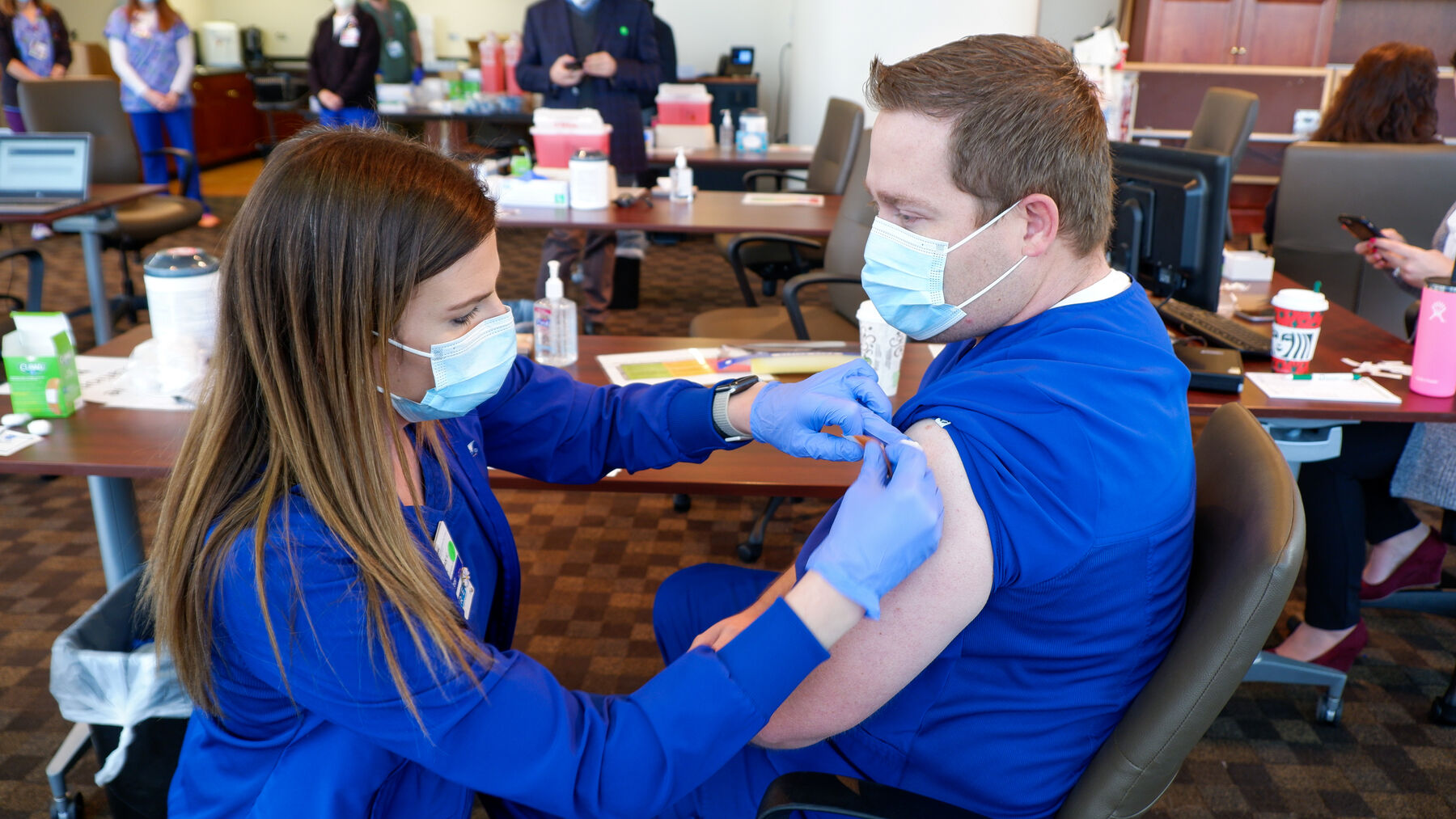
For one state lawmaker and several dozen medical personnel in Denver, immunization against COVID-19 represented “the light at the end of the tunnel.”
“I legislate based on science. I trust the science and I trust our public health experts who spend their life doing this,” said Rep. Kyle Mullica, D-Northglenn, after his vaccination at Presbyterian/St. Luke’s Medical Center on Wednesday morning. “That’s why I’m here today, to show that it’s safe and this is the way we’re gonna get through this and I’m at the front of the line because I trust the science behind this.”
Mullica is an emergency room nurse who, prior to the pandemic, sponsored bills to try to boost Colorado’s low rates of childhood vaccination. He said he did not know what to wear for the immunization, but settled on his work scrubs because his status as a frontline health care worker was the reason he was receiving one of the first doses of the groundbreaking vaccine.
“The excitement is overwhelming. Seeing the harm that has come to our community from this and to be actually able to see that light at the end of the tunnel is so exciting because it’s been hard,” he said. “Really this is the solution to it. This is how we’re going to get out of this.”
St. Luke’s received 975 doses of the Pfizer vaccine, for which the U.S. Food and Drug Administration granted an emergency use authorization on Friday. The vaccine comes via a two-dose inoculation, and St. Luke’s expects the shipment of the second dose within weeks.
On Wednesday, the first day of shots at the medical center in central Denver, employees rode a single elevator to the top floor to receive immunizations. Only at-risk staff and those who interact directly with COVID-19 patients were eligible initially.
“I have definitely shed a few tears during this process,” said Laura-Anne Cleveland, associate chief nursing officer. She expected to receive her inoculation later this week or the following week, as immunizations will occur every day, 14 hours per day.
“I think it’s a little disheartening how polarized of an issue it is,” she said of the pandemic. “That’s hard for us on the front lines. But we absolutely feel supported.”
Grief and symptoms of post-traumatic stress disorder have appeared in frontline medical workers as the death toll has accelerated around them. Cleveland, who is also the incident commander for hospital and part of the vaccine work group, said St. Luke’s has helped its workers stave off depression and exhaustion during the past nine months. Some departments even receive stickers and coloring books to get their minds off of their immediate work.
Claire Meconi, a speech language pathologist at the hospital, received her shot shortly before 10 a.m. She said it was not nearly as bad as her regular flu inoculation. Although Pfizer has reported an effectiveness of the vaccine in excess of 90%, it is uncertain whether vaccinated individuals may still pass on the novel coronavirus to others. As such, Meconi said she will continue to wear masks and maintain distance.
“I think everyone should be vaccinated. Is that bad to say? People shouldn’t be hesitant,” she said. “Even though people consider it rushed, it’s very studied and I feel it’s going to be very effective.”
Recently, Meconi contracted COVID-19, and likened it to a bad head cold in her case. She believes she contracted it in the community, not at work.
“I feel like those people who choose to attend gatherings are putting others at risk and I think it’s selfish,” she said. Still, she was not angry at the behavior of others.
As of Wednesday, COVID-19 had killed over 305,000 Americans. Although other countries have been successful at eradicating or controlling the spread of the disease without the aid of a vaccine, the United States has failed at preventive measures, leading many to see a highly-effective vaccine as the only hope.
“For those who have already received the vaccine and the staff preparing to receive the vaccine, may it become a beacon of light in the midst of darkness, uncertainty and troubling times,” said Chaplain Mike Guthrie, a Presbyterian minister and director of spiritual care and volunteer services at the hospital. He gave a blessing of the vaccine, the workers administering it and the hospital staff.
Colorado began vaccinating health care workers on Monday, and will receive 46,800 initial doses. The FDA is preparing to authorize another vaccine from Moderna. Pfizer’s vaccine arrives as a frozen liquid. Pharmacists then thaw and dilute it, and administer it like any other vaccine.
Pursuant to the vaccine’s regulations, employees receiving their shots needed to wait for 15 minutes in an area for observation, in case they exhibited adverse reactions. No one did.
Guthrie himself received an inoculation after delivering the blessing. He said the only thing that will change for him going forward is the peace of mind that accompanies the vaccine. At the beginning of the pandemic, he worked to allow visitors for patients at the end-of-life stage. The biggest request he gets from family members was to pray for their loved ones.
“The people that are in the hospital fighting COVID are very scared and very isolated,” Guthrie said. “And so the ability to be able to put on the [personal protective equipment], to go in, to look them in the eyes, to give them spiritual support, to hear them and their anxiety is extremely important because they know they’re not alone.”


U.S. House probes reports of fraud, waste in Colorado’s Medicaid program
Marianne Goodland
marianne.goodland@coloradopolitics.com
Updated 7 minutes ago
A congressional committee is probing reports of waste, fraud and abuse in Colorado’s Medicaid program, citing recent stories outlining over-billing in transportation spending and The U.S. House Committee on Energy and Commerce has sent a letter to Gov. Jared Polis...

Colorado’s congressional redistricting proposal could flip three Republican House seats | ANALYSIS
Michael Braithwaite
michael.braithwaite@gazette.com
Updated 1 hour ago
A Democrat-backed proposal to redraw Colorado’s congressional map for the 2028 election could flip three Republican districts. The proposal, introduced by a group called Coloradans for a Level Playing Field, is yet another development in a national redistricting debate after...

Appeals court overturns Douglas County vehicular homicide conviction due to faulty jury instructions
Michael Karlik
michael.karlik@coloradopolitics.com
Updated 7 hours ago
Colorado’s second-highest court overturned a defendant’s vehicular homicide conviction and 12-year prison sentence on Thursday after determining a Douglas County judge omitted key language from the jury instructions that could have resulted in a different outcome. James Paul McDonald was...
Colorado lawmakers’ speeches on immigration, Iran draw worries about decorum, grandstanding
Marianne Goodland
marianne.goodland@coloradopolitics.com
Updated 6 hours ago
Several speeches from Colorado legislators this week have raised new worries about decorum and grandstanding in the state House after two members talked about immigration and Iran using what’s called a “point of personal privilege.” Under the rules of the...
Trump fires Homeland Security Secretary Noem after building criticism over immigration enforcement
Michelle L. Price
michelle.l..price@associatedpress.com
Updated 7 hours ago
WASHINGTON (AP) — President Donald Trump on Thursday fired his embattled Homeland Security Secretary Kristi Noem and said he will nominate in her place Oklahoma Republican Sen. Markwayne Mullin. Trump made the announcement on social media on Thursday, two days...

Trump wants to be personally ‘involved’ in picking next Iranian leader: Report
Christian Datoc, Washington Examiner
christian.datoc.washington.examiner@gazetteedit.wpenginepowered.com
Updated 8 hours ago
President Donald Trump told Axios Thursday that he wants to be personally involved with picking Iran‘s next leader, despite multiple senior administration officials repeatedly declaring that “regime change” is not a stated objective of Operation Epic Fury. Trump conducted an...

Iran widens regional war with first strike into Azerbaijan
Brady Knox, Washington Examiner
brady.knox.washington.examiner@gazetteedit.wpenginepowered.com
Updated 8 hours ago
Iran spread the growing regional war to the Caucasus with its first drone strike into Azerbaijan, hitting an airport terminal and damaging a nearby school. A video recorded by someone at Nakhchivan International Airport showed one of the drones exploding...
Rand Paul excoriates Congress for failure to pass War Powers Resolution: ‘Should be ashamed’
Claire Carter, Washington Examiner
claire.carter.washington.examiner@gazetteedit.wpenginepowered.com
Updated 8 hours ago
Sen. Rand Paul (R-KY) blasted his colleagues for failing to pass a resolution aimed at limiting President Donald Trump’s military campaign in Iran. The Kentucky Republican made the remarks in an opinion column published on Fox News a day after...
DOJ quietly closes autopen investigation targeting Biden and aides
Kaelan Deese, Washington Examiner
kaelan.deese.washington.examiner@gazetteedit.wpenginepowered.com
Updated 8 hours ago
The Department of Justice has quietly closed an investigation into former President Joe Biden’s use of an autopen to sign official documents, according to a source familiar with the matter. DOJ pardon attorney Ed Martin, the former “weaponization” czar, opened...

Colorado legislators eye changes to credit card ‘swipe fees’
Marianne Goodland
marianne.goodland@coloradopolitics.com
Updated 7 hours ago
Colorado legislators are proposing to eliminate “swipe fees” on sales taxes, a move that proponents say would save businesses tens of thousands of dollars a year but which will likely revive counter-arguments that those fees help create a stable and...
PREV
PREVIOUS

Denver's Larimer Square sold to out-of-state company
For the first time in nearly 30 years, Denver’s historic Larimer Square has a new owner. Asana Partners, a North Carolina based real estate firm announced Tuesday morning it had closed on its acquisition of the shopping and dining area for an undisclosed amount. With the purchase, the North Carolina firm now owns 25 properties […]
Colorado has avoided feared Thanksgiving coronavirus surge, officials say
Colorado has largely avoided an expected coronavirus surge after the Thanksgiving holiday, a top state health official said Wednesday, and the pandemic’s outlook here has improved as December has worn on and fears of overwhelmed hospitals have been significantly assuaged. “In general, numbers have been dropping, which is very exciting,” said Eric France, the chief […]