

VOICES OF THE VOTERS: FOUR CORNERS, TWO SIDES | A polarized electorate digs in their heels in southwest’s rural, urban divide
Editor’s Note: This story is part of an occasional series to capture views among Coloradans.
In the deep southwest pocket of the state, where the corners of Colorado, New Mexico, Arizona and Utah come together, voters are divided.
With few bridges left connecting rural and urban life, the region’s two largest counties split along party lines: one with the intent to preserve the past, the other pushing for progress.
In Montezuma County, where ranchers and farmers have lived for generations, Democrats historically have struggled to gain more than 35% of the vote in big-ticket races. About 59% of voters backed Republican Walker Stapleton over Jared Polis in the 2018 gubernatorial race; 61% turned out for Donald Trump in the 2016 presidential election; and nearly 60% voted for Cory Gardner of Yuma in the 2014 U.S. Senate race.
La Plata County, Montezuma County’s next-door neighbor to the east, has more than twice its population size at around 56,200, according to the census. Home to the small, but steadily growing city of Durango and a public liberal arts college, La Plata County leans left. About 56% of voters picked Polis for governor in 2018; Hillary Clinton beat Trump by 9 percentage points four years ago; and nearly 52% backed Democrat Mark Udall of Boulder over Gardner in the 2014 senate race.
This year, voters in both counties say they won’t waver much. The heels of an already polarized electorate, faced with a highly polarized election, have only been dug in deeper.
REGIONAL SNAPSHOT | The Four Corners region
But common ground, albeit dwindling, can still be found in Colorado’s dry, dusty desert. The heart of politics in the state’s Four Corners, no matter which side of the aisle you’re on, remains family, freedom and how the future shapes the two.
‘A way of life’
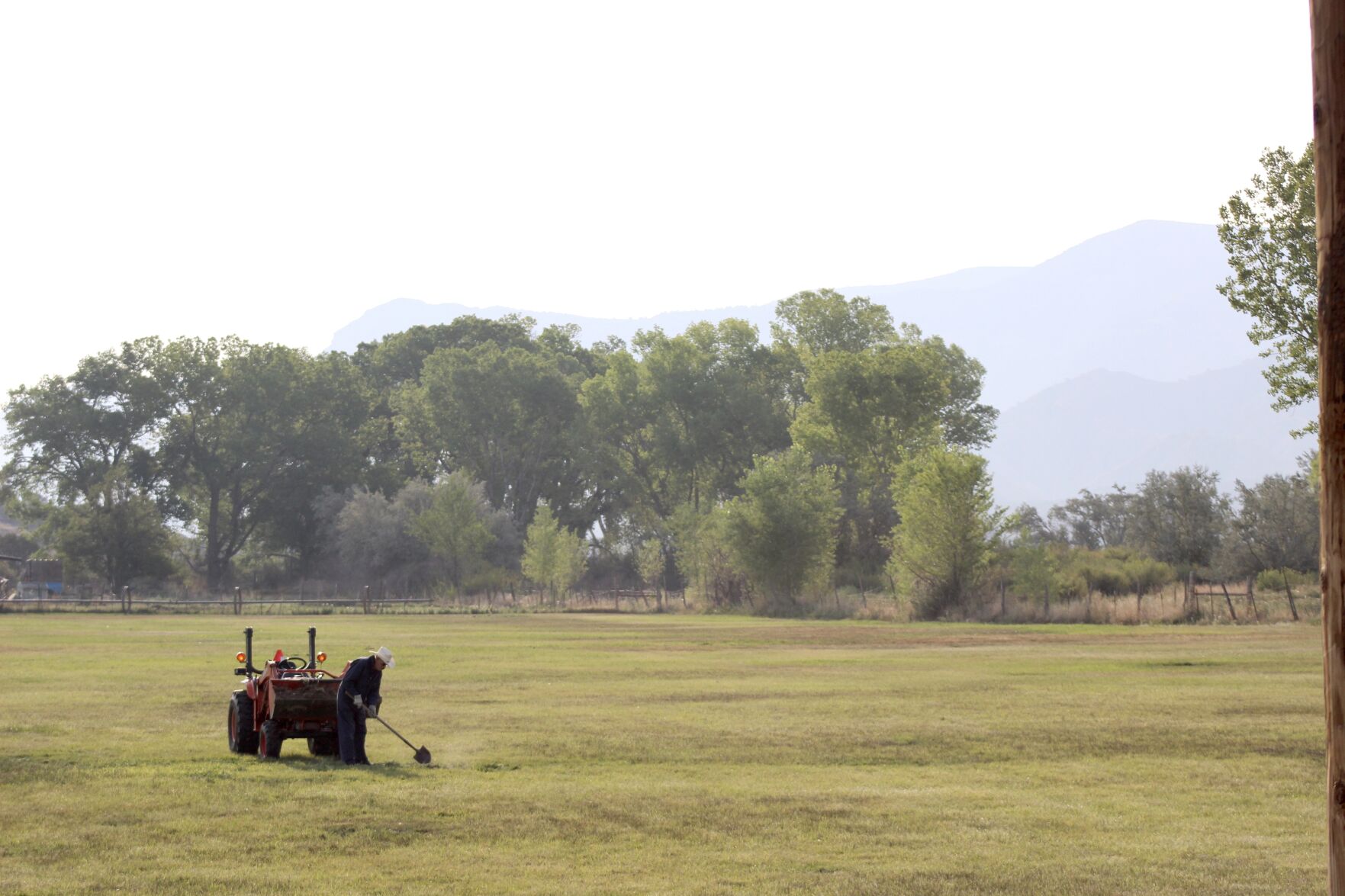
Allen Maez is a farmer and rancher in Cortez, the seat of Montezuma County and its most populous town with more than 8,700 people. He also chairs the Montezuma County Republicans.
“The Western slope is pretty much rural, and Montezuma County is no different,” Maez explained, donning a red “Keep America Great” cap and button for Colorado’s 3rd Congressional District candidate Lauren Boebert, in an interview at the county’s GOP office. “We depend on our livestock industry. We have oil and gas … but the farming and ranching, it is generational. There’s a lot of families that have been here for generations.”

Maez belongs to one of those families. “I’m the fourth generation, and my daughter will be the fifth generation,” he said, but they’re a dying breed.
It isn’t easy making a living off the land, especially in the high desert, where water rarely runs. Coupled with a shortage of steady, good-paying jobs in the area, locals lament the loss of the hundreds of ranching families that have been around since the 1800s.
“It’s hard to keep young people on the land here because they want to move off,” he said.
Judi Lichliter, a retired rancher and Republican in Cortez, recently sold the last parcel of homestead land that belonged to her late husband, “a great American cowboy,” because she had no one else to take care of it.
“My son knew at an early age this was not going to work for him to be carrying on the family tradition,” she said, “and so he got out, went to college and never came home.”
Montezuma County has grown 2.5% since 2010, the census estimates, compared to a 9.5% growth rate in La Plata and 14.5% rate statewide.
As more people cut ties with their rural roots to pursue higher education, better wages and new experiences, it becomes increasingly important to preserve “our freedoms, our way of life, our culture,” Maez said.
The resolve rural Republicans share to protect those values has strengthened, he said, “especially this year, with things that are happening in the cities,” referring to racial justice protests and calls to defund the police.
“Our folks here are waking up. That isn’t us. We don’t have those problems,” he said. “And they do feel that President Trump has come through with some of his promises.”
But bigger than that is who the president stands for, Maez said: “He is a Republican. So we’re going to back our candidates.”
Since June, in response to racial justice demonstrations, the Montezuma County Patriots have organized “Freedom Rides” in Cortez every Saturday morning on Main Street.


The weekly parade draws in hundreds of locals who drive their pickup trucks around town while honking and waving Trump flags, American flags, confederate flags and “Back the Blue” flags in support of police. The celebration kicks off after prayers and the Pledge of Allegiance are said in the dirt gravel parking lot of the Ute Coffee Shop, where throngs of mostly unmasked people, many also carrying firearms, meet up beforehand.
“They’re expressing their love of country and for people who serve, whether it’s military or law enforcement,” Maez said. But even more so, they’re “trying to keep those values alive for the kids,” many of whom ride along in the parades or can be seen cheering from the roadside with their families.
“It’s more than just showing colors,” he said. “The American flag, it’s a way of life here.”
‘Afraid for my grandchildren’
In Durango, just 45 miles east of Cortez, you won’t find much support for Freedom Rides, even among those who’ve served in the military.
Navy veteran Roy Parks, 70, has lived in Durango for 35 years and considers himself a patriot. But he doesn’t glean anything patriotic from Trump or the demonstrations that support him.
“Trump lies all the time, and so do his followers,” said Parks, who is voting for Joe Biden. “He’s ruined the country is what he’s done.”

“I’m so afraid for my grandchildren if [Trump] is in office again,” said Jan Larson, 65, who’s lived in Durango for nearly 50 years and is voting for Biden. “He is just horrific. He has no compassion. He’s not smart at all. He’s very inexperienced with people … and it’s just been a real depressing struggle these four years.”
Sitting next to Larson on the sprawling grass of Buckley Park was her friend 56-year-old Olga Tabley, a registered Democrat who moved to Durango from Russia three years ago.
“I wanted to move from government corruption in the country, and it seems right now this is what Trump is doing,” she said, “how he put his family in the government and he does not want to listen.”
He has also turned family and friends into foes, she said. “People who did not talk about politicians aggressively before now are ready to fight each other.”
Adding “wood to the fire,” Tabley said, is “not the government’s job. The government’s job is to keep people together.”
Fight for freedom ‘ignored’
Back in Cortez, most voters say the government’s job is to stay out of the way — and that decision-makers are increasingly doing the opposite.
“What we see coming out of the state legislature, coming out of the federal legislature is scaring people,” Maez said, highlighting school closures amid the pandemic and pushes for police reform.
“All of those things, we don’t even understand how or why those things should be happening,” he said. “We don’t need big government.”
Montezuma County voters want liberty, including the right to life, the freedom to bear arms and the guarantee of low taxes.
“I see the Republican platform as the most freedom-giving way to get there instead of limiting us,” said Jan Gardner, a Republican and small business owner in Cortez. “There’s more opportunity for expression.”
Yet, Montezuma’s message never seems to make it over the San Juan Mountains, locals complain.
“We’re not the state of Denver,” said Lichliter, the retired rancher who is voting enthusiastically for Trump. “We are the state of Colorado, and we’ve got to get those people in Denver to realize that they’re responsible for us, too, down here.”

Many voters in Colorado’s southwest corner say the lawmakers that do cross the divide typically target more populous places that are closer to the Capitol, namely Grand Junction and Durango.
“It’s always about the big cities,” Gardner said. “It just gets very old that we’re ignored.”
Trump, on the other hand, makes Colorado’s cowboy country feel heard.
Listening to his campaign speeches in 2016, Lichliter’s late husband, Charlie, saw Trump as “a real working man’s man,” and not “just another polished politician.”
“He just seemed to know that Trump was going to turn this nation around,” she said.
Lichliter is “excited by what Trump has done for the nation,” although she didn’t give specifics. “Unfortunately, we had a setback this year,” she said, referring to COVID-19, “but he’ll pull it out.”
The president and the pandemic
Scott Bickert owns a small brewery in Durango that, like most restaurants and bars across the country, has been hard hit by the pandemic.
His business sought help through the Paycheck Protection Program established by the Coronavirus Aid, Relief, and Economic Security Act, but had its loan application denied.
“Big companies,” on the other hand, “were getting $10 million loans,” said Bickert, a registered Independent who is not voting for Trump.
Still, he said, a rejected PPP loan is not his biggest grievance as a business owner. What he and his staff take issue with most is Trump’s resistance to embrace mask-wearing in public, emboldening patrons to do the same.
At Bickert’s brewery, which requires mask-wearing unless seated, “one of our biggest struggles is people come in, and they’re like, ‘This is bull—-. I’m going to do what I want,’” he said. “That’s the way this whole thing’s been played off. Policing has fallen on the business.”

Durango voters are also quick to condemn the country’s soaring number of COVID-19 deaths, which represent one of the highest mortality rates in the world.
Still, “you can’t fault [the president] for that,” Lichliter said, echoing the views of other Republicans in Cortez.
“He did what all the other nations in the world were doing. They pulled back, sent everybody home … and that maybe wasn’t the thing to do,” she said. “It didn’t help anything.”
Trump has not, in fact, issued a national stay-at-home order, a directive that was endorsed by Dr. Anthony Fauci, the country’s top infectious disease expert. The president instead has left the implementation of such rules to state and local governments.
‘Our rules’
Merlin Tom is a member of the Ute Mountain Ute Tribe, one of three federally recognized tribes of the Ute Nation. The Ute Mountain Ute Tribe reservation is headquartered in Montezuma County’s Towaoc, and spans into northwest New Mexico and small sections of southeast Utah.
Since the start of the pandemic, the tribal council set up a checkpoint that Tom helps run in Towaoc to make sure travelers entering the reservation wear a mask.
As a sovereign nation, “these are our rules,” he said, and “when you’re on our reservation, stepping on to our land, you need to abide by our laws.”
The checkpoint isn’t meant to be a power grab, however, but a civic duty.
“We’re doing this for our community and the surrounding communities,” including the border town of Cortez, he said, where many tribal members shop and send their children to school. “If everyone else just plays their part and didn’t get riled up and crazy about wearing a simple mask, numbers could actually go down. It’s just common sense.”
The tribe has more than 2,000 members, who largely vote Democrat, if they vote at all.
Tom was born and raised on the reservation and has never voted in a U.S. election, nor does he plan to this year.
“I don’t know if it really matters what goes on out there,” he said at the checkpoint, looking north toward Cortez. “I don’t think it really affects [the reservation] that much,” he said of voting. “We’re getting taken care of” through federal funding and various services offered by the tribal office.
The tribe, however, is very much still interwoven into the greater community, which tends to agree that tribal members’ votes do matter.
“They have a big role for labor and put a lot of money into the local area because of what they do,” said Maez, the chairman of the Montezuma County Republicans. “They have their own cattle operations. They farm the ranch. So they are just as much part of the community as farming and ranching go,” plus “their water comes from the same water source as the rest of us, the Dolores River.”
‘Most important election of our lives’
Access to fresh water is one policy every desert dweller can get behind, and an area where the GOP — a party that still largely denies climate change and related environmental pressures — typically falls short.
This year, however, conservatives are touting the Great American Outdoors Act, a bill co-sponsored by Republican U.S. Sen. Cory Gardner of Colorado that funds a backlog of national park projects and permanently funds the Land and Water Conservation Fund.
“We don’t see [Gardner] very much, but look what he did,” said Gardner, the small business owner in Cortez, who shares no relation to the senator. “He was very, very instrumental in the Great American Outdoors Act, so he’s doing some great things up there in Washington.”
This year’s election is “the most important election of our lives,” Maez said. “We’ve got to keep our president in place. … Sen. Cory Gardner, we need to keep him in office, and our state office, Marc Catlin, we need to keep him too.”
Electing Lauren Boebert of Rifle, who edged out incumbent Scott Tipton and now competes with Democrat Diane Mitsch Bush in the 3rd Congressional District race, is also a high priority for the region this year.
“She is making a big splash in Montezuma County,” Maez said, and not without good reason. “She is one of us. She speaks our language. She knows what it takes to work for a living. She understands oil and gas, it’s a resource we have here. She’s pro-life. She’s pro-2nd Amendment.”
But more importantly, “she’s pro-freedom,” he said. “That kind of feeling with her, with the president, that’s what’s getting our people ramped up.”
Momentum remains high on the left, too, even if most say Biden wasn’t their top pick.
Many voters worry about his age, the baggage he carries and whether he has what it takes on the debate stage to win over Americans stuck on the fence.
But his running mate, Kamala Harris, will give him a leg up, voters say.
“He’s going to get a lot more votes having a woman,” said Larson, the nearly 50-year resident of Durango. “I think it’s really good that she’s a woman of color and multicultural. She’s got a lot going for her that way, and she’s very intelligent.”

Larson and other left-leaning voters in the area also plan to vote for former Gov. John Hickenlooper, a Democrat, over incumbent Gardner in the U.S. Senate race.
“I know Gardner isn’t a good senator,” Larson said. “Hickenlooper has made some mistakes. We get it. So has everybody. But I thought he was a pretty good governor.”
In Durango, a vote against the right means the defeat of Trump and everything he stands for.
This election “is about being a human being,” said Tabley, the Russian immigrant, and about overcoming a “divisive” leader who has “absolutely split the country.”
“It’s a morality thing,” said Bickert, the brewery owner. “The rights of all people,” specifically women and everyone fighting for racial equality, he said, are at stake.

Colorado auditor finds serious issues with labor agency’s unemployment insurance accounting
Marianne Goodland
marianne.goodland@coloradopolitics.com
Updated 10 hours ago
Colorado’s state auditors found serious issues with the accounting practices of the unemployment insurance division of the Department of Labor and Employment, concluding the agency underestimated and overestimated figures to the tune of billions of dollars. The auditors labeled the...
Colorado’s newest federal judge speaks about techniques for advancing cases
Michael Karlik
michael.karlik@coloradopolitics.com
Updated 10 hours ago
U.S. Magistrate Judge Cyrus Y. Chung described on Wednesday the various tactics he employs to resolve court cases, summing up his role with a laxative-based metaphor. “Someone told a group of us federal magistrate judges that magistrate judges are the...

Three cargo ships damaged by ‘projectiles’ in Strait of Hormuz
Brady Knox, Washington Examiner
brady.knox.washington.examiner@gazetteedit.wpenginepowered.com
Updated 14 hours ago
Three cargo ships were damaged by unspecified “projectiles” while navigating the Strait of Hormuz, jeopardizing President Donald Trump’s goal of preserving the shipping lane’s safety. The strait was de facto closed the morning hostilities began on Feb. 28, with announcements...

Trump calls on Thune to be a ‘leader’ and get the votes for the SAVE America Act
NAOMI LIM Washington Examiner
naomi-lim-washington-examiner@coloradopolitics.com
Updated 14 hours ago
President Donald Trump increased pressure on Senate Majority Leader John Thune (R-SD) to pass the SAVE America Act, imploring him to be a “leader” after he expressed concerns that there is not enough support for the measure in his chamber....
The ‘talking filibuster,’ explained
Molly Parks, Washington Examiner
molly.parks.washington.examiner@gazetteedit.wpenginepowered.com
Updated 14 hours ago
Senate Republicans have for weeks been debating the use of the “talking filibuster” to guarantee the passage of the SAVE America Act in the upper chamber, after President Donald Trump called the legislation his “No. 1” priority. The bill, which...
Colorado’s Polis joins coalition of governors urging Congress to reject Trump tariffs
Marissa Ventrelli
marissa.ventrelli@coloradopolitics.com
Updated 10 hours ago
Colorado Gov. Jared Polis has joined 18 other governors in writing a letter to members of Congress, urging them to reject President Donald Trump’s efforts to codify tariffs that the U.S. Supreme Court recently invalidated. “Governors across the country are...

Department of Agriculture warns of packages holding potentially invasive seeds
Michael Braithwaite
michael.braithwaite@gazette.com
Updated 8 hours ago
Spring planting is around the corner, and the Colorado Department of Agriculture wants residents to know where their seeds are coming from. Officials with the department warned Tuesday that they received reports of unsolicited packages containing plant seeds mailed internationally...

Federal judge hears ICE agents’ confusion about law, injunction on warrantless arrests
Michael Karlik
michael.karlik@coloradopolitics.com
Updated 1 day ago
A federal judge heard testimony on Tuesday from U.S. Customs and Immigration Enforcement agents in Colorado, who had trouble describing the requirements of his recent injunction and the training they received on making warrantless arrests pursuant to the law. On...

10th Circuit dismisses challenge to Colorado legislature’s decorum rules
Michael Karlik
michael.karlik@coloradopolitics.com
Updated 17 hours ago
The Denver-based federal appeals court concluded on Tuesday that Colorado lawmakers cannot be sued for creating and enforcing rules of decorum that circumscribe the public commentary allowed at legislative committee hearings. A three-judge panel of the U.S. Court of Appeals...

U.S. energy secretary warns Colorado’s energy policies could drive up prices, deter businesses
Scott Weiser
scott.weiser@gazette.com
Updated 12 hours ago
U.S. Energy Secretary Chris Wright on Monday warned that Colorado’s energy policies could lead to higher electricity prices and deter businesses, such as data centers, from locating in the state. Wright, a former executive of a Colorado-based energy company tapped...
PREV
PREVIOUS

A LOOK BACK | Arapahoe County GOP claws its way back to unity
A weekly dive into the pages of Colorado Politics’ predecessor, The Colorado Statesman, which started in 1898: Thirty Years Ago: The Arapahoe County Republican Party clawed its way back to solvency after owing $3,000 in rent and facing imminent eviction from its offices. Chairman Tory Brown resigned, ostensibly to devote more time to his business, […]

Police ID suspect in fatal Civic Center protest shooting
Denver Police have identified the man being held in connection with a fatal shooting Saturday afternoon in Civic Center park as 30-year-old Matthew Dolloff. He is being held pending investigation for first-degree murder, police said. Denver police said the Office of the Medical Examiner would later release the name of the victim, but multiple media […]