

For judges, wedding duty moves online
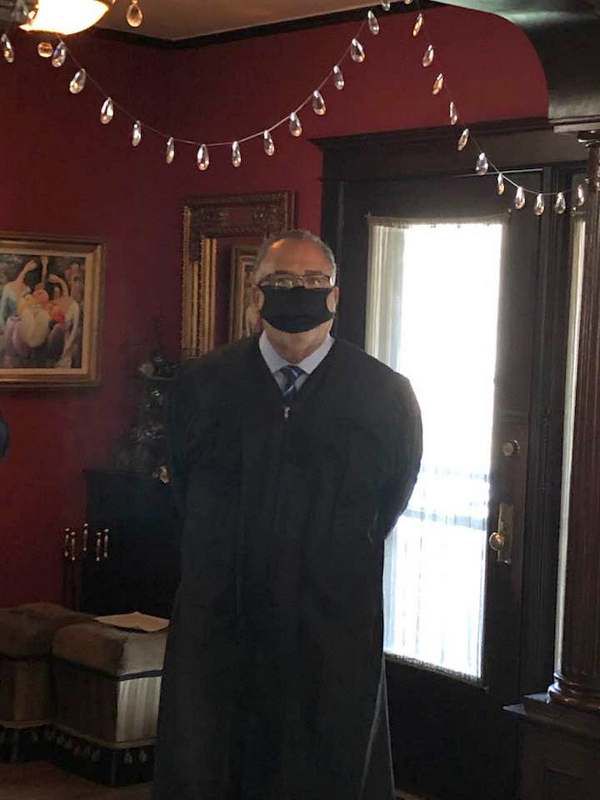
When a personal friend of Gary Jackson’s asked him in January to officiate his daughter’s wedding, the Denver County Court judge blocked off April 4 for the ceremony.
Then a global pandemic hit.
“The wedding was going to be at a commercial wedding venue and there were going to be 150 people there,” Jackson recalled. With a stay-at-home order in effect for Colorado and Kansas, where many of the wedding guests would travel from, the bride and groom nevertheless wanted to proceed as close to the plan as possible given the circumstances.
Jackson put on his robe, a face mask, and trekked seven blocks to his friend’s house. At the time, the judge “didn’t even think about” how he might have violated the stay-at-home order – as “weddings” are not included in the list of acceptable reasons to go outside.
“Doing weddings, I wouldn’t consider it to be an essential function of my job, even though it is something that is requested of all the judges,” he reflected.
At the house, only the bride and groom were not wearing face masks. (They had to kiss each other, after all.) The sole attendees were the bride’s parents and the family dog, although a camera set up in the room live streamed the ceremony to all the relatives in Kansas.
“I didn’t want to be in a place where there were going to be more than five or six people. I wanted to make sure that I remained 6 feet away from the bride and groom. So I kept the distance in mind for my own personal safety,” said the 74-year-old judge.
While the living room wedding was carefully choreographed for safety, the Tuesday morning wedding that Karen Steinhauser officiated took an extra precaution: she wasn’t there.
“The couple actually lives in Denver but they’re from Russia, and so all their family is back in Russia,” said Steinhauser, a relief judge for the Aurora Municipal Court. “They were at the steps of the city and county building and they were able to do a Zoom link.”
Steinhauser herself participated by video, and gave the groom her script beforehand so he could translate to Russian for the guests. Looking at the windows onscreen, she saw one group of attendees display signs that read “Congratulations” and other people hold up champagne glasses for toasts.
Even before the ceremony, the betrothed coordinated an elaborate means of obtaining the signature for their marriage license that may have actually complied with the letter (people may leave home for “obtaining necessary services … for themselves and their family”) of the stay-at-home order.
“I gave them my address. They drove over, left the envelope on my porch, went back to their cars, and stayed in there,” explained Steinhauser. “I signed it on my porch and left it on the porch. Then I went back in the house and they picked it up.”
In a non-crisis year, Steinhauser estimated that there was nearly one wedding per day at the Aurora courthouse, a practice which has since been halted. Pondering this week’s experience, the judge felt that people are learning to adapt to remote participation in cultural and community events – and for the better. The value of online participation may extend beyond the life of the coronavirus, as there will always be people who wish to attend events who are precluded by illness, lack of funds or logistical dilemmas.
“I’m not sure that people would have even thought of this had this pandemic not happened,” she said. “So going forward, this might also be a way that more people are able to be a part of these events that may not have been, even in non-COVID times.”
As for Jackson, he has another wedding scheduled for April 24. Like the first, it will be at the bridge and groom’s home, and there will be a camera live streaming to the guests.
“He had to make sure that his mother could be there, or she was going to disinherit him from the will,” Jackson said.

Colorado justices accept appeals on Netflix taxation, children pursuing neglect cases
Michael Karlik
michael.karlik@coloradopolitics.com
Updated 7 hours ago
The Colorado Supreme Court announced on Monday that it will decide whether Netflix subscriptions are subject to the state’s sales tax as “tangible personal property.” At least three of the court’s seven members must agree to hear an appeal. The...
Proposal outlines $300M deal separating Pinnacol from Colorado state government
Marianne Goodland
marianne.goodland@coloradopolitics.com
Updated 7 hours ago
Colorado lawmakers are weighing a proposal that would allow Pinnacol Assurance to sever its remaining ties to the state in exchange for a $300 million payment, a long‑debated shift that supporters say could stabilize the insurer’s future and help plug...
Bill requiring employers to grant unpaid leave to Colorado lawmakers heads to governor’s desk
Marissa Ventrelli
marissa.ventrelli@coloradopolitics.com
Updated 6 hours ago
Colorado lawmakers are one step away from securing guaranteed unpaid leave from their day jobs during the legislative session after the House narrowly approved the proposal Thursday. Senate Bill 087 would require businesses to allow employees who are members of...
Redistricting fight escalates as Colorado Title Board clears competing ballot proposals
Marianne Goodland
marianne.goodland@coloradopolitics.com
Updated 6 hours ago
Colorado’s title board on Wednesday gave final approval to multiple ballot measures related to congressional redistricting, setting up a series of proposals that could alter how the state draws its U.S. House districts for the 2028 and 2030 elections. The...

Trump downplays major reform bill and says housing is ‘all about interest rates’
Zach Halaschak, Washington Examiner
zach.halaschak.washington.examiner@gazetteedit.wpenginepowered.com
Updated 9 hours ago
President Donald Trump downplayed the bipartisan housing legislation that many congressional allies hope will ease the affordability worries plaguing voters, saying instead in an exclusive Washington Examiner interview that housing is “all about interest rates.” Trump said on a phone call Thursday morning...
Colorado lawmakers propose deep cuts to close $1.2B budget gap
Marianne Goodland
marianne.goodland@coloradopolitics.com
Updated 6 hours ago
The panel of Colorado legislators in charge of crafting next year’s budget has finalized the 2026–27 spending plan built on deep cuts and one‑time cash transfers in an attempt to close a shortfall of more than $1.2 billion. The plan...
Denver judge denies Gov. Polis request to dismiss ICE-related records case
Marianne Goodland
marianne.goodland@coloradopolitics.com
Updated 10 hours ago
A year after blocking the release of state records to federal immigration agents, a Denver judge has now denied Gov. Jared Polis’ effort to end the lawsuit at the center of the dispute. The lawsuit filed against the governor in...

10th Circuit grants rare all-judges’ review of Colorado banking regulation
Michael Karlik
michael.karlik@coloradopolitics.com
Updated 11 hours ago
The Denver-based federal appeals court announced on Thursday that it will hold a rare all-judges review of a recent decision that permits Colorado to require out-of-state banks to abide by the state’s maximum interest rates when they lend to in-state...
Colorado appeals court orders new sentencing for Tina Peters, upholds convictions
Michael Karlik
michael.karlik@coloradopolitics.com
Updated 6 hours ago
Colorado’s second-highest court determined on Thursday that a trial judge improperly sentenced former Mesa County clerk Tina Peters based upon her exercise of protected speech, while at the same time upholding her convictions. The three-judge Court of Appeals panel also...

Denver promised every school funding from $1B bond — but campuses later closed received far less | Analysis
Nico Brambila
nico.brambila@denvergazette.com
Updated 10 hours ago
Denver voters overwhelmingly approved the largest bond measure in Denver Public Schools history on the promise that every school — including charter campuses — would receive something. And they did. But the nearly $1 billion bond was not distributed evenly....
PREV
PREVIOUS

Highway commission looks to slash projects amid millions lost in revenue
Thursday was state highway director Shoshana Lew’s birthday, but a committee that oversees her agency’s budget had no good surprises but rather “hard choices and tough decisions.” “The bottom line is not pretty,” Lew told the Colorado Transportation Commission’s budget committee Thursday morning. The entire state budget is facing a $3.2 billion shortfall this year, […]

Black Hills Energy to give away trees for Earth Day
Black Hills Energy will give away 1,000 trees for Earth Day beginning on April 22, the seventh year of an initiative that has resulted in 6,686 trees planted. “Our world is hurting right now, we feel like we have an opportunity to give our customers a small way to help it heal,” said Susan Bailey, […]