

Civil rights claim filed against Aurora for racially-motivated searches

A Denver man has filed a claim in the U.S. District Court for Colorado claiming that the Aurora Police Department and at least six individual officers violated his constitutional rights by stopping and searching his vehicle without probable cause, reasonable suspicion or other legal basis.

Jehrone D. Falls wrote that on Sept. 2 he noticed a police Ford F-150 pickup truck following him as he left a friend’s house shortly before midnight. The officer driving allegedly activated his lights, and when Falls pulled over, four officers exited the vehicle. They informed Falls that he had failed to obey a traffic signal.
One officer returned to the F-150 while the others guarded Falls. When the officer came back to Falls’s vehicle, he demanded that Falls get out.
“When Plaintiff protested, because he knows his rights, Defendant [Dustin] Petersen snatched the vehicle door open, put Plaintiff in a twist lock, and pulled him out of the vehicle,” Falls wrote in the complaint.
The officers searched Falls’s vehicle, but ultimately did not find anything. Peterson allegedly told Falls that he had to search for drugs and firearms, given Falls’s criminal history. Falls said he received a traffic ticket from the interaction.
Falls cited another traffic stop on Sept. 17 along Colfax Avenue, in which four police vehicles surrounded him. The officer who pulled Falls over told him that his license plate validation tabs were attached improperly.
Falls said that two officers “opened the vehicle’s door, put Plaintiff in a twist lock, and pulled him out of his vehicle, without warning.”
Once again, they searched the vehicle, telling Falls that they were looking for guns and drugs due to his criminal history. Nothing was uncovered and Falls received another ticket.
A third incident on Nov. 29 followed the same pattern, with an officer “also mention[ing] the $300.00-$400.00 he seen in the cup holder of the vehicle” in explaining his decision to search the vehicle.
“Plaintiffs race was a motivating factor in the decision of Defendants to stop, detain and threaten Plaintiff, undertaken with the purpose of depriving Plaintiff of the equal protection and benefits of the law, equal privileges and immunities under the law,” Falls wrote.
He alleged that he suffered “humiliation, mental and emotional distress, [and] loss of enjoyment in life” as a result of these “Terry stops.” Such police interactions to detain and investigate suspects are done without probable cause and are lawful — New York City’s “stop and frisk” policy being a prominent example.
Falls said that he filed a complaint with the police department’s Internal Affairs Bureau, only to be told that the officers did nothing wrong.
Falls alleges that the department knew or should have known about its officers’ racially-biased searches.
He is requesting a jury trial. His complaint references police excessive use of force cases in Aurora involving blacks and Latinos. It also states that whites are subject to relatively fewer traffic stops and vehicle searches.
The Aurora Police Department did not immediately respond to a request for comment.
Last month, The Denver Post reported that the city is considering creating a civilian review board following the death of a 23-year-old unarmed black man who Aurora police detained forcibly and injected with ketamine, a strong sedative.
The body camera footage from the incident shows Elijah McClain saying “I have a right to walk where I am going” before the struggle commenced.
Colorado Politics Must-Reads:

Crank challenger Jessica Killin signs on to new centrist Democratic group’s ‘Promise to America’
Ernest Luning
ernest.luning@coloradopolitics.com
Updated 6 hours ago
Jessica Killin, one of the Democrats running in Tuesday’s primary for the chance to challenge U.S. Rep. Jeff Crank in Colorado’s 5th Congressional District, joined with more than a dozen incumbent Democratic lawmakers and candidates this week signing on to...

Colorado Politics Calendar June 29-July 5
Rachael Wright, Special to Colorado Politics
rachael.wright@coloradopolitics.com
Updated 4 days ago
CoPo’s weekly political calendar will help you find political and public-policy events throughout Colorado. It includes candidate and issue campaign events, public policy meetings, court hearings, state and local party conventions, assemblies, debates, rallies, parades, speaking engagements, traveling dignitary appearances,...
Gov. Lamm’s GOP challenger gives insights into his campaign | A LOOK BACK
Rachael Wright, Special to Colorado Politics
rachael.wright@coloradopolitics.com
Updated 4 days ago
Forty-five years ago this week: “I see Gov. (Richard) Lamm is fairly popular in general,” said gubernatorial candidate and state Sen. Bill Hughes, R-Colorado Springs. “ … And he’ll be hard to beat.” Hughes was on a whirlwind campaign trail...
Giving credit to Polis where credit is due | SONDERMANN
Eric Sondermann
eric-sondermann@coloradopolitics.com
Updated 4 days ago
It is an understatement to suggest that Gov. Jared Polis has had a tough couple of months. The bloom was already off the rose and Coloradans were paying far more attention to the choice of his replacement than they were...
Bennet, Hickenlooper to vote against Trump’s 10th Circuit nominee from Colorado
Michael Karlik
michael.karlik@coloradopolitics.com
Updated 17 hours ago
Colorado’s two Democratic senators will not vote to confirm President Donald Trump’s nominee to a vacancy on the Denver-based federal appeals court. Trump has selected U.S. District Court Chief Judge Daniel D. Domenico, who he appointed as a federal trial...
Who’s spending in Colorado to get your vote?
Marianne Goodland
marianne.goodland@coloradopolitics.com
Updated 18 hours ago
Groups that raise unlimited amounts of money have spent about $20 million in May and June to try and influence Colorado voters’ choices in the upcoming June 30 primaries. By law, these groups cannot coordinate with the candidates they support....
U.S. government declines to oppose multiple challenges to immigration detention in Colorado
Michael Karlik
michael.karlik@coloradopolitics.com
Updated 1 day ago
Multiple federal judges in Colorado granted petitions from people challenging the lawfulness of their immigration detention this week after the government took the unusual step of declining to submit arguments in opposition. Colorado’s federal trial court is facing a flood of...
Tina Peters tells supporters to ‘stand up and fight back’ at Castle Rock event
Marissa Ventrelli
marissa.ventrelli@coloradopolitics.com
Updated 1 day ago
Tina Peters, the former Mesa County clerk recently released from prison, warned supporters that what happened to her could happen to them, too, if they did not “stand up and fight back” at an event at the Douglas County Fairgrounds....

Iran strikes cargo ship in Strait of Hormuz, endangering Trump’s peace
Christian Datoc
christian-datoc@coloradopolitics.com
Updated 2 days ago
Iran attacked a cargo ship traveling through the Strait of Hormuz on Thursday, possibly upending President Donald Trump‘s diplomatic end to the war with Iran. A U.S. official confirmed to the Washington Examiner that the Islamic Revolutionary Guard Corps “struck...
Senate GOP tries to mend fences with Trump after heated lunch
David Sivak
david-sivak@coloradopolitics.com
Updated 2 days ago
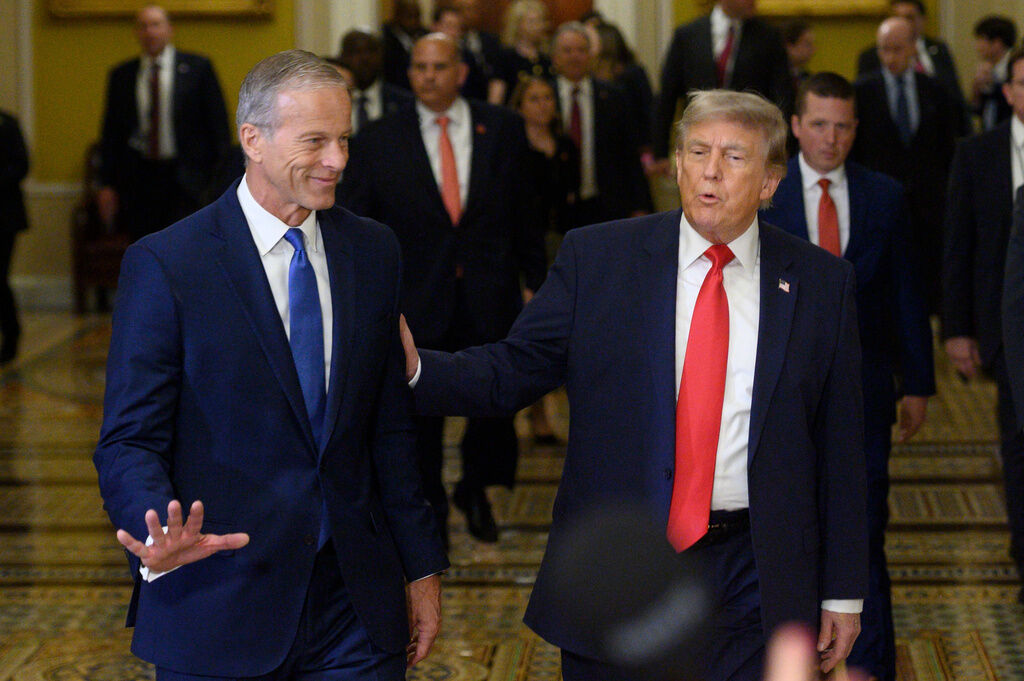
Senate Republicans are trying to turn the page on a heated lunch with President Donald Trump that brought weeks of tensions to a new high-water mark. In a symbolic gesture, Senate Republicans took another vote on the Iran war Wednesday...
PREV
PREVIOUS

Senator authors proposal to tweak RTD board
Sen. Jack Tate, R-Centennial, will introduce a bill to add two appointees of the governor to the Regional Transportation District’s board of directors, The Denver Post reports. “RTD needs a turn-around, not a Band-Aid, right now,” said Tate, according to The Post. “If they get their fiscal house in order, they will not have to […]

10 Colorado politicos to focus on in 2020
Here are the players that Colorado Politics expects to be hearing a lot about in 2020. 10. Rep. Tom Sullivan As gun-control advocates and Second Amendment advocates skirmish — before Democrats exercise their majority powers — expect Sullivan to once again be in the center state. His son, Alex, was killed in the Aurora theater shooting in 2012 […]