

U.S. government foreign policy to benefit Colorado’s natural gas industry

WASHINGTON – Colorado is well-positioned to join a surge in exports of liquefied natural gas the U.S. government wants to use to strengthen foreign relations, according to testimony at a congressional hearing Tuesday.
Natural gas exports could be used to counter Russian influence in Europe and to tap into East Asia’s growing economies, according to witnesses and lawmakers at the hearing of the House Natural Resources subcommittee on energy and mineral resources.
Two Colorado congressmen spoke about how their state could benefit from U.S. government efforts to leverage natural gas for foreign policy.
“America’s ‘shale revolution’ has transitioned the U.S. from a position of energy scarcity to one of energy abundance and security, with growing impacts in global energy markets,” U.S. Rep. Doug Lamborn, R-Colorado Springs, said in a statement.
The U.S. Energy Department has estimated natural gas exports will increase from about 2.3 billion cubic feet per day this year to about 4.6 billion cubic feet per day next year.
Colorado’s contribution is most likely to come from the Piceance Basin of Colorado. The U.S. Geological Survey (USGS) estimated in 2016 the Piceance Basin could yield 66 trillion cubic feet of shale natural gas and 45 million barrels of natural gas liquids through new technologies such as horizontal drilling and hydraulic fracturing, or fracking.
“Colorado and other leading gas producing states will benefit from the continued growth of high paying jobs as the U.S. allows LNG exports,” Lamborn said.
Lamborn has supported pending legislation that would repeal restrictions on the export and import of natural gas and speed up some permits for exporting natural gas.
“Are there any permitting issues that are outstanding today,” Lamborn asked natural gas industry officials during the hearing.
Christopher Smith, a vice president for Houston-based Cheniere Energy Inc., responded, “There are financing issues, there are commercial issues, but we don’t see permitting as being the primary issue.”
Colorado U.S. Rep. Scott Tipton, R-Cortez, was concerned about whether the infrastructure is available to deliver natural gas to export facilities.
One of them is the proposed Jordan Cove LNG export terminal on the Oregon coast, which could receive natural gas from a pipeline stretching into western Colorado.
“We’ve got the USGS coming out saying we could have the second largest reserve in the country,” Tipton said.”How important is it to have those pipelines to deliver it?”
Meg Gentle, president of Houston-based natural gas company Tellurian Inc., said, “Now that supply is coming from West Texas, the Rockies and Northeast, all of the pipelines have to be rerouted and new pipelines need to be built.”
She estimated $170 billion in new investment is needed to take advantage of all the opportunities created by the natural gas industry.
“Now we’re in a position where this country can lead,” Tipton said.
Two decades ago, U.S. dependence on imported natural gas was growing. However, by 2009, new technologies that created the “shale revolution” had transformed the United States into the world’s largest exporter, according to a congressional report.
Last year, the United States exported more natural gas than it used domestically for the first time since 1957, according to the U.S. Energy Information Agency. Much of it goes to China.
A concern in Congress and the Trump administration is the way Russia is using its natural gas exports to control energy markets in much of Europe.
In 2012, Russia completed construction of Nord Stream, the world’s longest undersea natural gas pipeline. Nord Stream’s two lines run 760 miles from Vyborg, Russia, to Greifswald, Germany.
Russia is building another pipeline called Nord Stream 2, which would increase the sometimes U.S. adversary’s pumping ability enough to supply 75 percent of Europe’s natural gas.
Political leaders in Denmark, Lithuania, Poland and elsewhere said the pipelines could undercut Europe’s energy diversification and give Russia greater political influence.
U.S. lawmakers and energy companies are seeking ways to compete with the Russian pipeline through inexpensive exports.
They also want to capitalize on liquefied natural gas shipments to China, South Korea and Japan, where imports rose 20 percent in the past year, according to a congressional report.


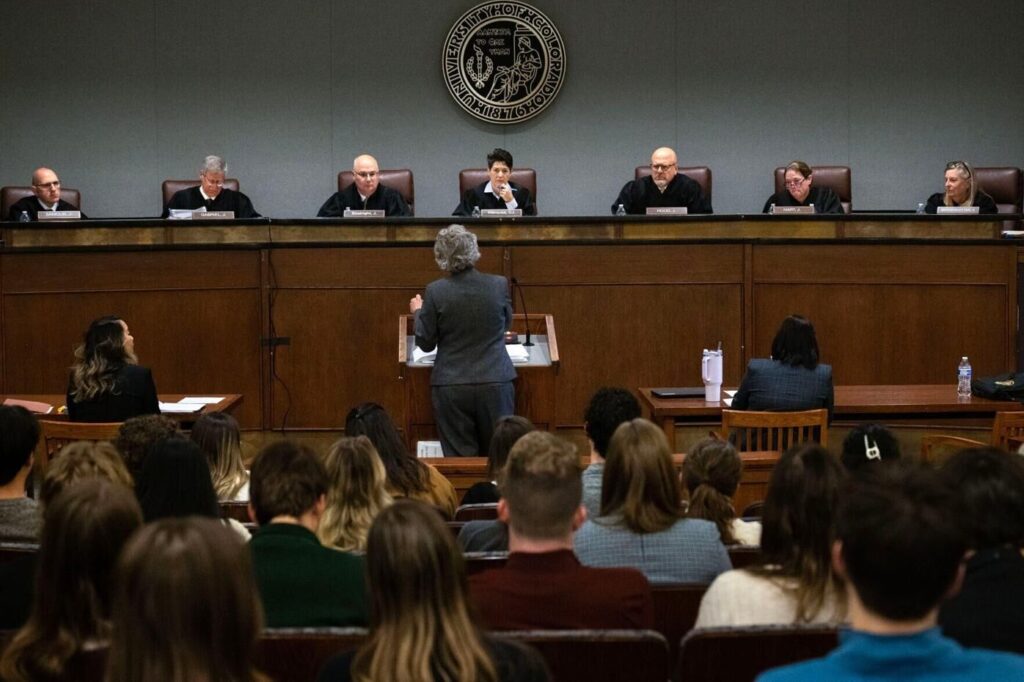
Who are the 3 finalists for the Colorado Supreme Court?
Michael Karlik
michael.karlik@coloradopolitics.com
Updated 3 hours ago
A citizen-led nominating commission has chosen the finalists for a vacancy on the Colorado Supreme Court, the first opening in five years on the seven-member court. The vacancy arose after the unexpected resignation of Justice Melissa Hart, who formally departed...

Christopher Zenisek, trial judge experienced with high-profile cases | SUPREME COURT FINALISTS
Michael Karlik
michael.karlik@coloradopolitics.com
Updated 3 hours ago
After the Marshall fire burned through Boulder County in the final days of 2021 and wound up destroying more than 1,000 homes, the sprawling 4,000-plaintiff litigation was assigned to District Court Judge Christopher Zenisek of Jefferson County. Zenisek would go...
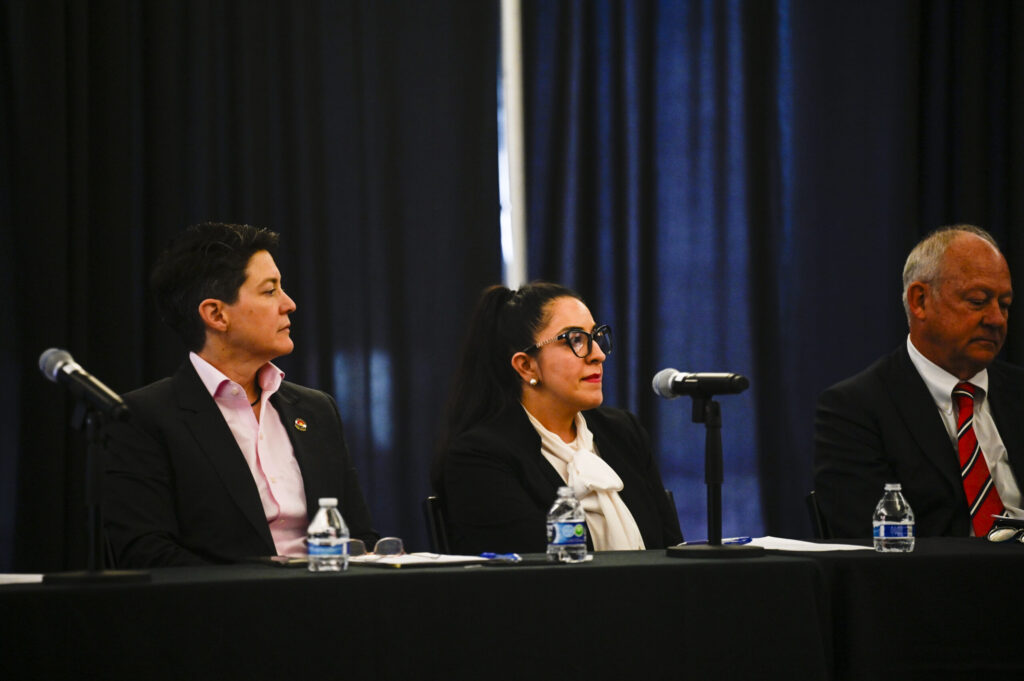
Andrea Wang, water and energy expert | SUPREME COURT FINALISTS
Michael Karlik
michael.karlik@coloradopolitics.com
Updated 3 hours ago
When the late Chief Justice Mary Mullarkey authored a 2002 opinion in the complex and long-running Taylor Ranch case involving landowners’ claims to access a 77,000-acre tract in the San Luis Valley, she worked with her law clerk, Andrea S....
Susan Blanco, innovator in the judiciary | SUPREME COURT FINALISTS
Michael Karlik
michael.karlik@coloradopolitics.com
Updated 3 hours ago
Less than 24 hours after her selection as a finalist for a Colorado Supreme Court vacancy, Chief Judge Susan Blanco was back on the bench in Fort Collins, moving methodically through the variety of complications she encountered. “Your goatee might...

Colorado GOP vice chair Richard Holtorf resigns, says it’s ‘impossible’ to work with chair Brita Horn
Ernest Luning
ernest.luning@coloradopolitics.com
Updated 28 minutes ago
Colorado Republican Party Vice Chair Richard Holtorf notified GOP officials on Tuesday that he will step down from the party position at the end of the month, citing his inability to work with state chair Brita Horn. Holtorf, a third-generation...

Daniels Fund awards $450K to three outstanding organizations | NONPROFIT REGISTER
Joanne Davidson Special to Colorado Politics
joanne-davidson-special-to-colorado-politics@coloradopolitics.com
Updated 5 hours ago
You know the old saying about how it’s an honor just to be nominated? In the case of the Daniels Fund and its annual $250,000 Medal of Excellence Award, it wasn’t just an honor to be considered; it was also quite profitable. ...

14th wolf dies in northwest Colorado
Marianne Goodland
marianne.goodland@coloradopolitics.com
Updated 1 day ago
The 14th wolf to die in Colorado since their reintroduction about two years ago took place during a “collaring” operation in the northwestern region of the state last week. Colorado Parks and Wildlife said the wolf, identified as #2305 —...

Colorado joins lawsuit against Trump energy emergency order
Scott Weiser
scott.weiser@gazette.com
Updated 4 hours ago
Colorado Attorney General Phil Weiser joined a multistate lawsuit challenging an executive order invoking the National Emergencies Act that President Donald Trump issued on the day of his inauguration. The order fast-tracks fossil fuel projects by bypassing or shortening environmental...
Colorado’s federal judges slash motions backlog to lowest in years
Michael Karlik
michael.karlik@coloradopolitics.com
Updated 1 day ago
Colorado’s federal trial judges collectively had 37 motions in civil cases that had been sitting on their dockets for at least six months without a ruling, as of Sept. 30. That is the smallest backlog the state’s U.S. District Court...

Colorado delegation splits in House vote to end federal government shutdown
Ernest Luning
ernest.luning@coloradopolitics.com
Updated 1 day ago
Colorado’s U.S. House members divided mostly along party lines Tuesday in separate votes on a funding deal to end the federal government’s partial shutdown, while giving Congress more time to negotiate long-term funding for the Department of Homeland Security. Lawmakers...
PREV
PREVIOUS
Your input wanted at Community Conversation on homelessness tonight in Colorado Springs
The final numbers for the 2018 community survey of the homeless population in Colorado Springs are not yet available, but the total number of homeless persons is expected to exceed the 2017 count of 1,415. The situation has worsened as more Denver metro residents turn south to escape that area’s white-hot housing market, pushing prices […]

What does it mean to be a community school? This Colorado bill would define it – and promote it.
A Colorado lawmaker wants to encourage struggling schools to adopt the community school model, which involves schools providing a range of services to address challenges students and their families face outside the classroom. Community schools are an old idea enjoying a resurgence in education circles with the support of teachers unions and other advocates. These […]