

House Speaker Crisanta Duran’s high profile rooted in Colorado goals
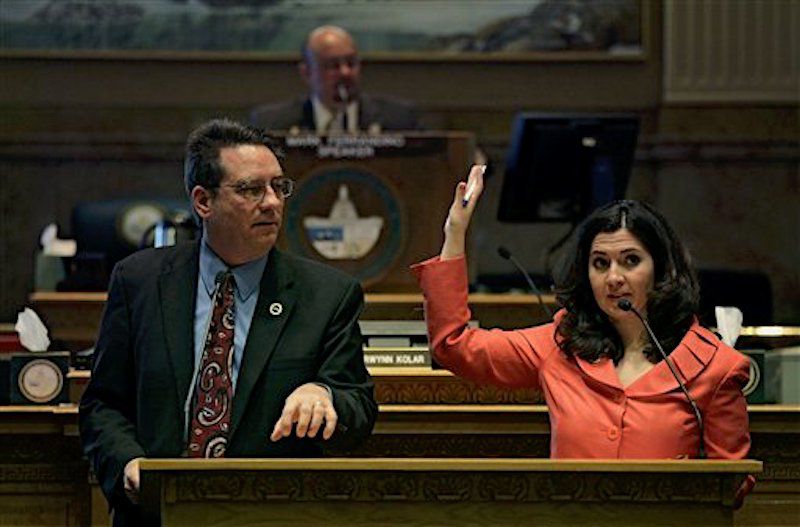
Colorado House Speaker Crisanta Duran, 37, is ending her House career at an age when many lawmakers are barely getting started.
In the last two years, Duran’s national profile has risen dramatically, even before becoming the state’s first Latina speaker of the house.
She won the Gabrielle Giffords Rising Star Award in March 2016 from Emily’s List, the Democratic committee that supports Democratic women running for office. Just five months later, she was at the podium of the Democratic National Convention in Philadelphia, telling her story.
“Only in America could a shy little girl from Northglenn and Arvada, Colorado, grow up to break glass ceilings and serve as the majority leader of the Colorado House of Representatives,” she said.
“So, to every shy little girl or boy out there listening, I want to say: No matter who you are, no matter where you’re from, or how you got here, you are special. And your potential is as big as America itself.”
Duran said in her last go-around in the lower chamber she will be “laser-focused” on issues such as affordable housing and child care, and a way to knock down some of the state’s $828 million obligation to public education.
Her biggest disappointment in 2017 – the failure of a statewide transportation package – still stings, and Duran indicated she doesn’t see much hope for a different outcome in 2018.
Instead, she’s supportive of a citizen-driven ballot measure that mirrors the 2017 bill and which could include many of the same stakeholders who backed the 2017 effort.
At this time, however, there are no ballot measures filed to do that; the half-dozen submitted by the Colorado Contractors Association last year expired, according to the Secretary of State’s office.
Duran also wants to have “tough conversations” about Colorado’s growth. Up until 2017, the state population had been growing at a robust rate of nearly 100,000 residents per year. State demographers predict Colorado will be home to 8 million residents by 2050, up from about 5.6 million today.
“We have an incredible quality of life, and have to do more to enhance and preserve it,” Duran said. “I don’t blame people for wanting to be part of our communities. But we also should have tough conversations about how we plan and adjust for the growth for the next generation.”
The bipartisan success of the 2017 session – breaking long-standing logjams over construction defects, the hospital provider fee and equitable funding for charter schools – is what Duran will look back on as part of her legacy. But the bottom line is that all of those measures demonstrated an ability to problem-solve on tough issues.
Duran’s thinks that ability will guide her future. What that will look like is a question she asks herself almost daily. For now, she will make sure the 2018 session is as productive as possible “and that we work to reform the culture at the capitol and address the harassment issues head-on.”
Duran doesn’t have a specific future office in mind, but is mindful of her role as a leader for women and Latinas in particular.
“I think a lot about the future of women in our country. My grandmother would never have imagined her granddaughter as speaker of the House” or earning a law degree, she said.
“It’s been the honor of my life to be the first Latina speaker in Colorado and the only Latina speaker in the nation. It is also important to me that I’m not the last, and that we continue to support women and Latinas specifically.”
Duran said she knows how hard it is for women to excel in politics.
“I had to work twice as hard and be twice as smart.” And even today, there is still much to be done to make sure women have the same opportunities,” she said. “I will continue to work to help others succeed in politics, especially women and Latinas.”
But she still needs a paycheck after 2018.
“I need to get a job,” she said. “I’d like to continue being able to problem solve. What that means, I’m thinking through … and you don’t have to be in the spotlight to do that.”


Colorado Democrats react to Alex Pretti’s death in Minnesota
Wire Services
wire-services@coloradopolitics.com
Updated 17 hours ago
Colorado’s Democrats called for an “impartial” investigation into the death of a man shot by a federal agent during an immigration operation on Saturday. Meanwhile, the chief of the Border Patrol defended the shooting, saying Alex Pretti inserted himself in...

National Western Junior Livestock Auction sets record
Marianne Goodland
marianne.goodland@coloradopolitics.com
Updated 2 days ago
The 120th National Western Stock Show, which closes Sunday, saw a standing-room only crowd in the CoBank auction arena at the new Sue Anschutz-Rodgers Livestock Center. Bidders set a record Friday for the top eight livestock – steers, lambs, goats...

The biggest accelerant of our political tribalism | SONDERMANN
Eric Sondermann
eric-sondermann@coloradopolitics.com
Updated 5 days ago
In years past, my go-to word in describing our political condition was “polarization.” I used it endlessly and still do on occasion. But as time has moved on, and the divide has only grown in depth and toxicity, polarization no...

Capitol M: Return to Gold Dome High, 2026 edition, and a salute to old IU
Marianne Goodland
marianne.goodland@coloradopolitics.com
Updated 4 days ago
Welcome back, campers! The 2026 legislative session is upon the good citizens of Colorado, and for a few, the first Monday of the session, Jan. 19, was pretty special. There are at least four folks in the Capitol who are...

Sundance kicks off in Utah with premieres, emotional tributes to Robert Redford | OUT WEST ROUNDUP
Ernest Luning
ernest.luning@coloradopolitics.com
Updated 4 days ago
UTAH Redford hailed at Sundance kick-off PARK CITY — Robert Redford liked to say that everybody has a story. He’s not the only person who said it, but he is one of the few who did something to celebrate it,...
Governor’s lobbyists should be banned from the house floor, legislator argues | A LOOK BACK
Rachael Wright
rachael.wright@coloradopolitics.com
Updated 3 days ago
Forty-Five Years Ago This Week: State Rep. Bob Stephenson, R-Colorado Springs, created an uproar in the chambers of the House of Representatives after he proposed a rule change that would ban the governor’s lobbyists from the House floor during the...
Republican candidates debate how to win the governor’s seat in Colorado — a position the GOP last secured in 2002
Thelma Grimes
thelma.grimes@coloradopolitics.com
Updated 3 days ago
Colorado has not elected a Republican governor since 2002. On Thursday night, four candidates offered competing visions for how the party can reverse its 20-plus years of failing to secure the seat. The discussion hosted by the Women of Weld...

Colorado’s charitable gaming board to study Denver Gazette’s findings
David Migoya
david.migoya@gazette.com
Updated 3 days ago
Colorado’s freshman board overseeing the state’s $110 million charitable gaming industry on Friday created a committee to tackle issues raised in a Denver Gazette investigation that exposed, among other issues, poor supervision and illegal operators. The Colorado Charitable Gaming Board,...
10th Circuit to address resentencing of probation violators in rare all-judges hearing
Michael Karlik
michael.karlik@coloradopolitics.com
Updated 2 days ago
The Denver-based federal appeals court agreed on Thursday to hold a rare all-judges hearing to determine the proper procedure for resentencing a criminal defendant who has violated the terms of his probation. In the federal appellate courts, the vast majority...

Vape shops challenge Denver’s flavored tobacco ban in court
Deborah Grigsby
deborah.smith@denvergazette.com
Updated 3 days ago
The smoke has yet to settle in the battle over the city’s flavored tobacco ban as local vape shop owners have sued the City and County of Denver, asking the court to declare the ordinance unconstitutional and stop its enforcement....
PREV
PREVIOUS

Tom Tancredo getting help from GOP operative who helped knock off Eric Cantor
Chris Doss, the campaign operative who helped take down U.S. House Majority Leader Eric Cantor in Virginia in 2014, is putting his brand on Tom Tancredo, or maybe it’s the other way around. Doss will be in Colorado next weekend talking to volunteers and helping Tancredo beef up his run for governor, according to an […]
Analysis: Surplus, roads, pensions and pot on tap for the legislative session
A rosy December revenue forecast gave lawmakers reason to believe they quite possibly will have an extra $300 million to spend in the legislative session that starts Wednesday, and that’s just one of their problems. The General Assembly gavels in Wednesday, and for the ensuing 120 days 100 lawmakers will debate about 700 bills and […]