

Plugging the settlement pipeline

For at least the fourth year in a row, the City and County of Denver will hand out settlements that total more than $1 million in 2016. Between 2013 and so far this year, the City Council has approved close to $15 million in mostly taxpayer money to settle various lawsuits involving the city, according to a tally from the city attorney’s office.
Among the higher-profile settlements over the last three years are $3.25 million to the family of Jamal Hunter and $6 million to the estate of Marvin Booker, both related to actions by city police officers or sheriff’s deputies. More recently, the council approved $360,000 of a $660,000 settlement for assistant city attorney Stuart Shapiro. And Mayor Michael Hancock announced a $200,000 settlement in a dispute with former aide Wayne McDonald.
Other settlements on the city attorney’s list over the last three years included attorney’s fees, injuries from slips and falls and motor vehicle accidents. City departments involved in settlements included the Denver police and sheriff’s departments, public works, the Denver Zoo, city attorney and mayor’s offices, among others.
While the total amount paid in settlements approaches $1 million, the city’s 2016 general fund budget is $1.2 billion.
Soft touch, deep pockets
Former city councilwoman Jeanne Faatz focused a lot of her 12 years in office on making sure the city did all it could to avoid or reduce the dollar amounts involved in settlements.
“The attitude has to be that our employees operate at the highest standard and do the best they can to assure the safety of themselves and our residents,” Faatz said. “The city should not be seen as a soft touch or have deep pockets. But I’m afraid that was the message” given when large settlements were approved.
During her time in office, from 2003 to 2015, Faatz said she wasn’t convinced the city was at fault in many cases, even though that’s how it was portrayed by the public.
“You have to have culpability and the damages have to relate to some reasonable calculation,” she stated. “My sense too often was that the settlements were for way too much, especially in the high profile cases like the Hunter case. I thought the city did have culpability there, but the amount was excessive.”
While Faatz said she spent a lot of time talking with city attorneys to get a good sense of each case, “In many ways, I thought the attitude was just to get in line for the next large handout.”
Settlements have their place
City Councilman Kevin Flynn, District 2, said he approaches each proposed settlement with the attitude of “if it’s a legitimate payment, we need to pay it. Even in the private sector, it’s common to settle legal disputes because it just gets more and more expensive.”
Flynn said he has voted against two proposed settlements. And settlements can turn out to be the right thing to do.
“We had a recent case in the past year where we decided to go to trial because we felt the police officer involved did not act improperly,” he explained. “But we lost the case at trial. So you step back and say if we lost a case like this, where we felt the officer did nothing wrong, but a 12-member jury in this kind of atmosphere surrounding law enforcement found him guilty, maybe we should have settled.”
“Hardest part of my job”
Councilwoman Robin Kniech, At-Large, said each proposed settlement comes out of different circumstances.
“I always say these things are the single hardest part of my job,” she said. “I look at three things. One, how should the city take responsibility in this particular case. Two, how can we minimize the risk to the taxpayer and if, by settling, we might be doing something wrong. And three, in every case, we need to ask how can this situation be prevented in the future. That’s the most important part.”
And Kniech said she does get calls from constituents every time a proposed settlement “makes the headlines. They care a lot.”
Along with a legal fine, damages and awards by a judge can quickly escalate the cost of a case involving the city, Flynn said.
“But I think we still need to push back more often on them,” he added.
Reforms underway to reduce settlements
Denver’s police and sheriff’s department have taken several steps to avoid future legal issues that can lead to expensive settlements, Flynn said. For example, in Mayor Michael Hancock’s 2016 budget proposal to the city council, he sought $24 million to enact reforms in the sheriff’s department, including hiring additional deputies and enhancing staffing, technology, data tracking, training and facilities.
Hancock also requested $1.4 million to continue to purchase body-worn cameras for most police officers who interact with the public, help increase transparency and accountability and reduce use-of-force incidents.
Hancock was reportedly out of the office until after Labor Day and unavailable for comment for this story. However, his office provided a written statement from Interim City Attorney Cristal DeHerrera that reads, “The city is always working to reduce the risk of claims and lawsuits. Denver’s reform efforts within its sheriff’s department are an example of these efforts. We believe Denver’s history of claims, settlements and judgments is not dissimilar from other major cities.”
Kniech also cited reforms in the city’s two law enforcement agencies as a hopeful sign the council will see fewer settlements.
“We’ve changed our police procedures and our chief has started very aggressive training,” she said. “There’s also a mental health team that now goes out on calls where officers know they’ll have to deal with someone who has those types of issues.”
“But I’m totally not satisfied,” Kniech added. “There’s always learning opportunities where we can do better.”
And Denver isn’t alone, she said.
“I know none of us are satisfied with where we need to be,” Kniech continued. “It is important that the police can protect themselves, but we also always want to address this and know how to avoid conflicts when it’s not needed.”
Flynn said he’s not sure if the city’s employee training and standards might need to be looked at for ways to avoid future issues and settlements.
“Our managers do need to know how to respond correctly to personnel issues as they come up,” he stated. “I don’t think we’ll know for sure if we’re on the right track until we start winning some of these cases and we don’t have so many settlements.”
“The city has some 13,000 employees, so we’re like any large corporation,” Kniech added. “Any large organization is going to have disputes.”
Usually the taxpayer’s dime
Since the city is self-insured, Faatz said most of the money paid in settlements is taxpayers dollars. Insurance covers such things as injuries from slipping and falling at public venues, but not for injuries or death in other circumstances. The city’s risk management department said the city has coverage for commercial general liability, workers’ compensation and business auto insurance.
Each proposed settlement involved several hours of study, Faatz said, to the point where she felt she had completed “pseudo law school.”
“Many times it was very unfortunate circumstances and in some cases, I didn’t feel the employee was at fault,” she added. “That’s when I would vote against it. It’s not the person involved, it’s the taxpayers that have to pick this up.”
Federal law and federal court rulings that require the city to pay things like treble damages and attorney’s fees are another incentive to settle, Faatz said.
“I think we need to bring things back into proportion. We don’t want the poor to be unable to file a lawsuit, but the way the federal rules are now, it encourages settlements. I think if the rules would allow some of that money to go to nonprofits that help people with whatever issue is involved, we might have far fewer of these lawsuits.”



Appeals court shuts down path to challenge convictions if lawyer tells jury that defendant is guilty
Michael Karlik
michael.karlik@coloradopolitics.com
Updated 16 hours ago
Colorado’s second-highest court concluded on Wednesday that defendants cannot challenge whether the evidence was sufficient to sustain their convictions if their lawyer argues to the jury that it should find the defendant guilty. The U.S. Supreme Court has provided guidance...
Colorado legislature votes to make committee hearing livestreams permanent
Marianne Goodland
marianne.goodland@coloradopolitics.com
Updated 17 hours ago
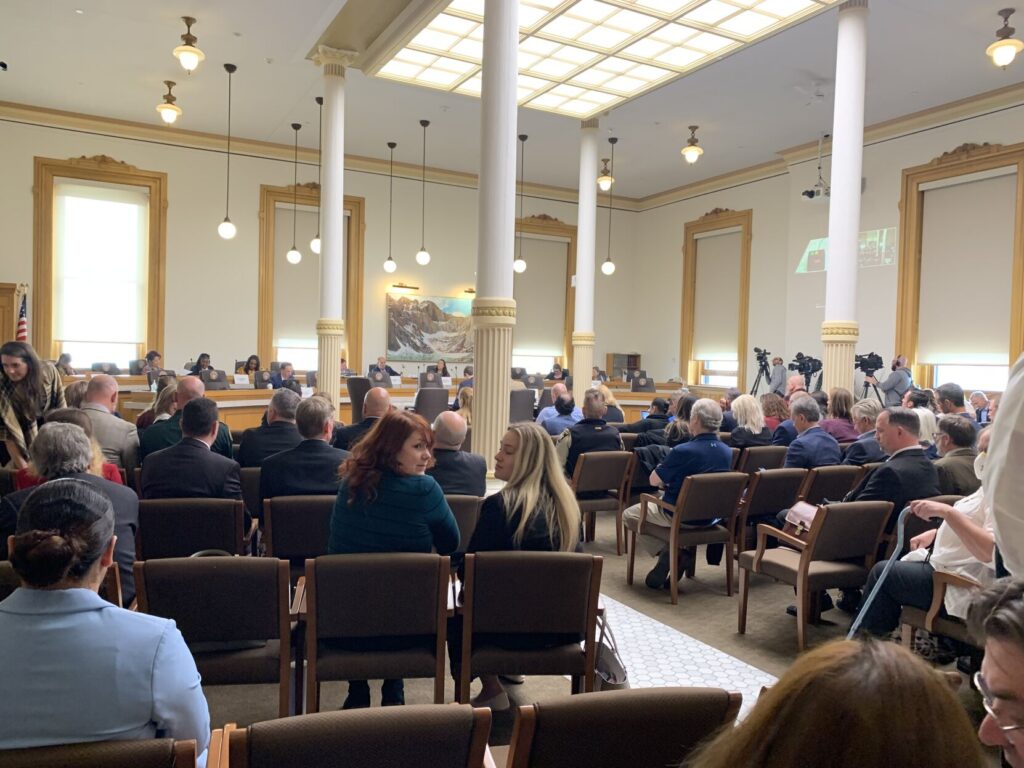
The executive committee of the legislative council—the six top leaders of the House and Senate—voted 5-1 Wednesday to make permanent the video livestreaming of committee hearings, starting in the 2026 legislative session, which begins Jan. 14. And they managed to...
Here’s where House retirements stand as clock strikes midnight on 2025
Rachel Schilke, Washington Examiner
rachel.schilke.washington.examiner@gazetteedit.wpenginepowered.com
Updated 19 hours ago
The House will return on Jan. 6, and with it, some 10% of lawmakers will start their final year in the lower chamber, either retiring or seeking higher office in the 2026 midterm elections. The lower chamber will get its...

Colorado senator, local officials push for new Colorado Springs federal courthouse
Michael Karlik
michael.karlik@coloradopolitics.com
Updated 18 hours ago
Local officials and one of Colorado’s U.S. senators urged the judiciary earlier this year to explore placing a new federal courthouse and judge’s chambers in Colorado Springs, while the district court is cautioning that Congress must establish new judgeships before...

SNAP recipients in five states will be banned from using assistance for candy and soda, beginning 2026
David Zimmermann Washington Examiner
davidzimmermannwashingtonexaminer@wpstage.coloradopolitics.com
Updated 18 hours ago
More than 1.4 million recipients of the Supplemental Nutrition Assistance Program across five states will be banned from using federal food assistance for candy and soda purchases, starting Thursday. Indiana, Iowa, Nebraska, Utah, and West Virginia are the first group...

Trump’s first year back in office: Four successes and four failures
NAOMI LIM Washington Examiner
naomi-lim-washington-examiner@coloradopolitics.com
Updated 17 hours ago
President Donald Trump is closing a seismic year as the country’s commander in chief. Since the first day of his second administration, when he issued 26 executive orders, 12 presidential memos, and four proclamations, the most first-day actions of any...

Gov. Polis appoints Lindstedt to Colorado Senate District 25 after vacancy committee misses deadline
Marianne Goodland
marianne.goodland@coloradopolitics.com
Updated 15 hours ago
Despite a similar vote by a Senate District 25 vacancy committee last week, it was up to Gov. Jared Polis on Tuesday to make sure the Senate seat was filled and ready for the 2026 session. That’s because the vacancy...

‘Rot in hell’: Trump post reignites feud with Colorado Gov. Jared Polis over Tina Peters
Thelma Grimes
thelma.grimes@coloradopolitics.com
Updated 16 hours ago
Heading into the New Year, President Donald Trump said he would like Gov. Jared Polis and others in Colorado to “rot in hell.” The object of the president’s ire is Tina Peters, the former Mesa County clerk convicted of state...
US Rep. Lauren Boebert calls for override vote after Trump vetoes bipartisan Colorado water bill
Marianne Goodland
marianne.goodland@coloradopolitics.com
Updated 16 hours ago
President Donald Trump issued the first veto of his second term Tuesday, blocking a long-awaited bipartisan effort to finish a southeastern Colorado water project that supporters say is critical to delivering clean drinking water to roughly 50,000 residents of the...

From Pope Francis to Charlie Kirk, many deaths in 2025 had a wide impact
Bernard Mcghee
bernard.mcghee@associatedpress.com
Updated 23 hours ago
The death of Pope Francis brought change to the Catholic Church, which counts 1.4 billion adherents and is now led — for the first time — by an American pope. The fatal shooting of conservative activist Charlie Kirk as he...
PREV
PREVIOUS

YESTERYEAR: Democrats defend Hillary Clinton as Bill nominated for second term
Twenty Years Ago this week in The Colorado Statesman … Democrats dispelled any preconceptions that their 1996 national convention would mirror “the GOP’s tightly controlled production” that relied on “cheerleading youth to generate enthusiasm and whips to silence dissenters,” The Statesman reported from Chicago, where delegates nominated Bill Clinton and Al Gore for a second […]

For Donald Trump, a day of political whiplash on immigration
For weeks, Donald Trump flirted with a self-described “softening” of the hard-line immigration policies that propelled him to the Republican nomination, raising the hopes of party officials, some Hispanic leaders and skeptical voters unnerved by his presidential candidacy. On Wednesday, he appeared on the brink of embracing that shift as he traveled to Mexico for a dramatic […]