

Lundberg bill signals continuing divide over death penalty policy

The Republican-controlled Senate Judiciary Committee voted down a bill Wednesday that would have made it less difficult for juries to deliver the death sentence in Colorado.
Opponents of the bill who packed the hearing room celebrated the committee’s decision and the swing vote cast by Chairperson Ellen Roberts, a Republican from Durango.
“I was dumbfounded by the result of the Holmes trial,” Roberts explained before casting her vote, referring to the two-years-long court battle to win the death sentence for Aurora Theater shooter James Holmes. The trial ended last August when the jury imposed a life sentence without parole. Tom Sullivan, father of Alex Sullivan, who was killed in the shooting, gave emotional testimony in support of the bill.
“I was moved by Mr. Sullivan’s testimony about the intentional and horrific murders and the loss of his son,” Roberts said. “I support the death penalty, but I believe we have to meet the highest procedural threshold.”
Senate Bill 64, sponsored by Sen. Kevin Lundberg, R-Berthoud, aimed to eliminate the state requirement that 12 jurors unanimously agree to impose a death penalty. The bill originally would have reduced the required number of jurors in agreement to nine, but Lundberg introduced an amendment at the opening of the hearing raising his proposed number to 11.
There is “a flaw” in the sentencing phase of capital cases, Lundberg told the committee members. That final phase of a jury’s deliberations is more subjective and, in the Holmes trial, “we (saw) it fail,” he said. “I believe state policy should be adjusted.”
“There should be a very high bar” when it comes to imposing a death sentence, he said, “but one that’s attainable.”
Only three capital punishment states do not require unanimous death penalty sentencing decisions — Florida, Alabama and Delaware. According to the Colorado chapter of the American Civil Liberties Union, all of those states now are reconsidering their sentencing systems, and one of them is currently considering eliminating the death penalty altogether.
Senate Minority Leader Lucia Guzman, D-Denver, strongly opposed the bill, agreeing with others at the hearing that it ran counter to growing national support for efforts to either do away with the death penalty altogether or to tighten up justice systems that have led to false convictions and a rash of death-row exonerations.
“This would move (the process) in a direction that doesn’t respect the jury system we have — the minds and the hearts of all of the 12 jurors,” she said.
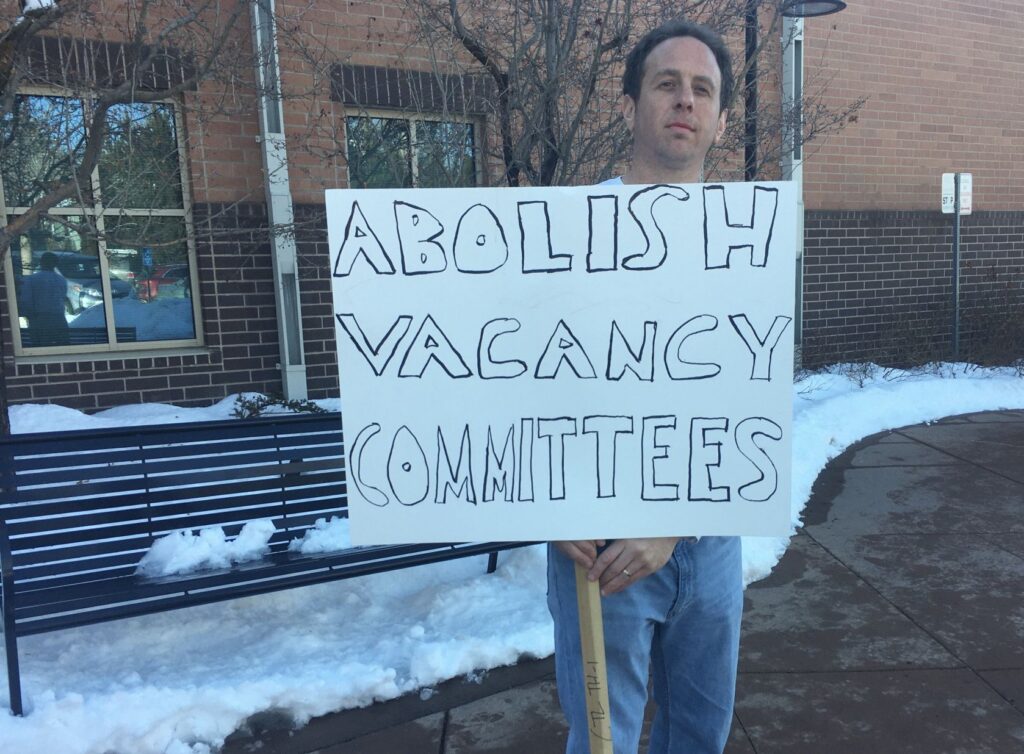
Opponents of the measure protested outside the hearing room, waving homemade posters along the street and from the building steps.
Some suspected the bill was intended at least partly to rally conservative voters in an intense presidential-election year.
Others derided it as the “George Brauchler do-over bill.”
Brauchler is the Arapahoe District Attorney who tried and failed to land the death sentence for Holmes. Although Holmes agreed early in the court proceedings to plead guilty in exchange for a life sentence, Brauchler pressed the case. As Lundberg pointed out at the hearing Wednesday, Brauchler won a unanimous guilty verdict but lost in the sentencing phase of the multimillion dollar trial.
After the hearing, Lundberg told The Colorado Statesman that the bill came from his heart, that the topic wasn’t something his constituents or colleagues were pressing. He said he simply felt the state had a death penalty system that no longer functioned, one that had slipped over the years into a policy in name only.
“Is the death penalty in Colorado a reality or is it a fiction?” he said.
The hearing was the latest back and forth in the “statewide conversation” on the death penalty called for by Gov. John Hickenlooper in 2013 after he granted a “temporary reprieve” to Nathan Dunlap, who was convicted of murdering four people in an Aurora pizza restaurant in 1993. Dunlap’s scheduled execution would have been the first in the state in 15 years.
In explaining his decision to grant the reprieve, Hickenlooper cited mounting evidence that capital punishment has been applied unreliably and inequitably for decades, targeting poor, ethnic minority, and mentally ill defendants.
“Such a level of punishment really does demand perfection,” he said.
The judiciary committee voted 3-2 against Lundberg’s bill. Lundberg, who is a member of the committee, and Sen. John Cooke, R-Greeley, voted in favor. Cooke was one of the bill’s co-sponsors.


10th Circuit rules State Farm not required to pay benefits in I‑25 swerving crash
Michael Karlik
michael.karlik@coloradopolitics.com
Updated 55 minutes ago
The Denver-based federal appeals court concluded last week that two vehicle occupants who were injured while swerving to avoid a man in the middle of Interstate 25 are not entitled to insurance benefits. Plaintiffs Stephanie Mazur and Julia Wunder were...
Colorado House ethics committee to review complaint alleging misuse of Democratic Caucus funds
Marianne Goodland
marianne.goodland@coloradopolitics.com
Updated 60 minutes ago
The House Ethics Committee is scheduled to meet Wednesday to review a complaint alleging that Aurora Democrat Rep. Mandy Lindsay misused House Democratic caucus funds. Rep. Bob Marshall, D‑Highlands Ranch, filed the complaint on Jan. 26. Marshall’s complaint outlines the...
Proposal to ban appointed Colorado legislators from serving in next term fails to advance
Marissa Ventrelli
marissa.ventrelli@coloradopolitics.com
Updated 2 hours ago
For the third year in a row, lawmakers have struck down a proposal that would have prohibited members of the Colorado General Assembly who were appointed through a vacancy committee from serving in the term immediately after. Sponsored by Rep....

Trump says Strait of Hormuz won’t reopen until Iran strikes a deal with US
Mabinty Quarshie, Washington Examiner
mabinty.quarshie.washington.examiner@gazetteedit.wpenginepowered.com
Updated 25 minutes ago
President Donald Trump said in a new interview that the Strait of Hormuz will remain closed until the United States and Iran reach a peace deal to end the ongoing war. The two nations are set to begin a second...

US and Iran signal new ceasefire talks in Islamabad as truce nears end
Jon Gambrell
jon.gambrell@associatedpress.com
Updated 6 hours ago
ISLAMABAD (AP) — The United States and Iran have signaled they will hold a new round of ceasefire talks in Pakistan, two regional officials said Tuesday, as leaders on both sides warned they were prepared for more fighting if a...
Aurora council moves forward with statement of ‘mourning’ for police shooting victims
Kyla Pearce
kyla.pearce@gazette.com
Updated 5 hours ago
In Monday night’s Aurora City Council study session, councilmembers moved forward with a resolution stating that the City Council “stands in mourning” with people who have lost loved ones to officer-involved shootings. The resolution, which initially passed through the Public...

Denver City Council makes annual bison donation permanent
Deborah Grigsby
deborah.smith@denvergazette.com
Updated 5 hours ago
Denver has codified its annual donation of surplus buffalo to American Indian tribes and American Indian nonprofits into law after a unanimous vote by the City Council on Monday. The City and County of Denver has managed one of the...

Colorado lawmakers push reforms for handling defendants deemed incompetent
Marissa Ventrelli
marissa.ventrelli@coloradopolitics.com
Updated 4 hours ago
Colorado lawmakers from both parties are backing a bill that would reshape how the state handles defendants found incompetent to stand trial and unlikely to regain competency, aiming to fill long-standing gaps in treatment and placement. Sponsors of Senate Bill...

Colorado title board rejects government transparency measure, backers plan appeal
Marianne Goodland
marianne.goodland@coloradopolitics.com
Updated 19 hours ago
A broad coalition’s push for stronger government transparency hit a major setback last week when Colorado’s title board rejected a proposed ballot measure that would allow more public access to most legislative deliberations. The three‑member title board on April 15...
Polis administration awards $12.4 million for geothermal projects in Colorado
Scott Weiser
scott.weiser@gazette.com
Updated 5 hours ago
The Polis administration is awarding another $12.4 million in state energy tax credits and cash to advance geothermal energy development in Colorado, supporting seven new projects for building heating and cooling systems as well as electricity generation. The funding, announced...
PREV
PREVIOUS

Dale Tooley autobiography tops charts, political dinners proliferate
Thirty Years Ago this week in The Colorado Statesman … I’d Rather Be in Denver — Dale Tooley’s Own Story, reached the top of the local best-seller lists just a few weeks after its release, according to both The Denver Post and the Rocky Mountain News. The former Denver district attorney had completed his autobiography […]

Pot industry group blazing new trail for Colorado marijuana businesses
Activist versus Entrepreneur: The activist has harped on the social aspects of recreational marijuana since its legalization in the state, while the entrepreneur in the burgeoning Colorado cannabis market has effectively remained mute. This has, in effect, allowed fear to fuel unfair market regulations. This, according to members of the Colorado Cannabis Chamber of Commerce, […]