

Mehringer: Reasons to hope for recovery from the Era of Super PACs

Guest Commentary
As the 2016 presidential campaign has made clear, American politics has entered the era of the Super PAC. Most of the candidates for president have not only set up their own candidate campaigns but will also benefit from single-candidate Super PACs supporting them. Candidates for Congress and state offices are sure to follow their lead.
Super PACs represent a nearly complete unraveling of our campaign finance regulation system. They are allowed to accept contributions of any size from almost any type of donor and spend unlimited sums on behalf of a single candidate or many candidates. Super PACs can and do already support federal, state, and local candidates.
That is not to say that Super PACs are completely without any form of regulation. They are required to report all contributions they receive and expenditures they make and are not allowed to coordinate with a candidate’s campaign. This disclosure requirement, however, has limited value, as donors to Super PACs frequently include organizations that do not need to report information about their donors — so an original donor’s identity can still be kept secret.
Likewise, the ban on coordination has limited impact. The value of donating to Super PACs is that Super PACs can and do communicate with candidates about specific policies they want candidates to support.
With all of that in mind, there are a few reasons to hope we can find a way out of the era of Super PACs:
1. It cannot get much worse. American politicians have long relied on special interests to fund their campaigns, largely because Americans have been reluctant to provide that funding. Self-interested donors step forward to give money to candidates who pledge to support specific policies. Super PACs now provide these special interests a way to fund candidates with little restriction on the extent of their influence. Sometimes you have to hit rock bottom to understand you need to make a change. America may soon reach that point.
2. Several presidential candidates have called for reform. While not all candidates agree on the need for reform, candidates from both major parties have emphasized the need for reform. Discussion of the issue of special interest money corrupting politics has previously lacked the urgency and attention that it has received this year. If a pro-reform candidate wins next year’s election, they will have a clear mandate to enact reform.
3. Groups focused on money in politics have put forward a reform agenda that would do more than try to “get money out” of politics. Our political system has always relied on elections to make our politicians dependent on voters to stay in office. As the size of the electorate grows, so does the pressure for candidates to raise money to communicate with voters.
This fundraising pressure has grown so strong that donors have supplanted voters as the group that politicians now depend on most. Past attempts at campaign reform have largely relied on contribution limits to reduce the influence of money in politics.
Recent research from CleanSlateNow.org has found that, while contribution limits can reduce the amount of money going into politics, contribution limits do not cancel out the pressure of candidates needing to raise money to communicate with voters.
However, more than a dozen pro-democracy organizations have joined together to propose a reform agenda that can help our country reverse course, based on four key reforms:
1. Amplify the voices of everyday Americans through public financing that matches small contributions made to qualified candidates;
2. Require real-time disclosure of contributions and expenditures for all political spending;
3. Reverse recent court decisions, especially Citizens United, either through a constitutional amendment or the appointment of Supreme Court justices committed to restoring the ability to enact regulations on campaign finance to prevent corruptions; and
4. Enhance enforcement of campaign finance regulations by strengthening the Federal Election Commission and appointing an attorney general who will crack down on violations of the law.
Fundamentally, the path back to a representative democracy requires far more Americans to begin participating in at least a small way in the funding of campaigns, whether through public financing or their own individual donations. The old adage “You get what you pay for” applies to our political process. As little as one dollar a month from tens of millions of American can start the process of cleaning up our campaign funding system. Or we can rely on self-interested donors to fund campaigns election after election, and expect politicians to behave differently than they have in the past.
Mark Mehringer is executive director of CleanSlateNow.org, a Denver-based nonprofit working to educate the public about the corruption caused by special interest money.

Primary rival sues to prevent Democrat Eileen Laubacher from going through assembly in Colorado’s 4th CD
Ernest Luning
ernest.luning@coloradopolitics.com
Updated 60 minutes ago
Democratic congressional candidate Trish Calvarese on Monday asked a judge to prevent one of her primary rivals, Eileen Laubacher, from participating in the caucus and assembly process to seek the nomination to challenge Republican U.S. Rep. Lauren Boebert in Colorado’s...
Colorado lawmakers tackle legislation on sexual assault
Jenny Deam
jenny-deam@coloradopolitics.com
Updated 4 hours ago
A panel of Colorado lawmakers on Monday unanimously approved a bill that supporters say will offer protections and support to victims of domestic violence, stalking, sex trafficking and sexual assault, including mandatory training for law enforcement on trauma. The measure,...

Denver adopts face mask ban for law enforcement
Deborah Grigsby
deborah.smith@denvergazette.com
Updated 36 minutes ago
Members of the Denver City Council unanimously approved an ordinance Monday that prohibits law enforcement officers, including federal immigration agents, from wearing a mask or face covering while interrogating, detaining, or arresting an individual within Denver, including in city-owned buildings....

More than 20 Colorado counties receive grants to improve land record-keeping systems
Maren Prince
maren.prince@denvergazette.com
Updated 14 minutes ago
More than 20 Colorado counties received $2.5 million to improve their land record-keeping systems, according to a Monday news release. The State’s Electronic Recording Technology Board awarded 22 counties with grants ranging from $5,000 to $350,000, according to the release....

Denver among top 5 finalist cities for 2028 DNC
Deborah Grigsby
deborah.smith@denvergazette.com
Updated 33 minutes ago
Denver is among the five cities that could host the 2028 Democratic National Convention, the Democratic National Committee announced Monday. Along with Denver, Philadelphia, Atlanta, Boston and Chicago have advanced in the application process to host the next DNC, which...
Colorado Supreme Court clarifies restraining order violations can always support burglary charge
Michael Karlik
michael.karlik@coloradopolitics.com
Updated 17 hours ago
The Colorado Supreme Court’s majority ruled on Monday that a violation of a restraining order can also serve as a basis for finding a defendant guilty of burglary. Under state law, a person commits second-degree burglary by unlawfully entering or...

Big week ahead for major legislation to address housing affordability woes
Zach Halaschak, Washington Examiner
zach.halaschak.washington.examiner@gazetteedit.wpenginepowered.com
Updated 20 hours ago
The Senate is pushing ahead with a bipartisan bill to improve housing affordability, teeing up a critical week for housing on Capitol Hill and raising major questions about what provisions will be included. Senate Majority Leader John Thune (R-SD) filed cloture on legislation from the...

Macron goes nuclear with increases to French warhead arsenal
Timothy Nerozzi, Washington Examiner
timothy.nerozzi.washington.examiner@gazetteedit.wpenginepowered.com
Updated 20 hours ago
French President Emmanuel Macron is channeling the atomic spirit of his predecessor Charles de Gaulle with orders for the French military to “increase the number of nuclear warheads” in the nation’s arsenal. Macron announced the seismic shift in France’s defensive...

Who has been killed so far during US-Israel mission in Iran?
David Zimmermann and Keely Bastow, Washington Examiner
david.zimmermann.and.keely.bastow.washington.examiner@gazetteedit.wpenginepowered.com
Updated 20 hours ago
There have been numerous casualties on all sides since the joint U.S.-Israel strikes against Iran commenced over the weekend, with more lives expected to be lost as the campaign continues. The Islamic regime’s leadership is currently bearing the brunt of...
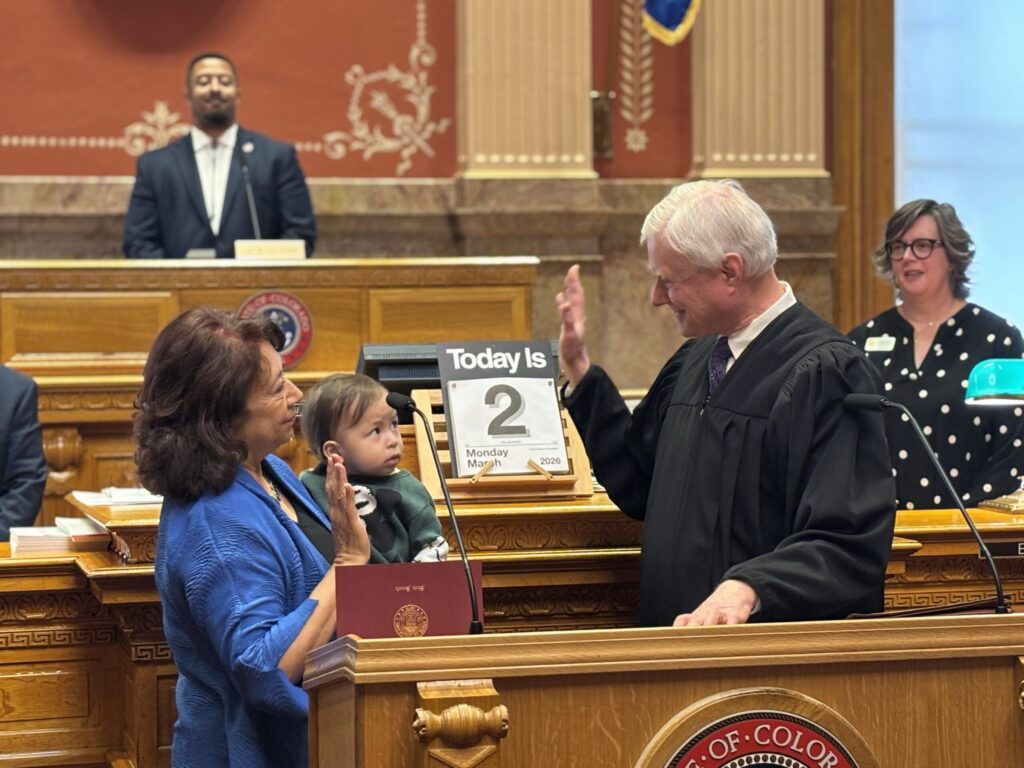
Colorado Senate swears in Adrienne Benavidez after district vacancy win
Marianne Goodland
marianne.goodland@coloradopolitics.com
Updated 20 hours ago
Sen. Adrienne Benavidez, a Democrat from Adams County, was sworn in Monday to the Colorado Senate, just four days after winning a vacancy election in District 21. She was sworn in by Colorado Court of Appeals Justice Lino S. Lipinsky...
PREV
PREVIOUS

Axiom Strategies: Inside powerhouse lobbying firm
As the staff of Denver-based powerhouse lobbying firm Axiom Strategies sits down around a conference table in their second-floor office just a stone’s throw away from the State Capitol, one of the first things that’s obvious is the gender discrepancy — all but one of the firm’s team members is female. Owner and President Micki […]

Mehringer: Reasons to hope for recovery from the Era of Super PACs
As the 2016 presidential campaign has made clear, American politics has entered the era of the Super PAC. Most of the candidates for president have not only set up their own candidate campaigns but will also benefit from single-candidate Super PACs supporting them. Candidates for Congress and state offices are sure to follow their lead. […]