

Federal judge opens new front in effort to increase magistrate judge handling of civil cases
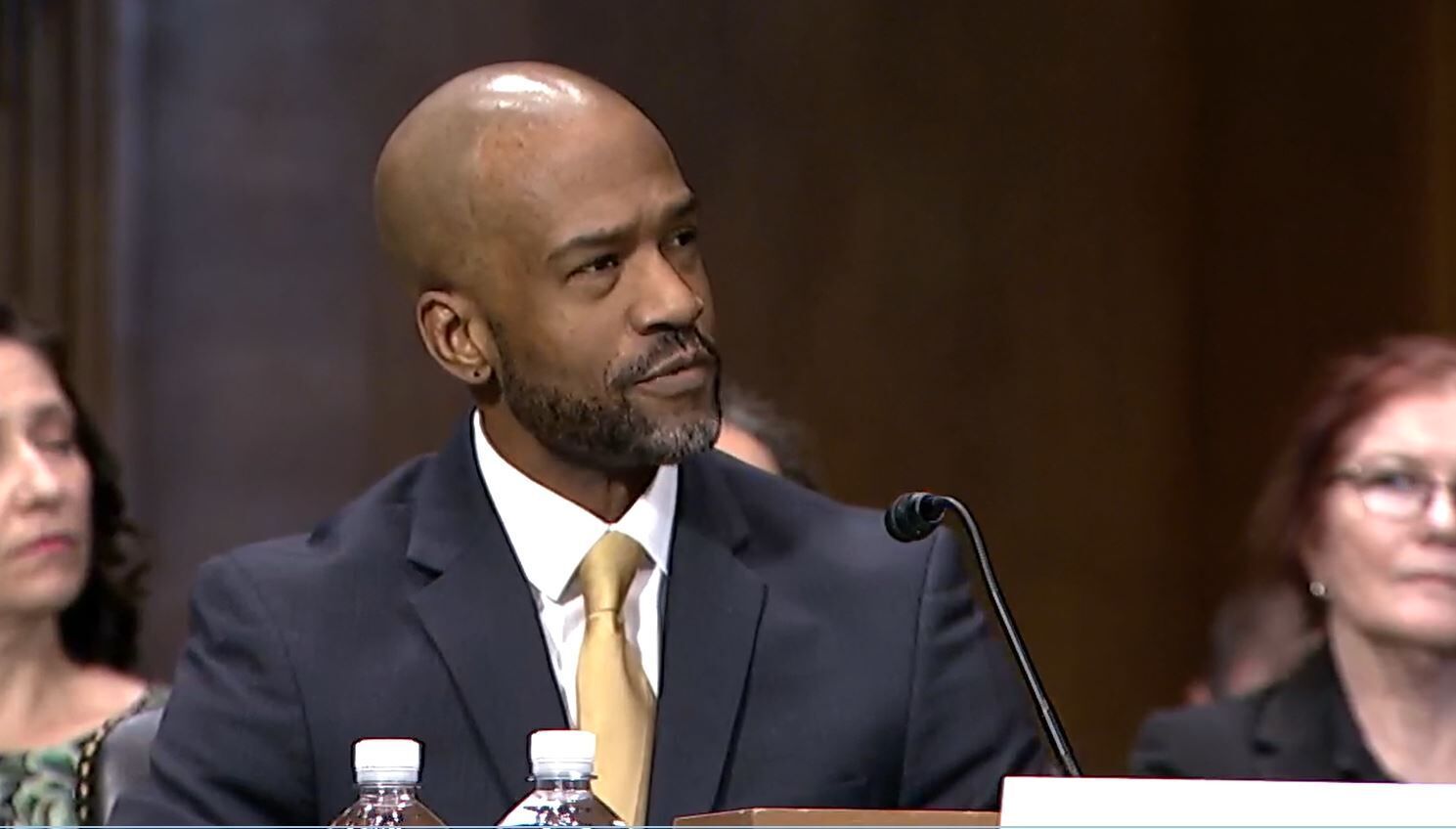
One of Colorado’s federal judges rang in the new year with a new effort to spread out the U.S. District Court’s civil caseload among its roster of magistrate judges.
“NOTICE ENCOURAGING CONSIDERATION OF CONSENT,” Judge S. Kato Crews has written in docket entries across at least nine recently filed civil cases so far. “This district’s magistrate judges play a crucial role in the work and structure of the district court and the administration of justice.”
In contrast to the life-tenured district judges, who the president nominates and the U.S. Senate confirms, magistrate judges are hired to eight-year terms through a merit selection process. They tend to handle preliminary and administrative matters in cases, as well as evidentiary disputes and settlement conferences. When both a district judge and a magistrate judge are assigned to a case, the magistrate judge may also evaluate and recommend on motions, with the district judge making the final decision.
However, if the litigants all consent, magistrate judges can handle civil cases entirely on their own, with appeals going directly to the circuit and supreme courts.
Colorado Politics identified nearly a dozen instances, beginning on Dec. 23, in which Crews filed docket entries encouraging litigants to consent to a magistrate judge handling cases assigned to him.
“There are many benefits to consenting. One such benefit is having a single judicial officer preside over every aspect of your case rather than two,” he wrote. “Consent to magistrate judge jurisdiction is voluntary, and no adverse consequence will result if one or more parties decline to consent.”
He added that, because district judges handle felony cases, which can take precedence over civil lawsuits under the speedy trial guarantee, a magistrate judge could bring a civil case to trial more expeditiously.
“I thought perhaps this may help parties give considered thought to the benefits associated with consent,” Crews told Colorado Politics in response to questions about his new practice. “My hope is that it will aid attorney conferrals over consent and give the lawyers a specific frame of reference when discussing the consent option with their clients. The magistrate judges have expressed their concerns over declining consents, and I feel it’s important to try to address those concerns.”
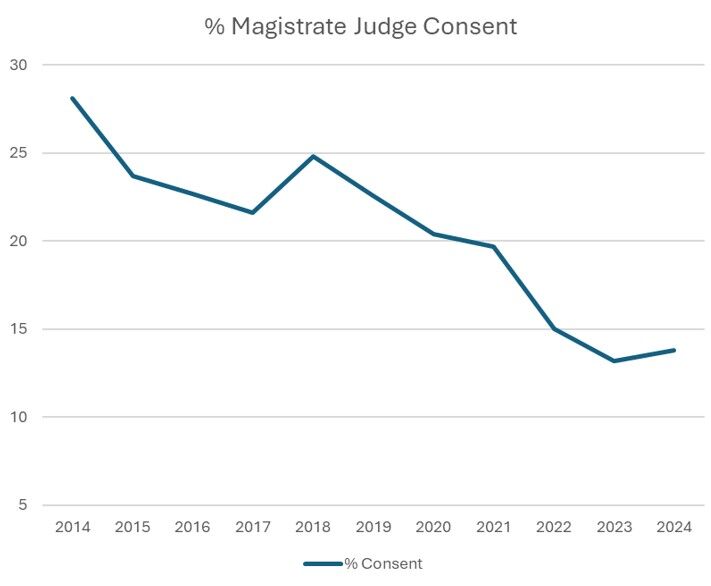
Statistics compiled by U.S. Magistrate Judge N. Reid Neureiter last fall showed that in 2024, parties were consenting to a magistrate judge’s handling at a rate of about 14%. A decade prior, the rate was double that.
“I hypothesized reasons why,” Neureiter told Colorado Politics in October. “But the answer is I don’t know. And nobody knows why.”
Crews, who was a magistrate judge for several years before his 2024 appointment to the district judge bench, spoke about the subject in early 2025 with Judge Charlotte N. Sweeney at a sparsely attended legal event.
“Nobody wants to talk about why they’re consenting or not consenting,” Sweeney said, commenting on the attendance level.
“I’ve estimated spending at least 500 hours a year, if not 700 hours a year, on criminal matters,” she added. Under magistrate judge consent, there is “a lot more time and attention they can give to your case.”
However, not all of Crews and Sweeney’s colleagues are receptive to increased handling of civil cases by magistrate judges.

In 2011, Senior Judge John L. Kane authored a statement disagreeing with a rule change at the court addressing magistrate judges’ authority to hear cases. Kane, joined by Senior Judge Lewis T. Babcock and the late Senior Judge Richard P. Matsch, indicated he was “deeply concerned by the relentless delegation of this court’s constitutional duties” to members of the bench who are not nominated and confirmed pursuant to Article III of the U.S. Constitution, as district judges are.
“Being an Article III judge is not merely a job. It is the embodiment of an independent and structurally fundamental separate branch of government,” Kane wrote. “One may consent to using the stairs to access the third floor of a building. One cannot ‘consent’ to the building’s architecture, which, having been carefully conceived, is essential to its structural integrity.”
Kane declined to comment on Crews’ new practice of encouraging civil litigants to consent to magistrate judges, but he confirmed he still feels the same as he did in 2011.
“The Constitution, in my view, controls, and it specifically states that cases and controversies are to be decided by judges appointed under Article III,” he wrote in an email. “In my view, it is not a matter of convenience; it is a matter of properly designated authority.”


Federal judge dismisses malicious prosecution claim against former Denver prosecutor
Michael Karlik
michael.karlik@coloradopolitics.com
Updated 28 minutes ago
A federal judge concluded on Monday that a former Denver prosecutor could not be sued for allegedly causing the arrests of two plaintiffs after they failed to appear for trial on the scheduled date, even though the trial had been...

Judicial discipline commission reports increased transparency, increased submissions
Michael Karlik
michael.karlik@coloradopolitics.com
Updated 1 hour ago
The Colorado Commission on Judicial Discipline received 473 misconduct complaints about judges in 2025, which was nearly 29% higher than in 2024 and substantially greater than any time in the past decade. However, only 31 complaints were referred to the commission...

Colorado Gov. Jared Polis sparks backlash after raising clemency questions in Tina Peters case
Marianne Goodland
marianne.goodland@coloradopolitics.com
Updated 1 hour ago
Gov. Jared Polis ignited a political firestorm Tuesday night after weighing in on the prison sentences of two former Colorado officials convicted of attempting to influence a public servant. The comments quickly fueled speculation about possible clemency for former Mesa...

Colorado Supreme Court signals intervention in dispute over treatment for trans children
Michael Karlik
michael.karlik@coloradopolitics.com
Updated 20 hours ago
The Colorado Supreme Court ordered Children’s Hospital Colorado on Tuesday to explain why it should not direct the organization to resume providing certain types of services to transgender children in compliance with the state’s non-discrimination law. Last month, a Denver...

Judge nixes latest policy requiring 7 days’ notice for Congress members to visit ICE facilities
Michael Kunzelman
michael.kunzelman@associatedpress.com
Updated 22 hours ago
WASHINGTON (AP) — A federal judge agreed on Monday to temporarily suspend the latest version of a Trump administration policy that requires members of Congress to provide a week’s notice before they can visit immigration detention facilities. U.S. District Judge...
Judge nixes latest policy requiring 7 days’ notice for Congress members to visit ICE facilities
Michael Kunzelman
michael.kunzelman@associatedpress.com
Updated 20 hours ago
WASHINGTON • A federal judge agreed on Monday to temporarily suspend the latest version of a Trump administration policy that requires members of Congress to provide a week’s notice before they can visit immigration detention facilities. U.S. District Judge Jia...

Colorado Supreme Court clarifies restraining order violations can always support burglary charge
Michael Karlik
michael.karlik@coloradopolitics.com
Updated 2 days ago
The Colorado Supreme Court’s majority ruled on Monday that a violation of a restraining order can also serve as a basis for finding a defendant guilty of burglary. Under state law, a person commits second-degree burglary by unlawfully entering or...

10th Circuit judge creates vacancy, district court gets new chief judge | COURT CRAWL
Michael Karlik
michael.karlik@coloradopolitics.com
Updated 1 day ago
Welcome to Court Crawl, Colorado Politics’ roundup of news from the third branch of government. A longtime member of the Denver-based federal appeals court will give the president a vacancy to fill, plus Colorado’s federal trial court will see a...

Morgan County man accused of killing wife, staging her suicide charged with first-degree murder
Kyla Pearce
kyla.pearce@gazette.com
Updated 19 hours ago
A grand jury announced the indictment of 52-year-old Ronald Lowry, who is accused of killing his wife in October 2023 and staging the crime scene to look like a suicide. Lowry, who was arrested Friday in Morgan County, was charged...
Gov. Jared Polis moves to end ICE subpoena fight over Colorado workers’ personal data
Marianne Goodland
marianne.goodland@coloradopolitics.com
Updated 5 days ago
The effort by Gov. Jared Polis to comply with an administrative subpoena from U.S. Immigration and Customs Enforcement for information held by several state agencies is over. Polis, in a motion filed Feb. 20, asked for a permanent injunction and...
PREV
PREVIOUS

Senate advances war powers resolution on Venezuela
The Senate advanced a measure to block the use of troops in Venezuela Thursday morning. The measure was approved on a vote of 52-47, after five Republicans voted with Democrats, ensuring a later vote for final passage on the measure that would require President Donald Trump to get permission from Congress to send troops to […]

Appeals judge urges restraint in labeling new offenses serious across board
A member of the state’s second-highest court urged his colleagues on Thursday to pump the brakes before declaring new offenses “grave or serious” in every possible scenario. The Eighth Amendment’s prohibition on cruel and unusual punishment means sentences cannot be grossly disproportionate to the crime. Consequently, when judges in Colorado examine the constitutionality of a […]