

Denver may revise animal bite penalties to consider criminal intent

Denver pet owners are responsible for bites and injuries caused by their animals, facing both civil penalties and criminal charges of up to $999 and 300 days in jail.
However, some city officials have suggested that the city consider revisions to the municipal code regarding animal-related violations, including adding “criminal intent” elements to some violations and converting others to civil infractions.
The officials would also like to see better inter-agency collaboration, especially in cases that cross jurisdictional borders, they said.
Denver Municipal Code Chapter 8 governs animals, including regulations for owning pets, and all of the animal violations in that chapter potentially expose residents to the city’s maximum penalty, Colette Tvedt, Denver’s chief municipal public defender, told Health and Safety Committee members on Wednesday.
“There are so many ordinance violations contained within that chapter, animal-related noise, leash-law violations, barking dogs, rabies vaccination, and the more serious offenses that you talked about today, and some of these offenses, including the attack and animal bites, are a strict liability offense,” Tvedt said. “And so, what that means is that there’s no mens rea involved, or what is the state of mind.”
A strict liability offense, according to Black’s Law Dictionary, is a crime in which the prosecution doesn’t need to prove that the defendant intended to break the law or cause harm to secure a conviction.
An example might be a case in which a dog with no history of aggressive behavior bites or attacks someone, while the owner is out of town.
“What we’re asking for, City Council, on behalf of the Office of the Municipal Public Defender, is just to take a look at the code, see if there are some areas that we can clean up, make them civil, and the ones that would remain would have a mens rea element,” Tvedt said.
DR IAN DUNBAR BITE SCALE

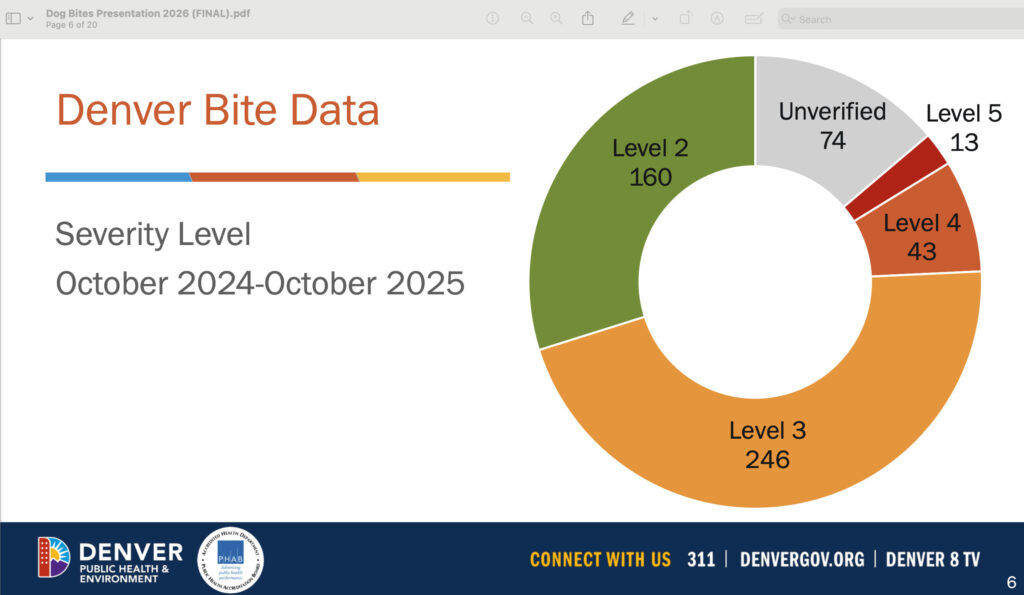
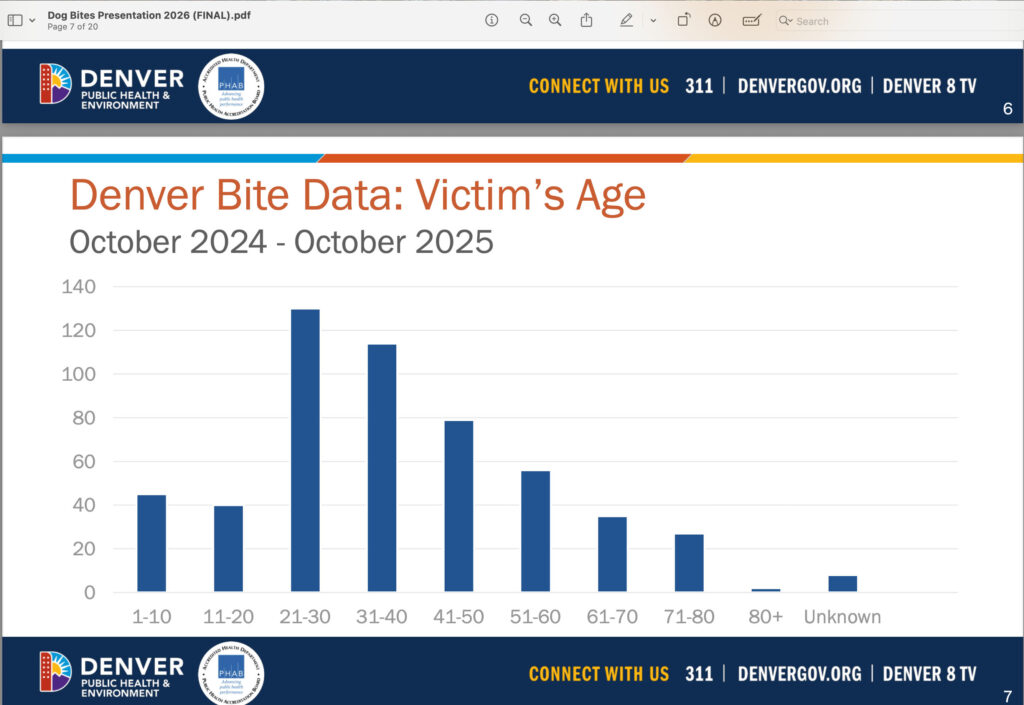
BEHAVIOR-BASED LAWS
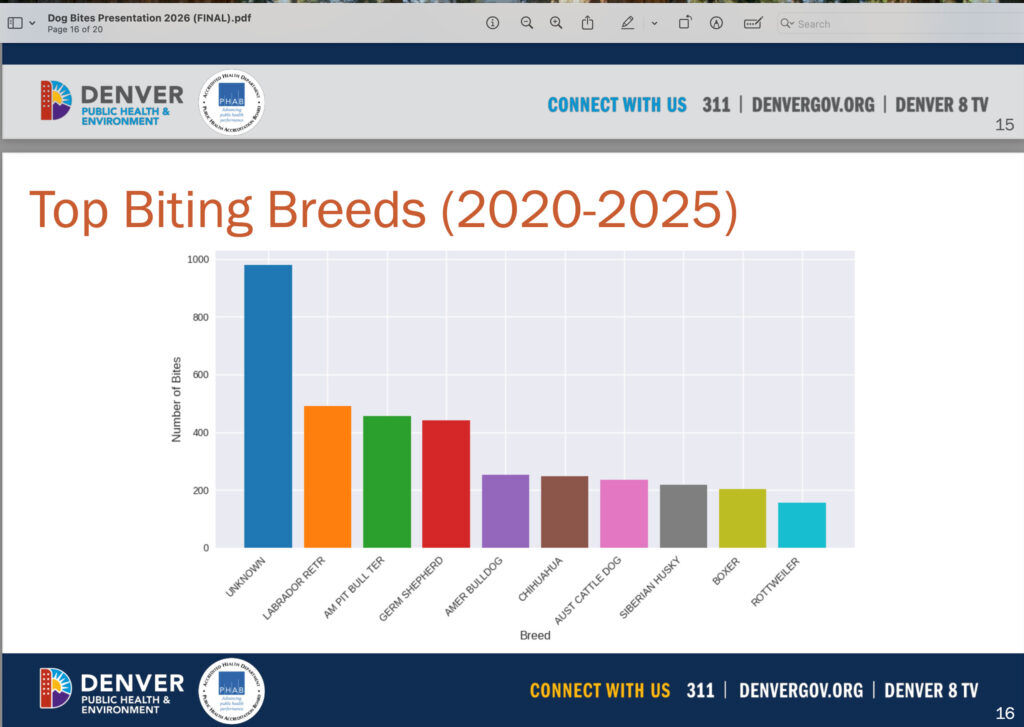
While the city does not have an outright breed ban, under Denver’s Ordinance Sec. 8-67, restricted breeds, such as the American Pit Bull Terrier, American Staffordshire Terrier, or Staffordshire Bull Terrier, are prohibited unless they have been issued a provisional breed-restricted permit, according to the city’s website.
Permits for restricted breeds may require an evaluation in some cases.
Permitted animals must also be microchipped, vaccinated against rabies, and spayed or neutered.
City animal protection officials argued that behavior-based laws are more effective than overall breed-based bans because they target actual aggression and not the animal’s breed or appearance.
When it comes to dog bites, Joshua Rolfe, a lieutenant with Denver Animal Protection, said dog breeds are misreported regularly.
“You know, the general public is not great about identifying dog breeds,” Rolfe said. “A lot of people are dog people, but it’s for the specific dog breed that they like. So, oftentimes we’ll get, ‘It was a large, brown, short-haired dog,’ and that could be any number of dog breeds.”
Dog breeds are usually not entered into a report until an officer has seen the animal first-hand.
“There’s a misnomer that dogs can be rehabilitated from a bite incident. You put them through a training course, and then you don’t have to worry about it again, because they’ve been trained not to do that,” Rolfe said. “That’s actually not true.”
Even with sufficient training, owners will have to manage the animal’s behavior for the rest of its life.
“A vast majority of animal bites that occur nationally go unreported,” Rolfe said. “They generally happen within somebody’s home and tend to be fairly minor incidents with family members, and people don’t seek medical attention for those.”
Doctors and medical offices are required to report animal bites.
“In Denver, we have an ordinance that requires anyone with knowledge of an animal bite to report that to the health department,” he said.
NEED FOR MORE INTERAGENCY COOPERATION
Dog bite incidents don’t always respect jurisdictional boundaries, and that worries District 5 Councilmember Amanda Sawyer.
“So, District 5 borders both Aurora and unincorporated Arapahoe County and Glendale,” Sawyer said. “And we see a lot of stuff happen across borders all the time.”
Sawyer referenced a case, in which a third attack by the same group of dogs occurred on the border of Denver, but the animal’s owner was a resident of Aurora.
Rolfe acknowledged that competing ordinances and laws impact what different agencies can do.
“For example, in the city’s municipal code, any city official who does enforcement, apart from Denver police, who enforces state laws, cannot go outside the city and county boundaries to issue criminal summons under the municipal code,” he said.
Rolfe added that his agency has collaborated with Denver police and the District Attorney’s Office to issue citations to the owner.
No proposed legislation was referred to the City Council by members of the Health and Safety Committee.


New Jersey signs legislation banning cellphones in schools
Molly Parks, Washington Examiner
molly.parks.washington.examiner@gazetteedit.wpenginepowered.com
Updated 3 hours ago
K-12 students in New Jersey will no longer be allowed to use their cellphones in school starting in the fall of 2026. Gov. Phil Murphy (D-NJ) signed a bill into law on Thursday establishing “phone-free” schools in the Garden State....

Gov. Jared Polis ‘frustrated, surprised’ at efforts to revive vetoed union bill
Marissa Ventrelli
marissa.ventrelli@coloradopolitics.com
Updated 2 hours ago
Gov. Jared Polis was surprised that Democratic lawmakers and labor groups are seeking to revive a union-backed legislation less than a year after he vetoed the bill due to concerns about its impact on businesses and mandatory dues. Elected officials...

Red Carpet Reception proves new home’s a winner for Coors Western Art Exhibit & Sale | NONPROFIT REGISTER
Joanne Davidson Special to Colorado Politics
joanne-davidson-special-to-colorado-politics@coloradopolitics.com
Updated 3 hours ago
NATIONAL WESTERN STOCK SHOW News: It wasn’t just the art that people were talking about at Thursday night’s Red Carpet Reception for the 34th Coors Western Art Exhibit & Sale. A good number of the 1,000-plus guests were on their first visit to the show’s spacious new location on the...

US intercepts fifth sanctioned tanker as it exerts control over Venezuelan oil distribution
Aamer Madhani
aamer.madhani@associatedpress.com
Updated 9 hours ago
WASHINGTON (AP) — U.S. forces boarded another oil tanker in the Caribbean Sea on Friday, the U.S. military said, as the Trump administration continues to target sanctioned tankers traveling to and from Venezuela. The pre-dawn action was carried out by...
Colorado candidates switch parties, races as midterm election year looms | TRAIL MIX
Ernest Luning
ernest.luning@coloradopolitics.com
Updated 7 hours ago
The final days of 2025 saw an unusually high number of Colorado candidates switch parties and races, reshaping at least a few primaries ahead of this year’s midterm elections. The state has seen its share of switchers over the years,...

Denver Auditor: Office of Social Equity and Innovation risks mismanaging or losing taxpayer money
Deborah Grigsby
deborah.smith@denvergazette.com
Updated 59 minutes ago
Denver’s Office of Social Equity and Innovation has yet to implement half of the 14 recommendations made by auditors in 2024, leaving the city and the Colorado Youth Detention Continuum Program at risk of misusing small-dollar funds. A follow-up report...

New Aurora councilmembers to host meetings about creating civilian oversight of police
Kyla Pearce
kyla.pearce@gazette.com
Updated 50 minutes ago
Two of Aurora’s new councilmembers plan to hold listening sessions with community members to talk about establishing an independent civilian oversight committee for Aurora police. Gianina Horton and Amy Wiles, who were both elected to the Aurora City Council in...

Final Lap: Gov. Jared Polis outlines his 2026 agenda for Colorado as he nears the end of his term
Marianne Goodland
marianne.goodland@coloradopolitics.com
Updated 1 day ago
A year from now, Gov. Jared Polis will wrap up eight years as the state’s chief executive officer, take off the governor’s mantle and go back to private life. The governor recently reflected on what remains to do in his...

Protect young people while respecting their data, privacy | OPINION
Bruce Brown
bruce-brown@coloradopolitics.com
Updated 21 hours ago
After 40 years practicing law, first as a public defender in Los Angeles, then in private criminal defense, and serving eight years as the elected District Attorney for Colorado’s 5th Judicial District, I’ve developed a straightforward test for evaluating any...

Regime change, this time down Venezuela way | Kelly Sloan
Kelly Sloan
kelly-sloan@coloradopolitics.com
Updated 21 hours ago
As luck and the calendar would have it, I penned my annual “state of the world” column two days before the grand fireworks in Caracas took place, and the column was subsequently published two days after. To prove I was...