

Pine beetle infestation in Colorado’s Front Range forests prompts action from Gov. Polis
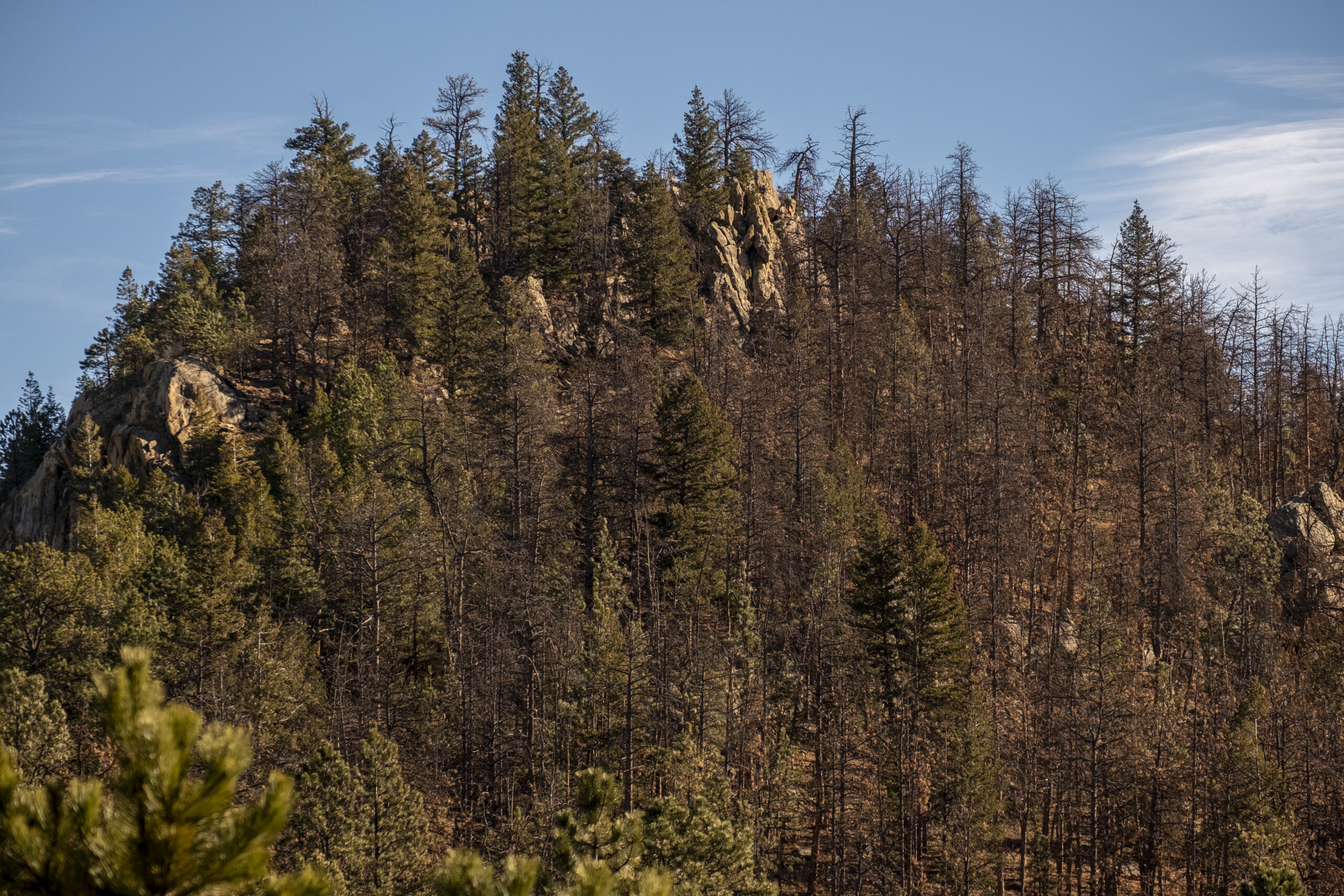
Pine beetle infestations are quickly spreading across large areas of Colorado’s ponderosa pine forests, evident from aerial surveys conducted by the U.S. Forest Service over the last year.
The USFS surveys found beetle infestations in mountainous and foothill regions from Larimer County to El Paso County have been on the rise over the last year, suggesting large areas of forests near major Colorado metro areas could look a lot different within the next five to 10 years.
To combat the pine beetle problem, Gov. Jared Polis created a Ponderosa Mountain Pine Beetle Task Force in a Dec. 15 executive order.
“Colorado has long been a leader in forest health and fire mitigation efforts, and this is no exception,” Polis said. “As the latest outbreak of pine beetles begins to take shape along the densely populated Front Range, we are taking an aggressive approach to boost tools and partnerships to help protect our communities, forests and key water sources, and equipping homeowners with the resources they need to better protect their homes.”
The governor will also submit a supplemental request to the state legislature, recommending actions aimed at reducing wildfire risk, supporting landowners and saving them money on risk mitigation investments, and strengthening Colorado’s long-term response to the pine beetle outbreak.
The Polis administration plans to appoint members of the task force by Feb. 1.
Beetle-caused mortality to forests can create public safety hazards, alter fire behavior and make fire suppression more challenging for firefighters, the USFS said.
Pockets of beetle-killed trees are already visible along the major Front Range highways like U.S. Highway 285 and Interstate 70.
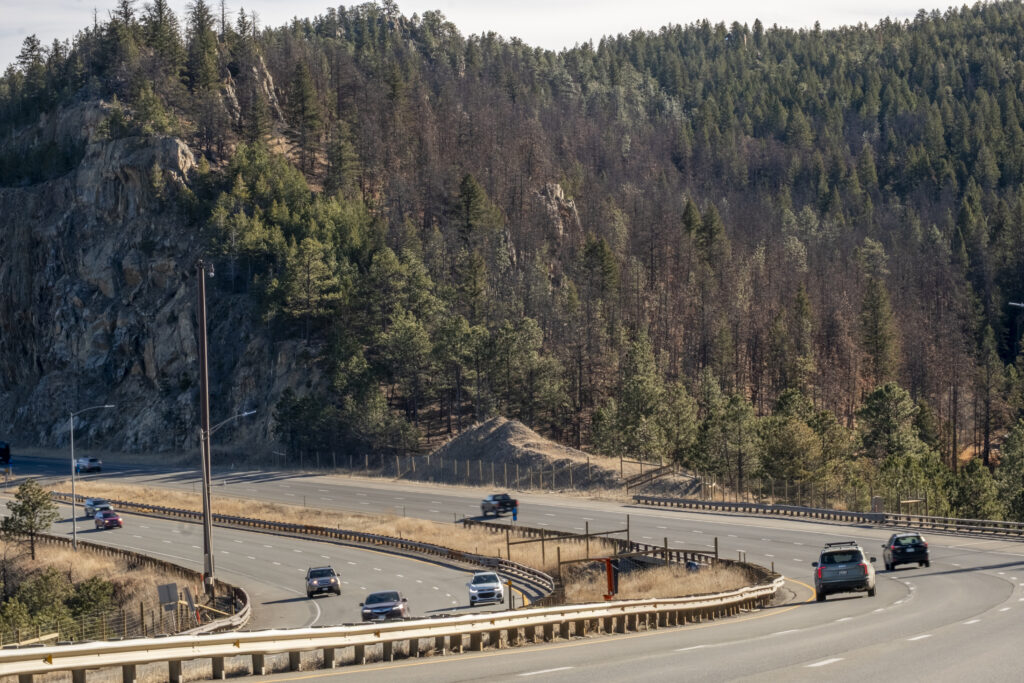
According to the USFS, warming climates and drought have created optimal environmental conditions for the beetles to spread into neighboring trees.
Very low temperatures are necessary to diminish the beetles’ progress. The state has recently been experiencing prolonged dry conditions, which weaken the trees’ defenses.
“A very high level of tree mortality, especially among ponderosa pines, is likely to continue for the next decade,” the USFS said.
The Colorado State Forest Service has an online map of Colorado showing where pine beetle infestations have been prevalent and expanding from 2022-2024.
The interactive map shows ponderosa pine forests in portions of Larimer, Gilpin, Clear Creek, Boulder, Jefferson, Park and Douglas counties are experiencing elevated levels of infestation from mountain pine beetles.
In addition, lodgepole pine forests in Park and Gunnison counties that evaded prior bark beetle outbreaks are experiencing elevated mortality of trees as populations of mountain pine beetles expand.
Lastly, ponderosa pine forests on the Uncompahgre Plateau in western Colorado have also been affected by increased pine beetle activity.
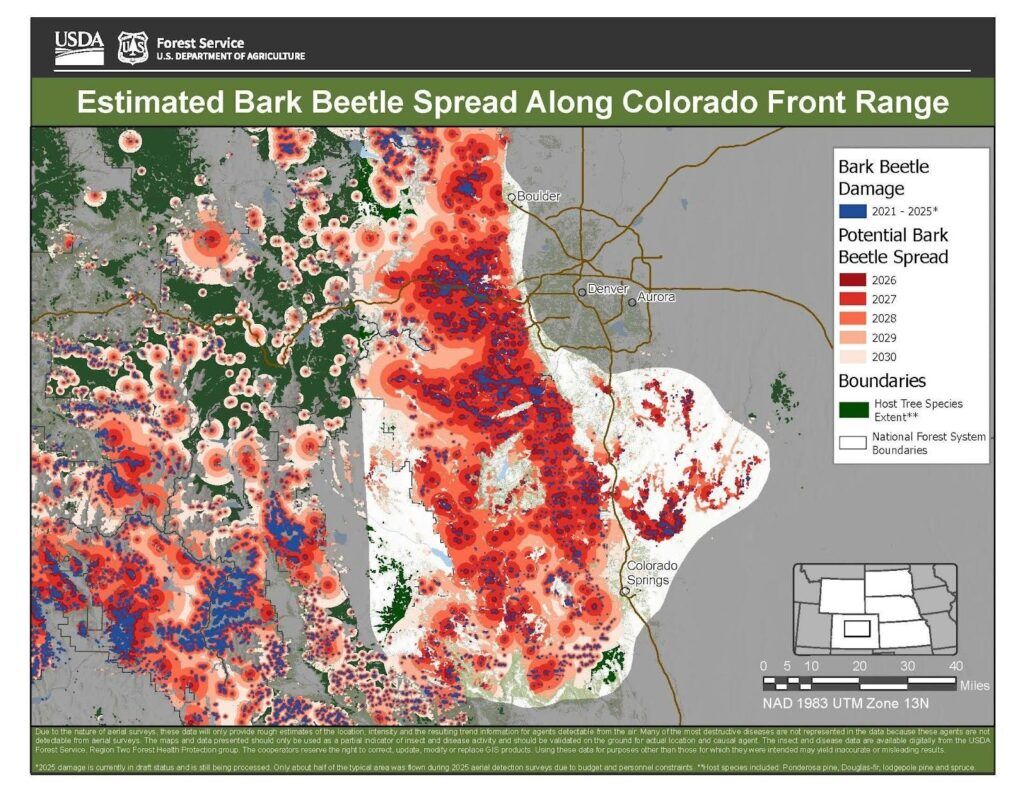
A forecast map from the USFS shows that beetles could kill nearly all of the ponderosa pines along the Front Range.
The map shows how foresters predict the beetles’ spread through the forests; however, unless a major weather event like flooding or an extended freeze cycle happens to slow the expansion, the beetles will continue to find new trees and spread across the forested regions.
The mountain pine beetle is native to Colorado and ranks first in destructiveness among the tree-killing bark beetles that are native to the West, according to the U.S Department of the Interior.
Bark beetles infest pine trees by laying eggs under the bark. When the eggs hatch, the larvae mine the area beneath the bark and eventually cut off the tree’s supply of nutrients. The beetles also carry a fungus that causes dehydration and inhibits a tree’s natural defenses against beetle attacks.
From the late 1990s through 2013, mountain pine beetles affected 3.4 million acres of forests in Colorado, predominantly attacking lodgepole pines, according to the Colorado State Forest Service. The beetles killed up to 80-90% of trees in some lodgepole pine forests in Summit, Grand, Eagle and Routt counties during the epidemic.
Pine beetles attacked ponderosa pine forests along the Front Range in the early 2010s, but heavy rains and flooding, like the 2013 floods, stopped their spread.
“This is not a time to panic, it’s a time to ramp up and take action to reduce the impacts of this outbreak and ensure we never allow our forests to become this vulnerable ever again,” Matthew McCombs, state forester and director of the Colorado State Forest Service, said in a news release.
The Colorado State Forest Service said residents should look for these telltale signs and symptoms of mountain pine beetle infestation:
- Popcorn-shaped masses of resin, called pitch tubes, on the trunk that may be brown, pink or white.
- Boring dust in bark crevices and on the ground immediately adjacent to the tree’s base.
- Woodpecker damage, where the birds have stripped portions of the bark in search of larvae, leaving accumulations of bark at the base of the tree.
- Presence of live mountain pine beetles (eggs, larvae, pupae and/or adults)
- Exit holes on the bark’s surface where adult beetles have emerged.
- Foliage turning yellowish to reddish throughout the entire tree crown, which usually occurs eight to 10 months after a successful attack.


Democrat Michael Bennet turns in petitions for Colorado’s gubernatorial primary, plans to skip caucuses
Ernest Luning
ernest.luning@coloradopolitics.com
Updated 2 hours ago
U.S. Sen. Michael Bennet, a Democratic candidate for governor, submitted nominating petitions for Colorado’s June primary ballot on Friday, his campaign and the Colorado Secretary of State’s Office said. Bennet plans to rely on his petitions to get on the...

Colorado Reps. Jason Crow, Gabe Evans clash over Trump’s Iran military operation
Thelma Grimes
thelma.grimes@coloradopolitics.com
Updated 5 hours ago
Colorado’s congressional delegation split sharply along party lines Saturday after the U.S. and Israel attacked Iran, triggering fresh debate in America over presidential war powers. Republicans, notably U.S. Rep. Gabe Evans, called the strikes a necessary move to counter Iran’s...
Cute puppy overload and an audition of a different kind: Capitol M | Week of Feb. 28, 2026
Marianne Goodland
marianne.goodland@coloradopolitics.com
Updated 2 days ago
The lighter side of the Capitol, and most days, you ought to be really grateful for it. There’s a rumor (jk) floating around that an amendment is coming for the bill to legalize prostitution. The amendment would ban condoms made...

Competing overtime bills for agriculture workers split Colorado Democrats
Marianne Goodland
marianne.goodland@coloradopolitics.com
Updated 1 day ago
Competing bills setting the overtime threshold for farmworkers have split legislators at the Colorado state Capitol, with one group saying a law passed in 2021 has harmed, rather than helped, farming operations and workers alike, while the other side insists...

Garfield County sheriff illegally collaborated with ICE, cease and desist letter claims
Michael Braithwaite
michael.braithwaite@gazette.com
Updated 1 day ago
A cease and desist letter filed Wednesday alleged that the Garfield County sheriff intentionally violated state law by collaborating with the U.S. Immigration and Customs Enforcement (ICE). The letter, filed by the law firm Towards Justice, claimed that Garfield County...
Male wolf dies after capture attempt, Colorado Parks and Wildlife officials confirm
Marianne Goodland
marianne.goodland@coloradopolitics.com
Updated 1 day ago
The Colorado Parks and Wildlife said the wolf, identified as #2305 — meaning it was one of the original 10 animals that came from Oregon — died on Jan. 28 in Routt County. The wolf was the male of the...

Gov. Jared Polis moves to end ICE subpoena fight over Colorado workers’ personal data
Marianne Goodland
marianne.goodland@coloradopolitics.com
Updated 1 day ago
The effort by Gov. Jared Polis to comply with an administrative subpoena from U.S. Immigration and Customs Enforcement for information held by several state agencies is over. Polis, in a motion filed Feb. 20, asked for a permanent injunction and...

Ex-Colorado Sen. Sonya Jaquez Lewis avoids prison, gets probation for forged ethics letters
Marianne Goodland
marianne.goodland@coloradopolitics.com
Updated 1 day ago
Former state Sen. Sonya Jaquez Lewis, D-Longmont, was sentenced Friday to two years of supervised probation and 150 hours of community service, and a $3,000 fine, to be waived if she completes an additional 100 hours of community service. The...

Benavidez chosen to fill Senate District 21 vacancy after Michaelson Jenet resigns
Marianne Goodland
marianne.goodland@coloradopolitics.com
Updated 1 day ago
A Democratic Senate District 21 vacancy committee Thursday night chose former Rep. Adrienne Benavidez, D-Adams County, to replace former Sen. Dafna Michaelson Jenet. Michaelson Jenet resigned on Feb. 13 to become the director of the David and Laura Merage Foundation...

Colorado delegation’s plus-one picks convey messages at Donald Trump’s State of the Union | TRAIL MIX
Ernest Luning
ernest.luning@coloradopolitics.com
Updated 1 day ago
It’s become a tradition for members of Congress to deliver messages of their own at the State of the Union address, though this year none of the Colorado lawmakers shouted at the president during the speech, nor did the delegation...
PREV
PREVIOUS

Court: Municipal sentences may not be greater for identical state crimes
The Colorado Supreme Court ruled on Monday that municipalities may not subject defendants to sentences that are harsher under their own ordinances than for identical offenses under state law. In the opinion, Chief Justice Monica M. Márquez noted localities are free to prosecute defendants in municipal court for crimes that could also be prosecuted in […]

Colorado Supreme Court ponders insurers' ability to defend against policyholders
The Colorado Supreme Court considered last week what steps insurance companies must take to defend themselves against lawsuits from injured policyholders who, based on a technicality, were legally not at fault for their injuries. When an insured driver has an accident with someone who is uninsured, they may obtain benefits under their own insurance policy […]