Webb scrambles to make a decision; Colorado legislator seeks to address Bush-Gore recount | A LOOK BACK
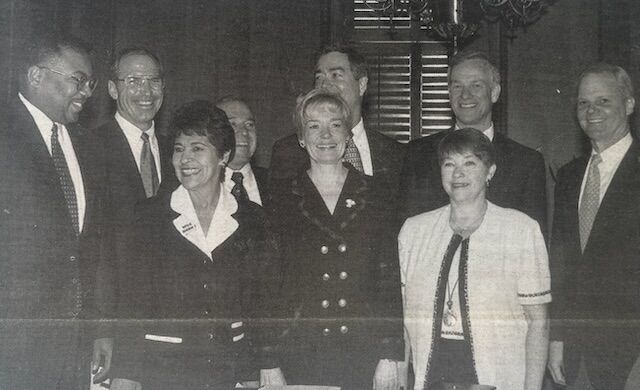
Thirty-Five Years Ago This Week: At a party hosted by the North Denver Democrats, Wellington Webb, Denver City Auditor, addressed the furor that had been created by Denver Mayor Federico Peña’s shock announcement that he would not run for a third term.
Webb said that he was waiting to decide whether or not to run until he’d spoken to his wife, state Rep. Wilma Webb, D-Denver. But that wasn’t proving easy because Wilma was enjoying the warmer climes of the U.S. Virgin Islands.
“Wilma was attending a meeting of the National Black Caucus of state Legislators,” Webb said. “I made an emergency phone call. She knew I would never make an emergency call like that unless it was something important, so when she got on the phone she asked, ‘Is it my mother or my children?’”
When Webb assured her that the family was safe and healthy and that it was Peña he was calling about, Wilma quipped, “You just never know what will happen when I leave town.”
By statute, Denver District Attorney Norm Early was one of the few potential mayoral candidates who would not have to choose between campaigning for their current position or for mayor. But the potency of his potential campaign was causing other prospective candidates to keep their powder dry, saying they would wait to see Early’s decision before making their own. Early did admit that voters might expect him to resign if he ran for mayor voluntarily.
Webb did the same when he ran for mayor in 1983 and served as the executive director of the Colorado Department of Regulatory Agencies. At that time, he had challenged Peña for his job directly, but lost. He was then reappointed to his DORA post by Gov. Dick Lamm.
Twenty-Five Years Ago: Recently elected state Sen. and outgoing Rep. Ron Tupa, D-Boulder, told The Colorado Statesman that even people who didn’t vote for the eventual winner should have a voice in picking the president.
Nearly six weeks after Election Day, the U.S. Supreme Court issued its decision in Bush v. Gore, which ended the lengthy Florida recount and officially made George W. Bush the president-elect.
Because of the disparity between Bush, who won the electoral college, and Gore, who won the popular vote, Tupa said he’d decided to introduce a bill in the next legislative session to apportion Colorado votes in the Electoral College based on congressional districts rather than the “winner take all” system that Colorado and 47 other states used.
“My bill will make our elections more democratic,” Tupa said at a news conference to announce his bill.
Under Tupa’s bill, one electoral vote would go to the winner of each congressional district and two to the statewide victor. Under Tupa’s system, Bush wouldn’t have received all of Colorado’s votes; instead, they would have been split, 6-2, since Al Gore carried two of the congressional districts. Nationwide Gore had 267 Electoral College votes.
Tupa said that if his bill were passed, it could spark action in other states.
“Most people don’t know,” Tupa said, “that they’re actually voting for a slate of electors instead of the candidate.”
State Sen. Gigi Dennis, R-Pueblo, wrote in The Statesman that proposed changes to Colorado’s election process were “premature and unlikely to pass.”
“I think it’s also important to note that the media was quick to politicize the judiciary in Florida, implying that the process was somehow biased,” Dennis wrote. “In Colorado, we are insulated from those concerns because … our judges are selected by the governor from a list of three submitted by a nominating commission.”
Dennis said that the United States, as a country, learned an essential lesson in the razor-thin election margin that had elevated Bush.
“The most telling lesson is that every vote counts,” Dennis mused. “It’s absolutely mind-boggling to realize that an election to decide the world’s best powerful leader essentially boiled down to a few hundred votes. Hopefully, Americans will take this election to heart and turn out in droves in the next election.”
Rachael Wright is the author of several novels, including The Twins of Strathnaver, with degrees in Political Science and History from Colorado Mesa University, and is a contributing columnist to Colorado Politics, the Colorado Springs Gazette, and the Denver Gazette.

Investigation finds Colorado Sen. Faith Winter was at fault in fatal crash
Marianne Goodland
marianne.goodland@coloradopolitics.com
Updated 8 hours ago
Legislator’s alcohol level was more than twice the legal limit County authorities have concluded their investigation into the I-25 crash that killed Colorado Sen. Faith Winter, determining the Colorado legislator was at fault in the two-vehicle collision. An autopsy found...
Forecast shows slowing growth in Colorado
Marianne Goodland
marianne.goodland@coloradopolitics.com
Updated 14 hours ago
Missing federal data complicates state forecast Colorado’s economy is holding steady, though growing warnings, particularly in consumer demand and spending, are emerging, according to state economists’ latest forecast. The December forecast presented on Friday was not as complete, given the...

Federal court issues injunction on Colorado gas stove labels law
Marissa Ventrelli
marissa.ventrelli@coloradopolitics.com
Updated 15 hours ago
A federal judge in Denver has issued an injunction blocking enforcement of a newly enacted state law that would have required retailers to place labels on gas-fueled stoves with warnings about their potential effects on air quality. The law, House...
Colorado officials stall progressive income tax ballot initiative again by declaring it to have multiple subjects
Ed Sealover
ed-sealover@coloradopolitics.com
Updated 17 hours ago
In a saga offering more twists than a soap opera, Colorado Title Board members reversed course on Wednesday and determined an initiative to establish a progressive income tax doesn’t qualify for the 2026 ballot because it doesn’t have a single...
Crank challenger Jessica Killin racks up endorsements from all of Colorado’s congressional Democrats
Ernest Luning
ernest.luning@coloradopolitics.com
Updated 21 hours ago
U.S. Sen. John Hickenlooper on Thursday endorsed fellow Democrat Jessica Killin’s bid to oust Republican U.S. Rep. Jeff Crank in Colorado’s 5th Congressional District, giving the first-time candidate a clean sweep of support from the state’s six-member Democratic delegation. Killin,...

US House passes Colorado Rep. Lauren Boebert’s bill to remove gray wolves from endangered species list
Marianne Goodland
marianne.goodland@coloradopolitics.com
Updated 18 hours ago
A bill sponsored by U.S. Rep. Lauren Boebert of Colorado to delist the gray wolf from federal protections for endangered species cleared the U.S. House late on Thursday, setting up a fight in the U.S. Senate over a measure supporters...

Jeffco restaurants face big losses during power outage
Sage Kelley
sage.kelley@denvergazette.com
Updated 19 hours ago
The ongoing Public Safety Power Shutoff (PSPS) by Xcel Energy has caused vexation for businesses still wondering when power will be fully restored. The Evergreen Bread Lounge, nestled off Bergen Parkway, was closed Wednesday and Thursday. General Manager Tyler Butler...

Trump signs executive order that could reclassify marijuana as a less dangerous drug
Lindsay Whitehurst
lindsay.whitehurst@associatedpress.com
Updated 2 days ago
WASHINGTON (AP) — President Donald Trump signed an executive order Thursday that could reclassify marijuana as a less dangerous drug and open new avenues for medical research, a major shift in federal drug policy that inches closer to what many...
Colorado campaign debt collection efforts aren’t much of an effort
David Migoya
david.migoya@gazette.com
Updated 2 days ago
It was only weeks after the U.S. military in September 2011 repealed its “don’t ask, don’t tell” policy barring openly gay men and women from serving in the armed forces that Army veteran Brian Carroll announced his candidacy for a...
Colorado campaign finance penalties ‘a runaway train without an off-ramp’
David Migoya
david.migoya@gazette.com
Updated 2 days ago
Each day, Mike Stapleton wakes up owing the state of Colorado another $1,550. By the end of each week, Stapleton’s debt for not filing nearly three dozen campaign finance reports dating to April 2018 will have grown by nearly $11,000....