

Important decisions made but long way to go for Front Range passenger rail | LOEVY
We already have a good idea of what proposed future passenger train service up and down the Front Range corridor of Colorado might be like.
Fast trains could run from Pueblo to Colorado Springs to Castle Rock to Littleton to downtown Denver to Boulder to Longmont to Loveland and then to Fort Collins.
Trains could operate from about 6 a.m. to around midnight. There will be a train approximately every hour-and-a-half in each direction — northbound and southbound.
In other words, you will not have to wait more than 90 minutes for the next train going the way you’re going.
Trains could run at what has been for many years now the average speed of United States passenger trains — 79 miles-per-hour.
That is fast enough to compete with driving your automobile on adjacent highway Interstate 25, but not so fast as to require a big monetary investment in better and straighter (and thus faster) railroad track.
That means Front Range passenger trains will only be using and improving the existing freight railroad tracks, originally constructed in the late 19th century, and not building any new and very expensive high-speed rail.
In case you hadn’t noticed, the terrain along the Front Range is very hilly and requires lots of curves and long uphill and downhill grades. It simply is not a good place for high-speed trains running mainly in straight lines on level ground.
Front Range passenger trains will be “heavy rail” and not the “light rail” such as you find in cities like Denver.
That means full-sized passenger cars with comfortably upholstered adjustable seats (no plastic chairs) and tables for drinks and food. Hopefully, there could be full-service dining cars serving complete breakfasts, lunches and dinners.
All of the above is not the idle dreams of passenger train fans. It is the result of work done by the Federal Railroad Administration (FRA) in the U.S. Department of Transportation (DOT), which is providing financial assistance from the United States government.
Participating in the planning for passenger rail along the Front Range of Colorado are the BNSF and Union Pacific railroads, who own the existing rail infrastructure that will be used.
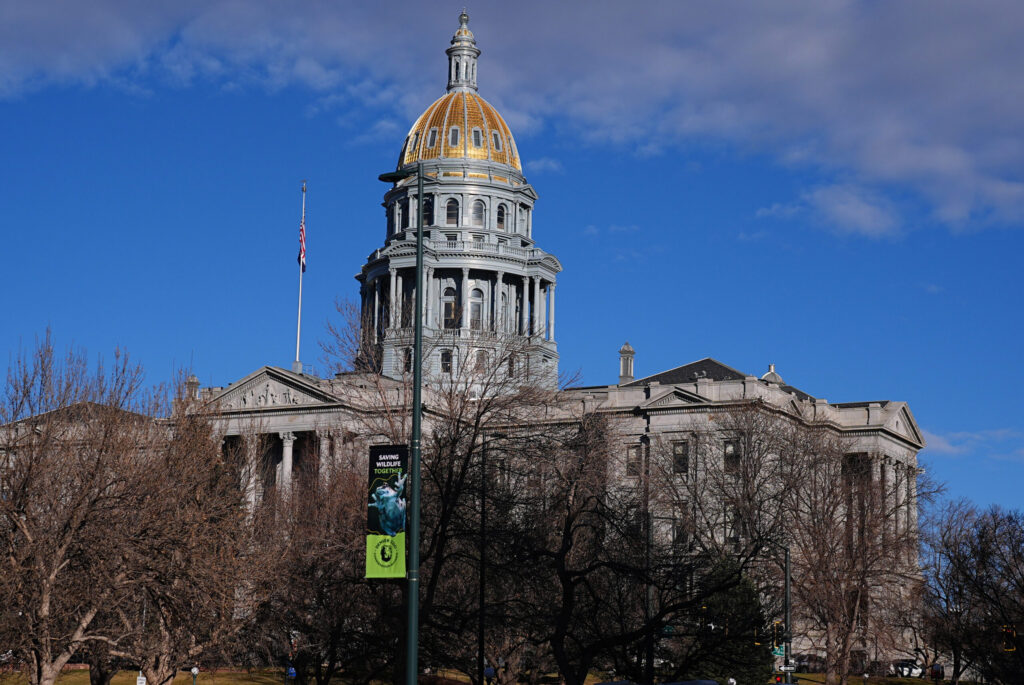
The Colorado state legislature, meeting at the State Capitol in Denver, has passed state legislation supporting the project
The end result will be a Service Development Plan (SDP) which will be part of the Federal Railroad Administration’s (FRA’s) Corridor Identification Program.
The people working on this are very serious about it. Systematic efforts such as they are making have usually resulted eventually in running passenger trains.
A spur track running from Greeley to Denver via Brighton was considered by the passenger rail planners, but it will have to wait until a later date when trains are operating and more money is available.
The same is true for a westward passenger rail connection up into the ski areas such as Vail and Aspen in the Colorado Rocky Mountains.
The rail planners have recommended the Front Range have one passenger train in each direction. north and south, every 90 minutes.
The result is there will be 10 trains a day in each direction.
The Front Range passenger rail study has identified 12 corridors in the United States that already have inter-city passenger rail service and resemble the situation in Colorado. All 12 have their passenger trains operated by Amtrak with additional state financial support.
A few of these well-known currently operating passenger rail corridors include Empire Service (New York City to Niagara Falls, New York); the Downeaster (Portland, Maine to Boston); the San Joaquins (Bakersfield, California to San Francisco); the Cascades (Vancouver to Eugene, Oregon); and the Pacific Surfliner (San Luis Obispo, California to San Diego.
These passenger trains all run down thickly populated strings of cities similar to the Front Range of Colorado. In Europe such strings of cities are referred to as “Pearls on a String.”
Keep in mind some 85% of Colorado residents live on the Front Range and would be serviced by the proposed Front Range passenger train.
Two major decisions remain to be made before Front Range passenger rail could become a reality.
One is the type of equipment to be used and who will manufacture it.
Looking at existing corridor-type rail equipment in use in the United States, it appears likely the equipment chosen for Colorado will be three-car or four-car trains with double-decker service (two levels of passengers) in each passenger car.
The passenger cars will be pulled from in front in one direction and pushed from behind in the other direction by a diesel locomotive.
A “cab car” with a set of controls for the locomotive engineer will be at the other end of the train when the diesel locomotive is in push mode.
This push-pull type of service will save the trouble of turning the train around when it reverses direction at each end of the line (Pueblo and Fort Collins).
The second major issue still to be decided for Front Range passenger rail will be financing.
In many cases throughout the United States, intercity passenger rail service is supported by sales taxes passed by a majority vote of the taxpayers in the area served by the new trains.
Due to the TABOR tax requirement in Colorado (“a vote on all tax increases”), such a citizen vote on increased taxes to support inter-city rail service will be needed in Colorado.
Critics point out passenger trains cost much more than the money collected in fares. They would like to see the money spent on additional highways instead. Many people, they note, will want to drive even when the passenger train alternative is available.
A personal note to conclude here. I grew up and spent my young adult years in Baltimore, a major stop on the Northeast Corridor passenger rail line. Southbound trains left every hour for Washington, D.C., and northbound trains left every hour for Philadelphia and New York City.
When a child and young adult, I rode the trains to visit Independence Hall and the Liberty Bell in Philadelphia, to go to the wonderful plays and musicals in New York, and to observe and have a major internship at the U.S. Capitol in Washington D.C.
These were memorable experiences made possible by the frequent train service.
In the same way, I would like to see life on the Colorado Front Range improved and enhanced by frequent passenger train service to Denver, Boulder, Fort Collins and other exciting and educational Front Range cities.
Bob Loevy is a retired professor of political science at Colorado College.

Colorado auditor finds serious issues with labor agency’s unemployment insurance accounting
Marianne Goodland
marianne.goodland@coloradopolitics.com
Updated 4 hours ago
Colorado’s state auditors found serious issues with the accounting practices of the unemployment insurance division of the Department of Labor and Employment, concluding the agency underestimated and overestimated figures to the tune of billions of dollars. The auditors labeled the...
Colorado’s Polis joins coalition of governors urging Congress to reject Trump tariffs
Marissa Ventrelli
marissa.ventrelli@coloradopolitics.com
Updated 3 hours ago
Colorado Gov. Jared Polis has joined 18 other governors in writing a letter to members of Congress, urging them to reject President Donald Trump’s efforts to codify tariffs that the U.S. Supreme Court recently invalidated. “Governors across the country are...
Senate Bill 22 critical to keeping energy costs affordable, power reliable | PODIUM
Colorado Politics
colorado-politics@coloradopolitics.com
Updated 21 hours ago
By Brian Wortinger I love Colorado’s outdoors. I’m an avid skier and hiker and my happiest days are spent deep in the mountains with no one around for miles. I want to protect that environment as much as anyone along...
Swipe-fee ban a giveaway to big boxes, mega-chains | IN RESPONSE
Colorado Politics
colorado-politics@coloradopolitics.com
Updated 22 hours ago
By Jenifer Waller Four Colorado lawmakers recently published an op-ed in Colorado Politics calling for legislation to prohibit interchange fees on the sales tax portion of credit and debit card transactions (“Why Colorado should stop charging swipe fees on sales...

Leveling the playing field —why Colorado must fight fire with fire on redistricting | OPINION
Colorado Politics
colorado-politics@coloradopolitics.com
Updated 12 hours ago
By Curtis Hubbard So Dick Wadhams suddenly cares about mid-decade redistricting — hyperventilating about efforts to “hijack Colorado’s congressional map” and calling those of us involved with the effort “amazingly naive.” Where was his outrage last year when President Donald...
Split vote by Colorado Title Board stops ballot push to privatize Pinnacol Assurance
Marianne Goodland
marianne.goodland@coloradopolitics.com
Updated 1 day ago
The Colorado Title Board, a three-member panel that sets the language for ballot measures, recently reversed a prior decision and blocked a proposal to privatize Pinnacol Assurance from moving forward. The main issue decided by the title board is whether...
You get what you pay for in your state reps | Hal Bidlack
Hal Bidlack
hal-bidlack@coloradopolitics.com
Updated 2 days ago
My regular readers will know of my affection for the Out West Roundup, a Colorado Politics feature that lets us keep up to date with the goings on out here in the western U.S., and draws attention to stories that...
A warrant should mean something — expedite carrying them out | OPINION
Colorado Politics
colorado-politics@coloradopolitics.com
Updated 2 days ago
By Aaron Ping My name is Aaron Ping. I am a father from Washington state, and I am writing because my 16-year-old son, Avery, cannot. Avery died on Dec. 19, 2024. The drugs that killed him were ordered through Snapchat....
Lower Basin must adapt to Colorado River hydrology | OPINION
Colorado Politics
colorado-politics@coloradopolitics.com
Updated 2 days ago
By Nick Peters A February deadline for determining future operating guidelines for the West’s two largest reservoirs came and went with no agreement on the table and clear lines drawn in the sand. A seven-state resolution to how Lake Mead and Lake Powell will...
Keep kids safe without overregulating childcare | OPINION
Colorado Politics
colorado-politics@coloradopolitics.com
Updated 2 days ago
By Tamra Ryan As the Coors Economic Mobility Fellow for Common Sense Institute, I have written several reports in the past two years about the challenges related to affordability and availability of child care in our state. Though there are many factors affecting the dearth of...
PREV
PREVIOUS
A Colorado ranching legacy further reaching than any executive order | GABEL
Often referred to only as “Dan” or “Our Dan” by the media at the time, photos and articles about former Gov. Dan Thornton were mainstays in the state newspapers in the 1950s. He was Colorado’s own Gipper, born in California, educated in Texas and a West Slope cattleman who entered politics and served as governor […]
The future of Colorado water: How the fight over Shoshone water rights affects the Front Range
A million acre-feet of water in the Colorado River — and the efforts by Western Slope water partners to keep it there — became the subject of a recent two-day hearing that could decide just who gets water and how much. One of the major points of tension is the objection by several water providers […]