

Colorado justices weigh new trial for defendant barred from testifying about his lawyer’s advice
Members of the Colorado Supreme Court considered last week whether a man serving a lengthy prison sentence for securities fraud should receive a new trial, after he was prohibited from testifying about what information his lawyer advised him to disclose to investors.
Kelly James Schnorenberg contended he did not commit securities fraud because he consulted with an attorney who advised him what “material facts” he needed to disclose to investors about his prior business troubles. Because the lawyer was unavailable to appear at his criminal trial, Schnorenberg attempted to testify about the advice himself, only for the prosecution to object and for the trial judge to bar the evidence.
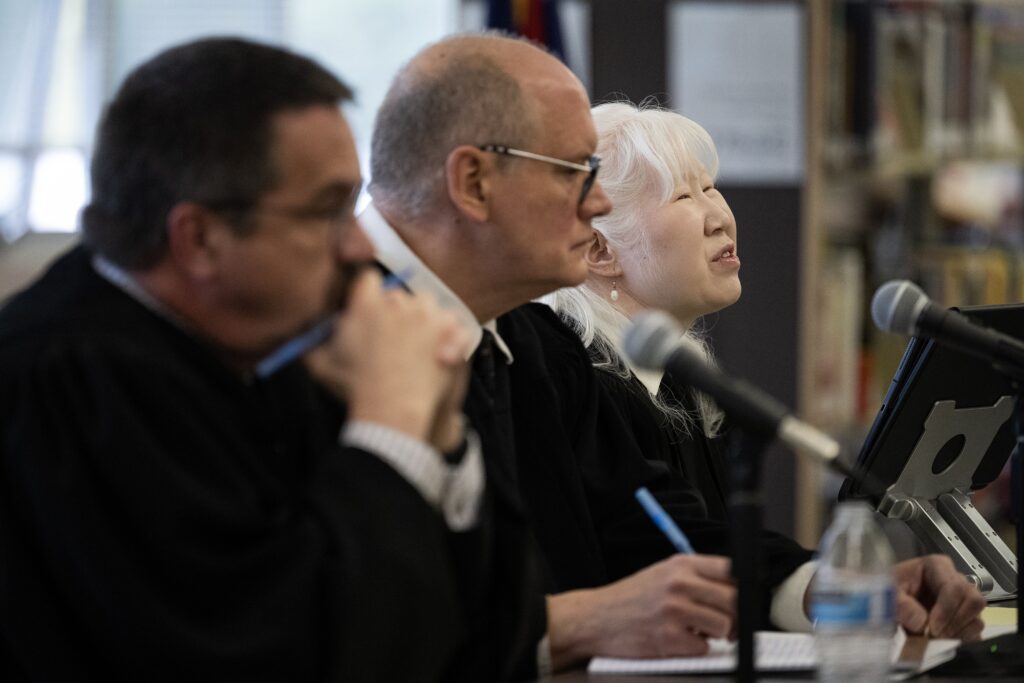
During the May 13 arguments to the Supreme Court, Schnorenberg’s counsel maintained the advice was relevant to proving whether he willfully violated state law.
“What innovator would risk entering the market if they had to guess at whether they might go to prison for 76 years for failing to disclose something, even if their lawyer advised them they didn’t need to?” said attorney Lynn C. Hartfield.
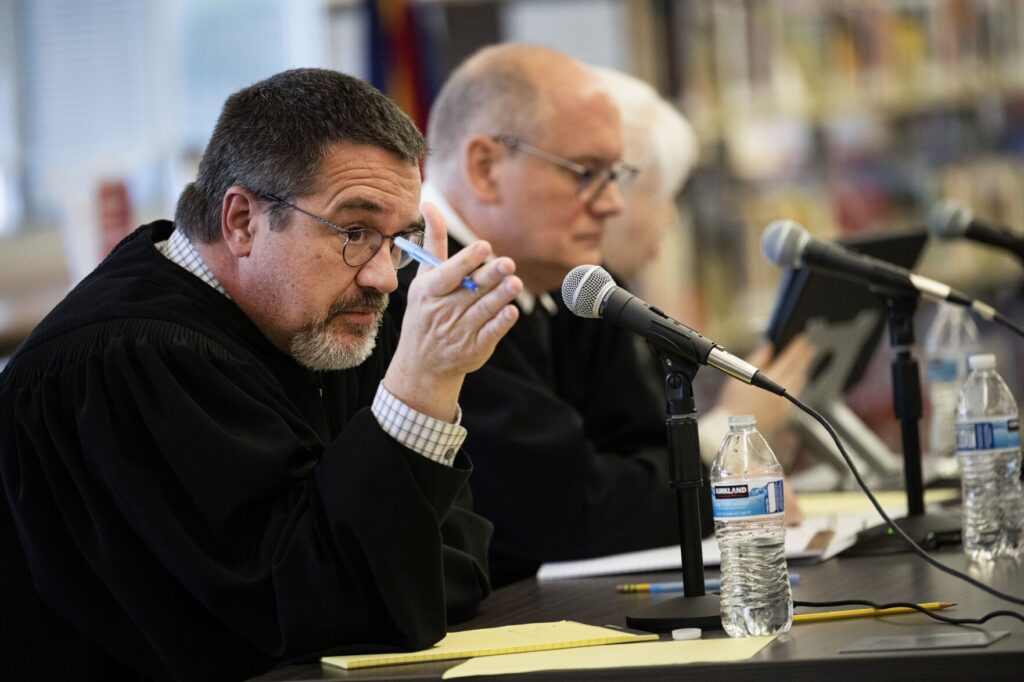
Justice Richard L. Gabriel signaled he was sympathetic to that view.
“Why would it not be relevant for the lawyer to have told the client, ‘I don’t believe it’s material, you don’t have to disclose it?'” he asked the government’s attorney. “Fair enough for the prosecutor to say, ‘I think he’s making it up.'”

Schnorenberg raised in excess of $15 million from hundreds of investors for an insurance marketing venture. He failed to disclose that he was barred from selling securities in Colorado, had not paid his earlier investors, carried large debt loads in his companies and had outstanding civil judgments against him, among other things.
Prosecutors charged Schnorenberg with more than two dozen counts of securities fraud. Douglas County jurors convicted him and he received a prison sentence of 76 years and an order to pay nearly $14 million in restitution.
In 2023, the Court of Appeals vacated seven of Schnorenberg’s convictions for being brought outside the statute of limitations — which the government did not dispute. However, the three-judge appellate panel also reversed the remaining convictions based on an error at trial.
Former District Court Judge Paul A. King refused to allow Schnorenberg to testify about the advice he allegedly received from his lawyer, telling Schnorenberg he did not have to disclose key pieces of information to investors.
Although Schnorenberg was able to testify narrowly that he received advice on certain topics, King believed the remaining information called for a hearsay response — meaning a statement made out of court that is being used to prove the truth. King also rejected the defense’s attempt to instruct the jury that it may consider evidence of Schnorenberg’s “good faith reliance on the advice of counsel.”
The appeals panel concluded Schnorenberg should have been allowed to speak about the alleged advice, as it could have proven Schnorenberg did not have the mental state required to commit the crimes.
“Though no Colorado case has addressed whether advice of counsel regarding the materiality of a misstatement or omission is relevant to determining if a defendant had the requisite mental state to commit securities fraud, we conclude that it is,” wrote Judge Daniel M. Taubman.

The Colorado Attorney General’s Office appealed, arguing defendants cannot assert that they misunderstood the law. Moreover, any advice Schnorenberg received from his lawyer would have illustrated his intent — but the securities fraud law does not require an intent to defraud investors.
“He has to know all of the facts around what he said and what he didn’t say, and that it was misleading to not say it,” argued Senior Assistant Attorney General Trina K. Kissel.
But Hartfield, representing Schnorenberg, pointed out it is not a crime to misstate or omit facts to investors. Only material, or important, misstatements or omissions lead to criminal liability, which was the factor Schnorenberg’s testimony sought to illuminate.
“A fairer and more sensible rule would be one that permits defendants in securities fraud cases to introduce evidence of advice received from counsel as one factor that the jury could consider in determining whether they acted willfully,” she said.
Gabriel suggested the dilemma could be attributed to the prosecution’s opposition to postponing the trial until Schnorenberg’s attorney could appear in person.
“I don’t want to be harsh, but the counsel wasn’t there because the prosecutor opposed the continuance,” he said. “It’s a little bit of chutzpah to say, ‘Use against the defendant the fact his counsel wasn’t there,’ when the defendant asked for a continuance so his counsel could be there and the prosecutor objected.”
Kissel disputed that characterization of the trial, but she also contended the evidence jurors did hear was plenty to support Schnorenberg’s conviction.
“He was selling securities and was banned from selling securities and didn’t tell anyone that he was banned from selling securities,” she said. “One does not need to consult a lawyer to know that is a material misstatement or a material omission.”
The case is People v. Schnorenberg.


Out-of-state judges address ex-discipline director’s lawsuit, Colorado justices accept federal invitation | COURT CRAWL
Michael Karlik
michael.karlik@coloradopolitics.com
Updated 3 hours ago
Welcome to Court Crawl, Colorado Politics’ roundup of news from the third branch of government. A pair of out-of-state judges got down to business in a lawsuit brought by Colorado’s former judicial discipline director, plus the state Supreme Court has...
Federal judge upholds constitutionality of Colorado campaign contribution limits
Michael Karlik
michael.karlik@coloradopolitics.com
Updated 3 days ago
A federal judge upheld Colorado’s individual campaign contribution limits as constitutional on Thursday, finding that three Republican plaintiffs failed to prove the campaign finance framework violates their First Amendment rights. U.S. District Court Senior Judge John L. Kane recognized that...

Appeals court rejects theory that existing tax revenue undermines need for new fees
Michael Karlik
michael.karlik@coloradopolitics.com
Updated 3 days ago
Colorado’s second-highest court rejected a plaintiff’s claim on Thursday that the tax revenue generated by an existing activity should prevent local governments from imposing new fees aimed at regulating the activity. The question stemmed from Colorado’s unique constraints on taxation...
Appeals court finds no illegal sentence when defendants forfeit time-served credit
Michael Karlik
michael.karlik@coloradopolitics.com
Updated 2 days ago
Colorado’s second-highest court ruled on Thursday that criminal defendants may agree to relinquish the credits they earned while incarcerated pending trial, despite a state law guaranteeing that such time “shall be deducted” from a person’s sentence. Kerry Ellis Endsley pleaded...
Appeals court reinstates Garfield County arson charge
Michael Karlik
michael.karlik@coloradopolitics.com
Updated 22 hours ago
Colorado’s second-highest court reinstated a Garfield County defendant’s arson charge on Thursday, concluding a trial judge improperly credited a witness’s claim that she alone was responsible for starting the fire. A sheriff’s deputy responded to a brush fire near Parachute...
Federal judges rebuke ex-Colorado judicial discipline director for conduct in lawsuit
Michael Karlik
michael.karlik@coloradopolitics.com
Updated 4 days ago
A pair of federal judges expressed a desire on Thursday to break the logjam on a lawsuit by Colorado’s former judicial discipline director against the state Supreme Court and related entities, while simultaneously showing little tolerance for the plaintiff’s scorched-earth...

Democratic bill would let recipients of ‘conversion therapy’ sue Colorado providers with no statute of limitations
Marissa Ventrelli
marissa.ventrelli@coloradopolitics.com
Updated 4 days ago
Colorado lawmakers have advanced a proposal that would allow people who underwent conversion therapy to sue licensed providers for damages, moving the measure forward on a party-line vote in the House Judiciary Committee. House Bill 1322, proposed by Democratic Reps....
Federal judge refuses to authorize immediate appeal in World Cup trafficking lawsuit
Michael Karlik
michael.karlik@coloradopolitics.com
Updated 5 days ago
A federal judge declined to authorize an immediate appeal last week of a prior decision allowing companies operating out of Colorado to be sued for allegedly participating in a human trafficking venture involving Filipino laborers who constructed facilities for the...
Federal judge considers second round of sanctions against ex-Colorado judicial discipline director
Michael Karlik
michael.karlik@coloradopolitics.com
Updated 5 days ago
A federal judge ordered Colorado’s former judicial discipline director on Tuesday to explain why she should not sanction him a second time for filing documents for improper purposes, such as harassment or delay. U.S. District Court Senior Judge Kathryn H....
Colorado justices agree to review insurance question that has divided federal judges
Michael Karlik
michael.karlik@coloradopolitics.com
Updated 5 days ago
The Colorado Supreme Court granted a federal judge’s request on Friday to address an issue that has produced conflicting answers in policyholders’ lawsuits against insurance companies over unpaid benefits. “Parties (and judges) regularly spend undue time and money fighting in...