

Colorado justices consider scenario where civil defendants turn around and sue plaintiffs
Members of the Colorado Supreme Court considered on Wednesday how easily defendants who win their civil lawsuits should be able to turn around and sue the plaintiffs for allegedly entangling them in baseless litigation.
A person may sue for malicious prosecution when someone knowingly initiates a criminal or civil legal proceeding that lacks merit and the case ends in the person’s favor. Among other things, the party alleging malicious prosecution must establish there was no probable cause to initiate the original proceeding in the first place.
However, the question for the Supreme Court revolved around how heavily trial judges should rely on the original proceeding when looking at probable cause. Specifically, if a judge in the original proceeding opted to advance the lawsuit all the way to a jury trial, does that automatically suggest probable cause existed all along?
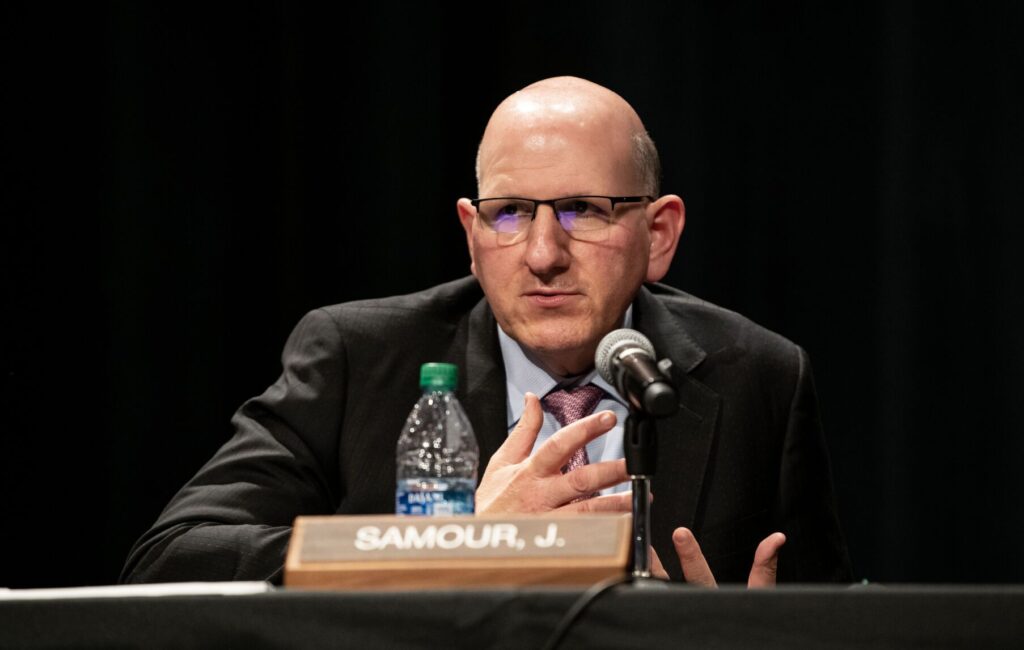
During oral arguments, Justice Richard L. Gabriel observed there can be many reasons a judge will deny a civil defendant’s request for summary judgment, which would end the case in their favor without a trial. And the reasons for putting the lawsuit in front of a jury may not be entirely transparent.
“I did business litigation for a long time and there was one judge — I’m not gonna say who or where — I filed a fulsome motion for summary judgment,” he said, “and the judge’s practice was to write ‘denied’ on the cover every time.”
Gabriel added some judges will always be hesitant to decide that a defendant should prevail as a matter of law, without the need for a jury to adjudicate conflicting facts.
“Particularly in a commercial litigation where you’ve got hundreds of pages of exhibits on both sides and it is not unreasonable for judge to say, ‘There’s gotta be a fact question here somewhere,'” he said.

How much weight a judge should place on what happened in a prior civil case could incentivize the filing of malicious prosecution lawsuits, prevent successful defendants from seeking accountability for bad-faith litigation or, conceivably, alter behavior within individual cases.
In the case at hand, Patricia Ann Scott originally sued Steamboat Springs real estate broker Kaylee Schnelle, accusing Schnelle of professional negligence for the way she marketed Scott’s commercial property. Schnelle moved for summary judgment, but a judge believed there were disputed issues for a jury to resolve.
At trial, Schnelle also moved for a directed verdict in her favor after Scott presented her case, but the judge similarly denied that motion. The jury ultimately sided with Schnelle.
Schnelle then sued Scott and Scott’s lawyers for malicious prosecution. The defendants moved to dismiss, focusing on one of the elements of malicious prosecution: lack of probable cause. By rebuffing Schnelle’s motions to end the professional negligence case, they reasoned, the original trial judge found probable cause of Schnelle’s wrongdoing — even if she ultimately prevailed.
Chief Judge Michael A. O’Hara III, who was also the judge in the original civil case, noted there were two schools of thought from courts around the country. Some states’ courts treat the denial of a defendant’s summary judgment motion or directed verdict as generally fatal to a later claim of malicious prosecution. Other states use it as “just a factor” to consider. O’Hara opted to treat the prior rulings as a factor and declined to dismiss Schnelle’s malicious prosecution claim.
A Court of Appeals panel agreed with that approach. Judge Christina F. Gomez expressed concerns about giving significant weight to a pretrial ruling in another case — which “almost certainly wasn’t subject to any potential appellate review” — when deciding whether to bar a later malicious prosecution lawsuit.
The defendants in Schnelle’s case appealed to the Supreme Court, arguing the Court of Appeals’ decision would make it easier to pursue retaliatory lawsuits and increase legal costs.
Attorney John M. Palmeri told the justices that if a judge previously allowed a lawsuit to proceed to a jury verdict, there should be a presumption that probable cause existed, which the person bringing the malicious prosecution lawsuit needs to rebut to keep their claim viable.
“If we’re going to allow a case to get to a jury, it has to mean something,” he said.
“A lot of trial judges are gonna say, ‘We’re gonna let the jury decide and if there’s something that came up on the back end, I’ll clean it up,'” said Justice Maria E. Berkenkotter, a former trial judge. “How do you know kind of what the trial judge was thinking?”

Clark L. Davidson, the attorney for Schnelle, argued both jury trials and malicious prosecution lawsuits are rare. He noted his client’s case was also unusual in that the same judge who let the original lawsuit go to trial also believed Schnelle’s malicious prosecution claim was viable.
Based on the circumstances and the evidence, Davidson believed Schnelle would succeed even if the higher standard applied to her.
“But what about all the cases that follow? What about all the people behind her?” he asked.
The case is Cantafio et al. v. Schnelle.

Judge rules that Colorado law makes it too hard for parties to bar unaffiliated voters from primaries
Ernest Luning
ernest.luning@coloradopolitics.com
Updated 2 hours ago
A federal judge ruled in favor of the Colorado Republican Party late Tuesday, saying that a portion of the state law that allows unaffiliated voters to cast ballots in party primaries is unconstitutional because it imposes an unrealistic burden on...

10th Circuit upholds regulator’s methodology for Tri-State exit fees
Michael Karlik
michael.karlik@coloradopolitics.com
Updated 4 hours ago
The Denver-based federal appeals court upheld a regulatory agency’s methodology for calculating the fee owed by entities seeking to withdraw from Tri-State Generation and Transmission Association last week. Tri-State is a Westminster-based cooperative that provides and transmits electricity to member...
Federal judge proposes sanctions against Mike Lindell’s lawyers for continued fake citations
Michael Karlik
michael.karlik@coloradopolitics.com
Updated 5 hours ago
A federal judge is once again pursuing sanctions against lawyers for MyPillow CEO Mike Lindell for continuing to cite to court cases that do not exist, likely based on the faulty output of artificial intelligence tools. Last year, a jury...

Susan Blanco signals views on role of appellate courts in first opinion as Colorado justice
Michael Karlik
michael.karlik@coloradopolitics.com
Updated 9 hours ago
Justice Susan Blanco’s first solo opinion as a new member of the Colorado Supreme Court made clear her view of the guardrails that keep the state’s highest court tethered to the issues it is asked to decide. On Monday, the...

Colorado leaders weigh next steps after Supreme Court rejects state ban on ‘conversion therapy’
Marissa Ventrelli
marissa.ventrelli@coloradopolitics.com
Updated 1 day ago
Colorado leaders said they are weighing next steps after the U.S. Supreme Court on Tuesday rejected the state’s ban on “conversion therapy” for children, as critics and supporters cheered or lambasted the ruling. The court’s near-unanimous decision called the Colorado...
Federal judge dismisses U.S. government lawsuit against Colorado, Denver’s ‘sanctuary’ laws
Michael Karlik
michael.karlik@coloradopolitics.com
Updated 1 day ago
A federal judge dismissed the U.S. government’s lawsuit against Colorado and Denver on Tuesday, which alleged that various local policies impermissibly infringed on federal immigration enforcement. U.S. District Court Judge Gordon P. Gallagher followed the lead of judges in Illinois...
Federal judge finds DOJ adequately searched for, disclosed records related to Bidens
Michael Karlik
michael.karlik@coloradopolitics.com
Updated 1 day ago
A federal judge determined on Friday that the U.S. Department of Justice adequately searched for and disclosed records to a Colorado attorney in response to his request for documents related to former President Joe Biden’s son and brother. In November...
10th Circuit warns lawyers after finding fake case in filing
Michael Karlik
michael.karlik@coloradopolitics.com
Updated 23 hours ago
The Denver-based federal appeals court warned attorneys to be more careful last month after discovering one lawyer cited a fake case in his arguments. In recent months, federal and state judges in Colorado have begun cautioning lawyers explicitly about the...

10th Circuit rules cognitively impaired man’s risk of lobotomy, mistreatment in Mexico not ‘torture’
Michael Karlik
michael.karlik@coloradopolitics.com
Updated 2 days ago
The Denver-based federal appeals court concluded last month that a man’s risk of mistreatment or forced lobotomy in his native Mexico did not amount to “torture” that should shield him from deportation. A three-judge panel of the U.S. Court of...
Colorado justices side with news organizations for disclosure of high-level child abuse data
Michael Karlik
michael.karlik@coloradopolitics.com
Updated 1 day ago
The Colorado Supreme Court ruled on Monday that the state must disclose the number of child abuse reports at individual group living facilities in response to an open records request, as the addresses are already in the public domain. The...