

With governor’s race looming, what role will public school funding play? | NOONAN
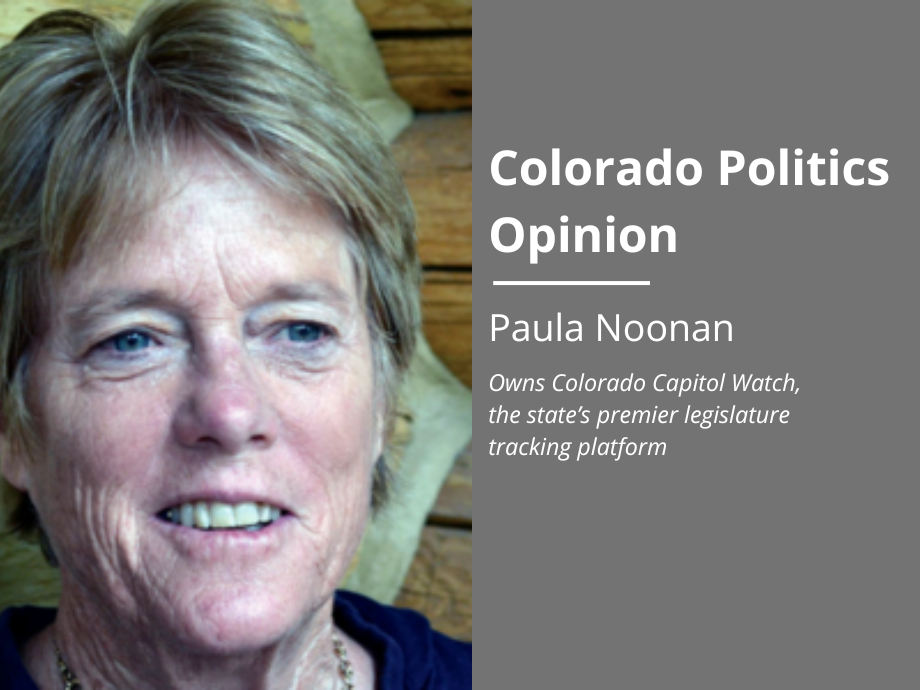
Paula Noonan

Paula Noonan
The adage “don’t put the cart before the horse” needs to change related to Colorado’s public school finance. It should be “don’t put the 80-foot extendable double-drop trailer before the truck cab.”
For 30 years, Colorado’s state legislators and various governors have insisted on setting “high academic standards” and imposing expensive student standardized testing on schools. For that same period, Colorado’s legislators, governors, and citizens have refused to pony up the money for students, statewide, to have a fighting chance of achieving those outcomes.
Two reports authorized by the 2023 legislature are complete. They address Colorado’s funding for public school students based on “adequacy.” They come to the same conclusion: our students are underfunded by $4,000 to $4,500 each per year or about $4 billion total for 2024.
A recent 2025 legislature preview sponsored by Chalkbeat Colorado with two Joint Budget Committee members, Sens. Jeff Bridges and Barbara Kirkmeyer, covered the outlook for Colorado’s 2025-2026 school finance act. The main theme is these two legislators don’t want to go back to the budget stabilization factor (BS factor) used during the last decade to balance the state budget, shorting public schools by about $10 billion overall.
Stay up to speed: Sign up for daily opinion in your inbox Monday-Friday
According to Bridges and Kirkmeyer, it was an astonishing feat for Colorado to finally deliver money to schools that brings the state up to 1989 funding levels, adjusted for inflation. That’s about 33% less than what’s actually needed, according to the two highly detailed, in-the-weeds studies.
For citizens and legislators who believe “money isn’t the solution” to Colorado’s education deficiencies, these reports are a black-belt karate chop to the nose. Money is necessary to get to the sufficient conditions for student success.
The reports confirm what most people following public school finance and student outcomes have known for years: teachers are underpaid, at-risk students are under-resourced, English Language Learners (ELL) are particularly under-nourished, our property taxes reward wealthy districts and punish poor districts, state equalization dollars for low-income and rural districts are not near enough, low-wealth districts have to create more local tax money they don’t have to serve their less financially privileged children, and taxing constraints exacerbate each one of these problems.
The question these reports present is simple: will the state legislature, governor and citizens step up?
So far, there’s been back and forth between the governor and legislators related to whether there will be another year of so-called full funding for public schools. Currently, the base funding per student is $8,076. Additional funding gets lopped on top of that number based on a variety of factors such as cost of living, student status, district size and location. The reports argue base funding should be in the $12,500 per student range, about what Minnesota gins up, with additional funds for in-need students that significantly exceed what’s currently offered.
Overall, according to both reports, students who lose most in our current backwater funding system are low-income kids, ELL students and special education children. Our teachers receive less income compared to other professionals of similar age and education than any teachers in any other state.
During these under-funded decades, school districts with the most at-risk and ELL students have been subjected to the most searing critiques from the Colorado Department of Education based on the state’s “school accountability” program. CDE acted in the case of Adams 14 to require the district to spend $8 million on a private school management company to improve test results. That didn’t work out and the district lost those dollars. Other low-income districts have also been subjected to deep criticism unaccompanied by sufficient dollars to adequately support their students. It’s a moral travesty.
The two reports, one by Colorado’s Augenblick, Palaich and Associates, the other by American Institutes for Research from Arlington, Virginia, use four different assessment methodologies between them. Every one of these vantage points results in a common conclusion: not enough money funds our public schools. Standardized testing has confirmed year after year that lack of funding produces underwhelming outcomes based on the state’s academic metrics.
Common attacks against public schools and their employees aren’t analysis. The old lines that teachers make too much money, they’re coddled and they get too much time off don’t hold up in an environment where shooter drills are now a norm. The view that school districts squander resources doesn’t hold water when there’s not enough money for squandering.
Previous attempts to ask voters statewide for more money haven’t worked. The legislature and governor last year reduced the state’s income tax percent without regard to this gaping school finance problem. The governor has put more political capital into enabling charter schools than tending to the financial needs of the 85% of children in our public schools.
A governor’s race is on the horizon. This governor no doubt has political ambitions. These are the leaders who must stand up to persuade the public-school funding is under water. These are the individuals who should stand down our state’s standardized testing program that costs too much and produces too little.
The first leader out of the pro-school funding gate should get our votes.
Paula Noonan owns Colorado Capitol Watch, the state’s premier legislature tracking platform.

President Trump puts Colorado farmers and ranchers first | GUEST COLUMN
Colorado Politics
colorado-politics@coloradopolitics.com
Updated 18 hours ago
By Brooke L. Rollins Ever since Colorado was admitted to the union 150 years ago this month, farmers and ranchers across the state have kept our nation’s food supply secure and our freedom alive. From cattle ranchers on the eastern plains to specialty crop producers on the Western Slope, Colorado is home to more than 36,000...
No license, no inspection, no accountability — who is protecting women? | GUEST COLUMN
Catherine Wheeler
catherine-wheeler@gazette.com
Updated 18 hours ago
In early August, Massachusetts Gov. Maura Healey signed into law expansion of abortion from 24 weeks through the entire pregnancy. While many celebrated, Colorado serves as a staunch warning of the unintended consequences of unrestricted, unregulated abortion. Whether pro-life or pro-choice,...
Gong-Show Griswold’s latest data dump a disaster | George Brauchler
George Brauchler
george-brauchler@gazette.com
Updated 2 days ago
Last week, Colorado Secretary of State Jena Griswold’s office discovered they exposed for weeks the addresses of more than 130,000 “confidential voters” — including victims of sexual assault, domestic violence — and her political opponent in the attorney general’s race,...
Colorado’s education paradigm déja-vu | Paula Noonan
Paula Noonan
paula-noonan@coloradopolitics.com
Updated 2 days ago
Déja-vu for 10 years. In 2015-2016, state standardized testing was fully integrated into teacher performance evaluation. The tests comprised 50% of teacher “performance.” The idea was to follow the General Electric “rank-and-yank” human resources model. At GE, the model went...
Don’t trade away our TABOR refunds | PODIUM
Barb Kirkmeyer
barb-kirkmeyer@gazette.com
Updated 3 days ago
Here we go again — tax-and-spend politicians going in the wrong direction. Colorado families are being asked to believe a familiar lie: the only way to fund education is to let politicians keep more of your money — forever. Proposition...
Trump’s ‘BBB’ casts aside rural Colorado healthcare | Hal Bidlack
Hal Bidlack
hal-bidlack@coloradopolitics.com
Updated 4 days ago
Well, as I often do, let me start by yet again telling you what I am not going to be writing about (Editor: sigh…). I’m not going to talk about President Donald Trump’s most recent (of many, many) attacks on...
A course correction Canada would concur with | Miller Hudson
Miller Hudson
miller-hudson@coloradopolitics.com
Updated 7 days ago
I’ve always harbored a soft spot for Canada. My father was stationed there twice, once in the 1960s as the Atomic Energy Commission’s American liaison with the Canadian nuclear reactor program in Chalk River, Ontario and again in the 1970s...

Private property rights challenge rural Colorado communities | Rachel Gabel
Rachel Gabel
rachel-gabel@coloradopolitics.com
Updated 7 days ago
If there were ever a topic I believe deeply in, it’s private property rights. If there were ever a topic that leaves me in a moral conundrum more often than not, it’s private property rights. The northern portion of Weld...

Gaylord — you never check in, but still pay | Jon Caldara
Jon Caldara
jon-caldara@coloradopolitics.com
Updated 1 week ago
I go to a lot of conferences, often in beautiful cities I never actually see. Friends hear where I’ve been and ask depressing questions like, “Did you visit the famous museum?” No. I saw Ballroom C, the lobby bar and...
Reflections on Weiser-Lopez, Crank-Killian debates | Tom Cronin
Tom Cronin
tom-cronin@coloradopolitics.com
Updated 7 days ago
Thursday night, The Gazette and KOAA TV hosted two important candidate debates. The first featured incumbent Republican U.S. Rep. Jeff Crank, who is just completing his first term representing El Paso County in Congress, and Jessica Killian, a Democrat who has...