

Preliminary numbers show enrollment drops in 2 of Colorado Springs’ largest school districts
Preliminary figures indicate that many school districts in the Colorado Springs area lost students over the past year.
Academy D-20 and School District 49 released preliminary numbers from their October student counts that both show decreases in student enrollment during their board of education meetings Dec. 12.
D-20 reported a slight drop of 38 students to 26,569 this fall while D-49 reportedly lost 109 students from last year’s 25,799 total.
Both numbers come from totals tallied by the districts on Oct. 1, which is required every year by state law. While enrollment figures constantly change throughout the course of the school year, the Colorado Department of Education uses the October totals to calculate each district’s annual per-pupil revenue amount, the primary source of funding for public education.
Colorado school districts grapple with new state law to honor students’ chosen names
Contrary to the rest of the state, D-49 increased student enrollment each year over the past five. This year would mark the first time D-20 lost enrollment since 2020.
In D-49’s case, this year’s loss of students amounts to about $1 million in per-pupil revenue, said budget manager Spencer McCabe during a presentation to the board.
The board would later move to approve an amended budget for the current school year, based on this and other factors, at a later meeting in January. D-20’s board will be presented with their own amended budget next month.
Joining a regional trend
Elsewhere in the Pikes Peak region, neighboring school districts reported their own drops in student enrollment this fall. 131 fewer students in Woodland Park School District RE-2, nine in Cheyenne Mountain D-12 and 18 in Lewis Palmer D-38 compared to figures recorded from the 2023-24 count were all presented over the past two months.
Woodland Park School District reports decline in enrollment
A spokesperson for Colorado Springs District 11, the third-largest district in El Paso County, told The Gazette in an email that the district is waiting for the finalized totals to be released by the Colorado Department of Education in January before commenting on this year’s enrollment.
If these numbers are finalized by the state, it would continue the trend of overall declining enrollment that was reported last year. The 881,464 preschool through high school students reported in 2023-24 marked the lowest in a decade, according to the CDE.
Colorado Springs area mirrors public school trend of declining enrollment
Incoming Colorado Board of Education member Kathy Gebhardt told The Gazette that the trends identified in recent years like increasing homeschoolers can still be attributed to the declines felt across the state. As the former board president of the Boulder Valley School District, she added that districts in growing communities like hers, Colorado Springs and Falcon are indirectly impacted by factors for incoming families.
“The cost of living is part of it, so is the decline in birth rate and other societal factors that the districts themselves don’t have a whole lot of control over,” she said.
For rural districts with smaller classes, staffing and infrastructure, Gebhardt noted that additional sources of funding revenue like mill levy overrides often aren’t available to account for revenue losses, as they are in larger districts, typically.
“Each district is unique,” she said. “And I would say that it’s up to each district and their board to determine their needs for their communities.”
School district responses
A former director for the Colorado Association of School Boards, Gebhardt noted that these differences in economies and communities also lead different responses by the districts.
To address their own declining enrollment in recent years, Boulder Valley’s board of education developed a task force to engage with the community to determine district responses over a long period of time. Decisions to consolidate can range from closing schools to funding teachers and staff to cutting district-wide programming.
The Denver Public Schools board of education voted unanimously to close seven schools and restructure three others to address enrollment challenges. The Jefferson County Public Schools Board of Education voted similarly to close 16 of its schools.
Other districts like Colorado Springs D-11 have responded to decades of losing enrollment with the creation of charter schools, specialized curricula for existing schools and new programs to generate interest among local families. D-11 also rolled out a master plan in 2021 to account for building improvements and declining enrollment. Last year’s report marked the first time the district gained students since 2011.
In Woodland Park, middle school students began attending classes at the school district’s high school building this fall to account for its declining enrollment and to better utilize existing space. Gateway Elementary School also located in the district closed in 2024 for similar reasons.
D-20 parents were informed in May that the Aspen Valley Campus would cease their middle school programming due to decreased interest and enrollment in their eighth-grade offerings and shift its focus toward curriculum {!–StartFragment–}{span data-olk-copy-source=”MessageBody”}that emphasizes students spending time in advisories, internships or externships with community partners. The decision was made to open up spaces for various programs in the district. {/span}{!–EndFragment–}
Regardless of what each district and its board ultimately decide, Gebhardt said that it should always include planning and multiple opportunities for public involvement, given the community role the schools play for local families and neighborhoods.
On a statewide level, adjustments were made during the 2024 legislative session to increase funding for English language learners, students with disabilities and low-income students. Since the current funding formula will continue to rely primarily on student totals, Gebhardt said further adjustments may be needed going forward.
“I think we have to start thinking about budgets that aren’t dependent on growth,” she said.


Colorado Supreme Court clarifies restraining order violations can always support burglary charge
Michael Karlik
michael.karlik@coloradopolitics.com
Updated 40 minutes ago
The Colorado Supreme Court’s majority ruled on Monday that a violation of a restraining order can also serve as a basis for finding a defendant guilty of burglary. Under state law, a person commits second-degree burglary by unlawfully entering or...

Big week ahead for major legislation to address housing affordability woes
Zach Halaschak, Washington Examiner
zach.halaschak.washington.examiner@gazetteedit.wpenginepowered.com
Updated 3 hours ago
The Senate is pushing ahead with a bipartisan bill to improve housing affordability, teeing up a critical week for housing on Capitol Hill and raising major questions about what provisions will be included. Senate Majority Leader John Thune (R-SD) filed cloture on legislation from the...

Macron goes nuclear with increases to French warhead arsenal
Timothy Nerozzi, Washington Examiner
timothy.nerozzi.washington.examiner@gazetteedit.wpenginepowered.com
Updated 3 hours ago
French President Emmanuel Macron is channeling the atomic spirit of his predecessor Charles de Gaulle with orders for the French military to “increase the number of nuclear warheads” in the nation’s arsenal. Macron announced the seismic shift in France’s defensive...

Who has been killed so far during US-Israel mission in Iran?
David Zimmermann and Keely Bastow, Washington Examiner
david.zimmermann.and.keely.bastow.washington.examiner@gazetteedit.wpenginepowered.com
Updated 3 hours ago
There have been numerous casualties on all sides since the joint U.S.-Israel strikes against Iran commenced over the weekend, with more lives expected to be lost as the campaign continues. The Islamic regime’s leadership is currently bearing the brunt of...
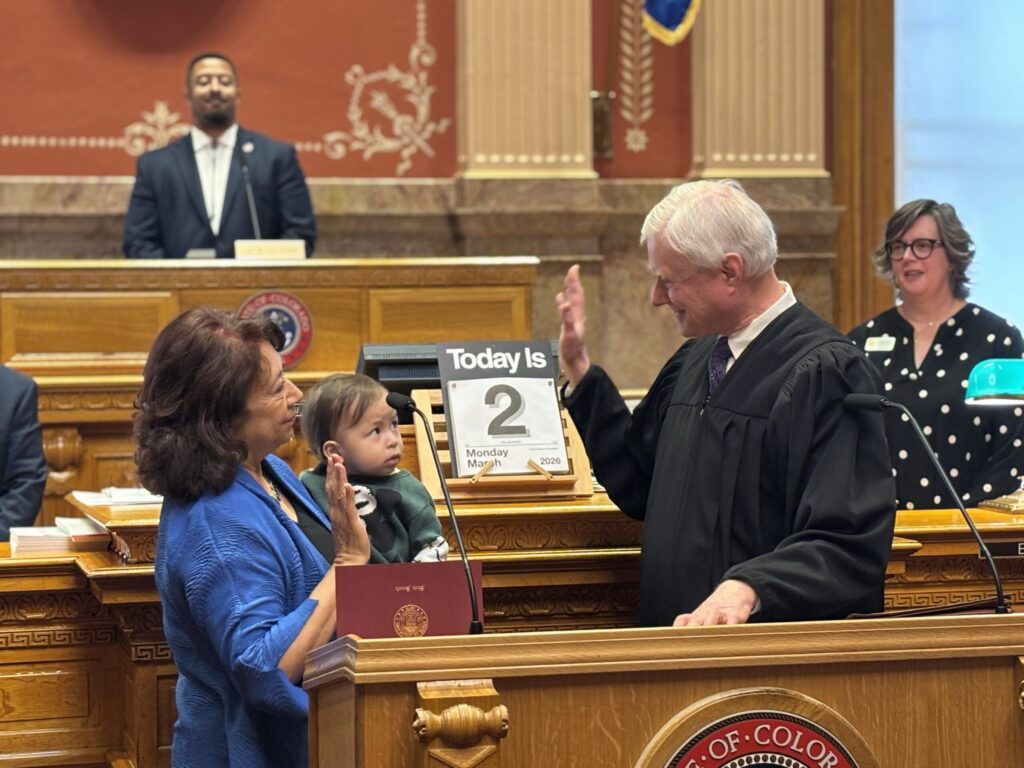
Colorado Senate swears in Adrienne Benavidez after district vacancy win
Marianne Goodland
marianne.goodland@coloradopolitics.com
Updated 3 hours ago
Sen. Adrienne Benavidez, a Democrat from Adams County, was sworn in Monday to the Colorado Senate, just four days after winning a vacancy election in District 21. She was sworn in by Colorado Court of Appeals Justice Lino S. Lipinsky...

10th Circuit judge creates vacancy, district court gets new chief judge | COURT CRAWL
Michael Karlik
michael.karlik@coloradopolitics.com
Updated 5 hours ago
Welcome to Court Crawl, Colorado Politics’ roundup of news from the third branch of government. A longtime member of the Denver-based federal appeals court will give the president a vacancy to fill, plus Colorado’s federal trial court will see a...
War in the Mideast widens as Trump says strikes on Iran could last several weeks
Jon Gambrell
jon.gambrell@associatedpress.com
Updated 6 hours ago
DUBAI, United Arab Emirates (AP) — The war in the Middle East spiraled further Monday as Israel and the United States pounded Iran in a campaign that U.S. President Donald Trump said would likely take several weeks. Tehran and its...

Denver mayor says his commute time tripled following ‘road diet’ change
Mark Samuelson Special to The Denver Gazette
mark.samuelson@denvergazette.com
Updated 2 hours ago
Mayor Mike Johnston is pushing back sharply against the claim by Denver councilmembers and bike activists that the city succumbed to lobbying pressure in revising a “road diet” plan for East Alameda Avenue, while noting that his own commute time...

Rural legislators, Colorado farmers defeat pollinator bill backed by Gov. Polis
Marianne Goodland
marianne.goodland@coloradopolitics.com
Updated 3 hours ago
A proposal to limit the use of neonicotinoid-coated crop seeds collapsed in the Senate Agriculture and Natural Resources Committee last week, as rural lawmakers, including two Democrats, joined Republicans to reject what they called an expensive, impractical mandate on farmers....

WATCH LIVE: Trump speaks on Iran
Dan Boniface
dan.boniface@denvergazette.com
Updated 8 hours ago
U.S. President Donald Trump is speaking live on Monday, March 2, 20026, about the conflict in Iran as he awards three U.S. soldiers the Medal of Honor.