

‘On the verge of a renaissance’: Colorado’s chief magistrate judge encourages use of settlement conferences
Chief U.S. Magistrate Judge Michael E. Hegarty told an audience of lawyers on Wednesday that despite his status as the most prolific settler of cases on Colorado’s federal trial court, his upcoming retirement should not be cause for concern that settlements will diminish.
“I fully believe there are many cases that should be tried to a jury. I’ve tried 30-35 here,” said Hegarty, speaking at the Alfred A. Arraj U.S. Courthouse in Denver. “But there are many that don’t need to be, and the wisest use of everyone’s time is to resolve it.”
Hegarty is stepping down in January after having facilitated more than 1,400 settlement conferences since joining the bench in 2006. When he first stepped into the role, Hegarty recalled the presidentially appointed district judges felt the most important responsibility of magistrate judges was signing off on criminal warrants. The second priority was conducting settlement conferences in civil cases.
“We were doing about 900 settlement conferences a year. I was doing around 180 myself. Sometimes, three at once. So, I would have six rooms in a courthouse,” Hegarty described, adding his law clerk would follow him “like a doctor’s assistant with a bunch of medical records.”

FILE PHOTO: The Alfred A. Arraj U.S. Courthouse in downtown Denver.
However, in 2012 the district court shifted toward a different means of satisfying its congressionally mandated duty to provide alternate dispute resolution. It instituted “early neutral evaluations,” an optional — and rarely used — procedure permitting judges to give their non-binding assessment of a case. Afterward, settlement conferences dipped to just 116 in 2013, Hegarty said.
This year, the court is on track to complete 170-180 settlements between its nine full- and part-time magistrate judges, with an estimated 80% success rate.
“Everyone’s numbers are going up across the board,” said Hegarty. “In my view, settlement conferences are back in good graces in all corners of the courthouse. I think we’re on the verge of a renaissance for settlement conferences.”
Settlements facilitated by magistrate judges far eclipse the number of trials at the district court, which amounted to 51 total last year. Settlements can also be time intensive, with Hegarty spending 160 hours to settle one case over several months — all while needing to draft decisions and recommendations in other litigation. Hegarty said some judges have the view that if parties to a federal case wish to settle, they can go to private mediators for that service.
However, he continued, his opinion is that resolving a case early will save judges time in issuing orders, presiding over the discovery of evidence and conducting a trial — with the possibility of appeal afterward.

FILE PHOTO: The Alfred A. Arraj federal courthouse in Denver
“A settlement is simply a negotiation repositioning the parties’ legal position vis-à-vis one another,” said Hegarty. He elaborated that a settlement raises the possibility that he can convince a defendant to agree to certain things the plaintiff might not obtain otherwise through trial.
“That only comes by experience. What’s really fun for me, since I don’t get to be a trial lawyer anymore, this is my chance to win,” he said. “I love it when I can get to something and both sides go, ‘We would have never thought of that. That’s perfect!'”
He acknowledged some lawyers may be fearful of asking a magistrate judge about facilitating a settlement conference because it may signal to the opposing side that they perceive their case to be weak. But Hegarty said attorneys can circumvent that perception by always asking magistrate judges to explain their settlement protocols as a matter of course.
Sometimes, Hegarty said he will raise the possibility of settlement himself during a courtroom appearance, calling the parties up to the bench to negotiate one at a time.
“My experience is I like it when one side is unrepresented, mostly. Because honestly, it’s the attorney who’s interfering with the progression for the settlements,” he said, adding that magistrate judges are empowered to appoint pro bono lawyers solely to represent a party in settlements if necessary.

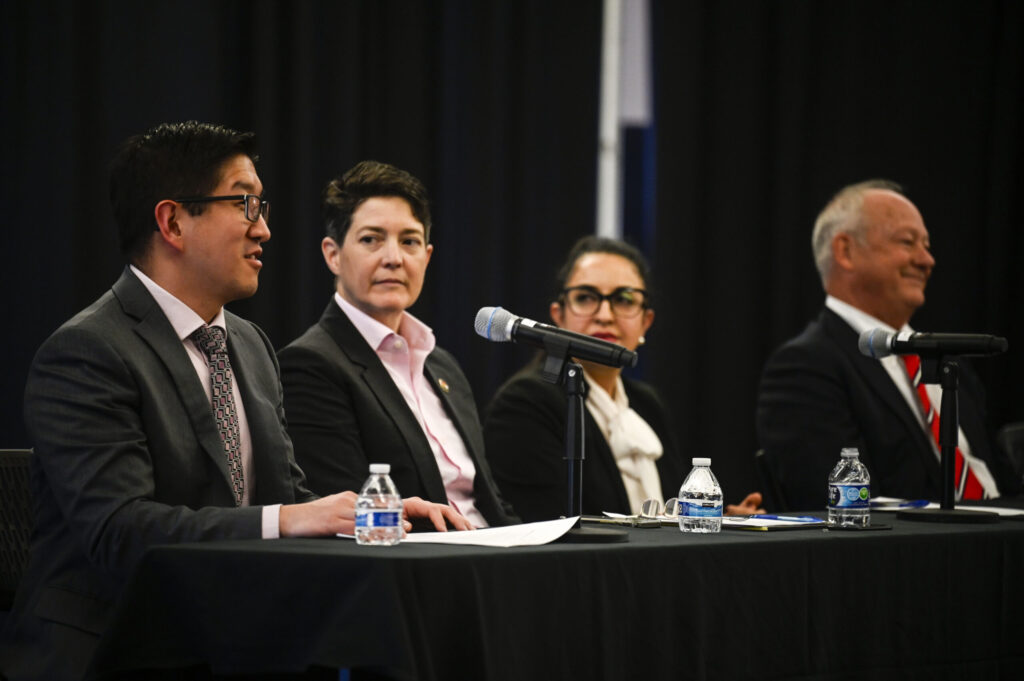
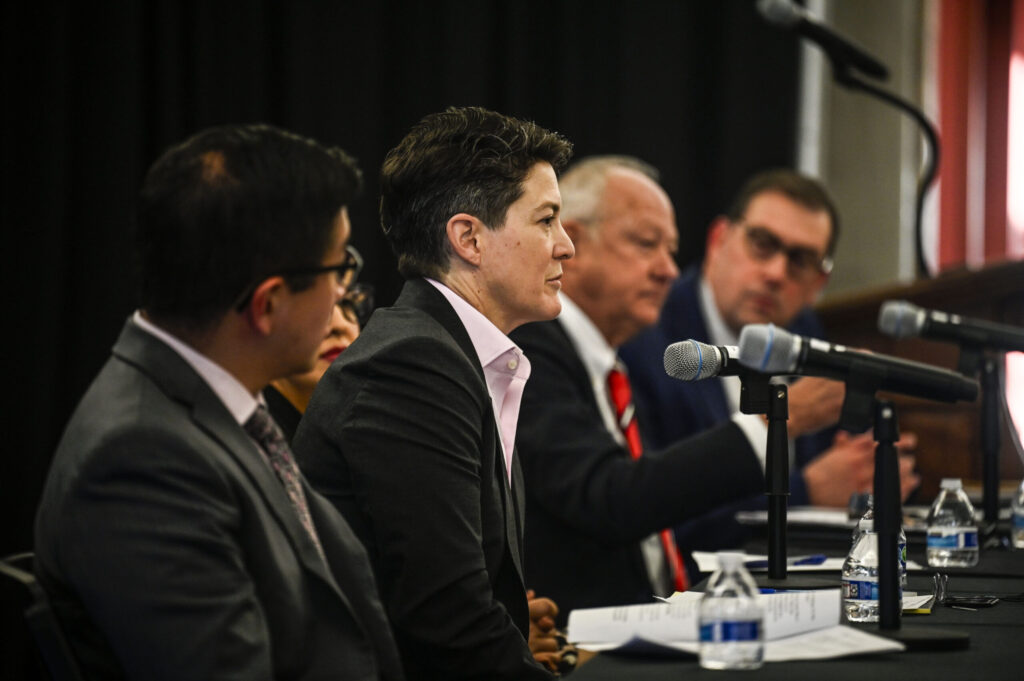
Attorney Matthew Skeen, U.S. District Court Judges Gordon P. Gallagher and S. Kato Crews, retired U.S. Magistrate Judge Kristen L. Mix and attorney Kevin Homiak speak on a panel about pro bono opportunities for lawyers at Colorado’s federal trial court on May 8, 2024.
Hegarty surveyed the other magistrate judges on the court about their pet peeves during settlement conferences. Among their frustrations were attorneys who make unreasonable initial demands, who fail to prepare their client or who engage in “chest thumping” in front of the judge.
He said he respects attorneys who are candid with him about hang-ups their clients are having.
“If I’m having a hard time getting someplace, and it seems like I’ve convinced you (the lawyer), why aren’t we getting closer? Let me know,” he said.
None of the magistrate judges predicted court-facilitated settlements will decrease after Hegarty’s departure, but he acknowledged the large amount of turnover in recent years means the newer magistrate judges will need time to perfect their style. However, Hegarty reminded the audience that the magistrate judges were all trial attorneys, so they are familiar with the dynamics of civil litigation.
He also advised that for many litigants, a settlement conference may be the only opportunity for them to be in court and state their case to a federal judge face-to-face. In that setting, Hegarty said he is able to learn about what the parties actually need for a resolution.
“Maybe you never even asked the ultimate question: What’s the basic wrong here? The law was violated? Fine. But what is it you really want to bring you back to a place where you can have peace?” he said. “If I can find that, that’s great.”

Colorado justices skeptical of appellate court’s limitation on prosecution’s appeal
Michael Karlik
michael.karlik@coloradopolitics.com
Updated 2 days ago
The Colorado Supreme Court seemed skeptical on Tuesday that Denver prosecutors should be barred from appealing a trial judge’s permanent dismissal of a criminal case, based upon the sequence of events after the original ruling. Prosecutors charged Quinn M. Jebe...
Federal judge: Government violated order shielding man from deportation in ‘one-off mistake’
Michael Karlik
michael.karlik@coloradopolitics.com
Updated 2 days ago
A federal judge acknowledged on Thursday that the government violated his order by deporting a man in immigration detention during his pending court case, but it “serves nobody’s interests” to require the government to return him. On Feb. 18, Tesfami...
Colorado Supreme Court lifts curtain on decision-making at legal event
Michael Karlik
michael.karlik@coloradopolitics.com
Updated 2 days ago
Members of the Colorado Supreme Court sat down with lawyers on Wednesday to answer questions about behind-the-scenes topics, including what happens immediately after an appeal is argued, why they might intervene in an ongoing case, and the consequence of a...
Colorado’s newest federal judge speaks about techniques for advancing cases
Michael Karlik
michael.karlik@coloradopolitics.com
Updated 3 days ago
U.S. Magistrate Judge Cyrus Y. Chung described on Wednesday the various tactics he employs to resolve court cases, summing up his role with a laxative-based metaphor. “Someone told a group of us federal magistrate judges that magistrate judges are the...

Federal judge hears ICE agents’ confusion about law, injunction on warrantless arrests
Michael Karlik
michael.karlik@coloradopolitics.com
Updated 4 days ago
A federal judge heard testimony on Tuesday from U.S. Customs and Immigration Enforcement agents in Colorado, who had trouble describing the requirements of his recent injunction and the training they received on making warrantless arrests pursuant to the law. On...

10th Circuit dismisses challenge to Colorado legislature’s decorum rules
Michael Karlik
michael.karlik@coloradopolitics.com
Updated 2 hours ago
The Denver-based federal appeals court concluded on Tuesday that Colorado lawmakers cannot be sued for creating and enforcing rules of decorum that circumscribe the public commentary allowed at legislative committee hearings. A three-judge panel of the U.S. Court of Appeals...
Colorado Supreme Court blocks ballot initiative defining ‘fees’
Michael Karlik
michael.karlik@coloradopolitics.com
Updated 5 days ago
The Colorado Supreme Court blocked a proposed ballot initiative on Monday that would have required voter approval for new fees above a certain threshold, while also enshrining a definition of “fee” into the state constitution for the first time. Chief...
Colorado justices, by 5-2, say Longmont detective did not violate suspect’s Miranda rights
Michael Karlik
michael.karlik@coloradopolitics.com
Updated 22 hours ago
The Colorado Supreme Court’s majority ruled on Monday that a Longmont detective did not coerce a suspect into talking by making references to how a judge would look at his character, and by suggesting he may get out of prison...
Colorado justices find Fort Collins police lacked probable cause to arrest suspect in park
Michael Karlik
michael.karlik@coloradopolitics.com
Updated 5 days ago
The Colorado Supreme Court agreed on Monday that Fort Collins police lacked probable cause to arrest a man for a child sex offense based on his presence in a public park around the time they intended to meet with their...

Supreme Court to hold oral arguments, discipline commission releases report | COURT CRAWL
Michael Karlik
michael.karlik@coloradopolitics.com
Updated 5 days ago
Welcome to Court Crawl, Colorado Politics’ roundup of news from the third branch of government. The state Supreme Court is holding oral arguments this week, plus Colorado’s judicial discipline commission released its annual report. Colorado Supreme Court news • The Supreme...