

Kamala Harris’ energy policy evolution provides clarity for workers | OPINION

Jason Wardrip
Following Vice President Kamala Harris’ acceptance of the Democratic Party’s presidential nomination, much attention has been given to her position on domestic U.S. energy production — particularly whether or not she supports a ban on fracking. Given the role of both energy production and related infrastructure development in building and advancing the US economy, as well as supporting workers and good-paying union jobs, it’s a fair question to ask. As the business manager of the Colorado Building and Construction Trades Council, I recognize the importance of energy and infrastructure projects, particularly in terms of how they support our union members.
Though some of her past positions on this issue may have raised concerns, her evolution in approach to the topic has been encouraging in that she has now committed to not banning fracking.
This pivot in how she views the big picture of domestic energy production in the United States, from a more narrowly focused perspective to a wider, more comprehensive and holistic approach, began as she joined the Joe Biden ticket in 2020 and has progressed since then. This is an encouraging policy evolution which the vice president can crystallize by articulating more forcefully the need for a steady supply of reliable, home-grown energy to power our homes, communities and businesses. She also needs to commit unequivocally to the view domestic energy production plays a vital role in providing jobs for American workers, and particularly for unionized trades workers.
Stay up to speed: Sign up for daily opinion in your inbox Monday-Friday
Harris has indicated quite clearly she does not support a ban on fracking, which would translate to a de facto ban on domestic oil and gas production. She has stated this on the campaign trail and reiterated it, both on a televised interview and during her debate with her opponent, former President Donald Trump. Furthermore, her support for West Virigina U.S. Sen. Joe Manchin’s amendment to open new offshore leases for oil and gas production in the Inflation Reduction Act, for which she was the tie-breaking vote, is equally encouraging.
Some have criticized the vice president for this policy adjustment, labeling it a “flip-flop.” This is an unfair characterization. Reassessing one’s position in light of changing circumstances, or simply upon obtaining a greater understanding of the broader issue, is a sign of statesmanship — not weakness.
Domestically produced American oil and gas has come to play a tremendous role in the global economy, and has helped propel new infrastructure projects that support construction and trades workers around the country. Globally, the U.S. has become an energy powerhouse, and the world’s largest exporter of liquefied natural gas (LNG) in 2023 according to the U.S. Energy Information Administration (EIA). The EIA further reports those American LNG exports went primarily to Europe in 2022 and 2023 following the Russian invasion of Ukraine, thereby serving as a foreign policy tool to support our allies and national security goals.
Back on U.S. soil, pipeline capacity grew by 5.2 billion cubic feet per day (Bcf/d) in 2023, also according to the EIA. Much of this pipeline growth was in Texas and Louisiana, where LNG export hubs have dominated, and was built by unionized labor. This includes plumbers, pipefitters and steamfitters, an occupational category currently expected to grow by 2% in the next decade according to the Bureau of Labor Statistics (BLS). In trades like these, the BLS reports construction on new pipelines and infrastructure projects is among the top industries (the top two being building equipment contractors and utility system construction). Harris’ affirmation of her clear support for domestic oil and gas production would help secure these union jobs.
Along with her wise rejection of a fracking ban, and her support for the Inflation Reduction Act with its new federal offshore leasing provisions, Harris’ support of the Bipartisan Infrastructure Law has shown infrastructure investment and job growth are key priorities for her. Here in Colorado, thousands of unionized jobs depend on such projects advancing, in an industry that has become so dominant during the past decade. We hope and trust that, if elected, Harris will honor her commitment to pursuing pro-energy, pro-worker policies — including a lifting of the LNG export ban — that will allow American workers to build the infrastructure needed to supply our neighbors and allies around the work with the energy to meet the challenges of tomorrow.
Jason Wardrip is business manager at the Colorado Building & Construction Trades Council.


You get what you pay for in your state reps | Hal Bidlack
Hal Bidlack
hal-bidlack@coloradopolitics.com
Updated 18 hours ago
My regular readers will know of my affection for the Out West Roundup, a Colorado Politics feature that lets us keep up to date with the goings on out here in the western U.S., and draws attention to stories that...

A warrant should mean something — expedite carrying them out | OPINION
Colorado Politics
colorado-politics@coloradopolitics.com
Updated 18 hours ago
By Aaron Ping My name is Aaron Ping. I am a father from Washington state, and I am writing because my 16-year-old son, Avery, cannot. Avery died on Dec. 19, 2024. The drugs that killed him were ordered through Snapchat....

Lower Basin must adapt to Colorado River hydrology | OPINION
Colorado Politics
colorado-politics@coloradopolitics.com
Updated 18 hours ago
By Nick Peters A February deadline for determining future operating guidelines for the West’s two largest reservoirs came and went with no agreement on the table and clear lines drawn in the sand. A seven-state resolution to how Lake Mead and Lake Powell will...

Keep kids safe without overregulating childcare | OPINION
Colorado Politics
colorado-politics@coloradopolitics.com
Updated 9 hours ago
By Tamra Ryan As the Coors Economic Mobility Fellow for Common Sense Institute, I have written several reports in the past two years about the challenges related to affordability and availability of child care in our state. Though there are many factors affecting the dearth of...

Colorado’s GOP at its best — and worst | Dick Wadhams
Dick Wadhams
dick-wadhams@coloradopolitics.com
Updated 3 days ago
By Dick Wadhams Colorado Republicans are fighting to be relevant in the face of gross mismanagement by Democrats who totally control state government. While the Colorado Republican Party is mired in controversy, several Republican elected officials and candidates represent the...

Someone’s lying in latest activist embarrassment for Polis’ CPW Commission | Rachel Gabel
Rachel Gabel
rachel-gabel@coloradopolitics.com
Updated 3 days ago
Either Samantha Miller is lying, or Gov. Jared Polis is. If Miller is lying, she is so secure in the red carpet rolled out for animal activists by this administration she is willing to put words in the governor’s mouth....

Ask Secretary of State candidates if they’re in favor of independent election audits | Jon Caldara
Jon Caldara
jon-caldara@coloradopolitics.com
Updated 5 days ago
This part will disappoint angry people on Twitter: Relax. Put the pitchforks down. I am not relitigating the 2020 election or mail ballots or even Tina Peters. But I am saying people don’t trust elections like they used to. And...

Redistricting plan to give Colorado Dems 7 members of the U.S. House will split El Paso County | Bob Loevy
Bob Loevy
bob-loevy@coloradopolitics.com
Updated 3 days ago
A proposed redistricting plan, which would give Colorado seven Democratic members of the U.S. House of Representatives and only one Republican, will split El Paso County into two parts and thereby weaken the county’s influence in Congress. El Paso County,...

Can deliberation save democracy? | Vince Bzdek
Vince Bzdek
vince.bzdek@gazette.com
Updated 1 day ago
In September 2019, 523 Americans traveled to Dallas for an experiment called “America in One Room.” The gathering was designed to test a theory: Could representative citizens deliberate productively even in an era of intense polarization? The event focused on...
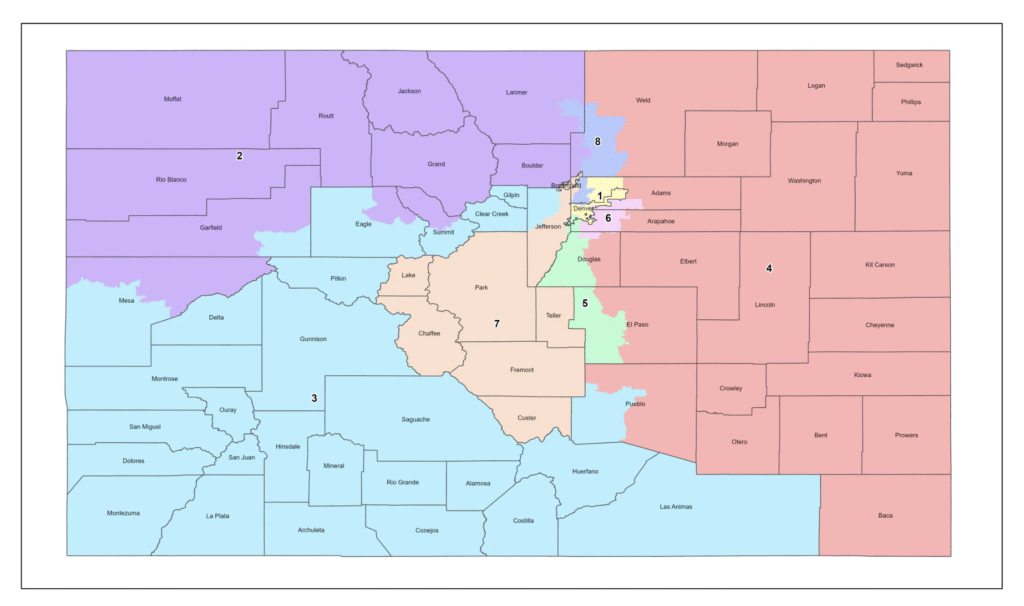
Redistricting scheme would give Colorado Democrats seven House members, split El Paso County | Bob Loevy
Bob Loevy
bob-loevy@coloradopolitics.com
Updated 2 days ago
A proposed redistricting plan, which could give Colorado seven Democratic members of the U.S. House of Representatives and only one Republican, would split El Paso County into two parts and thereby weaken the county’s influence in Congress. El Paso County,...