

Amendment H dastardly dishonest about judicial discipline | OPINION

Chris Forsyth
You know those scary movies where there’s a monster lurking and no one knows? You’re in one right now. It’s a ballot issue with a big “H” for Halloween.
But Amendment H is not that straightforward. Even its ballot title doesn’t fully inform you of what it is. I, and many others, sincerely wish all the claims about Amendment H were true. Unfortunately, they’re not. And Amendment H will make you scream.
Amendment H regards judicial discipline. If someone believes a judge has violated the Code of Judicial Conduct, they can file a complaint with the Colorado Commission on Judicial Discipline. After a judicial scandal was reported involving the state court administrator and chief justice, legislators convened to address judicial discipline.
But everywhere legislators turned, judges were influencing them. The separation of powers was nowhere in sight. And thus the spell of “H” was cast.
Those under the spell claim Amendment H would hold judges more accountable, that there would be more transparency and a new board would be “independent.” Only when the spell is broken will anyone realize that none of these allegations are true. But will it be too late?
The current judicial discipline commission would remain in place under Amendment H. Since 1984, 7,157 complaints have been filed by the public against judges. These figures are from the annual reports of the discipline commission. Of those complaints, 7,145 (99.8%) were handled out of public view. Those beguiled by H believe it will change all of this. It will not. The darkness will remain.
Stay up to speed: Sign up for daily opinion in your inbox Monday-Friday
In 40 years, the discipline commission issued private discipline in 182 complaints. That’s 2.5% of all complaints filed. Amendment H would not only leave all such slaps on the wrist in the dark, it would give those who would receive private discipline a reprieve.
Amendment H provides that judges can confidentially appeal private discipline to a panel of three selected from a 12-member adjudicatory board. It’s a second chance for a judge to get a complaint dismissed covertly. Then a third chance is provided by Amendment H because the panel’s ruling could privately be appealed to the Supreme Court.
So Amendment H would create more actions that can take place in private — multiple private appeals of private discipline. And it increases the Supreme Court’s involvement in judicial discipline. The Supreme Court is not currently involved in private discipline. But now we know how Michael Myers keeps coming back in all those Halloween movies — secret appeals.
A public hearing would be required under Amendment H when an accused judge and the commission don’t agree regarding public discipline and the commission desires a formal hearing. Historically, this happens in less than 1% of complaints filed by the public.
There are only 12 cases of public discipline in the last 40 years. That’s 0.17% of total complaints filed. So when the full moon, the blood moon and the harvest moon all coincide with a dozen howling werewolves at the Interstate 70 and Interstate 25 intersection in Denver, Amendment H would create a public hearing.
At this point, Amendment H would not allow the commission to proceed on its own in private as it currently does. It would require an additional step to discipline a judge. The commission would refer the matter to a separate three-member panel, selected from the 12-member adjudicatory board.
The ballot title and text of Amendment H claim the adjudicatory board is “independent.” But wicked spells distort reality.
Members of the adjudicatory board created by Amendment H would be selected by the Supreme Court and the governor. The Supreme Court would also appoint members to a rulemaking committee whose rules the adjudicatory board would have to obey under Amendment H. And the three-member adjudicatory panels selected from the adjudicative board to hear a formal judicial discipline proceeding under H? They would be selected by the state court administrator who is hired by, and reports to, the Supreme Court. The Supreme Court already appoints members to the discipline commission that remains in effect under Amendment H.
And if that wasn’t enough Supreme Court influence, Amendment H also provides that the board’s ruling on public discipline can also be appealed to the Supreme Court. Under Amendment H, the Supreme Court would review issues of law “de novo.” That means the Supreme Court would still be the ultimate authority on interpreting the Code of Judicial Conduct. Facts would not constitute a violation of the Code of Judicial Conduct unless the Supreme Court interprets the code to say the facts constitute a violation.
Amendment H increases the Supreme Court’s involvement in judicial discipline, makes it harder to discipline judges, creates more proceedings held out of public view and makes it more likely judges will remain unaccountable.
The “H” spell turns the lemon of the judicial scandal into the lemonade for judges that is Amendment H. Colorado must enact laws that decrease the judicial branch’s ability to influence legislators. That’s how we got here. We have to ensure this doesn’t happen again.
But first, we must break the spell. Wake up! “H” stands for hogwash.
Chris Forsyth has practiced law in Colorado for 30 years and is executive director of The Judicial Integrity Project (judicialintegrity.org).


You get what you pay for in your state reps | Hal Bidlack
Hal Bidlack
hal-bidlack@coloradopolitics.com
Updated 16 hours ago
My regular readers will know of my affection for the Out West Roundup, a Colorado Politics feature that lets us keep up to date with the goings on out here in the western U.S., and draws attention to stories that...

A warrant should mean something — expedite carrying them out | OPINION
Colorado Politics
colorado-politics@coloradopolitics.com
Updated 16 hours ago
By Aaron Ping My name is Aaron Ping. I am a father from Washington state, and I am writing because my 16-year-old son, Avery, cannot. Avery died on Dec. 19, 2024. The drugs that killed him were ordered through Snapchat....

Lower Basin must adapt to Colorado River hydrology | OPINION
Colorado Politics
colorado-politics@coloradopolitics.com
Updated 16 hours ago
By Nick Peters A February deadline for determining future operating guidelines for the West’s two largest reservoirs came and went with no agreement on the table and clear lines drawn in the sand. A seven-state resolution to how Lake Mead and Lake Powell will...

Keep kids safe without overregulating childcare | OPINION
Colorado Politics
colorado-politics@coloradopolitics.com
Updated 8 hours ago
By Tamra Ryan As the Coors Economic Mobility Fellow for Common Sense Institute, I have written several reports in the past two years about the challenges related to affordability and availability of child care in our state. Though there are many factors affecting the dearth of...

Colorado’s GOP at its best — and worst | Dick Wadhams
Dick Wadhams
dick-wadhams@coloradopolitics.com
Updated 3 days ago
By Dick Wadhams Colorado Republicans are fighting to be relevant in the face of gross mismanagement by Democrats who totally control state government. While the Colorado Republican Party is mired in controversy, several Republican elected officials and candidates represent the...

Someone’s lying in latest activist embarrassment for Polis’ CPW Commission | Rachel Gabel
Rachel Gabel
rachel-gabel@coloradopolitics.com
Updated 3 days ago
Either Samantha Miller is lying, or Gov. Jared Polis is. If Miller is lying, she is so secure in the red carpet rolled out for animal activists by this administration she is willing to put words in the governor’s mouth....

Ask Secretary of State candidates if they’re in favor of independent election audits | Jon Caldara
Jon Caldara
jon-caldara@coloradopolitics.com
Updated 5 days ago
This part will disappoint angry people on Twitter: Relax. Put the pitchforks down. I am not relitigating the 2020 election or mail ballots or even Tina Peters. But I am saying people don’t trust elections like they used to. And...

Redistricting plan to give Colorado Dems 7 members of the U.S. House will split El Paso County | Bob Loevy
Bob Loevy
bob-loevy@coloradopolitics.com
Updated 3 days ago
A proposed redistricting plan, which would give Colorado seven Democratic members of the U.S. House of Representatives and only one Republican, will split El Paso County into two parts and thereby weaken the county’s influence in Congress. El Paso County,...

Can deliberation save democracy? | Vince Bzdek
Vince Bzdek
vince.bzdek@gazette.com
Updated 1 day ago
In September 2019, 523 Americans traveled to Dallas for an experiment called “America in One Room.” The gathering was designed to test a theory: Could representative citizens deliberate productively even in an era of intense polarization? The event focused on...
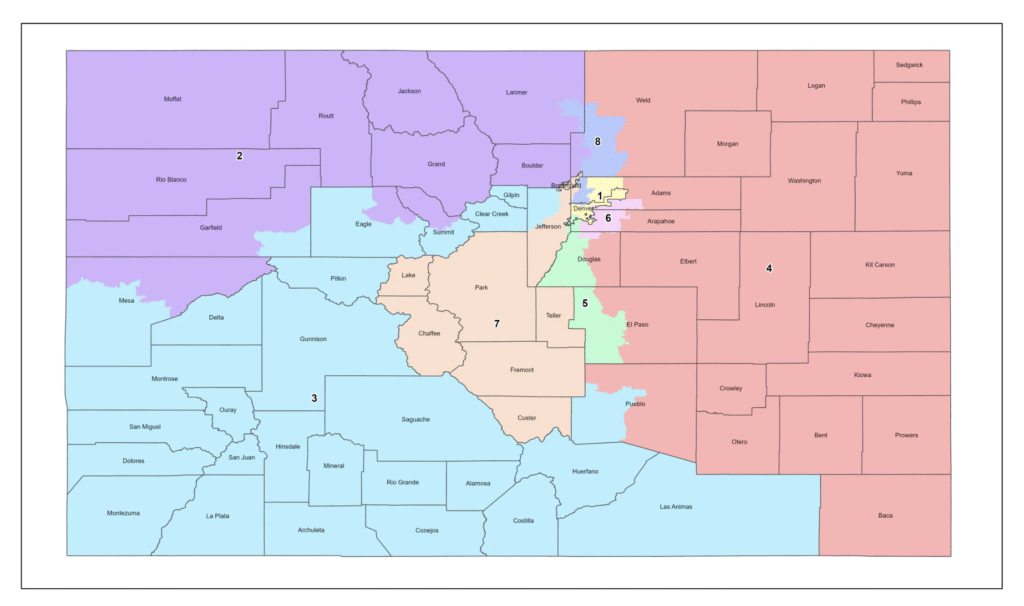
Redistricting scheme would give Colorado Democrats seven House members, split El Paso County | Bob Loevy
Bob Loevy
bob-loevy@coloradopolitics.com
Updated 2 days ago
A proposed redistricting plan, which could give Colorado seven Democratic members of the U.S. House of Representatives and only one Republican, would split El Paso County into two parts and thereby weaken the county’s influence in Congress. El Paso County,...