

What to do with candidates who won’t respond to surveys? | PODIUM

Roland Halpern

Roland Halpern
In election years I like to focus on how voters feel about animal welfare issues as well as their expectations the candidates they vote for share similar values. We know Coloradans love their pets. A full 64.7% of Colorado households own a pet and a poll conducted in 2021, found among registered Colorado voters, 62.7% said they would be more likely to vote for candidates who support strong animal protection laws.
To aide voters’ decision making, Colorado Voters for Animals publishes its “Ballot Buddy” based on the results of a survey in which candidates are asked how likely or unlikely they are to support potential future legislation, or they can indicate they are undecided. The results are averaged, and each candidate is ranked on his or her degree of “animal-friendliness” ranging from “zero” to 100%.
Stay up to speed: Sign up for daily opinion in your inbox Monday-Friday
For our 2024 survey we compiled a list of candidates using information from the Colorado Secretary of State’s TRACER database. An initial survey invitation was emailed to candidates on July 12 with a follow-up email on July 21. If there was still no response, a hard copy letter was mailed on August 12th to the candidate’s address on record. This letter provided a link for the survey, and additionally an offer to send a hard copy survey with a postage-paid return envelope.
Of the 178 candidates receiving surveys (no emails or letters were returned as undeliverable) only 58, or about 33% responded, meaning approximately two-thirds of voters don’t know their candidate’s position on animal welfare. Why such a poor return is hard to say, given two of the questions simply asked what role animals played in the candidate’s life, and whether there were any current animal related issues important to them; questions that every candidate could answer. Perhaps a candidate was running unopposed and so felt there was no need to reply. Or maybe the candidate doesn’t comprehend the importance animal welfare issues play in the lives of their constituents.
So, what do voters think about candidates who won’t respond? We decided to conduct a survey asking just that question. We emailed invitations to our supporters, intentionally closing the survey when it reached 200 responses, as we felt that was a respectable representative sampling. One supporter was eliminated after indicating they were not registered to vote. All the others claimed they were registered and would be voting in November. And all answered “yes” to the question “Are you more likely to vote for candidates who support strong animal welfare and protection laws?”
We also asked what supporters felt about those candidates who didn’t respond. Of the multiple choice answers, 63% said they would not trust the candidate as much, 26% said they would not vote for the candidate, 3% said it made no difference in their voting decision and 8% checked “other.” They entered comments such as “I would be disappointed but still vote if they were the better candidate,” and “A candidate who does not participate likely would not be supportive of animal protection measures.”
To be clear, this was not intended to be a highly scientific peer-reviewed study prepared for publication in a political science journal. Rather, it offers a snapshot from a cohort of voting animal-lovers reflecting their support for candidates who share their values, as well as their distrust of those candidates who refused to participate in the survey.
Given some races are decided by a few hundred votes — or less — candidates who did not respond may be doing so at their own peril. They very well could be losing votes that could carry them over the finish line.
Colorado Voters for Animals’ “Ballot Buddy” will be available on line in late September on CVA’s website under the “Elections” tab.
Roland Halpern is executive director of Colorado Voters for Animals, a nonpartisan nonprofit advocacy organization whose mission is to identify and help elect animal-friendly candidates and work with lawmakers to pass sensible animal protection laws.


‘CoCo’ would take taxpayers for a ride | John Caldara
Jon Caldara
jon-caldara@coloradopolitics.com
Updated 2 days ago
Colorado wants taxpayers to spend another $4.73 billion on passenger rail. Don’t worry. They have a plan. Which is a little like your brother-in-law announcing he’s launching another exciting restaurant venture after his last three restaurants ended in bankruptcy. Please....
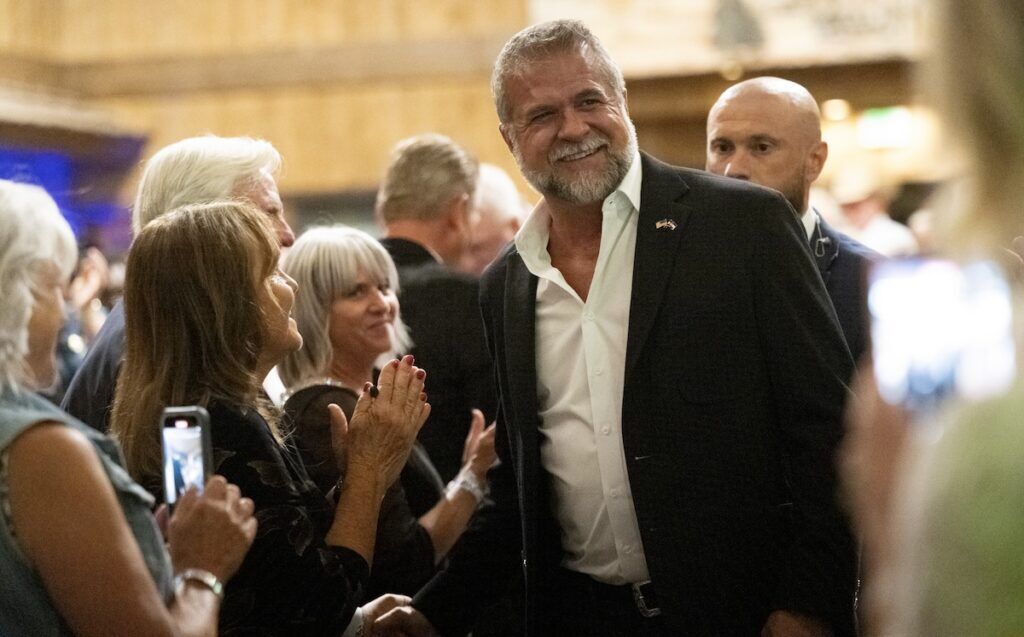
The through line from Donald Trump to Victor Marx | SONDERMANN
By Eric Sondermann
by-eric-sondermann@coloradopolitics.com
Updated 4 days ago
Over 10 years ago, before Donald Trump could ever defeat Hillary Rodham Clinton, he had to first engineer a hostile takeover of the Republican Party. Prior to his descent of that golden escalator, the previous seven Republican presidential nominees had...
Primary voters rejected big money in politics | Paula Noonan
Paula Noonan
paula-noonan@coloradopolitics.com
Updated 1 day ago
While we’re in an election campaign lull between now and Labor Day, we have time to consider the impact of $102 million in campaign contributions in the primary. In the general election, more money will fill candidate campaign coffers, and...
Colorado’s primary proved in this political climate money doesn’t buy electoral happiness | Paula Noonan
Paula Noonan
paula-noonan@coloradopolitics.com
Updated 3 days ago
To catch you up, campaign committees from this 2026 election cycle already collected and shoveled out a lot of cash: $102.64 million. That’s contributions in all forms — dollars, in kind, loans, etc. — from December 2024 to now. Total...
Protecting Colorado from wildfire starts before fire arrives | PODIUM
Colorado Politics
colorado-politics@coloradopolitics.com
Updated 4 days ago
By Rick Cables Colorado is once again being reminded of how significantly wildfires can affect the people and places we love. In southern Colorado, the Aspen Acres fire has burned through the Wet Mountains near Beulah and Rye, quickly becoming...
Stop making business the health care scapegoat | GUEST COLUMN
Colorado Politics
colorado-politics@coloradopolitics.com
Updated 1 week ago
By John Carson It is perhaps a sad commentary in the wake of our nation’s 250th birthday to note even in this hyper-polarized age, one thing nearly every American can agree on is American health care is a mess. But...

Could an independent win CD-1?
Greg Fulton
greg-fulton@coloradopolitics.com
Updated 4 days ago
Turnout in Colorado’s 2026 primary election should concern many citizens. Only 36% of active registered voters participated, meaning a relatively small share of the electorate effectively determined the choices voters will see on the November ballot. Low participation has allowed...
Affronts to our children’s children | Hal Bidlack
Hal Bidlack
hal-bidlack@coloradopolitics.com
Updated 5 days ago
As my regular reader (hi Jeff!) will recall, I’m quite fond of the Colorado Politics section called Out West Roundup. On that page, readers can learn about quite a few things happening in the American west that missed the front...

The CPW Commission’s act of courage | GUEST COLUMN
Colorado Politics
colorado-politics@coloradopolitics.com
Updated 1 week ago
By Eric Washburn Winston Churchill once said: “Courage is rightly esteemed the first of human qualities because, as has been said, it is the quality which guarantees all others.” Until this year, CPW has allowed hunters to kill as many...
The CPW Commission’s act of courage | GUEST COLUMN
Colorado Politics
colorado-politics@coloradopolitics.com
Updated 1 week ago
By Eric Washburn Winston Churchill once said: “Courage is rightly esteemed the first of human qualities because, as has been said, it is the quality which guarantees all others.” Until this year, Colorado Parks & Wildlife has allowed hunters to...