

How will Colorado navigate ‘The Storm Before the Calm’? | HUDSON

Miller Hudson
I’ve always harbored doubts about futurists who claim American history is steered by predictable social and economic cycles. I’m reminded of a book that undermines the pyramidologists, mostly Victorian explorers, who took thousands of measurements at Giza — returning to England and playing with them for a decade. A modern laptop would have reduced their labors to a few minutes and discovered hundreds of relationships that mimic geometric and mathematical constants. Touted as proof of alien or divine influence in the construction of the Egyptian pyramids, similar results can be produced by measuring the Washington Monument.
Consequently, I was skeptical when I picked up George Friedman’s, “The Storm Before the Calm.” Friedman is the founder of Geopolitical Futures, a forecasting company that works mostly with private businesses. Before that he served as chairman of STRATFOR, a global intelligence clearing house. He also penned the bestsellers, “The Next Decade “and “The Next 100 Years.” Published in 2020 before the last presidential election, “The Storm Before the Calm” has been receiving recent attention for its surprisingly accurate predictions regarding the political turmoil afflicting the United States. Friedman postulates a pair of American crisis cycles: an 80-year governmental and institutional realignment repeatedly linked to wars and a recurring 50-year socioeconomic restructuring. For the first time, they are arriving simultaneously at the end of this decade.
Stay up to speed: Sign up for daily opinion in your inbox Monday-Friday
I’ve always been more of a “black swan” believer, looking for unexpected disruptions rather than searching out patterns. One conclusion I’ve reached is that we tend to overlook the perspective of historical figures since the advent of the industrial and technological revolutions. We forget they perceived their lives and world as being slick and modern and as advanced as civilization would ever achieve. They were dead wrong, of course. Change just keeps hurtling at us — trains, automobiles, planes, radios, nuclear bombs, television, space travel, personal computers, email, Twitter and now, artificial intelligence. It’s all proven so glamorous we forget to attend to the obligations of family, romance and friendships. How can they be as important, exciting and world-changing as whatever new tech gadget will appear next?
My grandfather, Byron Howard, was born in 1881. He was released from the Naval Academy in 1901, after losing hearing in one ear following a mastoid infection. He then traveled to Boise, Idaho from Maryland by train and rode on to the School of Mines in Moscow, Idaho by stagecoach. In 1903 he departed for the Klondike gold fields where he would remain until 1916, returning to Minnesota as a mining engineer on the Mesabi Iron Range. He lived with us when I was attending high school. I remember his discovery of Alvin Toffler’s bestseller, “Future Shock,” which upset him considerably. Toffler’s prognostications left him concerned my brother and I were destined for a dismal future. I never bothered to read the book then but recently located a used copy, at least in part to discover what Toffler may have gotten wrong. My grandfather had experienced more change in his 90 years than I imagined I would ever witness.
Friedman argues the major institutional failure causing our growing political friction is the complexity of the federal government and a societal surrender to technocracy and the cult of expertise. This formulation caught me somewhat by surprise — I suspect because I’ve spent much of my working life enmeshed in this technocracy. He believes we are fast approaching our fourth institutional cycle, the first running from the Revolution through the Civil War, the second extending through our victory in WWII and the present cycle dominated by technological innovations. Our fourth lies immediately ahead, but Friedman envisions choppy political seas as we transition to a more humane arrangement between bureaucrats and voters. Friedman predicts the candidate elected in 2024 will experience a failed presidency only to be replaced by the man or woman who restores calm and launches another era of prosperity. I can imagine far grimmer scenarios.
Friedman has a point, however, about how the complexity of governance has grown so opaque that the Affordable Care Act, as an example, ran more than 2,000 pages, replete with provisions that were actually contrary with one another. This was the byproduct of “too many cooks in the kitchen,” each drafting their tiny piece without any coordination, which prompts me to consider the failure of last year’s 58-page Proposition HH advertised as the solution for reducing property taxes. In fact, it only shrunk the size of expected increases. All this legerdemain came across to voters as a bait-and-switch maneuver. This November’s 38-page substitute will ask Colorado homeowners to choose between a complicated rate-braking formula, which wisely includes Republican input, up against brief, understandable property tax caps offered from right field think-tanks.
In a brief encounter with one of the 2024 legislation’s senate sponsors, I pointed out legislators were at a disadvantage as they were once again proffering property tax relief only in so far as it slows the degree of increase and then markets this as tax savings. “It could have been worse!” makes a dubious campaign slogan. The sponsor’s response was, “Voters need to decide whether their elected legislators should be writing property tax laws, or should it be Phil Anschutz?” It’s true Anschutz has been a career donor to Republican causes and candidates (as well as owner of this paper), but it’s unlikely he has a granular command of Colorado’s property tax conundrum. Homeowners feel no sense of responsibility for, nor the legitimacy of the phenomenal run-up in residential home values. It can even be suggested that decades of wiser land use policy would have headed off our housing shortage in the first place.
Addressing our current political crisis, Friedman observes, “Conflict will build into one between expertise and common sense. Expertise will make the valid claim that the issues are complex and need to be managed by experts… (while) common sense argues expertise… neglects citizens’ experience so profoundly that it only creates the illusion of a solution.” Does that sound familiar?
Miller Hudson is a public affairs consultant and a former Colorado legislator.

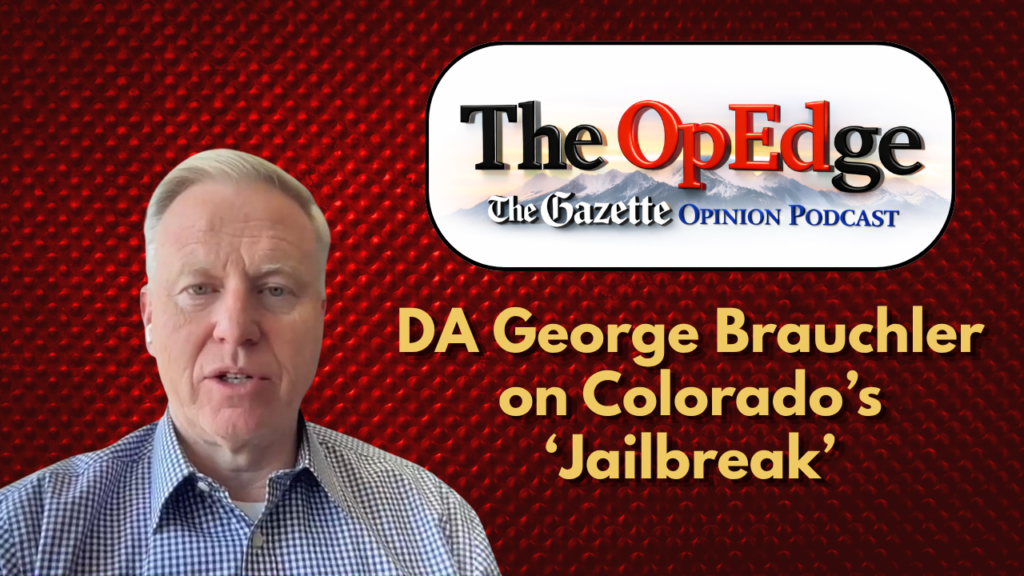
George Brauchler on Colorado’s ‘Jailbreak’ | The OpEdge Podcast
Tony Olivero
tony.olivero@gazette.com
Updated 9 hours ago
We are pleased to introduce the inaugural episode of The OpEdge — The Gazette’s new opinion podcast. District Attorney and law enforcement hawk George Brauchler tells host and investigative columnist Jimmy Sengenberger what lawbreakers can expect in the 23rd Judicial District. Brauchler recaps...
Update, safeguard Colorado’s mail ballot with voter ID | PODIUM
Colorado Politics
colorado-politics@coloradopolitics.com
Updated 11 hours ago
By Chuck Broerman and Suzanne Taheri Coloradans often refer to our state as a leader for accessible and secure elections. We have led on all-mail ballots, automatic voter registration, and same-day registration, turning Colorado into a model for modern elections...
Preserving access for vulnerable communities should be a top priority in Congress | OPINION
Colorado Politics
colorado-politics@coloradopolitics.com
Updated 11 hours ago
By Tony Henderson As both a minister and as president of the NAACP Denver, I believe access to high-quality, accessible health care is a right that should be afforded to each and every one of us. To that end, Medicare...
Yet again, when rights are in conflict | Hal Bidlack
Hal Bidlack
hal-bidlack@coloradopolitics.com
Updated 2 days ago
I admit, it is going to take quite a bit of self-control to not have this entire column end up being yet another screed about a certain president who continues to shock the world in his race to the bottom...

Turn blueprint into action with the Outdoors Opportunities Act | OPINION
Kent Thiry
kent-thiry@gazette.com
Updated 2 days ago
Nearly a year has passed since Gov. Jared Polis, Colorado Parks and Wildlife, the Colorado Department of Natural Resources, Colorado’s Outdoor Recreation Industry Office and other key partners finalized the visionary Colorado Outdoor Strategy, establishing the framework to ensure Colorado’s...
Let Colorado’s communities govern their own neighborhoods | OPINION
Colorado Politics
colorado-politics@coloradopolitics.com
Updated 2 days ago
By Jeff Bailey and Cindy Bailey Coloradans have always done things their own way. From how we manage our land to how we build our economies, the instinct to govern locally — to trust mayors, councils and commissioners over distant...

Threats inside and out loom for Colorado’s Republicans | Dick Wadhams
Dick Wadhams
dick-wadhams@coloradopolitics.com
Updated 3 days ago
Colorado Republicans made strides in 2024 despite an insidious state chairman who tried to defeat successful Republican candidates. Newly elected U.S. Reps. Gabe Evans, Jeff Hurd and Jeff Crank fought off unethical opposition from their own state party chairman, making...

Is it time for both parties to bail on Colorado’s political nominating system? | Miller Hudson
Miller Hudson
miller-hudson@coloradopolitics.com
Updated 3 days ago
Cracks are beginning to appear in Colorado’s political nominating system. Recently, Mario Nicolais, a formerly Republican-leaning pundit, and Doug Friednash, former Democratic legislator, have opined regarding the imminent demise of the caucus/assembly framework which controls partisan candidate selection. There has...

Recognizing the value of generational work | Rachel Gabel
Rachel Gabel
rachel-gabel@coloradopolitics.com
Updated 3 days ago
The Lesser Prairie Chicken habitat in southeastern Colorado is a swath of prairie that begins in Cheyenne and far-southeastern Lincoln counties and moves south and east into Kiowa, Prowers and Baca counties. This is cattle country where the short grass...
Why the controversy with mail-in ballots? | Cronin & Loevy
Tom Cronin Bob Loevy
tom-cronin-bob-loevy@coloradopolitics.com
Updated 3 days ago
Most Coloradans enjoy the right to vote “by mail” at election time. Most Americans favor this process. But U.S. President Donald Trump is trying to federalize (nationalize) this practice and shift the supervision of voting from county clerks to the...