

Equal isn’t equal in Colorado public education funding | NOONAN

Editor’s note: The following article has been edited from a previous version
Hooray for Gov. Jared Polis and the state legislature’s Joint Budget Committee (JBC) for pitching in $450 million extra to public education. Hooray for the governor and the JBC for bringing Colorado’s public education funding to 1989 levels. Say what?
The Great Recession concluded more than a few years ago. So why has it taken so long for the JBC, the governor and the state legislature to implement the state constitution’s Amendment 23, approved by voters, to add funds each year for education finance to cover growth, inflation and a little bit more? Every tooth but one has been pulled from the mouth of public education to get this 2024 funding deal done. What we have now is a one-tooth smile congratulating our elected officials for what they should have accomplished years ago. A whole generation of students has graduated from our public schools without the support they needed, even during COVID, to reach our ostensible but wildly underfunded education goals.
Stay up to speed: Sign up for daily opinion in your inbox Monday-Friday
A School Finance Task Force has put forward recommendations to change our school finance formulas. Their mission did not include offering recommendations concerning our inscrutable school finance revenue collection. Over the years, before and after TABOR passed in 1992, voter decisions, legislature indecision and cowardice have created public school funding budgets that defeat the best mathematicians in the state. Our school funding basis in property taxes with state funds acting as “equalizer” has produced a radically unfair taxing system that puts school districts unwilling to pay their fair share of school taxes at an advantage over school districts that have stepped up.
The following is an attempt to make clear the inexplicable.
For individuals interested in examining Colorado’s school finance formulas and per-student, per-district funding dollars, they should go to the Colorado Department of Education’s Fiscal Year 2023-2024 school finance funding document on the CDE’s website. The documents are, on first examination, difficult. But on further examination, it’s possible to disentangle the mess to discover how the state’s funding policies undermine supporting districts with significant education challenges while leaving districts with ordinary challenges off the hook.
Follow along: Most school districts, except for Charter Institute Schools, are funded based on local property taxes and state taxes from the general fund that “equalize” total per-student dollars to ensure each district receives approximately the same amount of money to educate students. Based on this concept, most districts get about $10,500 to $11,500 per student no matter how many challenges the districts may or may not face. The exceptions to this $10,500 to $11,500 rule are mostly rural districts. These are small districts with large geographies and sometimes high percentages of free/reduced lunch and English language-learning students. These districts can receive up to $16,000, in large part to cover transportation expense and lack of economies of scale in purchasing products and services necessary for educating children.
It’s important to note equal funding does not produce equal opportunity. It’s also important to note equal funding does not occur equally. Equal funding depends on how much property tax districts bring forward to cover the cost of educating their students. Some districts have “de-bruced,” taking themselves out of funding limitations of TABOR. These districts’ residents pay more property tax toward their school district funding. Other districts have not “de-bruced.” They rely on state funds to bail them out of gross underfunding of their schools. It seems, whether knowingly or inadvertently, the property tax vs. state tax funding mechanisms have resulted in “gaming” school finance.
In Adams County and Arapahoe County, as examples, four districts with large minority and English Language Learning student populations have stepped up with producing property taxes that about match or largely exceed the state funds that produce “equal” per student school finance. These districts are Mapleton 1, Adams 14, Englewood 1, and Sheridan 2. Mapleton and Adams 14 about match the state funding 50-50. Englewood and Sheridan, both majority-minority districts with low income and lots of English Language Learners, far exceed state funding with their local property tax dollars. Their local dollars reach these heights because their residents voted to “de-bruce” to increase their local revenues for their schools.
Some districts have de-bruced, such as Cherry Creek, but their mill remains lower than others. So while Adams 14 and Mapleton are currently at the maximum mill levy allowed by the state, .027, and Sheridan and Englewood are gradually climbing to that rate at .024 for Sheridan and .025 for Englewood, Cherry Creek school district is .0187. Cherry Creek’s local property tax contribution to their students’ education is $166,505,000 with the state pitching in $384,000,000.
Meanwhile, Englewood puts in $20,000,000 to the state’s $3,500,000; Sheridan pitches in $8,000,000 to the state’s $5,300,000; Mapleton provides $32,000,000 to the state’s $40,000,000; and Adams 14, that has received an on-going pummeling from the state, contributes $33,000,000 to the state’s $36,000,000.
To be clear, the state is paying about 70% of Cherry Creek’s per student cost of educating its students. The state is paying about 15% of the cost of educating Englewood’s students. To provide guidance as to how messed up this is, the median household income in Centennial, a major player in Cherry Creek School District, is $114,375. The median income in Englewood is $79,375, and in Sheridan it’s $53,000. Median income in Mapleton and Adams 14 is $66,000. Cherry Creek district has low income neighborhoods, but the majority rise above.
Our state’s school finance system allows Cherry Creek to maintain its relatively low property tax rate. Ironically, the state adjusts its contribution to the local contribution to reach the per student dollars. If a district contributes fewer dollars, the state pays more. If a district contributes more dollars, the state pays less. This is why equal is not equal in the state of Colorado.
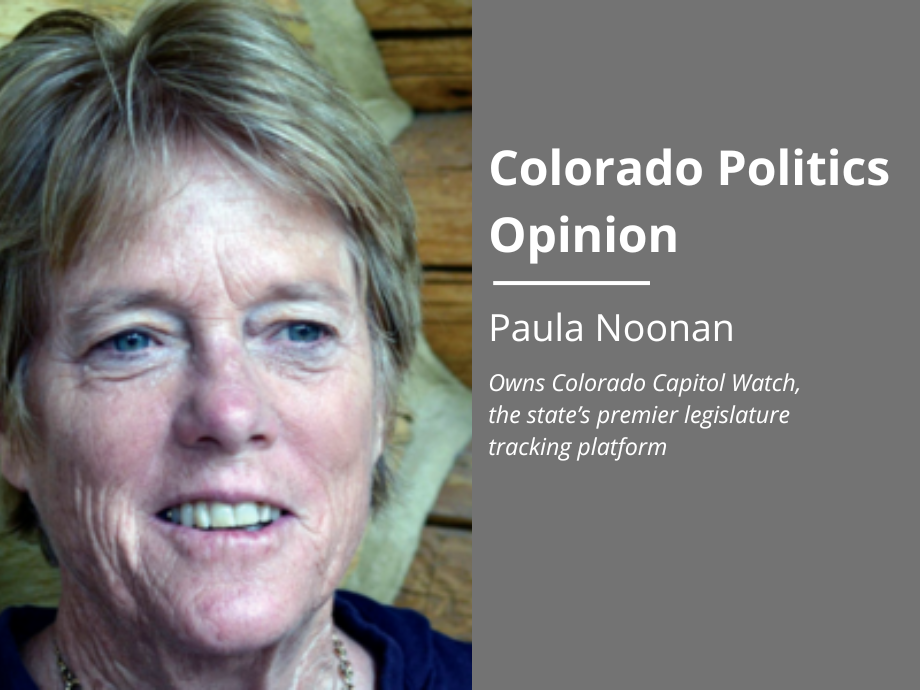
Paula Noonan owns Colorado Capitol Watch, the state’s premier legislature tracking platform.


Colorado’s election audits are built on math, not politics | IN RESPONSE
Colorado Politics
colorado-politics@coloradopolitics.com
Updated 2 hours ago
By Amanda Gonzalez You don’t build a secure election system overnight. You build it over years — layer by layer — reinforcing it with stronger safeguards, better technology and more transparency. In Colorado, one of those safeguards is a little-known...
The backstory behind the school-funding TABOR ballot initiative | Paula Noonan
Paula Noonan
paula-noonan@coloradopolitics.com
Updated 20 hours ago
Last session, the General Assembly took in a report on K-12 public school funding. The legislature ordered the report because an idea circulated Colorado was among the bottom five states in dollars allocated per student even though it is one...
Senate Bill 22 critical to keeping energy costs affordable, power reliable | PODIUM
Colorado Politics
colorado-politics@coloradopolitics.com
Updated 2 hours ago
By Brian Wortinger I love Colorado’s outdoors. I’m an avid skier and hiker and my happiest days are spent deep in the mountains with no one around for miles. I want to protect that environment as much as anyone along...
Swipe-fee ban a giveaway to big boxes, mega-chains | IN RESPONSE
Colorado Politics
colorado-politics@coloradopolitics.com
Updated 2 days ago
By Jenifer Waller Four Colorado lawmakers recently published an op-ed in Colorado Politics calling for legislation to prohibit interchange fees on the sales tax portion of credit and debit card transactions (“Why Colorado should stop charging swipe fees on sales...

Leveling the playing field —why Colorado must fight fire with fire on redistricting | OPINION
Colorado Politics
colorado-politics@coloradopolitics.com
Updated 1 day ago
By Curtis Hubbard So Dick Wadhams suddenly cares about mid-decade redistricting — hyperventilating about efforts to “hijack Colorado’s congressional map” and calling those of us involved with the effort “amazingly naive.” Where was his outrage last year when President Donald...
You get what you pay for in your state reps | Hal Bidlack
Hal Bidlack
hal-bidlack@coloradopolitics.com
Updated 3 days ago
My regular readers will know of my affection for the Out West Roundup, a Colorado Politics feature that lets us keep up to date with the goings on out here in the western U.S., and draws attention to stories that...
A warrant should mean something — expedite carrying them out | OPINION
Colorado Politics
colorado-politics@coloradopolitics.com
Updated 3 days ago
By Aaron Ping My name is Aaron Ping. I am a father from Washington state, and I am writing because my 16-year-old son, Avery, cannot. Avery died on Dec. 19, 2024. The drugs that killed him were ordered through Snapchat....
Lower Basin must adapt to Colorado River hydrology | OPINION
Colorado Politics
colorado-politics@coloradopolitics.com
Updated 3 days ago
By Nick Peters A February deadline for determining future operating guidelines for the West’s two largest reservoirs came and went with no agreement on the table and clear lines drawn in the sand. A seven-state resolution to how Lake Mead and Lake Powell will...
Keep kids safe without overregulating childcare | OPINION
Colorado Politics
colorado-politics@coloradopolitics.com
Updated 2 days ago
By Tamra Ryan As the Coors Economic Mobility Fellow for Common Sense Institute, I have written several reports in the past two years about the challenges related to affordability and availability of child care in our state. Though there are many factors affecting the dearth of...

Colorado’s GOP at its best — and worst | Dick Wadhams
Dick Wadhams
dick-wadhams@coloradopolitics.com
Updated 19 hours ago
By Dick Wadhams Colorado Republicans are fighting to be relevant in the face of gross mismanagement by Democrats who totally control state government. While the Colorado Republican Party is mired in controversy, several Republican elected officials and candidates represent the...
PREV
PREVIOUS

Bill's impact on state Rx affordability board penalizes rare disease patients | OPINION
Tamika Matthews Senate Bill 060 proposes the Colorado Prescription Drug Affordability Review Board (PDAB) “should have no authority to perform an affordability review of, or establish an upper payment limit for any prescription drug designated for a rare disease or condition as defined by the FDA.” The proposed exemption of “orphan drugs” in this bill […]

Colorado nursing homes need real solutions, not unfunded mandates | OPINION
Arlene Miles Staffing shortages have been long-standing within the long-term care profession, pre-dating the pandemic. For several years, nursing homes have sounded the alarm and called for help but have not received the help needed. The Biden administration’s remedy to impose an unfunded sweeping staffing-level mandate is opposite to what nursing homes need to solve […]