

Putting in perspective the price of liberty the Greatest Generation paid | HUDSON

The TV series, “Masters of the Air” (MOTA), is reported to be reaching the largest audience ever for the AppleTV+ streaming service. The fact this is the third in the World War II stories produced by Steven Spielberg and Tom Hanks, preceded by “Band of Brothers” (2001) and “The Pacific” (2010), has to be the major attraction. Their shared admiration for the “Greatest Generation” may not confirm the title but, without a doubt, it was among our bravest. Another audience seems to be a fangirl base taken with MOTA star Austin Butler’s performance in the movie “Elvis,” many of them no longer girls but who lost their own men in Vietnam.
It’s estimated platoon leaders in Vietnam, fresh from Officer Candidate School (OCS), were likely to be killed or wounded within their first 30 days “in country.” Wars demand courage. There’s no better example today than Ukraine. My 13-year-old grandson has developed a fascination with World War II. He is fortunate to have a pair of great-grandfathers who provided heroic service. My father-in-law, Earl Harnest, was a high school graduate from West Virginia. The U.S. army was running out of college graduates to train as pilots by 1944 and started identifying the smartest of the draftees, steering them to flight school. Earl met Marge, an acrobatic dancer at a Philadelphia night club. They were quickly married and their first son, Donald, was soon on the way.
Stay up to speed: Sign up for daily opinion in your inbox Monday-Friday
Earl flew off to England and a bomber group — not the 100th featured in Masters of the Air — but a comparable unit. The expected lifespans of these young men were even shorter than the infantry lieutenants in Vietnam. Somehow, Earl survived his required 25 or 30 missions that included two crashes — one into a turnip field in the Netherlands, fortunately after it had been liberated from German occupation, and a second several hundred yards short of his runway on a return to England with a single remaining engine. The Army pressured pilots to sign up for a second tour. Earl opted to return to Texas and train another crop of aspiring flyers. He was something of a barracks card shark and had amassed a substantial hoard of cash.
My own Dad was enrolled in the Naval ROTC program at the University of New Mexico in Albuquerque when the Pearl Harbor attack occurred. It was only a matter of days before Japanese Forces overran the Philippines. The New Mexico National Guard had been activated and dispatched to the island nation a few months earlier, equipped with World War I rifles. They were quickly defeated and became the bulk of the Americans enduring the Bataan Death March across Corregidor. You may have noticed the many monuments in Santa Fe to these captured soldiers. Their chaplain was a Catholic priest from the Mescalero Apache reservation near Ruidoso, who returned after the war to build a beautiful stone church there. My father knew he would surely be sent to the South Pacific. Receiving orders to OCS at a makeshift training facility on the campus of Columbia University, in New York City, he graduated a 90-day wonder.
He volunteered for mine sweep duty. I would only learn during my own Vietnam naval service from several senior chiefs this was regarded as so dangerous only volunteers were accepted. When I asked him, nearly 25 years later, why he had requested so dangerous an assignment, his reply was, “I wanted to come back all in one piece, or not come back at all.” Though this choice has its logic, it was not a logic he had shared with my mother. When the war concluded, he was required to remain an additional 18 months cleaning up American mines placed in shipping channels throughout the Philippines. During the evacuation of the islands, the maps to these minefields were lost — an oversight for which he held Douglas MacArthur personally responsible. My twin brother and I were nearly two years old before he arrived home.
Earl Harnest discovered his refusal to accept a second tour on the European flight line was held against him when he was passed over for promotion after the Japanese surrender — a variant on Joseph Heller’s “Catch-22” novel recounting the bomber war. Although he hoped for an Air Force career, it was not to be. Leaving the service before Korea, he declined a request to return to uniform. He took his now considerable poker winnings, much like Richard Nixon, another card shark, who used his cache to finance a Congressional campaign. Earl launched a chainlink fencing business in the Maryland suburbs outside Washington, D. C. just as home-building exploded. He sold his business just as chainlink was losing popularity and went to work for the city of College Park, home to the University of Maryland, as its public works director.
My Dad returned to college at New Mexico A&M in Las Cruces, where his parents were available to help babysit twin boys. With a degree in chemical engineering, he went to work for Phillips Petroleum in 1948. This led to an assignment at the Idaho National Reactor Test Site (now the Idaho National Energy Labs) and a career with the U. S. Atomic Energy Commission. The heroes of World War II, whose risks leave you shuddering as you watch the MOTA bomber crews, returned to raise families, build businesses and, in my father’s case, design nuclear warheads. In the final decade of his career, he joined the nuclear disarmament negotiating team at the Department of State, where he liked to quip, “They dispatch me and nine lawyers.” Someone in the delegation needed to understand how our weapons actually worked. It’s taken 80 years for such stories of incomprehensible courage to be told. Combat survivors rarely reveal the fears and pain they have endured. Hanks and Spielberg are opening our eyes to the price of liberty.
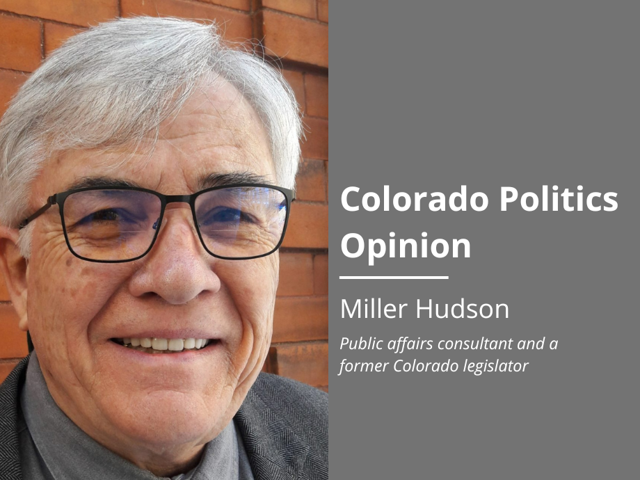
Miller Hudson is a public affairs consultant and a former Colorado legislator.


Colorado’s election audits are built on math, not politics | IN RESPONSE
Colorado Politics
colorado-politics@coloradopolitics.com
Updated 7 hours ago
By Amanda Gonzalez You don’t build a secure election system overnight. You build it over years — layer by layer — reinforcing it with stronger safeguards, better technology and more transparency. In Colorado, one of those safeguards is a little-known...
The backstory behind the school-funding TABOR ballot initiative | Paula Noonan
Paula Noonan
paula-noonan@coloradopolitics.com
Updated 1 day ago
Last session, the General Assembly took in a report on K-12 public school funding. The legislature ordered the report because an idea circulated Colorado was among the bottom five states in dollars allocated per student even though it is one...
Senate Bill 22 critical to keeping energy costs affordable, power reliable | PODIUM
Colorado Politics
colorado-politics@coloradopolitics.com
Updated 7 hours ago
By Brian Wortinger I love Colorado’s outdoors. I’m an avid skier and hiker and my happiest days are spent deep in the mountains with no one around for miles. I want to protect that environment as much as anyone along...
Swipe-fee ban a giveaway to big boxes, mega-chains | IN RESPONSE
Colorado Politics
colorado-politics@coloradopolitics.com
Updated 2 days ago
By Jenifer Waller Four Colorado lawmakers recently published an op-ed in Colorado Politics calling for legislation to prohibit interchange fees on the sales tax portion of credit and debit card transactions (“Why Colorado should stop charging swipe fees on sales...

Leveling the playing field —why Colorado must fight fire with fire on redistricting | OPINION
Colorado Politics
colorado-politics@coloradopolitics.com
Updated 2 days ago
By Curtis Hubbard So Dick Wadhams suddenly cares about mid-decade redistricting — hyperventilating about efforts to “hijack Colorado’s congressional map” and calling those of us involved with the effort “amazingly naive.” Where was his outrage last year when President Donald...
You get what you pay for in your state reps | Hal Bidlack
Hal Bidlack
hal-bidlack@coloradopolitics.com
Updated 3 days ago
My regular readers will know of my affection for the Out West Roundup, a Colorado Politics feature that lets us keep up to date with the goings on out here in the western U.S., and draws attention to stories that...
A warrant should mean something — expedite carrying them out | OPINION
Colorado Politics
colorado-politics@coloradopolitics.com
Updated 3 days ago
By Aaron Ping My name is Aaron Ping. I am a father from Washington state, and I am writing because my 16-year-old son, Avery, cannot. Avery died on Dec. 19, 2024. The drugs that killed him were ordered through Snapchat....
Lower Basin must adapt to Colorado River hydrology | OPINION
Colorado Politics
colorado-politics@coloradopolitics.com
Updated 3 days ago
By Nick Peters A February deadline for determining future operating guidelines for the West’s two largest reservoirs came and went with no agreement on the table and clear lines drawn in the sand. A seven-state resolution to how Lake Mead and Lake Powell will...
Keep kids safe without overregulating childcare | OPINION
Colorado Politics
colorado-politics@coloradopolitics.com
Updated 3 days ago
By Tamra Ryan As the Coors Economic Mobility Fellow for Common Sense Institute, I have written several reports in the past two years about the challenges related to affordability and availability of child care in our state. Though there are many factors affecting the dearth of...
Colorado’s GOP at its best — and worst | Dick Wadhams
Dick Wadhams
dick-wadhams@coloradopolitics.com
Updated 1 day ago
By Dick Wadhams Colorado Republicans are fighting to be relevant in the face of gross mismanagement by Democrats who totally control state government. While the Colorado Republican Party is mired in controversy, several Republican elected officials and candidates represent the...
PREV
PREVIOUS

What will Senate do as wolf-weary ranchers grill Polis's CPW appointees? | GABEL
Rachel Gabel The three appointees of Gov. Jared Polis to the Colorado Parks and Wildlife Commission faced the Senate Agriculture and Natural Resources Committee on Thursday. It was as fiery as I could have anticipated and, with the committee sending Gary Skiba and Jessica Beaulieu to the full Senate, saddled with an unfavorable recommendation. Jack […]
Patients with rare diseases deserve access to lifesaving drugs | OPINION
Jacinta M. Behne Imagine being diagnosed with a disease your friends and family have never heard of and your doctor may not know how to treat. It can feel isolating and terrifying. There is little information on the internet, and often times the information you can find is not promising. That’s often the experience of […]