

Colorado bill would modify felony charges for harming or killing law enforcement animals
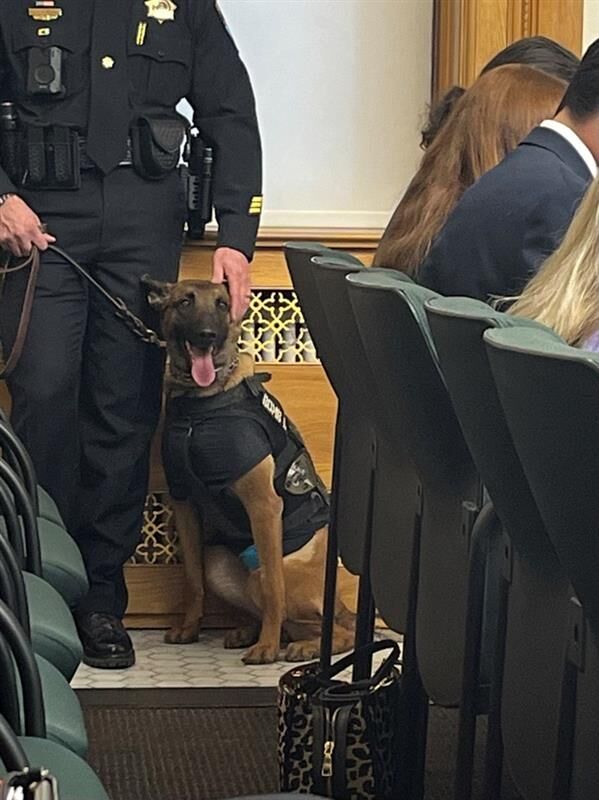
A bill that modifies the Class 4 felony for harming or killing a law enforcement animal is moving forward in the Colorado House.
House Bill 1074, sponsored by Reps Ryan Armagost, R- Berthoud, and Monica Duran, D-Wheat Ridge, passed the House Judiciary Committee in a 6-5 vote.
If signed into law, the bill modifies existing law to create a different kind of class 4 felony, one that specifies a separate class 4 felony charge for someone who “knowingly or recklessly” kills or harms a law enforcement animal, including when the animal is out of commission for at least three months.
The penalty for harming or killing a law enforcement animal is already a Class 4 felony, which carries a fine of up to $500,000 and up to six years in prison. The penalty does not change under HB 1074.
Law enforcement officers from several departments favored the bill, testifying about their strong bond with their canine partners.
Deputy Ronnie Hancock, a K9 handler with the El Paso County Sheriff’s Department, lost his police dog, Jinx, in 2022 after he was shot by a suspect in Manitou Springs.
“Without hesitation, Jinx laid down his life so that I, and the three other officers, could go home to our family that night,” Hancock said. “In that moment, our agency lost a force multiplier and a protector, and I lost my partner. I can’t even begin to tell you about the bond that was shattered that evening. The trust a K9 and its handler build and have with each other is indescribable.”
One state resident, Manige Blackburn, testified against the bill.
“Police dogs spend more time training than the officers themselves,” she said. “My concern is not with them, but their handlers. Should we really be increasing protections for the police’s use of weapons when we have lots of examples of their misuse where police are not held accountable? All the testimony we’ve heard ignores that policing in the U.S. is at odds with the communities they purport to protect and serve, and there is an astonishing lack of civilian voice and a lot of officers pretending to know what is needed.”
Commerce City Officer Gilbert Abdulla, a former K9 handler with the Adams County Sherriff’s Department, highlighted police dogs’ role as a de-escalation strategy. He recounted a specific incident in which a suspect in a domestic abuse case would not cooperate until a K9 arrived on the scene.
“Immediately the situation was dissolved,” Abdulla said. “It’s a great example of how these dogs are used as a de-escalation tool. We do not want to hurt people. We use the dog as a last resort to peaceably resolve [situations], so No. 1, citizens don’t get hurt, No. 2, suspects don’t get hurt, and No. 3, we don’t get hurt.”
After discussion, Reps Leslie Herod, D-Denver, and Mike Weissman, D-Aurora, proposed an amendment requiring law enforcement officers to intervene and report the incident to their supervisor if they see a colleague improperly using their K9. The amendment was adopted unanimously, along with three other minor amendments.
Rep. Javier Mabrey, D-Denver, voted against the bill.
“Animal cruelty is already a crime under Colorado law,” he said. “This legislation creates a different standard for aggravated animal cruelty based on the role of the animal, which I personally don’t believe should be a factor in determining when animal cruelty has taken place under the law.”
Mabrey also claimed research shows that increasing punishment and severity does little to nothing to prevent crime, noting it only breeds “more imprisonment and punishment.”
“Of course, animal cruelty is wrong. Of course, I want to do everything to prevent it. I just respectfully do not believe this bill will reduce actual instances of animal cruelty,” he said.
Editor’s note: The story was updated to clarify the bill’s correct verbiage.
marissa.ventrelli@coloradopolitics.com

Rep. Jeff Crank thinks Democrats are too focused on Trump, not enough on Colorado Springs | Vince Bzdek
Vince Bzdek
vince.bzdek@gazette.com
Updated 14 hours ago
For U.S. Rep. Jeff Crank, who’s unopposed in the Republican primary for the 5th Congressional District but the main target of both candidates in the lively Democratic primary, the big question in the midterms is not who will stand up...

Grand Junction roundtable spotlights public access while Interior faces scrutiny over targeted land sales
Scott Weiser
scott.weiser@gazette.com
Updated 5 days ago
U.S. Health and Human Services Secretary Robert F. Kennedy Jr. and Interior Secretary Doug Burgum joined Bureau of Land Management Director Steve Pearce in Grand Junction Wednesday for a roundtable focused on linking public land access to improved physical activity...
Flat or graduated income tax? Colorado groups push dueling measures for November election
Marissa Ventrelli
marissa.ventrelli@coloradopolitics.com
Updated 1 week ago
Colorado voters could face two opposing income-tax measures on the November ballot, with the dueling campaigns seeking to advance proposals that would take the state in sharply different fiscal directions. One initiative seeks to replace Colorado’s flat income tax with...
Colorado governor signs bill requiring pollution controls, cost reporting for extended coal operations
Scott Weiser
scott.weiser@gazette.com
Updated 1 week ago
Gov. Jared Polis signed into law a bill in reaction to orders from the U.S. Department of Energy to keep older coal units online. The federal government’s instructions applied to Craig Unit 1 in Colorado, one of five coal units...

A tale of two debates | Vince Bzdek
Vince Bzdek
vince.bzdek@gazette.com
Updated 2 weeks ago
Ballots go out Monday as the June 30 state primary elections bear down on us. As a result, it is suddenly the season of proliferating political debates, and there have been some doozies already. I had the chance to see two very...

As Colorado’s population growth slows, some metro counties see losses
Mark Samuelson Special to The Denver Gazette
mark.samuelson@denvergazette.com
Updated 3 weeks ago
Population growth in Colorado, which had helped drive the region’s burgeoning economy over recent years, has slowed markedly, with some counties in metro Denver experiencing losses, according to a new report. From 2024 to 2025 the state added just 33,151...

Colorado governor candidates confront business climate, housing affordability woes
Marianne Goodland
marianne.goodland@coloradopolitics.com
Updated 3 weeks ago
Four of the five major-party candidates for Colorado governor share common ground on two big issues: they see the perception that Colorado has become less business‑friendly as a serious concern, and they view housing affordability as central to the state’s...
Tapped: Worst winter in memory triggers cascading economic strain in Colorado mountain towns
Bernadette Berdychowski
bernadette.berdychowski@denvergazette.com
Updated 4 weeks ago
Editor’s Note: The Denver metro region sits at the center of one of the American West’s most complex and consequential water challenges. This series examines the interconnected systems that determine how the region secures, stores, and conserves its water while...

Business leaders see ‘cracks’ in Colorado, while governor insists state is ‘competitive’
Marianne Goodland
marianne.goodland@coloradopolitics.com
Updated 1 month ago
How does Colorado get back to the climate in the early 2000s, when there was collaboration between state government, companies and colleges and universities? That was the question posed to Gov. Jared Polis and a panel convened Tuesday by the...

Colorado’s proposed battery regulations target fire risks, raise enforcement, cost questions
Scott Weiser
scott.weiser@gazette.com
Updated 1 month ago
Some worry consumers would face civil or administrative fines under the legislation Lawmakers have passed new regulations mandating sellers of lithium-powered batteries to register with the state and produce outreach plans before they can engage in business in Colorado. Under...
PREV
PREVIOUS

Biden faces progressive reckoning on failed Senate border deal
President Joe Biden’s standing with the progressive Left could be further imperiled by his support for the Senate’s failed bipartisan border deal. Biden has faced months of slumping poll numbers and surveys that show him losing in November to former President Donald Trump due to the diminished turnout of his 2020 coalition. Those numbers have […]
Colorado House bill takes on 'predatory towing' practices
Towing companies are on notice to change their towing practices under a bill approved Tuesday by the state House Transportation, Housing and Local Government Committee. House Bill 1051 is the work of the Transportation Legislative Review Committee from last fall and the result of attention to what some described as predatory towing that lawmakers thought […]