

SPECIAL SESSION UPDATES: fourth (and final) day of special session

Editor’s note: We are tracking Day Four of the special session on property taxes. Check here for updates.
2:37 p.m. The General Assembly adjourns, sine die
And not one minute too soon, either.
2:05 p.m. Weinberg addresses House, responding to Epps
Over the last 45 minutes or so, Rep. Elisabeth Epps was up in the gallery with Pro-Palestinian protesters, while others tried to de-escalate the situation, including other members of her caucus.
It didn’t work, but the gallery has now been cleared by the House sergeants.
Rep. Ron Weinberg, R-Loveland, spoke for a few minutes, at times being shouted at by Epps, who was in the gallery at the beginning of his remarks. Not only did his entire caucus stand with him, but all the House Democrats stood behind him, as well. He talked about peace and collaboration and said no one supports genocide.
The Senate bill that started all of this, SB 2, passed on a 44-16 bipartisan vote.
The House has now finished its last piece of business, which was to concur on amendments on Senate amendments on the property tax task force.
And that’s a wrap.
1:20 p.m., Just when you thought they were done
The House recessed so that leadership from both parties could decide what to do next. Rep. Ron Weinberg, R-Loveland, who issued a statement on the anti-Semitic remarks made on Saturday, asked to be allowed to speak without being gaveled by the Democrats, pointing out that they are not being treated fairly. He was granted that permission and lattitude to speak his mind.
Weinberg began by noting that he’s had little sleep, but that the last 12 hours of the special session, going back to last night, “are not about the people of Colorado.” This bill (SB 2) has become about an international situation, not about Colorado kids, he explained.
As he continued to speak, those in the gallery began shouting at him, including Epps, who according to the Colorado Sun told Weinberg he was out of order. After multiple warnings from Speaker Pro tem Chris Kennedy, the House sergeants and state patrol told the protesters to leave for disrupting the House. They are refusing to leave, according to the Sun.
House Rule 23(b) does not allow lawmakers to disrupt or otherwise encourage disruption of House proceedings.
12:54 p.m. Epps seeks amendment on summer food and nutrition program
Rep. Elisabeth Epps is again attempting to introduce an amendment, this time on third reading, that appears to be similar to the one she tried last night. As opposed to a second reading amendment, a title ruling is not required.
Epps was denied permission to offer the amendment by a 39-21 vote.
She ended a 10-minute speech with “free Palestine!” She then went up to the House gallery, where Pro-Palestinian protesters continue to watch the proceedings.
12:30 p.m. Senate wraps up the last of its special session work, now awaiting adjournment
The Senate has approved the House amendments on Senate Bill 1. That’s it for the Senate’s work on the special session.
12:10 p.m. House starts to work on final vote on the summer food and nutrition program bill
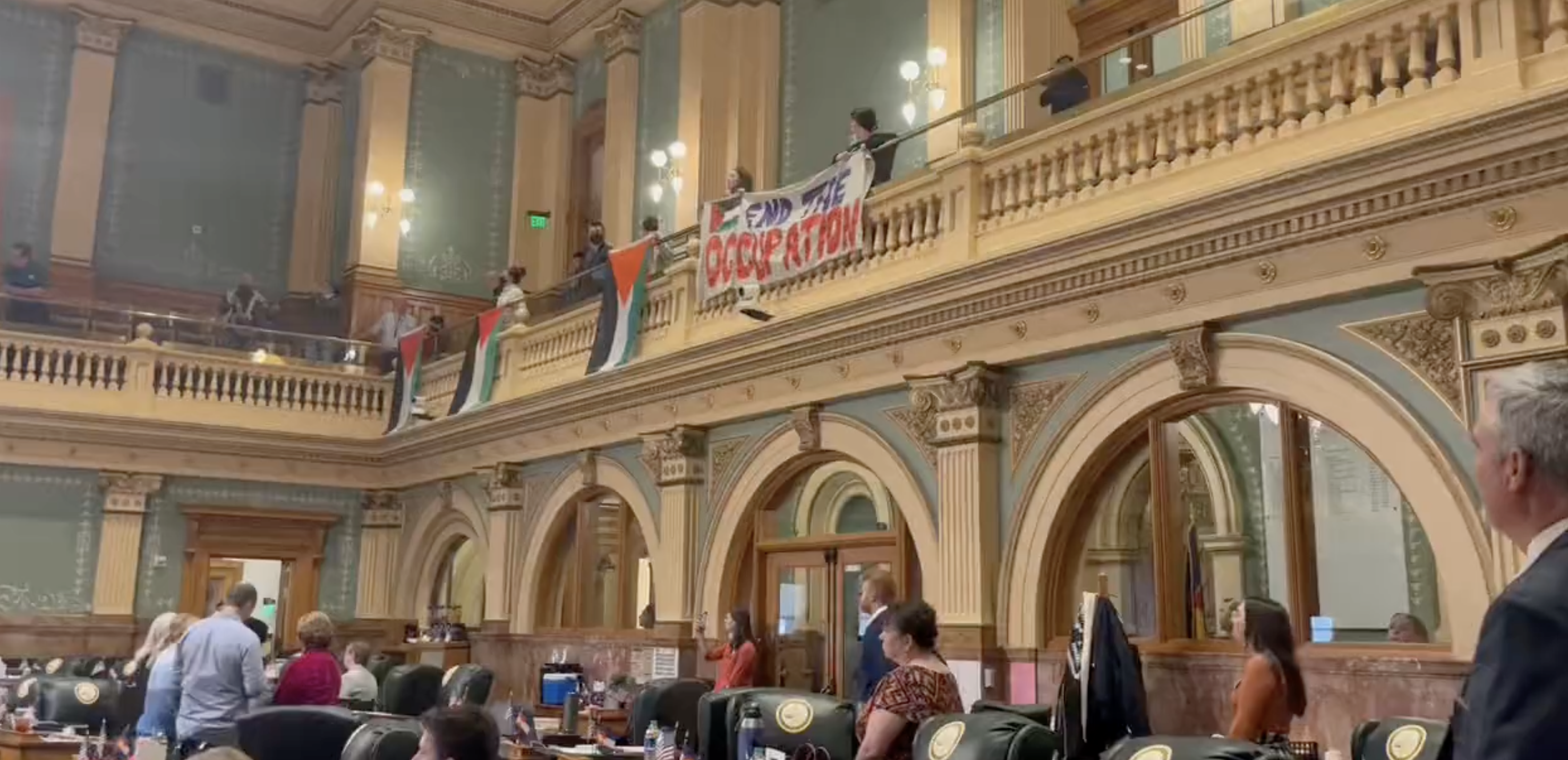
Senate Bill 23B-002, which almost caused the House to push the special session into a fifth day, is now up for its final vote. Protesters in the House gallery are once again displaying Palestinian flags. Speaker Pro tem Chris deGruy Kennedy told them they are welcome in the people’s house but to take the flags down.
11:45 a.m. Senate works on task force bill, now awaiting return of Senate Bill 1 from House
Senate President Steve Fenberg, in discussing the property tax task force bill, hinted at the tone of the special session and appears to be concerned that the 2024 session could be the same. I’m hearing that from others, that this special session could be a portend for 2024 and not a good one.
“Let’s take the temperature down…decide what to do together,” Fenberg said of the bill, but that could apply to the 120 days ahead.
The debate this morning on the task force, according to Sen. Chris Hansen of Denver, is “don’t confuse a lack of bipartisan votes” with the lack of bipartisanship on the task force, which as constituted could have as many 10 or 11 Republicans out of 19 members. That’s pretty good, Hansen said. He was responding to comments from Sen. Mark Baisley, R-Woodland Park, who complained about having a member of a teacher’s union on the task force and complaining that the Colorado Education Association tells Democratic lawmakers how to vote.
“This bill makes sure we have that rural perspective,” said Sen. Kyle Mullica, D-Thornton, who spent hours Sunday reworking the membership to address concerns about lack of rural representation.
Sen. Byron Pelton, R-Sterling, while advocating for a “no” vote on the bill, applauded the bipartisanship shown by Mullica, and his hope that that idea continues into the 2024 session.
The Senate has now voted on its two final bills, the task force (20-15, with three Democrats voting against) and on the rental assistance bill (HB 23B-1001), which passed on a 23-12 party-line vote.
The House amended Senate Bill 23B-001, the main property tax relief bill, and gave it final approval Monday morning on a 42-18 party-line vote (with five excused). Since it was amended the bill has has to come back to the Senate for their review and/or approval of the amendments.
10:45 a.m., Senate’s first order of business, getting outta here
The Senate has just introduced a resolution to adjourn sine die, which means we’re getting out of here sometime today, presumably. The resolution will be voted on later.
Monday 9:30 a.m. Waiting on House and Senate to start, and a wrap-up of last night’s shenanigans in the House
There was nearly a fifth day of the special session.
The House worked until 11:50 p.m. Sunday night, coming thisclose to pushing the special session into a fifth day.
The issue: the one bill that seemed to raise little objection: the summer food and nutrition program covered under Senate Bill 23B-002.
The bill came up late Sunday night with just two hours before the tolling of the midnight bell.
If the House had not finished their second reading debate on SB 2 before midnight, that debate would have to be finished on Monday, and by law the final vote couldn’t be taken until Tuesday. Meaning one more day of the special session.
The bill was then turned into a debate on the Palestinian-Israeli conflict by Rep. Elisabeth Epps, D-Denver.
House Majority Leader Monica Duran then announced debate would be limited to one hour. Once the bill’s sponsors had wrapped up their explanation of the bill, Epps asked for the 12-page bill to be read at length, eating up about 20 minutes of that hour.
Epps then asked for an amendment that would block any food being used for the program that came from the occupied territories. That could include hummus or dates, for example.
She also rejected calls from the chair of the debate to stick to the amendment, stating she would say what she needed to say. “You are not going to do this right now,” she said to Rep. Andrew Boesenecker, D-Fort Collins.
“I don’t know what the motive would be for wanting to feed one set of children while exploiting others…or to allocate our resources in a way that is just,” she told the House.
Epps spoke for 50 minutes, drawing the session closer to the midnight hour. As the hour allotted for the debate expired, Rep. Lorena Garcia, D-Adams County, asked for a title ruling on the amendment, to see if it fit under the bill’s title. Boesenecker ruled it did not, and that was the end of it, with just 15 minutes until midnight.
While Epps was shut down on the amendment, she wasn’t finished. She took to social media throughout the night to blast Garcia, normally one of her allies, and House Democrats for what she viewed as a betrayal. On X, at 6 a.m., she asked if Hamas was controlling the West Bank, stating she was asking on behalf of McCluskie and the House Democrats. She also called Garcia and co-sponsor Rep. Shannon Bird, D-Westminster liars, because she said they agreed not to challenge the amendment.
Epps claimed she yelled “shame on you” to Rep. Mike Weissman, D-Aurora, when both were in the state parking garage around 12:45 a.m.
Sunday 7:20 p.m., Senate has (finally) reconvened, working on task force bill
After a delay of several hours, the Senate is back to working on its final bill of the night.
Sen. Kyle Mullica, D-Thornton, is presenting the amendment that would shake up the membership of the task force contained in House Bill 23B-1003. He noted a bill offered during the 2023 session by Sen. Byron Pelton, R-Sterling, that would have set up a task force on long-term property tax relief solutions. Mullica said his amendment attempted to respect what Pelton was trying to do with that previous bill.
Mullica described his amendment as “putting out the olive branch” to the minority party.
Pelton, who is in his first term as a state senator but spent eight years as a county commissioner, has been the leader in the Senate on the task force issue. While Pelton complimented Mullica for his work on the amendment, there were a few areas in which they diverged, such as on regional representation for counties, which was in Pelton’s 2023 bill. The bill also would retain language that Republicans felt went beyond the scope of what the task force should be working on, such as looking at housing affordability and impacts of property tax increases on lower income Coloradans, including renters.
Pelton’s 2023 bill simply asked for a task force to look at the causes of rising property taxes, review best practices for short- and long-term property tax relief and make recommendations.
Sen. Dylan Roberts, D-Eagle, said when HB 23B-1003 came over from the House he was skeptical, in part because of its lack of local representation. He complimented Mullica particularly for inclusion of more county voices. He warned his Senate colleagues that if they don’t come up with their own task force ideas, “the governor will do it anyway.”
Notably, the amendment did not include the representation referred to as the “Michael Fields clause.”
The amendment passed, and the Senate approved the bill on a voice vote. It heads to a final vote on Monday and then will go back to the House for review of the amendment.
And that’s a wrap for the Senate tonight.
6 p.m. SB 1 is in da House
Senate Bill 1, the major property tax relief bill, is now being debated in the House on second reading. Republicans are running lots of amendments, including one that they suggested could use American Rescue Plan Act money for county backfill. Rep. Mike Weissman, D-Aurora, who seems to know something about everything, says that is not a permissible use of ARPA money.
5:30 p.m. Negotiations ongoing around task force bill
There’s chatter afoot around BIG changes to the property tax task force bill. The bill was amended by a strike below (basically, a rewrite) in the House but the committee’s makeup is drawing a lot of grousing from just about everyone.
Here’s the latest: the task force bill as amended was to include 18 members, 14 appointed by the governor, senate president and house speaker. That wasn’t going over well, given the past history by the governor, according to Republicans, of changing boards and commissions to eliminate as many Republicans and/or rural Coloradans as possible.
The rewrite also added someone from labor, causing some head-scratching over why that was necessary.
There’s a couple of amendments floating around the building. One, according to Jesse Paul of the Colorado Sun, would add what he initially called a “Michael Fields clause” to the bill, with an appointment from someone who’s running a ballot measure on property taxes in 2024. But the amendment also says it could be someone from an issue committee, leading to the idea that it could be someone from an anti-Initiative 50 committee.
The other amendment would substantially cut down the number of appointments to be made by the president, speaker and governor, add appointments to be made by the minority party leadership, and allow appointments to be made by the Colorado Municipal League, the fire chiefs and the Special District Association.
Senate Democrats are on the prowl for any Senate Republican who’d be willing to sign onto this amendment, which Republicans say is an improvement over the current version of the bill. But that also would mean Democrats could claim one of the property tax bills is bipartisan, and that’s not a victory Republicans are willing to hand to the majority party, at least at the moment.
4:30 p.m. Senate Bill 1 clears first House committee
The House Transportation, Housing and Local Government Committee, on a party-line vote, approved Senate Bill 23B-001, the main property tax relief bill.
The hearing drew this interesting comment from backer Scott Wasserman of the Bell Policy Center: this should be the last time the state meddles in property taxes. The state has few tools in which to deal with this problem, and “we desperately need better tools or get out of this game entirely.”
2:00 p.m. First two special session bills head to the governor
The Senate made quick work Sunday on two special session bills from the House: HB23B-1008, the expansion of the treasury loan program for property taxes; and House Bill 23B-1002, expansion of the Earned Income Tax Credit, which taps $185 million in TABOR surplus dollars. Both bills are now on their way to the governor for signing.
1:15 p.m. Saturday’s disruption leads to rebuke from Jewish lawmaker
Rep. Ron Weinberg, R-Loveland, condemned the disruption of the House by Pro-Palestinian protesters yesterday.
In addition to Weinberg, at least three other members of the General Assembly are Jewish: Senate President Steve Fenberg, Sen. Dafna Michaelson Jenet and Rep. Steven Woodrow.
12:47 p.m. The main property tax relief bill is now out of the Senate and on its way to the House
Senate Bill 1 has finally passed on a party-line vote. Now heads to the House, where it is likely to take up much of the rest of the day.
If you’re following along on the Colorado Channel and wondering why Sen. James Coleman, the president pro tem, is wearing shades, it’s not because he’s throwing shade at his colleagues. He’s having some eye issues that makes them very sensitive to light.
11:30 a.m. The main item of the day in the Senate is up for its final vote
After more than an hour, the Senate is back to work on Senate Bill 1.
Sen. Chris Hansen, D-Denver, has a third-reading amendment that is intended to harmonize the amendments passed on Saturday.
11:a.m. Senate on hold
The Senate has managed to pass three of the four bills it had on its agenda for this morning, on equalized TABOR refunds, expansion of the Earned Income Tax Credit, and an appropriation to allow the Dept. of the Treasury to expands its property tax loan program.
What’s left? Senate Bill 1, of course, the main property tax relief bill.
The Senate is on a “Senatorial five” that has lasted almost an hour. There’s allegedly an amendment in the works, although third-reading amendments are usually a no-no unless it’s to correct a technical issue.
9:30 a.m. House is in session
The House is at this hour working on the last of the four special session bills that originated in the House. The Senate comes back in at 10 a.m.
2:30 p.m. House adjourns for the day
The House wrapped up its work on bills originating in that chamber and called it a day. They’ll be back at 9 a.m. Sunday to begin work on the three Senate bills headed their way. The Senate has wrapped up its second reading debate on Senate Bill 1, the main property tax relief proposal. A final vote will take place Sunday and the bill heads to the House.
1 p.m. Senate approves summer food and nutrition program on bipartisan vote
Yes, it is apparently possible for something to be bipartisan in the 2023 special session. The Senate voted 32-2 to approve SB23B-002, which addresses the governor’s call for the state to participate in a federal summer food and nutrition program.
12:35 p.m. Democratic lawmaker celebrates interruption of House session by Pro-Palestine protesters
Rep. Tim Hernandez, D-Denver, who has already been chastised by leadership for some of his comments and attendance at a Pro-Palestine rally last month, congratulated protesters who disrupted the House session earlier today.
In a post on X, formerly known as Twitter, Hernandez said he stands in solidarity “with Coloradans who bravely stood up and disrupted our job this morning calling for a Ceasefire in Gaza. Over a majority of Americans now support a Ceasefire. I urge my colleagues to listen.”
11:30 a.m. That didn’t last long
Rep. Richard Holtorf of Akron narrowly avoided being escorted out of the well of the House after getting into a bit of shouting match with Rep. Chris deGruy Kennedy of Lakewood, who is conducting the business of the House at the moment. Holtorf was warned multiple times his time was up and refused to leave the well until one of the House sergeants started walking toward him.
11:15 a.m. Calm restored to the House, more or less
House lawmakers are now working through the three bills up for final votes this morning. The Senate is also now back to work, and working on a final vote on the equalized TABOR refund bill, SB23B-003.
Tempers are cooler in both chambers, at least for now.
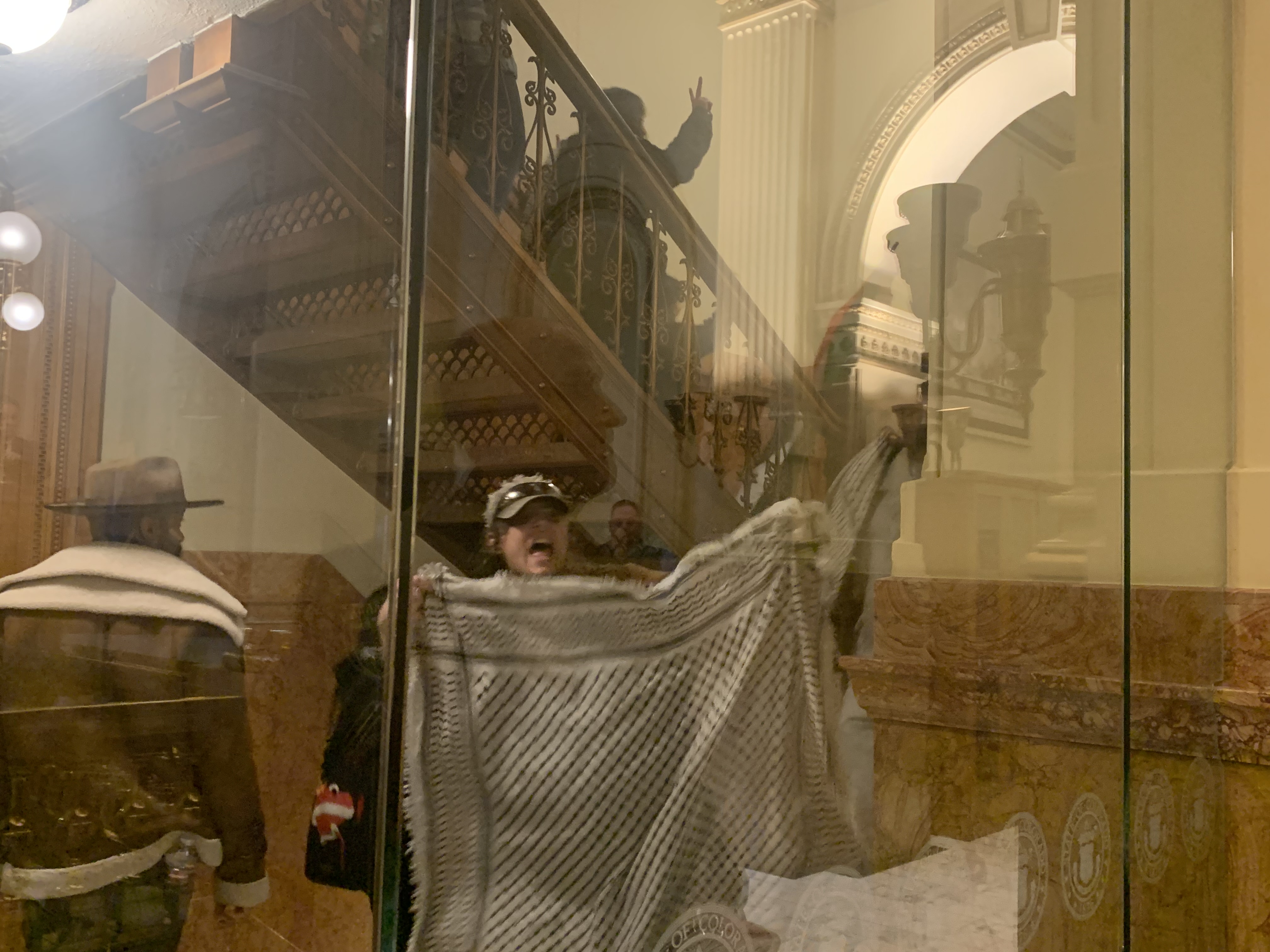
9:45 a.m. Protestors disrupt the House
Day Two of the Colorado General Assembly’s special session on property tax relief started off with a bang.
The Capitol is on higher security, with the galleries in the chambers closed off, extra officers in the building, and no parking in the Capitol circle. (The latter creates its own set of headaches due to a lack of parking in the Capitol area).
That’s not because of what’s going on in the House and Senate this weekend. Pro-Palestinian protesters are again trying to disrupt proceedings, and on Saturday morning, they succeeded in briefly shutting down the House. The protesters flew the Palestinian flag in the House gallery, and after being escorted out, went to the third floor and hung the flag over the third floor railing before being removed from the building by state patrol officers.
9:30 a.m. In the House, tempers flare between Republicans and Democrats
Meanwhile, tempers are flaring between legislators in the House this morning.
Republican Reps. Scott Bottoms and Brandi Bradley were chastised by House Speaker Julie McCluskie, who accused the duo of impugning their fellow members.
Now the chamber is in protracted recess to give people time to cool down.
That situation follows the drama last night from the Senate, which adjourned after Senate Democrats decided, after all, to allow an extra day for the session. Earlier, Senate Republicans pointed out the rules around special orders were not being followed. After hours of negotiations and delays, and after two votes on the matter, one hotly contested, the Senate adjourned without conducting a second reading debate on Senate Bill 1, the main property tax relief bill.
That decision means the special session will run at least through Monday.
8 a.m. Democrats insisted they secured supermajority vote on crucial rule, then rejected roll call request from Republicans
The special session that started on Friday ground to a halt for several hours after Republicans pointed out that Democrats failed to adhere to rules around procedure.
Ultimately, Senate Democrats prevailed – after declaring that the supermajority of the chamber backed a procedural motion. The Democrats simply decided that a voice vote was sufficient, instead of actually counting each vote, which would have likely shown they did not have enough to satisfy a two-thirds vote requirement to proceed.
The partisan breakdown in the Senate is 23-12, a vote short of a two-thirds majority.
At issue is Rule No. 4, which requires a two-thirds vote for the Senate to move into “special orders.” That allows senators to debate a bill that has not been previously announced on the day’s calendar.
Notably, it would allow them to advance Senate Bill 1, the Democrats’ primary proposal to offer property tax relief.
That rule can be suspended with a three-day written notice to the Senate.
However, someone on the Democratic side of the chamber forgot to send out that letter before the session started. It led to a brief discussion Friday morning, followed later in the day by hours of negotiations between the leadership of the two caucuses on how to move forward. Republicans asked for a delay in the special session to allow Coloradans more opportunity to read the bills on property taxes and other issues being considered in the special session.
The first vote was 23-12, a vote short of the two-thirds majority. The Senate then voted again, but Senate President Steve Fenberg denied Republicans the roll call vote and declared the motion passed. That led to another dustup between the two sides, specifically on whether Republicans had asked for the roll call vote in time.
Gardner appealed the decision, declaring the vote was not completed before his caucus called for the roll call vote, a request that could come at any time before the vote results are announced.
A review by Colorado Politics showed that somebody had asked for a roll call vote before the question was completed.
Gardner’s appeal, which required only a simple majority vote, was denied, and the Senate moved on to debate Senate Bill 1.
5:50 p.m. Will the special session come to a crashing halt – at least for a few days?
As it turns out, the special session on the Senate side has taken a twist that few expected.
The rules around the three-day suspension (see previous blog entry) were not adhered to, so, within the next hour or so, the Senate will vote to suspend the rules. They need 24 votes to do so, and it’s unlikely any Republican will cross over and join the Democrats.
Should that vote fail, the Senate Democrats would need to issue a three-day letter suspending the rules. That means the special session, at least on the Senate side, would come to a crashing halt until Monday and possibly Tuesday.
The House has similar rules, but theirs calls for a simple majority, not a two-thirds majority, and they can continue to work on their bills. The question now is whether the House would suspend action so that both chambers are more or less operating on the same page.
Stay tuned!
5 p.m. Having failed to suspend some rules earlier, Democrats negotiate with Republicans over special session schedule
The special session that started this morning is now in a holding pattern, at least in the Senate, over rules. So, follow along, as this is going to get a bit wonky.
In order to bring up special orders, which is what they will do to debate the bills already passed earlier today, one of two things needs to happen. The rules have to be suspended three days in advance. Obviously, that didn’t happen, as was pointed out by Senate Republicans in a little sidebar conversation this morning.
Failing that, the Senate must, by a two-thirds majority, vote to suspend the rules. That would take all 23 Democrats and one Republican, and the chances that one Republican would cross the aisle to vote with Democrats is admittedly slim. So, at this hour, Senate leaders are negotiating. Senate Republicans want to extend the special session for two days, and to work out a deal for amendments on Senate Bill 1.
Stay tuned.
4:30 p.m. Democrats began advancing property tax bill
The Democrats’ main proposal to deal with soaring property taxes cleared its first committee on a party-line 4-3 vote on Friday afternoon – but not without grumbling from counties and special districts that believe they have been left out.
Senate Bill 23B-001 passed the Senate Finance Committee on the first day of the Colorado General Assembly’s three-day special session.
The bill uses $200 million in general fund dollars, set aside in 2022 legislation, to cover any “lost” revenue by public schools and fire districts as a result of the legislation. That takes up $135 million of the pot; the rest goes to the hundreds of counties and special districts that saw less than 13% growth over the past two years. That’s a figure the bill’s sponsors came up with based on inflation over the past two years, and they indicated Friday they are willing to consider a different number.
But those numbers don’t work for counties and special districts, critics said.
In her testimony before the committee, Commissioner Kristin Stephens of Larimer County said counties don’t buy the things that factor into the Consumer Price Index. In fact, their costs have gone up more than that, she said.
12:30 p.m. House panel approves $30 million for emergency rental assistance
The House Transportation, Housing & Local Government Committee approved $30 million in emergency rental assistance, bringing the total amount available to help renters to $65 million. Of that amount, $35 million came from federal funds, which had already allocated.
“Everyone deserves a safe and stable place to call home, but many renters across our state are on the verge of losing their housing,” Rep. Mandy Lindsay, D-Aurora, said in a news release. “Rental assistance provides a critical lifeline to Colorado renters by giving them a fair chance to stay in their homes, avoid eviction, and get back on their feet.”
Under House Bill 23B-1001, which received an 8-4 vote, $30 million would go toward rental assistance for tenants making 80% of the area median income or below.
11:38 p.m. State Capitol on lockdown due to protests tied to Israel-Hamas war
Colorado’s state Capitol was briefly on a lockdown due to protests, tied to the Palestinian-Israeli conflict, happening on the west side. That’s also the reason lawmakers and staff are not being allowed to park in the Capitol circle during the special session.
11:10 a.m., First bill – and only bipartisan measure – goes down on party-line vote.
There’s one bipartisan bill so far in the special session, and it deals with an issue that isn’t technically in the governor’s call: homestead property tax exemptions. Proposition HH had proposed making those exemptions, available to seniors and veterans, portable. The proposal, offered by Reps. David Ortiz, D-Centennial, and Ron Weinberg, R-Loveland, would increase the exemption from the first 50% of $200,000 of home value to $325,000. The bill was reviewed moments ago in the House State, Civic, Military and Veterans Affairs Committee, where it died on a 7-3 party-line vote.
10:25 a.m. Advocating for a tiered approach
Colorado Counties, Inc and their member counties are raising concerns about the Democrats’ proposals for county “backfill.” The group has no concerns about the change in assessment rates, but it complained that a “one size fits all” value reduction on property values is a non-starter. For example, if someone owns a home in Yuma County that’s worth $100,000, a value reduction of $50,000 means a 50% reduction in property taxes for that county. But for a home worth $5 million in Pitkin County, for example, a $50,000 reduction is not nearly the hit to local property taxes. The group is advocating for a tiered approach.
9:20 a.m. Four Senate committees to tackle special session bills
The House gaveled into session at 9:03 a.m., while the Senate did the same at 9:12 a.m. There are four committees in the Senate that will handle bills: Appropriations, which deals with state spending; finance, which tackles proposals in which the state collects money; state affairs; and, local government and housing. The House is likely to do the same.
8:45 a.m. Special session convenes this morning
Colorado’s state legislators will convene this morning in a special session to tackle soaring property taxes. Republicans and Democrats expectedly are offering divergent ideas on how to ensure that property owners won’t face enormous tax hikes driven by home values that have skyrocketed in the last few years.
The Democrats’ proposed solution is to increase the property value exemption for residential property from $15,000 to $50,000 and decrease the assessment rate from 6.765% to 6.7%. This applies to the 2023 tax year only, as reflected in the governor’s call.
And to help local governments and schools, which will see a reduction in their tax revenue as a result, Democrats want to tap $200 million from the general fund, already available for those purposes from 2022 legislation, with $135 million going to the state education fund to ensure no loss of revenue for public schools. And whatever is left would go to fire districts and to counties that had less than 13% growth in the past year.
8 a.m. Pressure from business community mounts
Lawmakers are under pressure from some business groups to craft a “straightforward property tax relief for residents and small business.”
JJ Ament, president of the Denver Metro Chamber of Commerce, earlier said that Democratic proposals so far intend to engineer tax policy with “winners and losers” and that introduces complications the chamber opposes.
“When you start engineering, choosing winners and losers, that’s dis-favorable policy that is anticompetitive for Colorado,” he said, it makes the state less attractive to future capital investment and employment.
Meanwhile, Colorado Concern, a politically active alliance of top business executives, said its proposal, which it is filing on Thursday, would cap the growth of property value to avoid “runaway property tax bills.” The values would only reset upon the sale or major improvements. The group said that would establish a “true market rate” for tax calculation purposes.

marianne.goodland@coloradopolitics.com
marianne.goodland@coloradopolitics.com
tom.hellauer@denvergazette.com
tom.hellauer@denvergazette.com
marianne.goodland@coloradopolitics.com



National Western Junior Livestock Auction sets record
Marianne Goodland
marianne.goodland@coloradopolitics.com
Updated 6 hours ago
The 120th National Western Stock Show, which closes Sunday, saw a standing-room only crowd in the CoBank auction arena at the new Sue Anschutz-Rodgers Livestock Center. Bidders set a record Friday for the top eight livestock – steers, lambs, goats...

The biggest accelerant of our political tribalism | SONDERMANN
Eric Sondermann
eric-sondermann@coloradopolitics.com
Updated 3 days ago
In years past, my go-to word in describing our political condition was “polarization.” I used it endlessly and still do on occasion. But as time has moved on, and the divide has only grown in depth and toxicity, polarization no...

Capitol M: Return to Gold Dome High, 2026 edition, and a salute to old IU
Marianne Goodland
marianne.goodland@coloradopolitics.com
Updated 2 days ago
Welcome back, campers! The 2026 legislative session is upon the good citizens of Colorado, and for a few, the first Monday of the session, Jan. 19, was pretty special. There are at least four folks in the Capitol who are...

Sundance kicks off in Utah with premieres, emotional tributes to Robert Redford | OUT WEST ROUNDUP
Ernest Luning
ernest.luning@coloradopolitics.com
Updated 2 days ago
UTAH Redford hailed at Sundance kick-off PARK CITY — Robert Redford liked to say that everybody has a story. He’s not the only person who said it, but he is one of the few who did something to celebrate it,...
Governor’s lobbyists should be banned from the house floor, legislator argues | A LOOK BACK
Rachael Wright
rachael.wright@coloradopolitics.com
Updated 2 days ago
Forty-Five Years Ago This Week: State Rep. Bob Stephenson, R-Colorado Springs, created an uproar in the chambers of the House of Representatives after he proposed a rule change that would ban the governor’s lobbyists from the House floor during the...
Republican candidates debate how to win the governor’s seat in Colorado — a position the GOP last secured in 2002
Thelma Grimes
thelma.grimes@coloradopolitics.com
Updated 24 hours ago
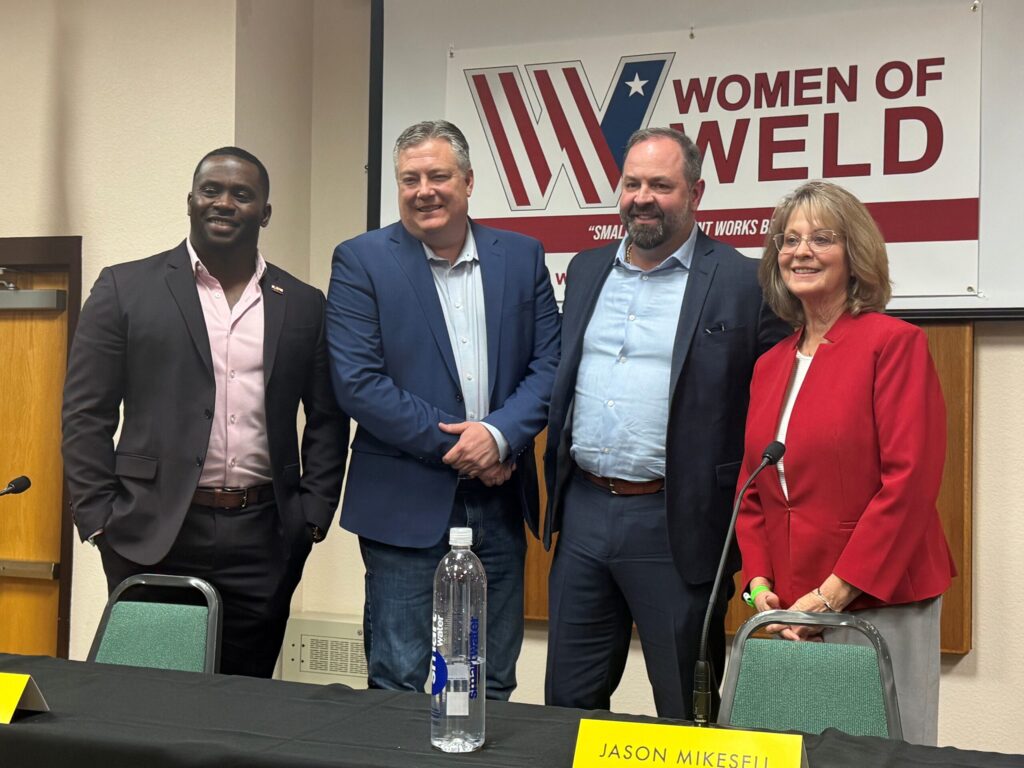
Colorado has not elected a Republican governor since 2002. On Thursday night, four candidates offered competing visions for how the party can reverse its 20-plus years of failing to secure the seat. The discussion hosted by the Women of Weld...

Colorado’s charitable gaming board to study Denver Gazette’s findings
David Migoya
david.migoya@gazette.com
Updated 1 day ago
Colorado’s freshman board overseeing the state’s $110 million charitable gaming industry on Friday created a committee to tackle issues raised in a Denver Gazette investigation that exposed, among other issues, poor supervision and illegal operators. The Colorado Charitable Gaming Board,...
10th Circuit to address resentencing of probation violators in rare all-judges hearing
Michael Karlik
michael.karlik@coloradopolitics.com
Updated 1 hour ago
The Denver-based federal appeals court agreed on Thursday to hold a rare all-judges hearing to determine the proper procedure for resentencing a criminal defendant who has violated the terms of his probation. In the federal appellate courts, the vast majority...

Vape shops challenge Denver’s flavored tobacco ban in court
Deborah Grigsby
deborah.smith@denvergazette.com
Updated 1 day ago
The smoke has yet to settle in the battle over the city’s flavored tobacco ban as local vape shop owners have sued the City and County of Denver, asking the court to declare the ordinance unconstitutional and stop its enforcement....

US officially leaves the World Health Organization
Washington Examiner Staff, Washington Examiner
washington.examiner.staff.washington.examiner@gazetteedit.wpenginepowered.com
Updated 1 day ago
The United States officially withdrew from the World Health Organization on Thursday, slightly over a year after President Donald Trump announced his intention to withdraw the U.S. from the WHO via an executive order on the first day of his...
PREV
PREVIOUS

President Joe Biden plans to visit Pueblo, hold Denver fundraiser on rescheduled Colorado trip
President Joe Biden plans to appear in Pueblo on Nov. 29, rescheduling a trip the White House canceled a month ago amid the mounting conflict in the Middle East, Colorado Politics has learned. Biden is again expected to pitch his administration’s economic accomplishments at Pueblo’s CS Wind factory, the largest wind turbine tower manufacturing plant […]

Boulder County oil, gas leases not terminated after temporary maintenance pause, Supreme Court says
The Colorado Supreme Court walked back a ruling by the state’s second-highest court on Monday, holding that a pair of oil and gas leases in Boulder County did not terminate simply because the pipeline operator halted production for four months to make repairs. The justices’ ruling had implications for extraction operations throughout the state, with […]