

Facts, credibility and finding ‘Waldo’: Regina Rodriguez cautions lawyers about their approach in federal court
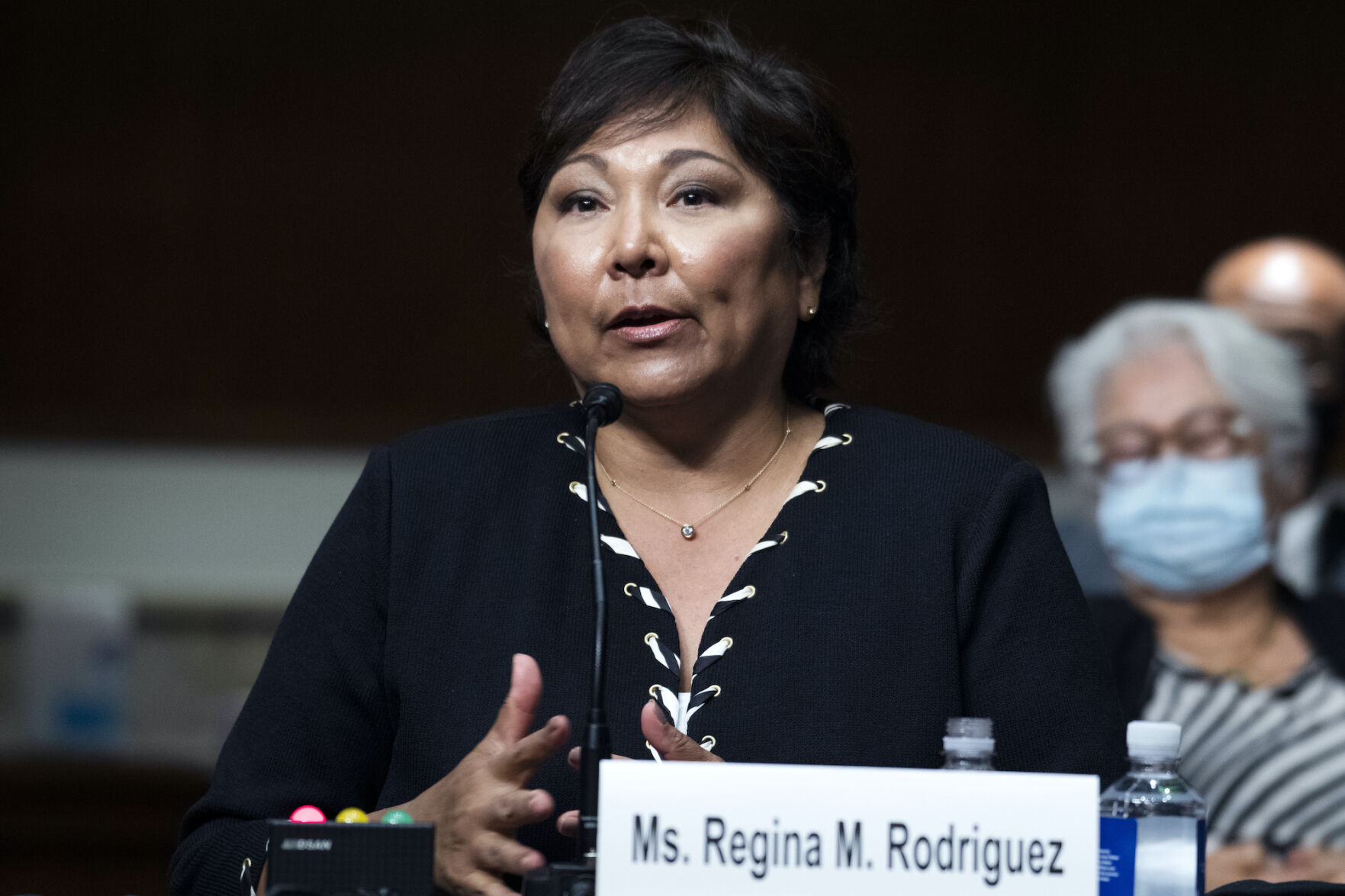
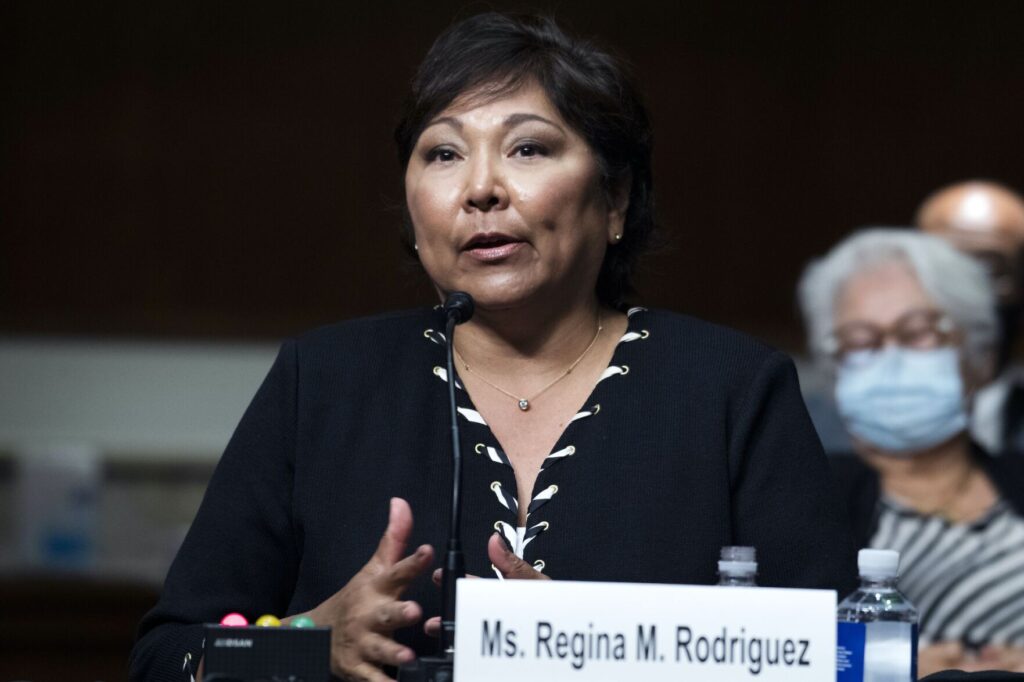
When U.S. District Court Judge Regina M. Rodriguez meets with juries after trial, one of the first questions they ask is, “Did we get it right?”
“They really take this seriously,” she told an audience of attorneys on Wednesday. “They don’t like it when you shade the facts, when you throw shade at your other counsel, when you’re rude, when you confuse the facts, when you argue the same thing over and over. They don’t like that. Why? They’re just trying to get it right. They are looking for an honest broker to help guide them.”
Rodriguez fielded questions at the courthouse in downtown Denver about the path she is charting on Colorado’s U.S. District Court. An appointee of President Joe Biden, she was the first in a wave of new judges to join the court since 2021. The turnover has made Rodriguez the third most-senior district judge in little over 24 months.
She made clear that the same attributes juries value, she desires as well.
Among the more prominent changes, Rodriguez has instituted new protocols for summary judgment – a mechanism to resolve civil cases without a trial when the key, undisputed facts lead to only one outcome under the law. A 30-year trial lawyer before her appointment, Rodriguez discovered on the bench that attorneys failed to grasp in many instances what a “fact” even was.
“Facts are beautiful things. When presented well, they don’t need a ton of embellishment, explanation or argument,” she said. “I find it often happens that lawyers confuse argument for facts.”
Moving cases forward
When Rodriguez joined the court in July 2021, she recalled inheriting 274 cases immediately, with 380 pending motions. She also had her first criminal trial scheduled just three weeks later.
“As I looked at the case I thought, ‘I’m not going to get any smarter if I wait.’ So, I tried that case,” Rodriguez said.
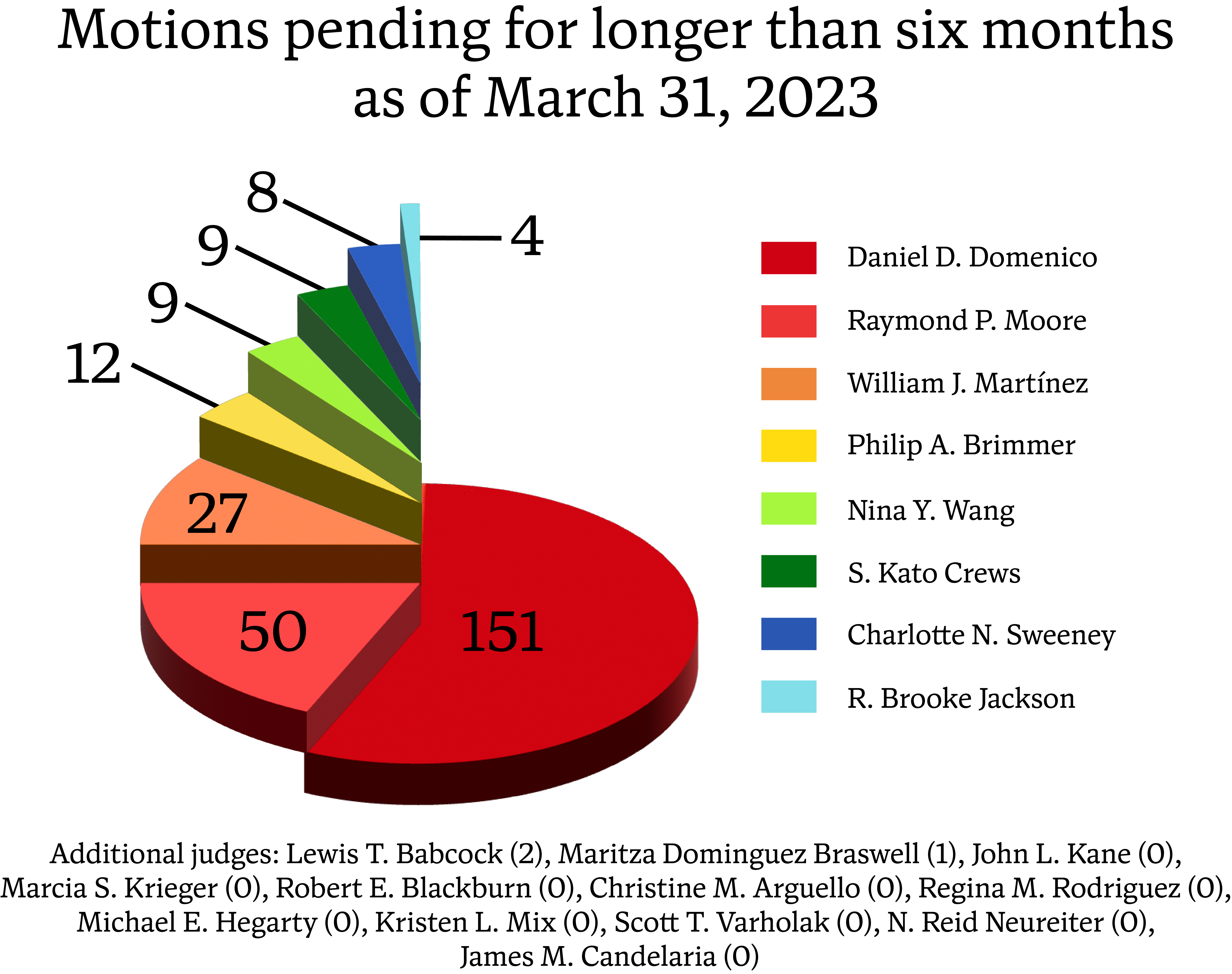
Many of the motions she inherited were on the “six-month list,” a product of the Civil Justice Reform Act of 1990. The law requires public disclosure of all motions that have been pending before federal trial judges for longer than six months. Colorado Politics recently reported that some judges in Colorado – specifically, those who are more senior – have persistently high backlogs in their civil caseloads.
Rodriguez’s first report from March 2022 showed a 36-motion backlog, which dwindled to zero one year later.
“Although that number gets reported out, ‘You have this double digit number,’ I was frankly quite proud of that,” she said. “There were long hours and weekends we worked. People have this notion that you get on the federal bench and you get to kick back and hang out and it’s an easy coast to retirement. For whatever it’s worth, unfortunately, that has not been the case.”
Rodriguez warned, however, that criminal cases generally take precedence over civil matters because of the constitutional guarantee of a speedy trial. Although felony filings in Colorado’s district court have been declining, Rodriguez said her individual caseload increased from 48 criminal proceedings in 2022 to 58 in 2023, so far.
A special requirement
Rodriguez advised lawyers about the need to establish reputations as honest brokers looking for solutions, who do not “pound the table” to get their message across.
“I don’t know I fully appreciated that as I do sitting on this side of the bench now. You as the judge walk into sometimes what looks like a WWE wrestling match,” she said. “I used to say, ‘Why can’t these judges just order sanctions? Just do this, just do that?’ Except when you’re in that position of having to make those decisions and you’re affecting people’s lives and livelihoods, you’re much more circumspect. And it’s a different experience standing in these shoes than in the shoes I used to stand in.”
In her courtroom rules, Rodriguez requires lawyers, if they want to file a motion for summary judgment, to confer with the other side and submit a chart listing the facts of the case and whether those are in dispute. Originally, Rodriguez said she made the charts herself in order to decide whether it was truly necessary for a jury to sort out the facts themselves in trial.
“When you started breaking it down and going in there, a lot of what they were passing off as fact was actually argument,” she said. “I was getting so frustrated. Then I thought, ‘Why was I making this chart? You all know the case better than I do. You should make the chart.'”
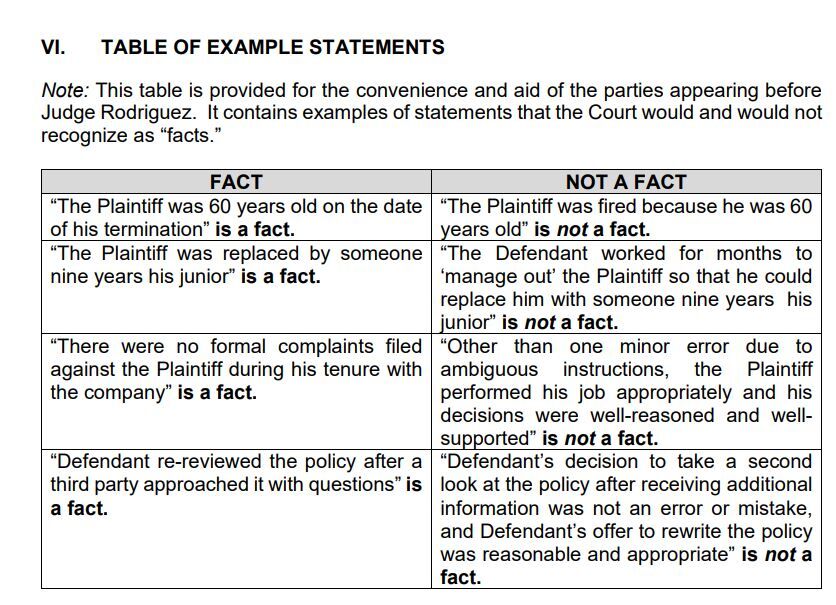
The result, Rodriguez said, was that lawyers found the process helpful and she was able to reduce her time to issue summary judgment decisions. Her average is 82 days, compared to 7.7 months for the court as a whole.
“Once you get the chart, it’s like ‘Where’s Waldo?’ All of a sudden you see Waldo,” Rodriguez explained.
Credibility and humanity
Speaking about good practices lawyers should engage in, Rodriguez recalled a criminal case in which the defendant looked “a little scary” – with face tattoos and scars. She said some defense attorneys may try to humanize their client under the circumstances by talking about the person’s biography or their character.
This defendant’s lawyer “said none of that stuff,” Rodriguez elaborated. “She sat next to her client. She spoke to him like a human being. There were times you could tell he had questions. She would stop, pause, lean over, speak to him. She treated him as an individual, as a human being, throughout the entire trial.”
Rodriguez called it an example of “showing,” not “telling,” and the jury noticed.
“To me, I thought that was brilliant lawyering,” she said.
She also told lawyers not to over-embellish or to overstate things. “I don’t know” is an acceptable answer, Rodriguez clarified, and is preferable to a misstatement.
“I will tell you like I tell my kids: 90% of the time when I ask a question, I already know the answer,” she said. “So, if you give me an answer which is not true or I know it’s belied in the record because I’ve looked at it, that’s gonna be a problem.”
Rodriguez added that she welcomes the “pressure test” of lawyers challenging her preliminary thoughts on an issue – especially if her logic may be faulty – as long as it is respectful. Alluding to recent attacks by former President Donald Trump on the clerk of the New York judge overseeing his civil fraud trial, Rodriguez said inappropriate behavior towards courthouse staff is rare in Colorado.
“A disrespect to my people is frankly worse than a disrespect to me individually,” she said.
Juries and tough cases
Rodriguez also spoke of her faith in juries, even with complex or technical cases. In response to the question she receives after trial – “Did we get it right?” – Rodriguez said she does not answer yes or no. Instead, she acknowledges jurors took the case seriously and it is their role to decide what the facts are.
“They pick up on everything. They see everything. And they hear everything,” she said.
Rodriguez added that access to justice is something the court takes “very seriously.” She mentioned the programs and pilot programs in place to assist self-represented plaintiffs, including those who are incarcerated, with their civil cases.
“I would say that probably some of my hardest cases are those where you have good counsel on one side and really bad counsel or no counsel on the other side. Those are really, really challenging,” she said.
The discussion was sponsored by the Faculty of Federal Advocates.

Federal judge upholds constitutionality of Colorado campaign contribution limits
Michael Karlik
michael.karlik@coloradopolitics.com
Updated 2 days ago
A federal judge upheld Colorado’s individual campaign contribution limits as constitutional on Thursday, finding that three Republican plaintiffs failed to prove the campaign finance framework violates their First Amendment rights. U.S. District Court Senior Judge John L. Kane recognized that...

Appeals court rejects theory that existing tax revenue undermines need for new fees
Michael Karlik
michael.karlik@coloradopolitics.com
Updated 2 days ago
Colorado’s second-highest court rejected a plaintiff’s claim on Thursday that the tax revenue generated by an existing activity should prevent local governments from imposing new fees aimed at regulating the activity. The question stemmed from Colorado’s unique constraints on taxation...
Appeals court finds no illegal sentence when defendants forfeit time-served credit
Michael Karlik
michael.karlik@coloradopolitics.com
Updated 1 day ago
Colorado’s second-highest court ruled on Thursday that criminal defendants may agree to relinquish the credits they earned while incarcerated pending trial, despite a state law guaranteeing that such time “shall be deducted” from a person’s sentence. Kerry Ellis Endsley pleaded...
Appeals court reinstates Garfield County arson charge
Michael Karlik
michael.karlik@coloradopolitics.com
Updated 12 hours ago
Colorado’s second-highest court reinstated a Garfield County defendant’s arson charge on Thursday, concluding a trial judge improperly credited a witness’s claim that she alone was responsible for starting the fire. A sheriff’s deputy responded to a brush fire near Parachute...
Federal judges rebuke ex-Colorado judicial discipline director for conduct in lawsuit
Michael Karlik
michael.karlik@coloradopolitics.com
Updated 3 days ago
A pair of federal judges expressed a desire on Thursday to break the logjam on a lawsuit by Colorado’s former judicial discipline director against the state Supreme Court and related entities, while simultaneously showing little tolerance for the plaintiff’s scorched-earth...

Democratic bill would let recipients of ‘conversion therapy’ sue Colorado providers with no statute of limitations
Marissa Ventrelli
marissa.ventrelli@coloradopolitics.com
Updated 3 days ago
Colorado lawmakers have advanced a proposal that would allow people who underwent conversion therapy to sue licensed providers for damages, moving the measure forward on a party-line vote in the House Judiciary Committee. House Bill 1322, proposed by Democratic Reps....
Federal judge refuses to authorize immediate appeal in World Cup trafficking lawsuit
Michael Karlik
michael.karlik@coloradopolitics.com
Updated 4 days ago
A federal judge declined to authorize an immediate appeal last week of a prior decision allowing companies operating out of Colorado to be sued for allegedly participating in a human trafficking venture involving Filipino laborers who constructed facilities for the...
Federal judge considers second round of sanctions against ex-Colorado judicial discipline director
Michael Karlik
michael.karlik@coloradopolitics.com
Updated 5 days ago
A federal judge ordered Colorado’s former judicial discipline director on Tuesday to explain why she should not sanction him a second time for filing documents for improper purposes, such as harassment or delay. U.S. District Court Senior Judge Kathryn H....

Colorado justices agree to review insurance question that has divided federal judges
Michael Karlik
michael.karlik@coloradopolitics.com
Updated 5 days ago
The Colorado Supreme Court granted a federal judge’s request on Friday to address an issue that has produced conflicting answers in policyholders’ lawsuits against insurance companies over unpaid benefits. “Parties (and judges) regularly spend undue time and money fighting in...
Federal judge dismisses background screeners’ challenge to Colorado law
Michael Karlik
michael.karlik@coloradopolitics.com
Updated 1 day ago
A federal judge dismissed a challenge on Friday to a portion of Colorado law that prohibits certain information from being included in consumer reports, in what seemed to be a conflict with federal law. Congress originally enacted the Fair Credit...
PREV
PREVIOUS

Gov. Jared Polis calls for property tax relief special session following defeat of Proposition HH
State lawmakers are headed back to the state Capitol this month after Gov. Jared Polis Thursday called for a special session to deal with property tax relief. The special session will start on Nov. 17 and could run at least three days, the minimum it takes to get legislation through both chambers of the Colorado […]

Colorado Springs mayor concedes defeat on police training funding
Colorado Springs Mayor Yemi Mobolade conceded Wednesday morning residents voted down a ballot question to set aside about $5 million for a new police training academy. The ballot count Wednesday morning showed the question failing 52.22% to 47.48%, along the same margins as Tuesday night, according to the El Paso County Clerk and Recorders’ Office. […]