

Cali proposition shouldn’t disrupt our pork production | GABEL
Food ought not be a partisan issue, but California’s Prop 12 has made the battle lines abundantly clear. Wide opposition to addressing the consequences of the measure that forces pork producers around the country to adhere to California’s animal rights-driven production requirements makes that fact an undeniable one.
The Ending Agricultural Trade Suppression, or “EATS,” Act, introduced by U.S. Sen. Roger Marshall (R-Kansas) and Rep. Ashley Hinson (R-Iowa) seeks to address Prop 12 to protect interstate commerce from one state’s disruption of the nationwide pork production system. It would prohibit a state or local government from imposing a standard on the preharvest production of agricultural products if the production occurs in another state.
If it isn’t the answer, a better one needs to be found. It may be a non-starter for Democrats, subsequently, a bipartisan legislative solution must be crafted in the interest of food security, the economies of food-producing states, the looming expiration of the current Farm Bill, and the ability of families to put food on the table.
The National Pork Producers Council challenged Prop 12, which requires all pork sold in California to come from pigs born to a sow housed in at least a 24-square-foot pen, arguing that California’s law impermissibly burdens interstate commerce in violation of the U.S. Constitution. The court found that, in short, Prop 12 regulates only in-state sales despite the onerous requirements it inflicts on pork producers nationwide and, in turn, consumers, and ultimately upheld the measure.
Stay up to speed: Sign-up for daily opinion in your inbox Monday-Friday
A single state, or even a small group of states, ought not be handed the power to disrupt the food supply and dictate production methods of which they know nothing firsthand, to the remainder of the country, nor should the moral priorities of the few trump the collective expertise of producers and the research that guides their decisions. Just as was presented before the land’s highest court, the law requirements are “inconsistent with industry practices and standards, generations of producer experience, scientific research and the standards set by other states.” The law regulates farms outside its borders where hog production happens primarily in the midwest. California pork production contributes negligibly to the whole, but the market for pork in the state is significant.
Before the bacon is brought home, one hog carcass may be split into what are called primal cuts and processed at different facilities for different end products. The ham in a sandwich may be expertly sliced from multiple hams and the bacon on a plate may have been sourced from different porkbellies. Tracing each slice of bacon and ham is nearly impossible, forcing wholesalers and retailers to only accept pork from hogs produced in compliance with the California requirements, even if it never finds its way to a plate in California. This raises prices across the country and steals the ability of consumers to vote with their dollars. The beauty of American agriculture is the choices reflected in consumers’ purchasing decisions. One consumer who prefers free-range chicken may pay a premium and support the producers utilizing that method. The next consumer, who trusts conventionally raised food and chooses it to feed their family within their means may do the same. Neither is wrong, but taking the choice away is.
Before Prop 12, activists forced the hands of Colorado’s egg producers, prompting producers to invest billions in animal rights-driven production requirements. The proverbial fox in the henhouse, the bill forced increased egg prices and decreased availability in the grocery stores for consumers, including those living on the margins who saw an affordable, high-quality protein dangled right above their reach. It was a toe-dip in the pool for Colorado and confirmed enough voters in the state trust extremists more than the people who are providing a safe, affordable and abundant food supply.
If Democrats are unable to separate what they interpret to be the sins of former Iowa Congressman Steve King from efforts to protect agriculture producers in 49 states from the whims of voters in one, then a solution must be found in the middle of the aisle. That solution then needs to become part of the Farm Bill to protect it further from people who damn agriculture with their mouths full and without their stomachs grumbling.
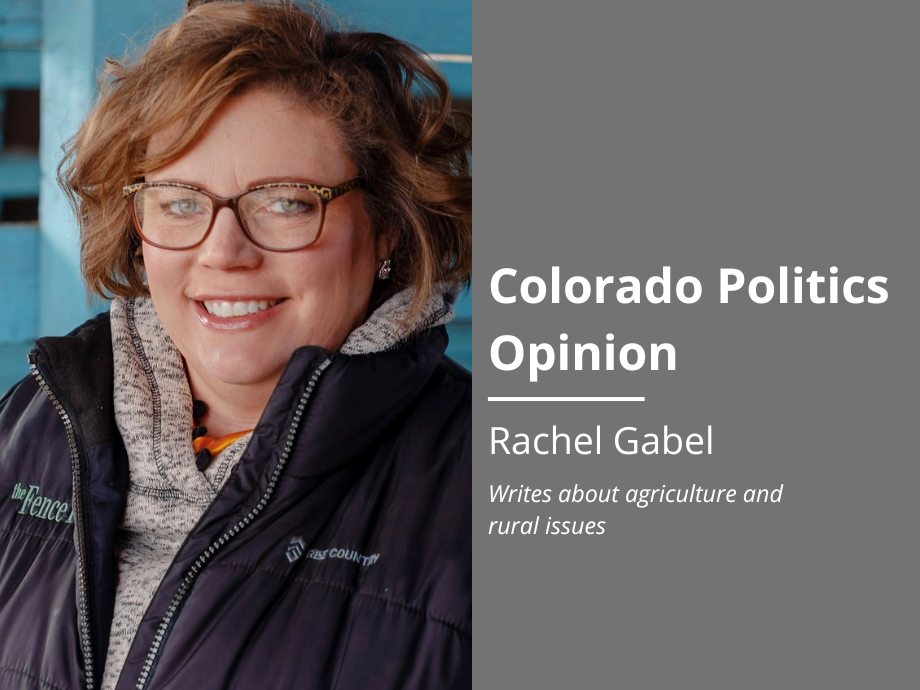
Rachel Gabel writes about agriculture and rural issues. She is assistant editor of The Fence Post Magazine, the region’s preeminent agriculture publication. Gabel is a daughter of the state’s oil and gas industry and a member of one of the state’s 12,000 cattle-raising families, and she has authored children’s books used in hundreds of classrooms to teach students about agriculture.

Update, safeguard Colorado’s mail ballot with voter ID | PODIUM
Colorado Politics
colorado-politics@coloradopolitics.com
Updated 8 hours ago
By Chuck Broerman and Suzanne Taheri Coloradans often refer to our state as a leader for accessible and secure elections. We have led on all-mail ballots, automatic voter registration, and same-day registration, turning Colorado into a model for modern elections...

Preserving access for vulnerable communities should be a top priority in Congress | OPINION
Colorado Politics
colorado-politics@coloradopolitics.com
Updated 8 hours ago
By Tony Henderson As both a minister and as president of the NAACP Denver, I believe access to high-quality, accessible health care is a right that should be afforded to each and every one of us. To that end, Medicare...
Yet again, when rights are in conflict | Hal Bidlack
Hal Bidlack
hal-bidlack@coloradopolitics.com
Updated 1 day ago
I admit, it is going to take quite a bit of self-control to not have this entire column end up being yet another screed about a certain president who continues to shock the world in his race to the bottom...

Turn blueprint into action with the Outdoors Opportunities Act | OPINION
Kent Thiry
kent-thiry@gazette.com
Updated 1 day ago
Nearly a year has passed since Gov. Jared Polis, Colorado Parks and Wildlife, the Colorado Department of Natural Resources, Colorado’s Outdoor Recreation Industry Office and other key partners finalized the visionary Colorado Outdoor Strategy, establishing the framework to ensure Colorado’s...

Let Colorado’s communities govern their own neighborhoods | OPINION
Colorado Politics
colorado-politics@coloradopolitics.com
Updated 1 day ago
By Jeff Bailey and Cindy Bailey Coloradans have always done things their own way. From how we manage our land to how we build our economies, the instinct to govern locally — to trust mayors, councils and commissioners over distant...

Threats inside and out loom for Colorado’s Republicans | Dick Wadhams
Dick Wadhams
dick-wadhams@coloradopolitics.com
Updated 3 days ago
Colorado Republicans made strides in 2024 despite an insidious state chairman who tried to defeat successful Republican candidates. Newly elected U.S. Reps. Gabe Evans, Jeff Hurd and Jeff Crank fought off unethical opposition from their own state party chairman, making...

Is it time for both parties to bail on Colorado’s political nominating system? | Miller Hudson
Miller Hudson
miller-hudson@coloradopolitics.com
Updated 3 days ago
Cracks are beginning to appear in Colorado’s political nominating system. Recently, Mario Nicolais, a formerly Republican-leaning pundit, and Doug Friednash, former Democratic legislator, have opined regarding the imminent demise of the caucus/assembly framework which controls partisan candidate selection. There has...

Recognizing the value of generational work | Rachel Gabel
Rachel Gabel
rachel-gabel@coloradopolitics.com
Updated 3 days ago
The Lesser Prairie Chicken habitat in southeastern Colorado is a swath of prairie that begins in Cheyenne and far-southeastern Lincoln counties and moves south and east into Kiowa, Prowers and Baca counties. This is cattle country where the short grass...

Why the controversy with mail-in ballots? | Cronin & Loevy
Tom Cronin Bob Loevy
tom-cronin-bob-loevy@coloradopolitics.com
Updated 3 days ago
Most Coloradans enjoy the right to vote “by mail” at election time. Most Americans favor this process. But U.S. President Donald Trump is trying to federalize (nationalize) this practice and shift the supervision of voting from county clerks to the...

Who are the kings being crowned here in Colorado? | Jon Caldara
Jon Caldara
jon-caldara@coloradopolitics.com
Updated 5 days ago
Though most of us celebrate “No Kings Day” on July 4, the Trump-deranged got a head start last weekend with rallies around the state. Attendees bravely fought oppression by blocking traffic for people with jobs. Rally-goers demanded freedom from tyranny,...
PREV
PREVIOUS

Empower parents with iPhones and flags | CALDARA
Jon Caldara There’s a lot to unfold with one Gadsden flag. The most surprising and disappointing point about this kerfuffle is that, even at a reputable charter school with a classical curriculum, with an emphasis on teaching historic accuracy, staff needs to be schooled by parents that one of America’s founding flags has nothing to […]
What a North Denver chili recipe reveals about the city's political path | HUDSON
Miller Hudson In July I attended the Denver Democratic picnic at Ruby Hill Park. The good news for Democrats is I saw very few people I knew. Instead, there was a preponderance of young Democrats assuming leadership. As I prepared a chili dog, which I smothered beneath a generous scoop of homemade red, I found […]