

The Fair Elections Fund made a difference in mayor’s race: a negative difference | Vince Bzdek
With the Denver mayoral campaign in its final days, it’s a fair time to ask: Did the Fair Elections Fund — the city’s inaugural stab at public financing for municipal elections — work?
The Denver Gazette gathered some of the city’s foremost political experts together Thursday for a final handicapping of the race, and to a person they all answered a resounding “No.”
“Eight million dollars that could have been used for anything else going into the pockets of schmucks and consultants like me doesn’t seem like a great use of taxpayer dollars,” said political consultant Ian Silverii, founder of the Bighorn Company. “I think this is proof that it is an abject failure.”
Q&A: Political experts size up Denver mayoral runoff between Mike Johnston, Kelly Brough
The purpose of the fund, approved by voters in 2018, was to encourage candidates to raise small donations, promising a nine-to-one match of every donation of $50. The Fund’s rules also limited how much candidates who accepted the funds could receive from any one entity, and recipients were barred from accepting contributions from political action committees (PACs) and corporations.
The idea was to level the playing field for rookie candidates, lessen the influence of big-money donors and give individual voters a greater say in elections.
“The stated goal of the Fair Elections Fund was to give candidates who would have been drowned out or wouldn’t have had the opportunity to speak up and run, resources to do that,” Silverii said. “I don’t think any of that money created any new conversations about any new issues that weren’t going to happen otherwise.”
Alan Salazar, chief of staff for Mayor Michael Hancock; Mike Kopp, President and CEO, Colorado Concern; and Steve Welchert, a veteran political, policy and strategic communications counselor, all agreed.
“Look, there are better ways to spend the money, and that’s where I land,” Salazar said.
The Fund was created in response to the 2010 U.S. Supreme Court Citizens United decision that opened up the political spending floodgates.
The Supreme Court ruled that limiting “independent political spending” from corporations and other groups violates the First Amendment right to free speech. The court essentially decided money is a form of speech.
The ruling reversed century-old campaign finance restrictions and enabled corporations and other outside groups to spend unlimited funds on elections.
CleanSlateNow Action, the group behind the creation of Denver’s Fair Election Fund, hoped to counter the unlimited campaign money given by super PACs to candidates with the enticement of public financing as an alternative.
Owen Perkins, the president of CleanSlateNow Action, thinks there’s actually a lot to be happy about with the Fund.
Sixteen candidates ran for mayor this go-round, and nine people vied to fill two at-large city council seats. Perkins told Denver7 more candidates on the ballot led to better representation of Denver’s diverse communities and viewpoints.
“It was great for the voters of Denver to have so much choice,” Perkins said. “You had an important discussion, and important issues, that rose to prominence that I don’t think would have happened if we hadn’t had these kinds of candidates getting access to the ballot.”
But voters complained that there were so many candidates it was hard to get a handle on who stood for what, and the confusion may have kept turnout low.
The biggest problem of many of these well-intentioned campaign finance laws aimed at blunting corporate influence over elections is that they have the opposite effect. In Denver’s case, the Fund spurred huge donations from outside groups called independent expenditure committees, many of the donors from out of state. Other cities such as Baltimore, Portland and New York City have attempted similar programs with comparable problems.
“When you reduce the amount of money that candidates can raise and spend on their own, you increase the megaphone that these independent expenditure committees can have,” Silverii said.
These independent expenditure groups, which have spent a total of $5.5 million in the mayor’s race, seek to influence voters’ choice but operate independently from the candidates’ campaigns.
Michael Bloomberg, the former mayor of New York City and once presidential aspirant, forked out half a million dollars to Advancing Denver, an independent expenditures group that backs Johnston. LinkedIn co-founder Reid Hoffman gave over $450,000 to the same group, as did former DaVita CEO Kent Thiry, who contributed $150,000; and hedge fund manager Stephen Mandel, who sent $100,000.
Big money floods Denver mayor’s race as Michael Bloomberg, Pete Coors make large contributions
A Better Denver, an independent group that supported Kelley Brough, saw far more donations than Advancing Denver – but in smaller amounts. Its contributors included Pete Coors, the Republican nominee for Colorado’s U.S. Senate seat in 2004, who handed over $50,000; Amacon Management LLC, which gave $25,000; Books and Bags Field Warriors LLC, which contributed $35,000; and Haselden Construction, which forked out $25,000.
As of Thursday, the independent expenditure groups backing Johnston had raised $4.2 million, according to the Office of the Denver Clerk and Recorder. The groups backing Brough had collected nearly $1.4 million.
Michael Dino, who served as campaign manager for former mayor Wellington Webb, agreed that Fair Elections Fund rules pushed larger and corporate contributions directly away from the candidates, so that’s a “small part” as to why outside groups are spending big money in this year’s race.
Dino told our reporter Kyla Pearce that independent expenditure groups are the “most convenient way to get huge donations from supportive special interests.”
“Money is the mother’s milk of politics,” Dino said. “I’ve been on all sides of campaigns and sometimes with the winners, and I have only encountered a handful of big donors who didn’t ask for something from or try to influence the winners.”
Kelly Brough slams Mike Johnston for millions in out-of-state money in Denver mayor’s race
The intention of the Fund did appear to be working better in city council races, where city council candidates receiving Fair Elections Fund money attracted plenty of small donors.
Money from the Fund accounted for a majority of the money raised by nine candidates running for two at-large Denver City Council seats, as well as by the 29 candidates vying for 11 city council district seats.
The big injection of Fund money into the lower-budget city council races may ensure that the City Council keeps the Fund going in the future, even if it has multiple shortcomings. Let’s hope they opt to tweak it significantly going forward.
The mayor’s chief of staff Salazar said that “when COVID hit, and the city faced a significant financial crisis on top of everything else, the mayor wanted to put the Fair Elections Fund into helping the city with what we thought would be a significant deficit problem or fiscal problem. And he encountered resistance from City Council. They wanted that money to be in place.”
In final last analysis, Mike Kopp, President and CEO of Colorado Concern, thinks the ability of an individual candidate to raise money herself or himself without any help from outside sources or special funds is one of the most surefire indicators of a viable candidacy.
“If you cannot go out and convince people that it would be a good idea to put you in political office, and that they ought to give you some traveling money so you can go produce a message, it almost speaks for itself,” Kopp said. “Maybe you’re not as articulate as you think you are. It sounds a little bit harsh, but I guess I take an old-school view about it. When people go run for office, there’s too many stories in American history to cite that hardscrabble people come from nowhere and they win races regularly. I think it makes them stronger elected officials when they have to break through that way.”


The real impact of regulations on businesses, employees and Colorado’s way of life | OPINION
Colorado Politics
colorado-politics@coloradopolitics.com
Updated 2 hours ago
By Loren Furman and Steve Swinney Every day in Colorado, business owners are faced with decisions most people never see, shaped by rising costs and a regulatory environment that has grown more complex over time. Those choices eventually reveal themselves...
Should we have recall votes for all Colorado elected officials? | Hal Bidlack
Hal Bidlack
hal-bidlack@coloradopolitics.com
Updated 9 hours ago
As I write this on the Sunday before you read it, we’ve just learned of the first American casualties of our, what — war? conflict? attack? — on Iran. The Supreme Leader of Iran, for the past 36 years or...
Colorado legislature should not reverse lottery modernization | OPINION
Colorado Politics
colorado-politics@coloradopolitics.com
Updated 10 hours ago
By Bill Clayton Four years ago, the Colorado General Assembly passed bipartisan legislation to modernize the state’s lottery system and strengthen funding for Colorado’s outdoor projects and open spaces. Lawmakers recognized a simple reality: consumer behavior has evolved. Most Coloradans...
Primary rival sues to prevent Democrat Eileen Laubacher from going through assembly in Colorado’s 4th CD
Ernest Luning
ernest.luning@coloradopolitics.com
Updated 2 hours ago
Democratic congressional candidate Trish Calvarese on Monday asked a judge to prevent one of her primary rivals, Eileen Laubacher, from participating in the caucus and assembly process to seek the nomination to challenge Republican U.S. Rep. Lauren Boebert in Colorado’s...
Colorado lawmakers tackle legislation on sexual assault
Jenny Deam
jenny-deam@coloradopolitics.com
Updated 4 hours ago
A panel of Colorado lawmakers on Monday unanimously approved a bill that supporters say will offer protections and support to victims of domestic violence, stalking, sex trafficking and sexual assault, including mandatory training for law enforcement on trauma. The measure,...

Colorado bill would require employers to grant legislative leave to state lawmakers
Marissa Ventrelli
marissa.ventrelli@coloradopolitics.com
Updated 46 minutes ago
When she was elected to the legislature in 2022, Sen. Janice Marchman was hopeful she could bring real-world experience to the state’s education policy. Marchman, a Loveland Democrat, was the only actively-working teacher in the General Assembly for the past...
Colorado Senate swears in Adrienne Benavidez after district vacancy win
Marianne Goodland
marianne.goodland@coloradopolitics.com
Updated 21 hours ago
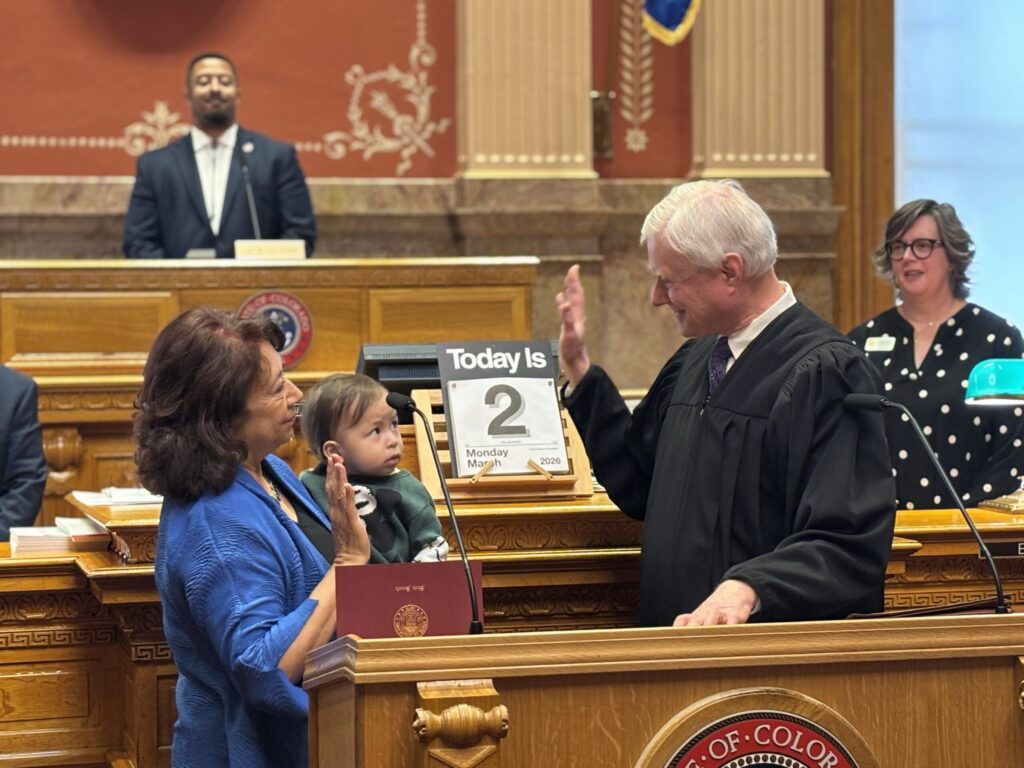
Sen. Adrienne Benavidez, a Democrat from Adams County, was sworn in Monday to the Colorado Senate, just four days after winning a vacancy election in District 21. She was sworn in by Colorado Court of Appeals Justice Lino S. Lipinsky...

Rural legislators, Colorado farmers defeat pollinator bill backed by Gov. Polis
Marianne Goodland
marianne.goodland@coloradopolitics.com
Updated 21 hours ago
A proposal to limit the use of neonicotinoid-coated crop seeds collapsed in the Senate Agriculture and Natural Resources Committee last week, as rural lawmakers, including two Democrats, joined Republicans to reject what they called an expensive, impractical mandate on farmers....

Competing overtime bills for agriculture workers split Colorado Democrats
Marianne Goodland
marianne.goodland@coloradopolitics.com
Updated 1 day ago
Competing bills setting the overtime threshold for farmworkers have split legislators at the Colorado state Capitol, with one group saying a law passed in 2021 has harmed, rather than helped, farming operations and workers alike, while the other side insists...
Could Weiser or Bennet as governor each be an improvement over Polis? | Miller Hudson
Miller Hudson
miller-hudson@coloradopolitics.com
Updated 2 days ago
The weekend before last was a forerunner to numerous forums and debates where U.S. Sen. Michael Bennet and Attorney General Phil Weiser will jostle for position in the Democratic primary for governor. The victor seems certain to be headed to...
PREV
PREVIOUS

Colorado progressive group attacks Lauren Boebert over voting record in new $300K ad campaign
A left-leaning Colorado nonprofit launched a six-figure ad campaign this week calling on U.S. Rep. Lauren Boebert to support lower prescription drug costs and federal social safety net programs. Rocky Mountain Values announced at a press conference in Pueblo on Thursday that the group plans to spend $300,000 this summer on TV, digital, radio, print […]

Polis signs 68 more bills into law | CROSSING THE FINISH LINE
Four days out from the deadline, Gov. Jared Polis has signed 365 bills into law. After being signed, bills take effect in August, 90 days after the general assembly adjourns, unless otherwise specified in the bill. A full list of legislation signed this year can be found online by clicking here. Polis has until June 7 […]