

As Colorado seeks better management of wild horses, Congress members target helicopter roundups
Just days after Gov. Jared Polis signed a law giving the state more authority over managing wild horse herds, a Congressional trio has taken another attempt to ban one of the most controversial tools for rounding up wild horses – helicopters.
On Wednesday, U.S. Reps. Dina Titus (D-NV), David Schweikert (R-AZ), and Steve Cohen (D-TN) reintroduced the Wild Horse and Burro Protection Act, which would prohibit helicopter roundups of wild horses.
Titus sponsored a similar measure in 2022 that stalled in a congressional committee, but which drew two Colorado co-sponsors: Reps. Diana DeGette, D-Denver, and Joe Neguse, D-Lafayette.
The American Wild Horse Campaign cheered the legislation, saying helicopter roundups are expensive, with the overall cost for roundups and lifetime captivity of horses pegged at $50,000 each.
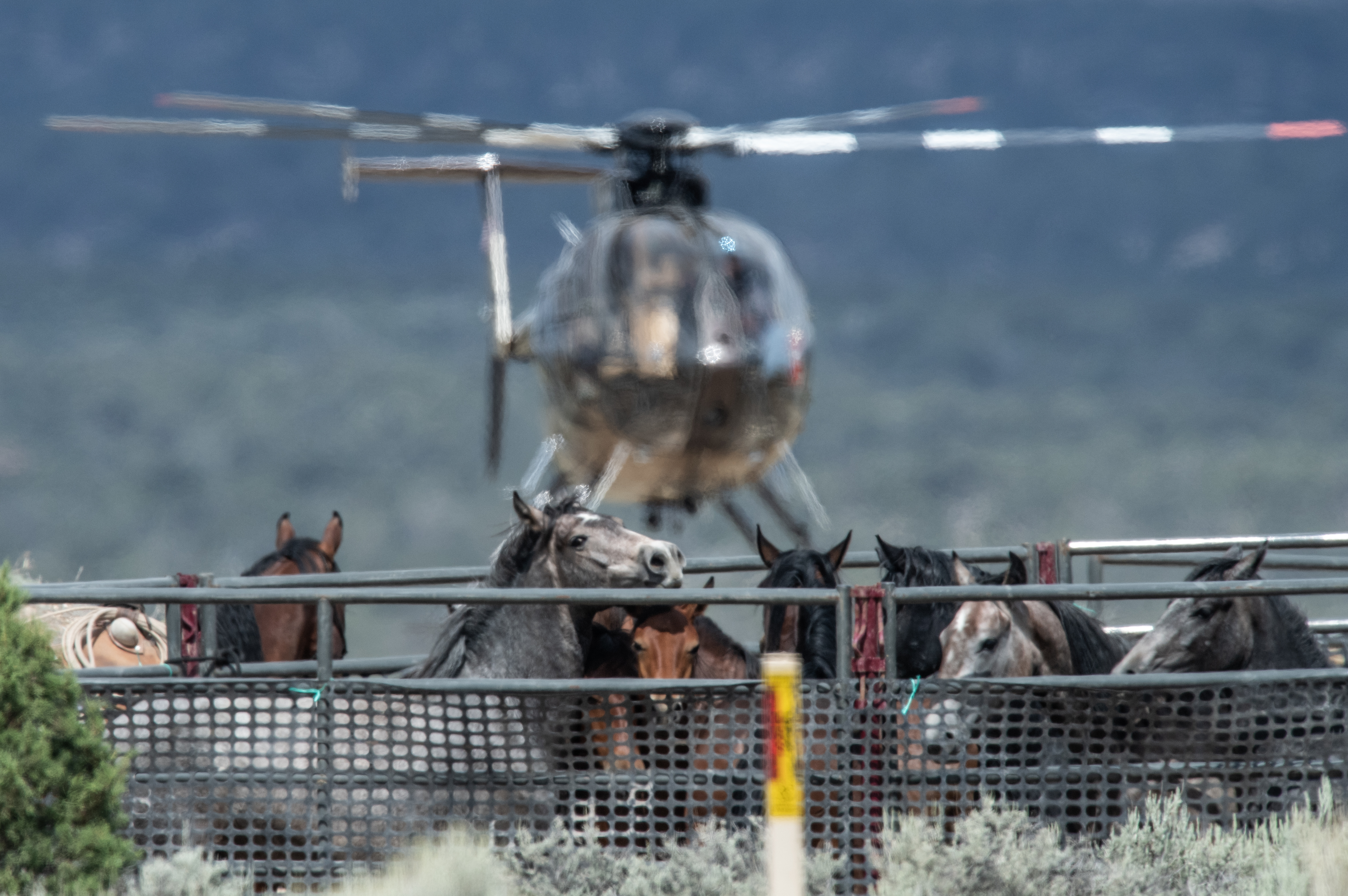
In Colorado, helicopter roundups of wild horses in several Horse Management Areas (HMAs) on the Western Slope have resulted in panicking the horses, which has led to injuries and fatalities.
The rounded-up horses, numbering more than 1,800 over the last two years, were then sent to Cañon City, where an outbreak of equine influenza resulted in the deaths of at least 146 just over a year ago. Out of those 146 fatalities, 22 were foals, less than a year old.
Actions by the Bureau of Land Management, which has oversight over horse management areas, led the American Wild Horse Campaign and its Colorado allies, including the governor and his husband, Marlon Reis, an animal rights activist, to advocate for Colorado lawmakers to respond.

That resulted in Senate Bill 275, which Polis signed on May 20 at the BLM-managed Little Book Cliffs Wild Horse Range northeast of Grand Junction.
Under the new law, the state will provide $1.5 million for scaled-up on-range and off-range wild horse conservation efforts by local volunteer groups. That includes creating the Wild Horse Management Project within the Colorado Department of Agriculture as a nonprofit, state-owned entity.
Putting the project at the Department of Agriculture turned out to be the biggest sticking point for the measure as it went through the General Assembly. Supporters of SB 275 told Colorado Politics the department did not want the project to be housed at the agency.
The project will manage a Wild Horse Stewardship Program and a Wild Horse Working Group, both established under the legislation, along with hiring a director for the project by August 1.
The Wild Horse Working Group will be tasked with identifying and pursing “humane, nonlethal alternatives for wild horses taken off-range or held in federal holding facilities in Colorado, opportunities for long-term care and management, and adoption partnerships.”
The stewardship program will work with the BLM on range infrastructure.
A second program established under SB 275 takes on one of the most controversial management aspects- horse fertility. That program will use the funds annually appropriated under the legislation to award grants to volunteer groups that will be trained in how to administer humane, nonlethal and safe fertility controls, often through remote darting with an air rifle.
Since 2012, one of the primary controls has been with a vaccine known as PZP, although, according to BLM, its efficacy lasts only one to two years. Another vaccine, GonaCon-Equine, which BLM started using in 2020, shows potential for longer-term control.
A fertility program operated by the American Wild Horse Campaign in Nevada reduced the foal birth rate by 61% over two years.
Finally, SB 275 prohibits surgical sterilization or other “lethal population management.”
The new law also requires heightened coordination between the state and the BLM.
Wild horse advocates have tried for several years to raise awareness about the problems attributed to BLM roundups in the Piceance Basin near Meeker and the Sand Wash Basin near Rangely, both in Rio Blanco County. Last year’s roundup, which used helicopters contracted by BLM, resulted in the deaths of several horses during the roundup.
After the outbreak of equine influenza, both Polis and Neguse called on the BLM to delay future roundups until the problems could be investigated.
An internal BLM assessment released May 24 last year documented significant mismanagement at the Cañon City corrals, including understaffing, vaccination and other biosecurity failures, poor record-keeping, poor animal management, lack of basic equine care, inadequate shelter, and substandard facility maintenance. The assessment found 13 areas of noncompliance with the federal program standards.
About 1,400 wild horses roam on four herd management areas. The cost in FY 2021 to operate the program stood at more than $115 million.
Keeping a wary eye on the program are agricultural interests, including ranchers whose livestock graze on some of the same public lands. The American Wild Horse Campaign claims 7.8 million acres of public land in Colorado are used for grazing, versus 365,000 acres used by wild horses and burros.
Austin Vincent of Colorado Farm Bureau said his organization’s members appreciated the state’s efforts to come up with solutions for wild horses and to make sure the money goes to the volunteers, who, he maintained, will take the concrete steps to address the population problem.
The concern among ranchers is competition for the land and grazing, and that the lands should only be used for wild and feral horses – meaning horses that have been abandoned by their owners. Grazing permit holders have a right to graze on those lands but they also want to ensure the land is not over-grazed, Vincent said.
And, with increasing horse populations, they worry about the effects on the land, he said.
Ranchers are required to have grazing permit with a stocking rate, which dictates how many animals a rancher can have on those federal lands, Vincent said.
“That’s why population control is so important,” he said, adding that’s also why they appreciate how the bill deals with long-term fertility control and adoption.
The Associated Governments of Northwest Colorado supported SB 275. Dianna Orf, who represents the group, said overgrazing and poor weather result in starvation when the herds grow too large.
“There’s nothing more cruel than allowing them to starve to death,” Orf told Colorado Politics.
Managing the herds is necessary, and it’s been a problem for at least 50 years, she said.
SB 275 was sponsored House Majority Leader Monica Duran (D-Wheat Ridge), House Minority Leader Mike Lynch (R-Wellington), Sens. Joann Ginal (D-Fort Collins), and Perry Will (R-New Castle). The legislation passed the General Assembly on the session’s last day, May 8.

Will Denver see stepped-up immigration enforcement next? | ANALYSIS
Nico Brambila
nico.brambila@denvergazette.com
Updated 7 hours ago
Two years ago — as Denver grappled with a sharp influx of immigrants, many who arrived in the city after illegally crossing America’s borders — Mayor Mike Johnston joined the mayors of Chicago and New York City in criticizing Texas...
Holocaust survivors, DU officials announce endowed antisemitism professorship
Michael Braithwaite
michael.braithwaite@gazette.com
Updated 11 hours ago
Eighty-one years after Auschwitz’s liberation, the University of Denver announced a new endowed role to help keep the Holocaust’s memory alive. In the space west of the Capitol’s rotunda, and under the gaze of portraits of former state leaders on...
Colorado’s unemployment rate fell again in December
Bernadette Berdychowski
bernadette.berdychowski@denvergazette.com
Updated 13 hours ago
Colorado’s unemployment rate fell to 3.8% in December, according to new data released Tuesday. The rate dropped one-tenth of a percentage point, following a monthslong trend of declining unemployment in the state, according to the Colorado Department of Labor and...
Voters will decide proposal to repeal Colorado limits on police cooperation with immigration authorities
Marianne Goodland
marianne.goodland@coloradopolitics.com
Updated 10 hours ago
A ballot initiative backed by the group Advance Colorado has qualified for the November general election, setting up a statewide vote on whether to undo limitations placed upon state and local law enforcement agencies’ ability to work with federal authorities....

Colorado Supreme Court to address child’s CCTV testimony
Michael Karlik
michael.karlik@coloradopolitics.com
Updated 16 hours ago
The Colorado Supreme Court announced on Monday that it will review the impact of a victim’s closed-circuit testimony on the prosecution of a juvenile defendant. At least three of the court’s seven members must agree to hear an appeal. There...
Colorado lawmakers reintroduce union bill, revive other stalled legislation
Marissa Ventrelli
marissa.ventrelli@coloradopolitics.com
Updated 11 hours ago
It can take years for a policy to successfully pass through the Colorado legislature, which is why it’s not uncommon to see the same bill or a version of it brought back from the dead several sessions in a row...

Appeals court indefinitely halts judge’s limits on ICE tactics in Minnesota
Kaelan Deese, Washington Examiner
kaelan.deese.washington.examiner@gazetteedit.wpenginepowered.com
Updated 18 hours ago
A federal appeals court on Monday blocked a lower-court judge’s restrictions on Immigration and Customs Enforcement tactics in Minnesota, handing the Trump administration a significant win as protests and legal challenges continue to surround federal immigration operations in the Twin...
Gun rights groups split with Trump administration over Minnesota shooting
Wire Services
wire-services@coloradopolitics.com
Updated 18 hours ago
The death of Alex Pretti in Minneapolis is opening a new fault line between President Donald Trump and his conservative base, as gun rights groups denounce what they say are a series of anti-Second Amendment statements justifying the shooting. The...

Greenland is now Colorado’s problem. And that’s a good thing. | Vince Bzdek
Vince Bzdek
vince.bzdek@gazette.com
Updated 18 hours ago
The conclusion to the dizzying odyssey over Greenland this week reminded me a little of the ending of the “Wizard of Oz.” If you recall, Dorothy, the Scarecrow, the Lion and the Tin Man finish a great and frightful quest...

10th Circuit to hold all-judges hearing, judicial committee turns down ‘civility code’ | COURT CRAWL
Michael Karlik
michael.karlik@coloradopolitics.com
Updated 1 day ago
Welcome to Court Crawl, Colorado Politics’ roundup of news from the third branch of government. The Denver-based federal appeals court agreed to hold a rare all-judges hearing in a criminal case, plus a state Supreme Court committee overwhelmingly rejected a...
PREV
PREVIOUS

'More sopapillas, please': Casa Bonita's openings bracket decades of Colorado memories | TRAIL MIX
Like millions of Coloradans – and Coloradans-at-heart – I’m anxiously awaiting the grand reopening of Casa Bonita. Although it’s been years since I last ventured into the 52,000-square-foot, Mexican-themed restaurant, frequent visits that began just weeks after it opened nearly 50 years ago imprinted the spectacular eatery on my childhood memories, leaving a mark as […]
Colorado appeals court reverses Adams County murder conviction due to judge's faulty analogy
Colorado’s second-highest court on Thursday once again overturned a defendant’s conviction because an Adams County judge illustrated reasonable doubt to jurors in a way that improperly lessened the prosecution’s burden to prove him guilty. The Court of Appeals has repeatedly reversed the convictions of defendants for more than a year – exclusively from Adams County – after the Colorado Supreme Court decided last January that some […]