

Deadline in space faced by U.S., allies

The U.S. and its allies are facing a deadline in space – the International Space Station will be taken out of orbit in January 2031, so the four companies planning to build commercial replacements must have their stations in operation by then to avoid a gap between them.
The stakes are high, said Brent Sherwood, a top executive with Blue Origin, which is a partner with Broomfield-based Sierra Space in Orbital Reef, one of the four planned commercial stations. Failure to replace the current station would give China the only presence in low-Earth orbit, a region of space below 1,200 miles above the Earth where scientists perform experiments, observation and manufacturing through 3D printing.
Blue Origin and Sierra Space “hope to be up and operating two years before the ISS reaches (its) end of life and avoid a gap,” Sherwood said. “The reason that it is so important to avoid a gap is that during the previous gap (before the ISS began operating in 2000) – eight years – we were able to buy access from a partner. Now we don’t have a partner, just an adversary. I hope we don’t abandon LEO (low-Earth orbit) for human spaceflight and habitation.”
Sherwood, Blue Origin’s director of advanced programs development, made his comments during a panel discussion on commercial stations Wednesday at the Cheyenne Mountain Resort during a part of the Space Symposium focused on change in the space industry.
Another panel member, Mike Gold, chief growth officer of commercial space company Redwire, echoed and amplified Sherwood’s warning about the danger of not having a replacement for the ISS ready before it is scheduled to stop operating.
“America can’t cede LEO to China. That’s what we are in danger of today and we have been through that with the launch gap (when NASA and private space players had to use rockets from Russia and other nations to reach space),” Gold said. “It is a geopolitical issue. If we can’t offer these LEO seats (on commercial stations), we will be sending customers to China. The national security implications of failing at Artemis (NASA’s mission to return to the moon) or LEO would be huge.”
Getting commercial stations built and operating by then is a “tough bet,” Sherwood said, since the National Aeronautics and Space Administration doesn’t have a lot of money to help private companies with the huge upfront engineering and other costs to meet the looming deadline.
While the agency signed contracts in 2021 with Orbital Reef, Northrop Grumman and Nanoracks (now called Voyager Space) totaling $415.6 million to develop commercial stations, and gave Axiom Space to build modules for the ISS that will later be used in its own station, fewer companies are expected to get a second round of contracts later in this decade to continue development.
“Investors are spooked by uncertainty and this (project) is filled with uncertainty. There needs to be a very special investor to put money into this and that set is pretty small. Moving humanity into space in a long game,” Sherwood said.
Each of the four companies are planning stations that would be far more than the platform for scientific experiments that the ISS has been. Orbital Reef calls its station a business park in space that could be used for zero-gravity manufacturing of pharmaceuticals, electronic components and artificial body parts as well as to host space tourists and scientists. Some will include inflatable components, and most are expected to be built for future expansion.
“We are building future infrastructure for millions of people to live and work in space for the benefit of mankind,” Sherwood said. “We are building a mixed-use business park and providing common infrastructure” for future tenants.
Tejpaul Bhatia, chief revenue officer of Axiom Space, said he doesn’t yet believe there is a market for commercial space stations, but added that all four companies are “racing to figure out if there is demand there. If we (generate) so much value up there, cost will become irrelevant.”




House Republicans split over SAVE America Act pressure campaign
David Sivak, Washington Examiner
david.sivak.washington.examiner@gazetteedit.wpenginepowered.com
Updated 3 hours ago
House Republicans are torn over how difficult to make life for the Senate as a band of rebels pressures Majority Leader John Thune (R-SD) to pass a national voter ID bill. Speaker Mike Johnson (R-LA) has cautioned House conservatives that...

Republican Jeff Crank, Democrat Jessica Killin qualify by petition for Colorado’s 5th CD primary
Ernest Luning
ernest.luning@coloradopolitics.com
Updated 3 hours ago
Republican U.S. Rep. Jeff Crank and Jessica Killin, one of the Democrats challenging the first-term incumbent, have both qualified for the primary ballot in Colorado’s 5th Congressional District after turning in a sufficient number of petition signatures, state election officials...

High winds force closures of I-25 and I-70, overturned semi-trucks, flight delays, power outages
Dan Boniface
dan.boniface@denvergazette.com
Updated 25 minutes ago
High winds, warm temperatures and dry conditions have meteorologists sounding the alarm across much of Colorado on Thursday. Here’s what you need to know. Red Flag Warning issued The National Weather Service in Boulder has issued a Red Flag Warning...

This winter was Colorado’s warmest on record
Matt Kyle
matt.kyle@denvergazette.com
Updated 1 hour ago
Colorado just had its warmest winter on record, while the Denver metro area had its second-warmest, according to meteorologists and National Weather Service data. Data show the average temperature between December and February was 33.6 degrees, nearly 2 degrees warmer...

Colorado auditor finds serious issues with labor agency’s unemployment insurance accounting
Marianne Goodland
marianne.goodland@coloradopolitics.com
Updated 3 hours ago
Colorado’s state auditors found serious issues with the accounting practices of the unemployment insurance division of the Department of Labor and Employment, concluding the agency underestimated and overestimated figures to the tune of billions of dollars. The auditors labeled the...
Colorado’s newest federal judge speaks about techniques for advancing cases
Michael Karlik
michael.karlik@coloradopolitics.com
Updated 19 hours ago
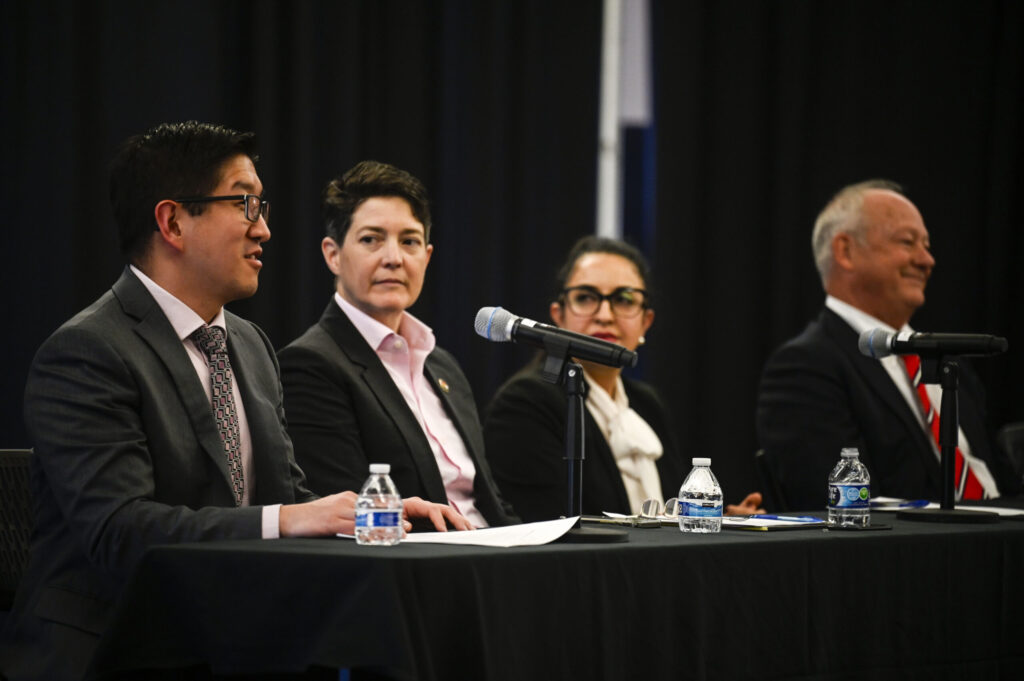
U.S. Magistrate Judge Cyrus Y. Chung described on Wednesday the various tactics he employs to resolve court cases, summing up his role with a laxative-based metaphor. “Someone told a group of us federal magistrate judges that magistrate judges are the...

Three cargo ships damaged by ‘projectiles’ in Strait of Hormuz
Brady Knox, Washington Examiner
brady.knox.washington.examiner@gazetteedit.wpenginepowered.com
Updated 23 hours ago
Three cargo ships were damaged by unspecified “projectiles” while navigating the Strait of Hormuz, jeopardizing President Donald Trump’s goal of preserving the shipping lane’s safety. The strait was de facto closed the morning hostilities began on Feb. 28, with announcements...

Trump calls on Thune to be a ‘leader’ and get the votes for the SAVE America Act
NAOMI LIM Washington Examiner
naomi-lim-washington-examiner@coloradopolitics.com
Updated 23 hours ago
President Donald Trump increased pressure on Senate Majority Leader John Thune (R-SD) to pass the SAVE America Act, imploring him to be a “leader” after he expressed concerns that there is not enough support for the measure in his chamber....
The ‘talking filibuster,’ explained
Molly Parks, Washington Examiner
molly.parks.washington.examiner@gazetteedit.wpenginepowered.com
Updated 23 hours ago
Senate Republicans have for weeks been debating the use of the “talking filibuster” to guarantee the passage of the SAVE America Act in the upper chamber, after President Donald Trump called the legislation his “No. 1” priority. The bill, which...

Colorado’s Polis joins coalition of governors urging Congress to reject Trump tariffs
Marissa Ventrelli
marissa.ventrelli@coloradopolitics.com
Updated 19 hours ago
Colorado Gov. Jared Polis has joined 18 other governors in writing a letter to members of Congress, urging them to reject President Donald Trump’s efforts to codify tariffs that the U.S. Supreme Court recently invalidated. “Governors across the country are...
PREV
PREVIOUS

Denver does not track spending on homeless encampment response, audit says
An audit of Denver’s homeless encampment response revealed major holes in the program, notably that the city does not track how much it actually spends on enforcement, outreach and clean-up activities. The city also does not “sufficiently” oversee the invoices for services it contracts with, including the amounts it pays vendors and how well the […]

Huntsville, in line for Space Command, makes presence known at Space Symposium 2023
Amid the forest of more than 200 exhibitors at the Space Symposium are hundreds of companies hawking products and services, more than a dozen national space agencies, several states and chambers of commerce representing just three cities. The Colorado Springs Chamber & EDC and the Metro Denver Economic Development Corp. aren’t big surprises given they […]