

Charter bills would further harm public education | NOONAN
The legislature may make significant decisions about K-12 public education this year. Two bills predict a bad trend. Democrat Dafna Michaelson Jenet, representative from Adams County representing Commerce City, and Republican Senator Janice Rich from Delta, are pitching bills to extend timelines for charter applications and to expand charter schools for individualized learning.
While seemingly innocuous, the bills will exacerbate the deleterious effects of the charter movement on public education. First, to the bills. HB23-1025 to extend charter school application timelines will allow charters an additional six months, from 12 to 18, to get their application act together. That’s six more months to market to parents a prospective charter will save children from the depredations of traditional public schools.
At least those are the arguments made by charter schools applying in Commerce City. The Adams 14 school board has resisted bringing charters into the district, although there are some already established. Current pressure comes from Denver charters that want to expand into Commerce City. The Adams 14 district is already in a steaming cooker heated up by the State Board of Education. Time extensions for prospective charters will distract this district and others from their true business of providing quality education. The charters are dangling unrealized promises that minority students will do better under their authority. Facts don’t support the claims.
HB12-1188 to bring individualized learning to students is actually a funding drainage system taking state funds that should support all public school students and diverting the money to home schooled children and their parents. The bill refers to the individualized learning in Vision Charter Academy in Delta and Mesa County Community School. Home schooling parents are “family partners.” These schools claim they engage, but the Vision Charter Academy calendar for February is empty except for winter break and a board meeting. There are no Vision Voice newsletters for January or February 2023. Mesa Community offers two education tracks. In one, students meet twice a week with subject teachers and in the other, students meet once a week. These are the two schools the bill cites as models of innovation.
Now for the bigger picture. PublicSchoolReview.com is a useful website for basic data on Colorado’s schools. It provides math and reading test information, demographic data, free and reduced lunch percents, etc. It also lists every school from first place by testing data to last place. It’s easy to sort by charter schools from first to last as well.
The data are startling. The charter schools in Colorado have essentially re-segregated, not desegregated, student communities. Justice Thurgood Marshall, who made his career in the Brown v. Board of Education decision that separate but equal is not constitutional, would be horrified at how the charter system has re-established school segregation in this state.
Of the 20 “top” charter schools in the state, only two have under 50% white students. Nine have more than 70% white students. In four of these charters, Asians are the second highest demographic. In terms of free lunch, only one has more than 10 percent of students in this category at 11%.
At the lowest end of the test scores, the story is the opposite among the charters. A Strive Prep school has 91% Hispanic students, Ricardo Flores Magon has 94% Hispanic, and Kipp Middle has 71% Hispanic, 18% Black, and 4% White students. Free and reduced lunch are above 50% of students.
Obviously about 15% of Colorado’s parents are okay with this stratification of our social system. But 85% of families, despite declining enrollments due to demography and the economy, are sticking with traditional public schools. Given our laws and the evolution of Colorado into a diverse state in which everyone at some level needs to get along in order to thrive, does it make sense to pour more money into schools that separate students by race, ethnicity and income? And the data are even more damning when assessing how children with disabilities are separated out of the charter system.
Charter supporters claim choice is the main thing. Fifteen percent of our population apparently believes separate and not equal is the right choice outcome. Those who claim charters are doing a better job of educating students, which is dubious when comparing schools of similar student demographics, must admit those high test scores come at a high cost to the social fabric.
Right now, 19 out of the top 20 charter schools by testing have fewer than 10% of students on free lunch. Nine of 20 have 5% or fewer students who qualify for free lunch. That distribution is not how Colorado will ever meet its constitutional requirement, and ideal, to provide a “thorough and uniform” education for its children.
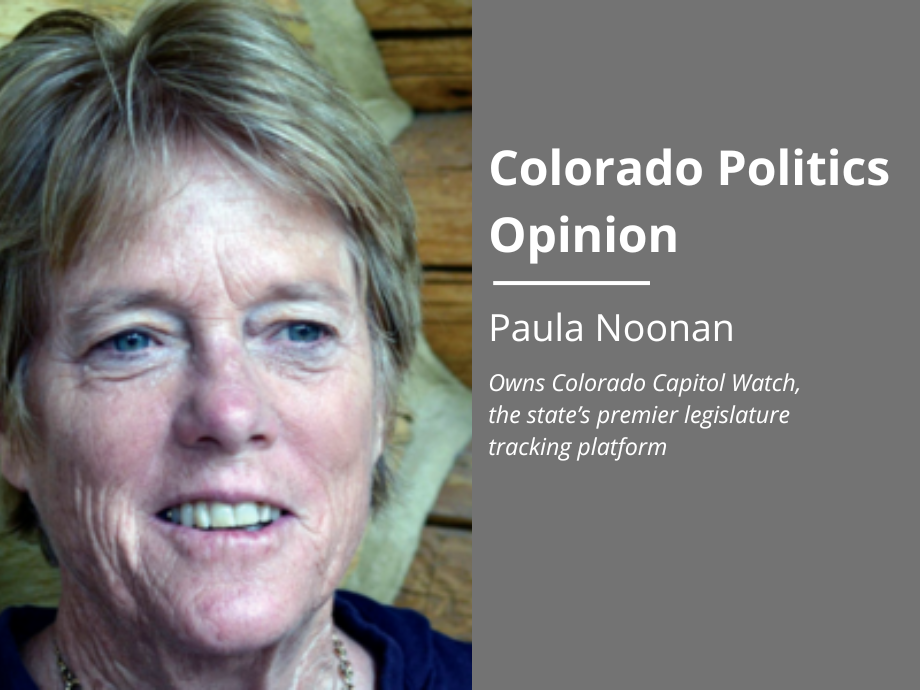
Paula Noonan owns Colorado Capitol Watch, the state’s premier legislature tracking platform.

Colorado’s place in President Trump’s oil-and-gas approach | Paula Noonan
Paula Noonan
paula-noonan@coloradopolitics.com
Updated 6 hours ago
Head spinning is the unwanted reality of today’s world. Let’s start at the international level. The wars in the Middle East since the 1950s have never ended. Though religion and ethnicity are factors, oil and gas access is always predominant...

Reject onerous ad limits in sports-betting bill | OPINION
Colorado Politics
colorado-politics@coloradopolitics.com
Updated 19 hours ago
By Justin Sasso A dangerous precedent is potentially afoot in the Colorado state Senate right now, where a bill was recently introduced to restrict advertising for local broadcast media across Colorado. Senate Bill 26-131, seemingly designed to discourage Coloradans from participating...
Reform to Colorado’s grantmaking drives efficiency, strengthens state’s partnership with nonprofits | OPINION
Colorado Politics
colorado-politics@coloradopolitics.com
Updated 19 hours ago
By Marco Dorado and Jack Murphy Colorado’s nonprofit sector is one of the most significant contributors to our state’s economic and civic life, with more than 14,000 registered nonprofit organizations supporting more than 262,000 jobs — approximately 10% of all...

Costly auto mandate amounts to needless overkill | FEEDBACK
Colorado Politics
colorado-politics@coloradopolitics.com
Updated 19 hours ago
HB26-1199 is currently in the legislature, and let me explain how this affects you. Currently in the state of Colorado, your vehicle’s emissions have to meet California standards even though you do not live in California. Though we all can agree...
Congress needs to protect 340B for rural Colorado | PODIUM
Colorado Politics
colorado-politics@coloradopolitics.com
Updated 6 hours ago
By Rod Pelton A lot of politicians talk about understanding what life is like for our rural communities, but not many really do. I’m a third-generation Cheyenne County farmer and rancher; I grew up on the eastern plains of Colorado, raised...

Caldara overlooked facts in slamming utilities | FEEDBACK
Colorado Politics
colorado-politics@coloradopolitics.com
Updated 2 days ago
Normally, I appreciate the variety of perspectives published on Colorado Politics. But regarding Jon Caldara’s recent column on Xcel, he irresponsibly neglects key facts to the point of annihilating credibility (“Are our overlords normalizing power outages?” March 15). He neglects...

Fix the process before reauthorizing state PUC | OPINION
Sara Blackhurst
sara-blackhurst@gazette.com
Updated 2 days ago
What needs to be fixed before reauthorizing the Public Utilities Commission? The answer is simple: the process. The last time the commission was reauthorized in 2021, lawmakers expanded its role in meaningful ways — particularly as Colorado accelerated its clean...
What exactly makes you a public figure? | Hal Bidlack
Hal Bidlack
hal-bidlack@coloradopolitics.com
Updated 3 days ago
Well, once again, this non-lawyer columnist is going to jump in the deep end of legal scholarship and will explore a recent Colorado Court of Appeals decision. Buckle up. In yet another terrific Colorado Politics Court Crawl article, we learned...
Modernizing Pinnacol is about its members, not politics | IN RESPONSE
Colorado Politics
colorado-politics@coloradopolitics.com
Updated 2 days ago
By Akasha Absher While we share the passion for protecting Colorado’s workers expressed in a recent op-ed from the perspective of trial attorneys and union representatives, the piece paints a picture of Pinnacol Assurance that is more rooted in 1915...

Mum on his own replacement, Bennet disrespects voters | Dick Wadhams
Dick Wadhams
dick-wadhams@coloradopolitics.com
Updated 6 hours ago
U.S. Sen. Michael Bennet is playing an arrogant game of hide-and-seek with Colorado voters as he seeks to abandon his Senate seat to become governor. Bennet insists that if he is elected governor in November, he will wait until he...
PREV
PREVIOUS

Bill favors Ticketmaster, slights Colorado consumers | OPINION
John Breyault In 2017 the Denver Broncos callously revoked the season ticket licenses of several fans because they resold their own season tickets to games they couldn’t attend on NFLTicketExchange.com, a website promoted and endorsed by both the NFL and the Broncos. Such anti-fan conduct was thankfully outlawed in 2018 when Colorado passed a law […]

Killed bill exposed Dems' disingenuousness on TABOR | OPINION
Ben Murrey Citing record inflation, Colorado Democrats passed legislation last year that sent out TABOR refunds early. Last week Democrats voted along party lines to kill a bill that would have had the same effect. Their about-face opposition to the bill gives new life to previous allegations that Democrats sent out last year’s refunds early, […]