

Legislative leaders outline priorities for 2023 session

Four of the legislative leaders for the General Assembly outlined their priorities for the 2023 session that starts Monday in the annual preview hosted by the Metro Denver Chamber of Commerce.
The chamber’s priorities for 2023 are similar to those presented by lawmakers during Wednesday’s breakfast: sustainability, including clean air, the current water crisis, public transit incentives, and renewable energy; housing, which means going beyond affordable housing with construction litigation, reforms, zoning, and land use; and economic competitiveness, according to moderator Kristen Blessman, president and general manager of PBS12.
The legislative leaders addressed questions on public safety/crime, rulemaking by state agencies, housing affordability, water, and sustainability, including green energy.
Speaker of the House designee Julie McCluskie, D-Dillon; Senate Majority Leader Dominick Moreno, D-Commerce City; Senate Minority Leader Paul Lundeen, R-Monument and
House Minority Leader Mike Lynch, R-Wellington commented on what it was like to come to Denver, particularly the 16th Street Mall, years ago, but that an explosion of drugs, including fentanyl, have changed it for the worse. He noted the 2022 measure he co-sponsored with then-Speaker Alec Garnett, but later withdrew from on its final vote. There’s more that can be done, Lynch said, to crack down on illegal drugs. But the legislature also needs to look at what it’s done in the past and “not be afraid to change” and reverse some of its previous decisions. People are afraid to say they were wrong and “let’s try something different,” Lynch said.
Senate Minority Leader Paul Lundeen, R-Monument, said he sponsored a bipartisan bill in the 2022 session to put $50 million into training on critical incident intervention for law enforcement. The bill was pared down to $500,000 and had a Democratic co-sponsor, but still failed. “It died for politics,” Lundeen said. “We have this challenge” because of the tone but “we need to come together and say, yes, we do perceive a problem,” which he said would require a cultural as well as a policy shift.
Speaker of the House designee Julie McCluskie, D-Dillon, commented that property and auto theft crimes should be addressed. “We’ve already made significant investments in safe streets,” McCluskie said. She also noted that crime in rural Colorado does not look the same as it does in urban communities, so the goal should be to tackle root causes, which include behavioral and mental health, and providing services to address those issues.
But the state has yet to see the results of the billions of dollars the General Assembly has invested in these areas, she said. It’s when those dollars will be in action that “we will begin to see the response to crime and the root causes of crime ultimately tackled.
Bipartisan legislation to address auto theft is already planned in the Senate, according to Senate Majority Leader Dominick Moreno, D-Commerce City. He noted current law dictates that stealing a car valued at $2,000 or less is considered only a misdemeanor. That’s negatively impacted low-income individuals who rely on those vehicles to get to work or for other purposes. Gov. Jared Polis, in a letter Sept. 15 to the Colorado Commission on Criminal and Juvenile Justice, indicated support for updating the law, to remove the monetary value language.
On the issue of agency rule-making, the lawmakers encouraged the public to engage with the legislature. A 120 day legislative session is not enough to engage with every stakeholder, Lundeen said. In addition, “we need to continue to observe and watch the implementation of policy make those course corrections when we see that implementation may not be producing the desired outcomes.”
“We need your input constantly as we go about moving the direction of the state,” Lynch added.
Blessman, on housing affordability, pointed out that it is the top obstacle for recruiting and talent for business, but the state is short about 225,000 housing units. More should be done regarding zoning, regulations, building codes and construction litigation reform, she said, asking how the legislature will address that issue, including on reforming zoning regulations.
While the recently voter-approved Proposition 123 will put millions of dollars annually into affordable housing, the program relies on local governments to opt in to receive those funds, Moreno said. “It’s not necessarily unreasonable for the legislature to assert a bit of a role in these housing decisions, because we need to create more units across the state in order to keep up with workforce demands and lower the price of housing for everyone,” he said, adding that it will be one of the big fights in the 2023 session.
Lundeen pointed to previous legislation on climate change that he said has added $42,000 to the cost of a new home. “Is it affordable housing or is it a $42,000 more expensive dwelling?” he asked. Lundeen advocated for “massive” capital deployment to build housing but without risking the loss of that capital. :It should be more than a state program that adds a few hundred million dollars here or there. We need to do some things that are fundamental in saying affordable housing is a priority.”
“The best thing we can do is get out of the way of the free market,” added Lynch, claiming the problem is overregulation of the housing industry, which he said requires spending tens of thousands of dollars before a home can even break ground.
Finally, the lawmakers addressed sustainability, in response to a question on how the state can better balance its “aspirational interests” around sustainability versus what is economically and technically reasonable according to the business community.
Lundeen spoke in favor of clean natural gas, stating it has done more to clean up the environment than any other type of fuel. The question, he said, is whether the goals are achievable in the timeframes that have been chosen.
Goals are great but what matters are actionable steps, Moreno said. The legislature hasn’t always done the best at making sure the state reaches the milestones.
Moreno also touted the governor’s $120 million plan for tax credits to get more electric vehicles on the road, which he said will help meet part of the “decarbonization” goal.
The focus on mobile sources is incredibly important, McCluskie said, adding that she’s eager to dive into the governor’s proposal.
marianne.goodland@coloradopolitics.com

Primary rival sues to prevent Democrat Eileen Laubacher from going through assembly in Colorado’s 4th CD
Ernest Luning
ernest.luning@coloradopolitics.com
Updated 6 hours ago
Democratic congressional candidate Trish Calvarese on Monday asked a judge to prevent one of her primary rivals, Eileen Laubacher, from participating in the caucus and assembly process to seek the nomination to challenge Republican U.S. Rep. Lauren Boebert in Colorado’s...
Colorado lawmakers tackle legislation on sexual assault
Jenny Deam
jenny-deam@coloradopolitics.com
Updated 5 hours ago
A panel of Colorado lawmakers on Monday unanimously approved a bill that supporters say will offer protections and support to victims of domestic violence, stalking, sex trafficking and sexual assault, including mandatory training for law enforcement on trauma. The measure,...
Colorado Supreme Court clarifies restraining order violations can always support burglary charge
Michael Karlik
michael.karlik@coloradopolitics.com
Updated 9 hours ago
The Colorado Supreme Court’s majority ruled on Monday that a violation of a restraining order can also serve as a basis for finding a defendant guilty of burglary. Under state law, a person commits second-degree burglary by unlawfully entering or...

Big week ahead for major legislation to address housing affordability woes
Zach Halaschak, Washington Examiner
zach.halaschak.washington.examiner@gazetteedit.wpenginepowered.com
Updated 11 hours ago
The Senate is pushing ahead with a bipartisan bill to improve housing affordability, teeing up a critical week for housing on Capitol Hill and raising major questions about what provisions will be included. Senate Majority Leader John Thune (R-SD) filed cloture on legislation from the...

Macron goes nuclear with increases to French warhead arsenal
Timothy Nerozzi, Washington Examiner
timothy.nerozzi.washington.examiner@gazetteedit.wpenginepowered.com
Updated 11 hours ago
French President Emmanuel Macron is channeling the atomic spirit of his predecessor Charles de Gaulle with orders for the French military to “increase the number of nuclear warheads” in the nation’s arsenal. Macron announced the seismic shift in France’s defensive...

Who has been killed so far during US-Israel mission in Iran?
David Zimmermann and Keely Bastow, Washington Examiner
david.zimmermann.and.keely.bastow.washington.examiner@gazetteedit.wpenginepowered.com
Updated 11 hours ago
There have been numerous casualties on all sides since the joint U.S.-Israel strikes against Iran commenced over the weekend, with more lives expected to be lost as the campaign continues. The Islamic regime’s leadership is currently bearing the brunt of...
Colorado Senate swears in Adrienne Benavidez after district vacancy win
Marianne Goodland
marianne.goodland@coloradopolitics.com
Updated 11 hours ago
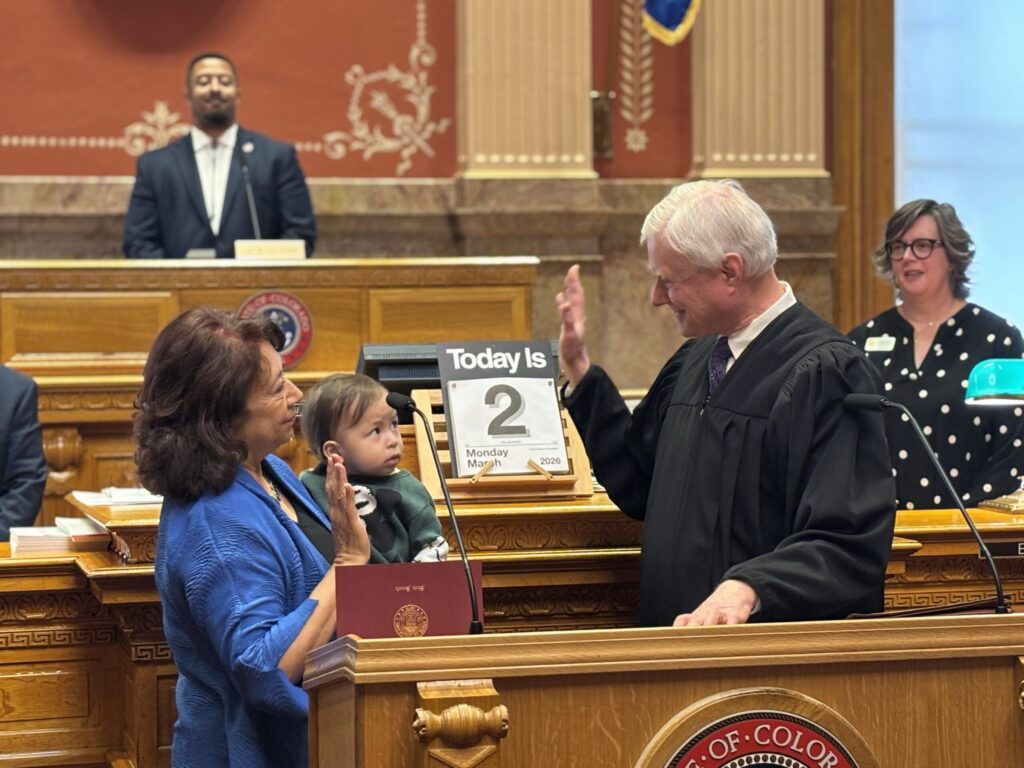
Sen. Adrienne Benavidez, a Democrat from Adams County, was sworn in Monday to the Colorado Senate, just four days after winning a vacancy election in District 21. She was sworn in by Colorado Court of Appeals Justice Lino S. Lipinsky...

10th Circuit judge creates vacancy, district court gets new chief judge | COURT CRAWL
Michael Karlik
michael.karlik@coloradopolitics.com
Updated 13 hours ago
Welcome to Court Crawl, Colorado Politics’ roundup of news from the third branch of government. A longtime member of the Denver-based federal appeals court will give the president a vacancy to fill, plus Colorado’s federal trial court will see a...

Denver mayor says his commute time tripled following ‘road diet’ change
Mark Samuelson Special to The Denver Gazette
mark.samuelson@denvergazette.com
Updated 11 hours ago
Mayor Mike Johnston is pushing back sharply against the claim by Denver councilmembers and bike activists that the city succumbed to lobbying pressure in revising a “road diet” plan for East Alameda Avenue, while noting that his own commute time...

Rural legislators, Colorado farmers defeat pollinator bill backed by Gov. Polis
Marianne Goodland
marianne.goodland@coloradopolitics.com
Updated 12 hours ago
A proposal to limit the use of neonicotinoid-coated crop seeds collapsed in the Senate Agriculture and Natural Resources Committee last week, as rural lawmakers, including two Democrats, joined Republicans to reject what they called an expensive, impractical mandate on farmers....
PREV
PREVIOUS

10th Circuit upholds sealing of records in response to Colorado Springs church's harassment
The federal appeals court based in Denver has upheld a trial judge’s decision to block access to certain court records, out of concern that members of a Colorado Springs church would use the information to harass and intimidate witnesses. A long-running and unusual quest for transcripts has been intertwined with the Colorado Springs Fellowship Church […]

Rich Jones, longtime policy wonk for the Bell, dies at 69
Rich Jones, the longtime director of policy and research for the Bell Policy Center, died Jan. 2 after a long illness. Jones’ funeral will be on Monday, Jan. 9 at 10:30 a.m. at St. Michael the Archangel Catholic Church in Aurora. He will be interred at Fairmount Cemetery at 1:30 p.m. In lieu of flowers, […]