

Heed mental health warning signs | SENGENBERGER


On Sunday morning, I woke up to news of yet another mass shooting in our state. This time, the dreadful attack was on Club Q, an LGBTQ nightclub in Colorado Springs. Like the rest of Colorado, I was devastated by the news, horrified that more lives had been taken in a senseless act of terror.
The killer now stands accused of murdering five people – of ripping five human beings away from their loved ones – and injuring more than two dozen others. Even more, he devastated two communities – both Colorado Springs and the LGBTQ community. Coloradans have joined one another in expressing grief, sorrow and support for the victims and their families.
The Gazette has reported background details of Colorado’s latest alleged mass murderer, formerly known as Nicholas Brink until he changed his name to Anderson Lee Aldrich at age 15. It appears Aldrich has had longstanding mental and emotional issues tracing back to childhood.
“His upbringing is marked by a biological father who dabbled in drugs and worked in the porn industry and a mother with multiple arrests in California and Texas, and the two parents separated while Aldrich was a toddler,” The Gazette summarized. “Shortly before he changed his name, the suspected shooter apparently was a target of online bullying and showed signs of a fascination with gay culture.”
In June of last year, Aldrich, then 21, was reportedly the suspect in a bomb threat incident in which he possessed “multiple weapons while threatening to blow a home ‘to holy hell.'” The incident was live-streamed, apparently on his mother’s Facebook page, showing him wearing body armor and a helmet.
His mother reported the threat to law enforcement, The Gazette reports, asserting that “her son had made threats from within the house shown in the video with a homemade bomb, several weapons and ammunition.” The suspect was accused of two counts of felony menacing and three counts of first-degree kidnapping, but no formal charges were pursued in the case.
Under a relatively new state law, that case was sealed automatically, meaning law enforcement may be precluded from having a critical tool in prevention. For instance, “these sealed records hobble the press and government agencies from scrutinizing who’s arrested, why and whether there are nefarious reasons for the number and target of arrests, or the lack of convictions.”
Moreover, Colorado has a red flag law. Aldrich’s purported 2021 incident seems like one instance where it may have been valuable. Yet it apparently was never used.
Here again, we have existing laws either serving as an impediment to information or not being utilized. Why not?
What we know now about Aldrich adds more to the story. We see a child raised in a broken home and a troubled childhood, and later, an adult who previously had a threatening run-in with law enforcement. We can conclude that there was a coalescence of significant mental health issues and a multilayered failure to act, culminating in Saturday’s atrocity.
To be clear, a man is responsible for his own actions. Aldrich – and Aldrich alone – is culpable for committing his unspeakable evil. Even so, what we learn about his background, and the possible failures along the way, is instructive. It reminds us to follow the warning signs and to take actions when we are in position to help. It reemphasizes the importance of mental health treatment as well.
The latter point seems especially crucial at the holidays.
As I thumbed through Twitter on Sunday, where I first saw the news about Club Q, I noticed another depressing loss. Jason David Frank (JDF), a mixed marital artist and actor who is best known for portraying Tommy Oliver on “Power Rangers,” had died the night before. Soon after, it was confirmed that JDF had taken his own life. He leaves behind four children.
As the original Green and White Rangers, Tommy was my favorite Ranger and an icon for my 1990s childhood. JDF became the most famous, visible and influential Power Ranger actor, returning to the series multiple times in future incarnations and promoting Power Rangers online and at events.
For many, the holidays are a difficult and emotionally trying time. Two years ago, I publicly shared for the first time my own struggles with depression and suicide. Readers are welcome to go back to that 2020 CoPo column, where I discussed my own experience.
Needless to say, I was treated for clinical depression and anxiety for more than seven years. During that time, on Dec. 31, 2013, I nearly took my own life. Fortunately, my family was there to support me – even if it meant calling the police on a mental health emergency.
“While I had no idea this would end up being one of the best things to happen to me – it set a new course for my treatment – it was the most intense and miserable night of my life,” I wrote. Every New Year’s is a bittersweet reminder.
Fortunately, as my life since that fateful night shows, there is a path forward. There are many treatments and services available for those in need, as well as for those who are in a position to help. Violence – against oneself or others – just isn’t the answer. Truth and love are.
Editor’s note: After this column was set for publication, The Gazette reported public defender records identify Aldrich as nonbinary and uses they/them pronouns.
Jimmy Sengenberger is host of “The Jimmy Sengenberger Show” Saturdays from 6 a.m. to 9 a.m. on News/Talk 710 KNUS. He also hosts “Jimmy at the Crossroads,” a webshow and podcast in partnership with The Washington Examiner.

You get what you pay for in your state reps | Hal Bidlack
Hal Bidlack
hal-bidlack@coloradopolitics.com
Updated 16 hours ago
My regular readers will know of my affection for the Out West Roundup, a Colorado Politics feature that lets us keep up to date with the goings on out here in the western U.S., and draws attention to stories that...
A warrant should mean something — expedite carrying them out | OPINION
Colorado Politics
colorado-politics@coloradopolitics.com
Updated 16 hours ago
By Aaron Ping My name is Aaron Ping. I am a father from Washington state, and I am writing because my 16-year-old son, Avery, cannot. Avery died on Dec. 19, 2024. The drugs that killed him were ordered through Snapchat....
Lower Basin must adapt to Colorado River hydrology | OPINION
Colorado Politics
colorado-politics@coloradopolitics.com
Updated 16 hours ago
By Nick Peters A February deadline for determining future operating guidelines for the West’s two largest reservoirs came and went with no agreement on the table and clear lines drawn in the sand. A seven-state resolution to how Lake Mead and Lake Powell will...

Keep kids safe without overregulating childcare | OPINION
Colorado Politics
colorado-politics@coloradopolitics.com
Updated 7 hours ago
By Tamra Ryan As the Coors Economic Mobility Fellow for Common Sense Institute, I have written several reports in the past two years about the challenges related to affordability and availability of child care in our state. Though there are many factors affecting the dearth of...

Colorado’s GOP at its best — and worst | Dick Wadhams
Dick Wadhams
dick-wadhams@coloradopolitics.com
Updated 3 days ago
By Dick Wadhams Colorado Republicans are fighting to be relevant in the face of gross mismanagement by Democrats who totally control state government. While the Colorado Republican Party is mired in controversy, several Republican elected officials and candidates represent the...

Someone’s lying in latest activist embarrassment for Polis’ CPW Commission | Rachel Gabel
Rachel Gabel
rachel-gabel@coloradopolitics.com
Updated 3 days ago
Either Samantha Miller is lying, or Gov. Jared Polis is. If Miller is lying, she is so secure in the red carpet rolled out for animal activists by this administration she is willing to put words in the governor’s mouth....

Ask Secretary of State candidates if they’re in favor of independent election audits | Jon Caldara
Jon Caldara
jon-caldara@coloradopolitics.com
Updated 5 days ago
This part will disappoint angry people on Twitter: Relax. Put the pitchforks down. I am not relitigating the 2020 election or mail ballots or even Tina Peters. But I am saying people don’t trust elections like they used to. And...
Redistricting plan to give Colorado Dems 7 members of the U.S. House will split El Paso County | Bob Loevy
Bob Loevy
bob-loevy@coloradopolitics.com
Updated 3 days ago
A proposed redistricting plan, which would give Colorado seven Democratic members of the U.S. House of Representatives and only one Republican, will split El Paso County into two parts and thereby weaken the county’s influence in Congress. El Paso County,...

Can deliberation save democracy? | Vince Bzdek
Vince Bzdek
vince.bzdek@gazette.com
Updated 1 day ago
In September 2019, 523 Americans traveled to Dallas for an experiment called “America in One Room.” The gathering was designed to test a theory: Could representative citizens deliberate productively even in an era of intense polarization? The event focused on...
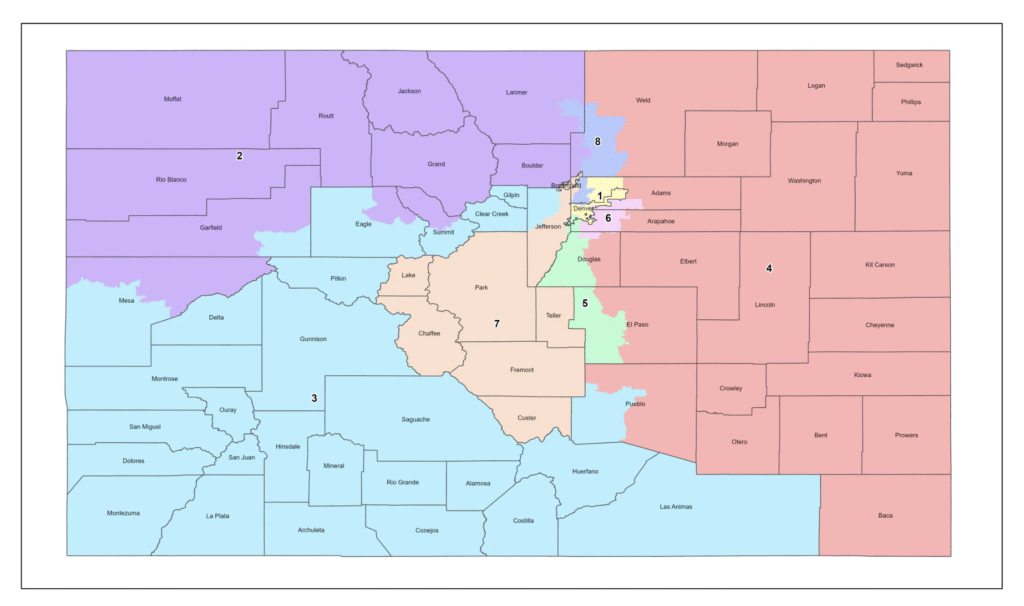
Redistricting scheme would give Colorado Democrats seven House members, split El Paso County | Bob Loevy
Bob Loevy
bob-loevy@coloradopolitics.com
Updated 2 days ago
A proposed redistricting plan, which could give Colorado seven Democratic members of the U.S. House of Representatives and only one Republican, would split El Paso County into two parts and thereby weaken the county’s influence in Congress. El Paso County,...
PREV
PREVIOUS

Republicans are blue in Colorado | PODIUM
Mark Hillman “Democracy,” wrote H.L. Mencken, “is the theory that the common people know what they want and deserve to get it good and hard.” A majority of Colorado voters have made it clear that they want to be governed by Democrats. With Democrats presiding over a struggling economy, widespread crime and social disorder, this […]

Freeing predators to prowl on parole | Colorado Springs Gazette
State Sens. Pete Lee of Colorado Springs and Julie Gonzales of Denver, and state Rep. Leslie Herod of Denver – have some explaining to do. Especially, to the grieving loved ones of 27-year-old Allison Scarfone. Scarfone was raped and killed in Colorado Springs last month. Her alleged killer was on parole at the time – […]