

Colorado Springs Gazette: Starbucks strike unveils the downside of unions
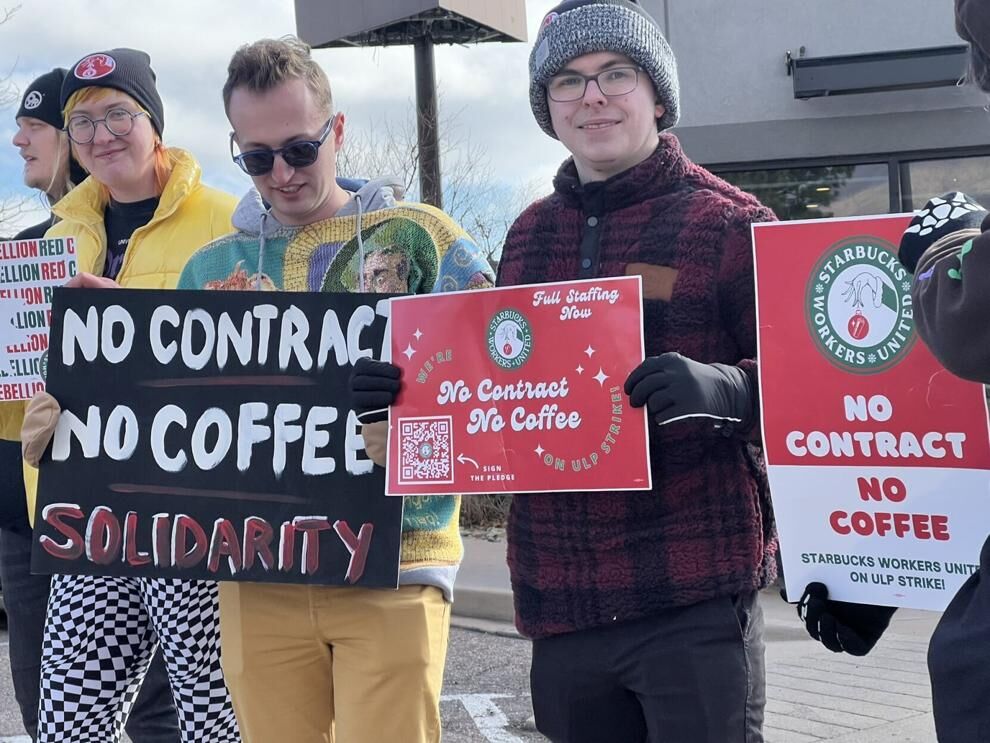
A small percentage of Starbucks employees went on strike Thursday, complaining of the corporation’s opposition to unionization. Inadvertently, strikers showcased the antiquation of unions and the need for a Colorado right-to-work law.
The unionized workers of Starbucks earn less than peers who aren’t bound by contracts and dues. Today’s unions can’t keep pace with modern market dynamics. Given this circumstance, joining a union should be 100% voluntary – as it is in 28 right-to-work states.
In Colorado, employees can force union membership by forming an “all-union” shop with approval of 75% of employees. A state that deregulates drugs and fancies itself the real Galt’s Gulch should not tolerate tyranny of the 75%.
The Starbucks strike involved about 100 of the company’s 9,000 shops. In Colorado, it took place at one location in Colorado Springs, Denver, Greeley and Superior.
The corporation wants to head off the early stages of a feeble movement that has unionized fewer than 3% of the chain’s stores. Workers at 57 Starbucks nationwide have voted down unionization.
The issue surfaced in Colorado Springs late last month when Starbucks corporate closed a store on South Nevada Avenue. Employees claim headquarters shuttered it because employees unionized in March. Corporate claims it closed the store over concerns for employee safety in a high-crime neighborhood.
In a better society the corporation could close a store for any reason. Authorities should force no one to sell coffee. We don’t live in such a free society. Section 8 of the 1935 Labor Relations Act prohibits employers from closing operations to avoid collective bargaining.
The National Labor Relations Board and federal courts occasionally grapple with cases like the Nevada Avenue Starbucks dispute.
Consider the case of RAV Truck and Trailer Repairs, Inc. The New York business laid off two workers and closed one of its operations in 2018 after employees unionized. The owner said the shop was losing money and its lease was up, claiming the layoffs and closure had no link to the union.
Former employees complained to the NLRB. The board ordered the company to reopen, reinstate employees and “make the separated employees whole for any loss of earnings or benefits,” and “to bargain with the Union upon request.”
A federal appellate court remanded the ruling back to the NLRB with instructions to reconsider. These regulatory quagmires should have no place in the 21st century, where innovation, creativity and technology constantly disrupt business-as-usual. Modern corporate executives and boards make instant, dog-fight decisions just to survive.
In contrast to today’s young adults, baby boomers and the World War II generation endured eras of grueling unemployment and stiff competition for any kind of work. Innovation and disruption were slow and favored the status quo. Employers held the cards and created demand for collective bargaining and minimum wages.
Today’s employers find themselves so desperate for employees they typically pay above minimum wage thresholds, which have quickly reached $12 to $15 throughout much of the country. Big tech firms voluntarily offer employees massages, gourmet cafeterias, laundry service and more.
Just this week, Centura Health announced $30,000 hiring bonuses for nurses. Signs at drive-throughs offer hiring bonuses, wages of $18-plus and “start today get paid tomorrow” arrangements. They’ll hire almost anyone willing to work.
Starbucks invested an additional $1 billion this fiscal year to improve pay and benefits to meet the market’s high valuation of labor. So far, the unionized workers have lost out on it.
“…workers are angry that Starbucks promised higher pay and benefits to non-union stores,” explains a Gazette news article. “Starbucks says it is following the law and can’t give union stores pay hikes without bargaining.”
Indeed, contemporary unions can harm employees. Maybe that’s why union membership among Colorado-based workers dropped from 11% in 2018 to a record low 6.5% in 2021.
Without masterful immigration reform or another baby boom – neither is likely – sustained labor shortages will replace the old bane of high unemployment. On the fly, as needed, employers will offer bonuses, benefits and wages above legal minimums or tenets of static union contracts.
Colorado’s Democratic legislature and governor aren’t likely to consider a right-to-work law. In recent years, they have expanded options for public sector unionization, a move to counter plummeting private sector membership.
Voters rejected a right-to-work ballot measure in 2012. Over 10-plus years, dynamics have changed. Voters have twice chosen to lower income taxes for employees, so they may be open to protecting them from compulsory and coercive unions.
When union contracts can’t keep up with market forces, they burden their members – as acknowledged on Thursday. Under these circumstances, the law should free all workers, public and private, from compulsory membership and dues. Maybe it is time to try the ballot again, in a serious effort to protect employees and their jobs.
Colorado Springs Gazette Editorial Board

Caldara overlooked facts in slamming utilities | FEEDBACK
Colorado Politics
colorado-politics@coloradopolitics.com
Updated 9 hours ago
Normally, I appreciate the variety of perspectives published on Colorado Politics. But regarding Jon Caldara’s recent column on Xcel, he irresponsibly neglects key facts to the point of annihilating credibility (“Are our overlords normalizing power outages?” March 15). He neglects...

Fix the process before reauthorizing state PUC | OPINION
Sara Blackhurst
sara-blackhurst@gazette.com
Updated 8 hours ago
What needs to be fixed before reauthorizing the Public Utilities Commission? The answer is simple: the process. The last time the commission was reauthorized in 2021, lawmakers expanded its role in meaningful ways — particularly as Colorado accelerated its clean...
What exactly makes you a public figure? | Hal Bidlack
Hal Bidlack
hal-bidlack@coloradopolitics.com
Updated 1 day ago
Well, once again, this non-lawyer columnist is going to jump in the deep end of legal scholarship and will explore a recent Colorado Court of Appeals decision. Buckle up. In yet another terrific Colorado Politics Court Crawl article, we learned...
Congress needs to protect 340B for rural Colorado | PODIUM
Colorado Politics
colorado-politics@coloradopolitics.com
Updated 7 hours ago
By Rod Pelton A lot of politicians talk about understanding what life is like for our rural communities, but not many really do. I’m a third-generation Cheyenne County farmer and rancher; I grew up on the eastern plains of Colorado, raised...

Modernizing Pinnacol is about its members, not politics | IN RESPONSE
Colorado Politics
colorado-politics@coloradopolitics.com
Updated 21 hours ago
By Akasha Absher While we share the passion for protecting Colorado’s workers expressed in a recent op-ed from the perspective of trial attorneys and union representatives, the piece paints a picture of Pinnacol Assurance that is more rooted in 1915...

Mum on his own replacement, Bennet disrespects voters | Dick Wadhams
Dick Wadhams
dick-wadhams@coloradopolitics.com
Updated 4 days ago
U.S. Sen. Michael Bennet is playing an arrogant game of hide-and-seek with Colorado voters as he seeks to abandon his Senate seat to become governor. Bennet insists that if he is elected governor in November, he will wait until he...

What kind of energy independence did we pay for? | Miller Hudson
Miller Hudson
miller-hudson@coloradopolitics.com
Updated 4 days ago
It was during the summer of 1972 AT&T published an internal solicitation for installation and repair supervisors with “inner-city” experience to transfer to Mountain Bell. The catch was an applicant’s readiness to work 10 hours a day, six days a...

Those who cannot live without wild things | Rachel Gabel
Rachel Gabel
rachel-gabel@coloradopolitics.com
Updated 4 days ago
Aldo Leopold wrote in his Sand County Almanac, “There are some who can live without wild things and some who cannot.” The collection of essays first published in 1949 was accepted by a publishing house after a steady stream of...

Thank God for Wyoming — the un-Colorado | Jon Caldara
Jon Caldara
jon-caldara@coloradopolitics.com
Updated 4 days ago
Years ago, I interviewed a Canadian health-care broker whose job was helping his countrymen escape their own failing system. When their “free” health care turned into “free to wait until you die,” he’d save his clients by routing them to...
It’s time to let unaffiliated voters caucus | Vince Bzdek
Vince Bzdek
vince.bzdek@gazette.com
Updated 2 days ago
There’s no getting around it: Colorado’s 3,000 county caucuses, which just wrapped up recently, left half the electorate out in the cold. Since unaffiliated voters now make up 51% of all Colorado voters, a majority of Colorado electors are barred...
PREV
PREVIOUS

Social studies standards warrant review by parents | OPINION
Pamela Benigno Colorado’s new social studies standards demonstrate why parents need to do their own homework and study what their children are taught in school. The Colorado State Board of Education has adopted newly revised social studies standards that include history, civics, geography, economics and financial literacy after a year-long process that elicited strong opinions […]

Sentinel Colorado: With election over, time to address Colorado's problems
There’s no time for partisan praise nor penance in Colorado. The election is over, and Republican candidates were decimated in elections across the state. It wasn’t surprising in any way. GOP hopefuls across the spectrum focused on stoking fears about crime, the economy and assorted conspiracy theories without offering any real or practical solutions. The […]