

Democrats split as Colorado House approves sweeping fentanyl bill
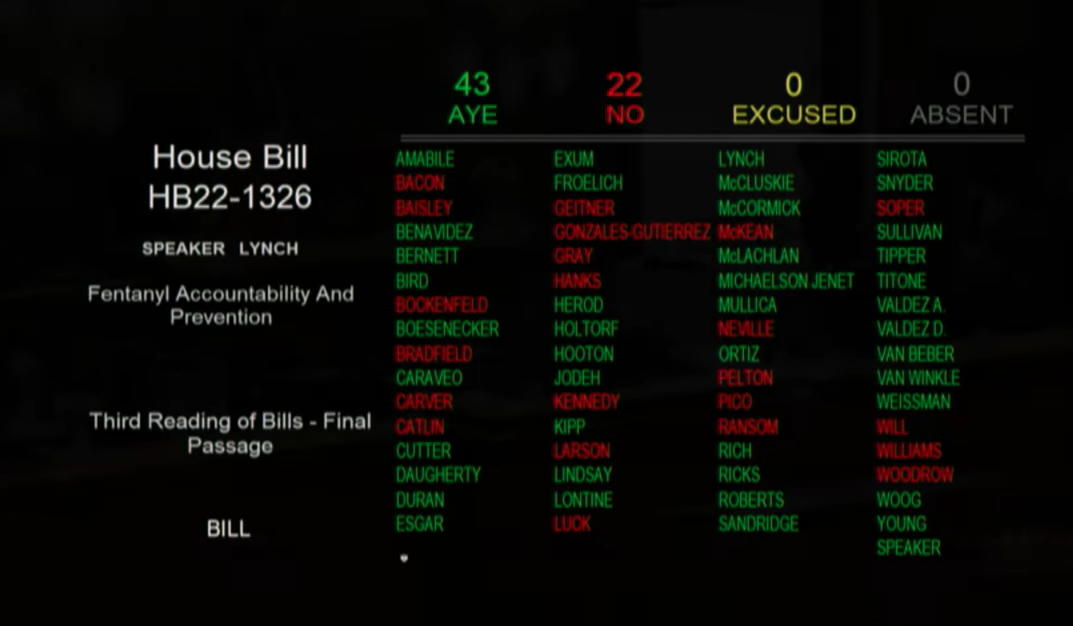
The state House on Monday passed sweeping changes to the state’s laws around fentanyl, but the measure, a priority of the chamber’s leadership, split the majority caucus and received strong opposition from some of the Democrats’ ranking members.
All told, five Democrats balked at the measure, including Rep. Chris Kennedy, D-Lakewood, who chairs the House’s State, Civic, Veterans and Military Affairs Committee. Kennedy voted “no” due to the bill’s “felonization” of low-level amounts of fentanyl possession.
That issue has provoked the most contention as the bill, which ultimately received a 43-22 vote, moved through the House after its introduction a month ago.
As introduced, House Bill 1326 ramps up criminal penalties for distribution of fentanyl, including a felony 1 drug charge for distribution that results in death. It also sets up a “Good Samaritan” clause, allowing a person who provides fentanyl to someone who overdoses – whether intentional or not – to face a lesser than a felony 1 drug charge, even if a recipient dies, if the person calls 911, stays on scene and cooperates with first responders or law enforcement.
The bill allocates $20 million to pay for more opioid overdose antidotes, such as Naloxone, $6 million to expand the state’s harm-reduction grant program this year, and $3 million to help jails develop new withdrawal treatment protocols. Correctional facilities would be required to offer opioid agonists and antagonists – methadone, for example – to inmates with opioid-use disorders. And if it’s medically necessary, treatment for that inmate will continue throughout their incarceration under the legislation.
The bill also includes an education program to inform users that fentanyl can be found in any illicit street drug, including heroin, methadone or cocaine, or mixed with analgesics, such as acetaminophen, the active ingredient in Tylenol, for example. The drug can also be formed to imitate other drugs, such as Percocet or Xanax. The bill contains harsher penalties for dealers and those who import pure fentanyl into the state.
But the biggest issue revolves around what to do with users caught with the drug. A 2019 law made possession of up to 4 grams of fentanyl a misdemeanor, but, as amended, HB 1326 lowers that felony threshold to 1 gram, or about 10 pills, if each pill contains about 1 milligram* of fentanyl, which is common.
The vote tested the majority’s unity in the chamber. Ultimately, the “felonization” provision in the bill cost House Speaker Alec Garnett, D-Denver, the support of five Democrats, who veered from the party line and voted against the legislation.
“I like what we’re trying to do to crack down on distribution of fentanyl and I especially like what we’re trying to do to invest in public health and harm reduction to save people’s lives,” said Kennedy, who also praised Garnett and co-sponsor Rep. Mike Lynch, R-Wellington, for their efforts to strike the right balance. “It’s helpful that we’re all talking about this together.”
But Kennedy said he doesn’t understand how charging someone with a felony will help save lives, arguing this approach to deterrence won’t work.
“The felony will hurt more people than it helps,” he said.
House Assistant Majority Leader Serena Gonzales-Gutierrez, D-Denver, initially said she would be a “yes” on the bill but with misgivings around the issue of making it a felony to posses any amount of fentanyl. She, too, argued that forcing people into treatment through felony charges won’t work.
“I don’t know if this is the way,” she said. She ultimately voted against the bill.
The measure also split the House Republican caucus.
The death toll will go higher without a strong change in laws to address the fentanyl crisis, warned Rep. Terri Carver, R-Colorado Springs, who tried during the House’s second reading debate to lower the threshold to zero for possession.
This bill fails to meet the challenge of the crisis, she said in explaining her “no” vote.
“If we don’t do our job today, shame on you,” said Lynch, the bill’s Republican cosponsor who sought to encourage his colleagues to support the legislation.
Several legislators who ultimately supported the measure described it as far from perfect but argued it contains enough provisions to start to confront the crisis.
Rep. Leslie Herod, D-Denver, said those who have been working on the bill, whether lawmakers or advocates outside the House, share common goals – to save lives and help those suffering from addiction. She said intervention programs work and noted that HB 1326 provides millions for harm reduction and treatment. She said it will prove to be the state’s largest investment in behavioral health, adding the bill will save lives and ensures punishment for peddlers.
Others, such as Rep. Alex Valdez, D-Denver, supports zero tolerance but also ultimately voted for the measure.
Valdez said his district, which includes downtown Denver, is ground zero of the fentanyl crisis and he can now differentiate meth smoke and fentanyl smoke.
“I saw my first dead body two weeks ago,” he said, adding he witnessed it at 14th and Curtis, right next to a pipe and foil. “I want it stopped, my constituents want it stopped.”
Zero tolerance is the tool Denver needs, he added.
Valdez, who described his position as a reluctant “yes,” said he hopes a “better bill” comes back from the Senate.”
“The bill falls short by one gram,” he said.
It’s not just a Denver problem, said House Minority Leader Hugh McKean of Loveland, who recounted how it was prom weekend in his city and he had warned his teens not to take anything, no matter who offered it.
Parents lawmakers heard from were “never given the chance” to tell their children they wanted to get them into treatment, he said. Instead, the parents found their kids dead, cold and pale, and could not revive them, he added.
This is not a perfect bill, Garnett told his colleagues. But it confronts fentanyl from both sides of the issue – meaning possession and treatment.
“With how deadly fentanyl is, it cannot just be one side or the other,” he said.
No one ever brought a possession bill to his desk, said Garnett, who also appeared frustrated by the opposition from his caucus.
“We’re trying to get a comprehensive bill that will save lives,” he said.
The people who want to save lives asked for the tools outlined in the bill, he said, adding the compromise, at 1 gram, will get pills off the street.
“The greatest failure of all is failure to act when action is needed, and action is desperately needed,” he said.
The bill now moves to the Senate, where more changes are expected. The bill is scheduled for a 2 p.m. hearing on Tuesday in the Senate Judiciary Committee.

Legal war over Trump’s immigration detention policy far from over despite key win
Jack Birle, Washington Examiner
jack.birle.washington.examiner@gazetteedit.wpenginepowered.com
Updated 12 hours ago
The Trump administration won a key victory at a federal appeals court late last week, when its mandatory detention policy for illegal immigrants was upheld, but it still faces skepticism in various other federal courts. The administration’s mandatory detention policy...

Laura Clellan named sole finalist for Colorado Parks and Wildlife director
Marianne Goodland
marianne.goodland@coloradopolitics.com
Updated 12 hours ago
The Department of Natural Resources announced Monday that Laura Clellan, who is currently serving as acting director of Colorado Parks and Wildlife, is the only finalist for the job. Clellan has been acting director of CPW since Nov. 25, when...

Colorado budget writers put Medicaid caregiver pay cuts on hold
Marissa Ventrelli
marissa.ventrelli@coloradopolitics.com
Updated 10 hours ago
The Colorado General Assembly’s budget decision-makers have put proposed pay cuts on hold for people who care for a family member with a disability who receives Medicaid. The Joint Budget Committee made the decision after hours of testimony from family...
Colorado lawmakers seek faster warrant response from social media firms
Sage Kelley
sage.kelley@denvergazette.com
Updated 10 hours ago
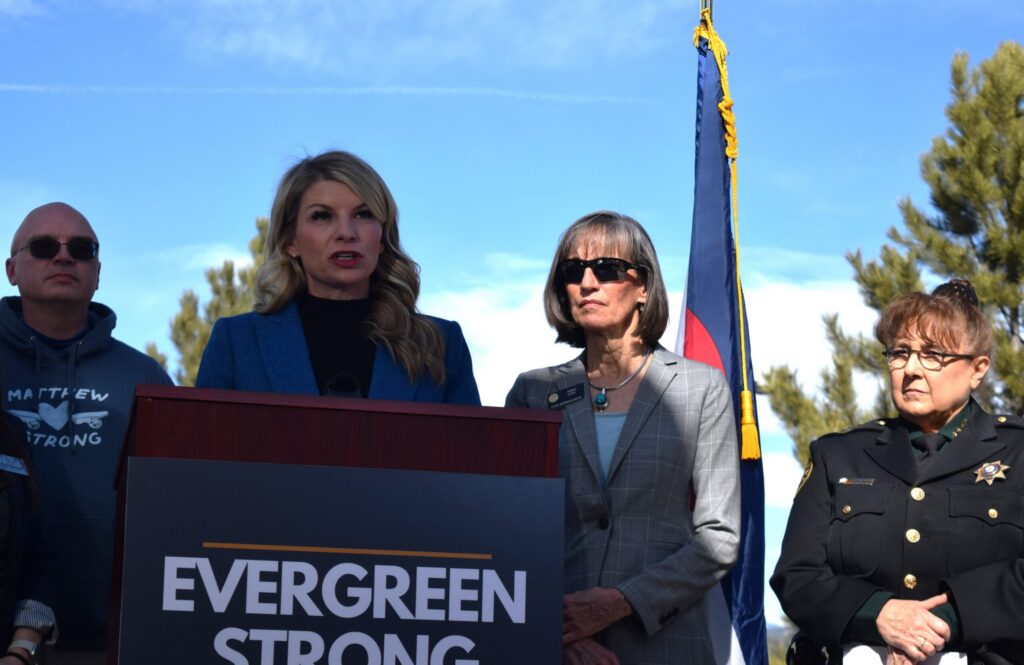
Proponents argue legislation would prevent school shootings Colorado officials on Monday claimed that the Evergreen High School shooting could have been prevented if social media companies had been required to respond faster to warrants — and they are pushing legislation...

10th Circuit orders lawyer to pay $1,000 for faulty AI citations
Michael Karlik
michael.karlik@coloradopolitics.com
Updated 10 hours ago
The Denver-based federal appeals court ordered a lawyer on Monday to pay $1,000 to the opposing side for submitting a legal filing with fake case citations generated by artificial intelligence. A three-judge panel of the U.S. Court of Appeals for...

A fight over seeds and bees: Colorado Democrats target neonicotinoid pesticides
Marianne Goodland
marianne.goodland@coloradopolitics.com
Updated 11 hours ago
Colorado lawmakers are weighing new restrictions on a class of pesticides after Gov. Jared Polis signaled support for a Democratic-backed bill aimed at protecting pollinators — a proposal that has raised sharp worries from farmers who rely on treated seeds...

Supreme Court finalists selected, federal judges slash backlogs | COURT CRAWL
Michael Karlik
michael.karlik@coloradopolitics.com
Updated 17 hours ago
Welcome to Court Crawl, Colorado Politics’ roundup of news from the third branch of government. Coloradans learned who the three finalists are for a state Supreme Court vacancy, and new data show that Colorado’s federal trial judges reduced their backlog...
Colorado Democrats propose changes to juvenile corrections, jail searches, municipal courts | Bills in brief
Marissa Ventrelli
marissa.ventrelli@coloradopolitics.com
Updated 15 hours ago
Colorado lawmakers introduce hundreds of bills each year. Bills in brief cuts through the noise by explaining which proposals matter, what’s at stake, and how decisions at the Capitol could affect everyday life across the state. Colorado lawmakers are advancing a slate...

Colorado’s legislative activity has increased 56% since 2012, report finds
Marissa Ventrelli
marissa.ventrelli@coloradopolitics.com
Updated 10 hours ago
The Colorado General Assembly has adopted increasingly more bills in the last several years, even as the proposals have also become more complex. The legislature passed 487 bills during the 2025 legislative session, representing a 56% growth in legislative output...

Ghislaine Maxwell declined to answer questions from a House committee, citing 5th Amendment rights
Stephen Groves
stephen.groves@associatedpress.com
Updated 19 hours ago
WASHINGTON (AP) — Lawmakers tried Monday to interview Ghislaine Maxwell, but the former girlfriend and confidante of Jeffrey Epstein invoked her 5th Amendment rights to avoid answering questions that would be incriminating. Maxwell was to be questioned during a video...
PREV
PREVIOUS

GOP congressional candidate Jan Kulmann debuts TV ad in 8th CD primary
Republican Jan Kulmann hits the airwaves Monday with her first TV ad in the primary for Colorado’s battleground 8th Congressional District. Saying she “won’t back down,” the Thornton mayor calls herself “an outsider who gets results” in the ad, which highlights a failed attempt to recall her from office six years ago. The 30-second spot […]

Colorado House OKs measure creating pandemic supply stockpile
The state House of Representatives approved a measure Monday to create an emergency stockpile of pandemic supplies. The bill passed almost entirely along party lines, with Democrats in support of the bill and most Republicans in opposition. It will now be sent to the state Senate for consideration in the coming weeks. If enacted, House […]