

Colorado lawmakers kill bill to prohibit firing employees for using marijuana

Colorado’s lawmakers on Thursday killed a bill that sought to prohibit employers from firing or refusing to hire an employee based on their use of marijuana.
Before the fatal vote, a House panel unanimously chose to completely rewrite House Bill 1152, replacing it with a proposed task force to study medical marijuana use in employment. As originally written, the bill would have allowed people to use marijuana outside of work and allowed card-carrying medical marijuana individuals to use the drug during work without negative professional consequences.
“The original bill has been introduced five times in the legislature and each time it has failed,” said bill sponsor Rep. Edie Hooton, D-Boulder. “(This would have) opened up the conversation between employers and workers, which is in the best interest of both parties.”
The House Business Affairs and Labor Committee indefinitely postponed the bill in a bipartisan 12-1 vote, with only Rep. Tom Sullivan, D-Centennial, voting in support of the measure.
Under the rewritten bill, a task force would have been created to consider how medical marijuana users could be employed without creating safety issues in the workplace. The task force would have recommended legislation based on its findings, though lawmakers would not be obligated to pursue the legislation.
Despite the amended bill not making any actual legislative changes, opponents said it would have attempted to find an avenue in which employers would be forced to allow medical marijuana use in the workplace, which they said is unacceptable.
“At the end of the day, this really boils down to an employer’s right to operate their business in a safe and quality way,” said David Burks, owner of Sweetheart Winery in Loveland, during Thursday’s panel meeting. “Our people need to be on top of their game and they can’t do that if they’re impaired.”
In addition to opponents who spoke at the meeting, nearly 70 businesses and organizations registered against the original bill, while only one – the Colorado Cross-Disability Coalition – supported it.
Some opponents said the bill is simply coming too soon due to the lack of technology to measure marijuana impairment. In Colorado, a person is considered legally impaired by marijuana if a blood test finds at least 5 nanograms of THC per milliliter of blood. However, some studies have found that THC in the bloodstream does not correlate to impairment and that there is no objective threshold for marijuana impairment.
“This is a necessary conversation,” said Eric Bergman, spokesman for Colorado Counties Inc., arguing that employers need to be able to measure whether employees are impaired if using medical marijuana at work. “Until such time when a test is available that will measure the active THC or the impairment levels in the bloodstream, we simply can’t move forward on this issue.”
Hooton said her intention with the bill was to protect the rights of Coloradans who use medical marijuana for health conditions, such as chronic pain and seizures. She said it is “grossly unfair” that these users lose out on employment opportunities that require drug tests.
The Colorado Supreme Court ruled in 2015 that companies are allowed to fire employees for using marijuana outside of work. Coats v. Dish Network revolved around a satellite TV provider firing a quadriplegic employee after he failed a random drug test. The employee, 35-year-old Brandon Coats, had a state-issued medical marijuana card and used the drug at night to help him sleep and quiet his muscle spasms.
“As a person with a disability and someone who uses medical marijuana, this bill is important,” said Francesca Mayes with the Colorado Cross-Disability Coalition. “It allows those who need it to work a full day without being in pain. It allows an employee the same rights as everyone else who relies on medication during the workday.”
Hooton said multiple state legislators have tried to pass versions of the bill since 2018 to protect employees, such as Coats and Mayes.
While marijuana is illegal federally, it has been legal for medical use in Colorado since 2009 and for recreational use since 2014.
“There are over 84,000 medical cannabis patients in Colorado, many of whom are denied employment opportunities despite being high-functioning,” Hooton said. “There is discrimination against medical cannabis users, which not only spills out into the workplace, but it also suggests to all Coloradans that medical cannabis use is dangerous, that it results in cognitive and physical impairment.”

Appeals court reinstates Garfield County arson charge
Michael Karlik
michael.karlik@coloradopolitics.com
Updated 10 hours ago
Colorado’s second-highest court reinstated a Garfield County defendant’s arson charge on Thursday, concluding a trial judge improperly credited a witness’s claim that she alone was responsible for starting the fire. A sheriff’s deputy responded to a brush fire near Parachute...

Democratic US Sen. John Hickenlooper qualifies for Colorado primary by petition, will skip assembly
Ernest Luning
ernest.luning@coloradopolitics.com
Updated 8 hours ago
U.S. Sen. John Hickenlooper has qualified for Colorado’s Democratic primary after the first-term incumbent submitted enough valid petition signatures to make the ballot, state officials said. Hickenlooper is facing primary challenges from state Sen. Julie Gonzales, D-Denver, and university professor...
Federal judges rebuke ex-Colorado judicial discipline director for conduct in lawsuit
Michael Karlik
michael.karlik@coloradopolitics.com
Updated 11 hours ago
A pair of federal judges expressed a desire on Thursday to break the logjam on a lawsuit by Colorado’s former judicial discipline director against the state Supreme Court and related entities, while simultaneously showing little tolerance for the plaintiff’s scorched-earth...

Democratic bill would let recipients of ‘conversion therapy’ sue Colorado providers with no statute of limitations
Marissa Ventrelli
marissa.ventrelli@coloradopolitics.com
Updated 9 hours ago
Colorado lawmakers have advanced a proposal that would allow people who underwent conversion therapy to sue licensed providers for damages, moving the measure forward on a party-line vote in the House Judiciary Committee. House Bill 1322, proposed by Democratic Reps....
Pinnacol separation bill delayed as Colorado budget remains in flux due to $1.5B deficit
Marianne Goodland
marianne.goodland@coloradopolitics.com
Updated 8 hours ago
A bill that would allow Pinnacol Assurance to formally sever its remaining ties with the state appears unlikely to emerge anytime soon, as House leaders juggle a massive budget shortfall, unresolved negotiations with key stakeholders, and growing doubts about whether...

100 days until America250: Five host cities unveiled for July 4 celebrations
Emily Hallas, Washington Examiner
emily.hallas.washington.examiner@gazetteedit.wpenginepowered.com
Updated 14 hours ago
America250, the entity tasked by Congress with marking the United States’ semiquincentennial, on Thursday revealed further details about its sweeping plans to celebrate the milestone. America250 chairwoman Rosie Rios launched the official 100-day countdown to July 4, and said the...

U.S. Sen. Michael Bennet qualifies by petition for Colorado’s Democratic gubernatorial primary
Ernest Luning
ernest.luning@coloradopolitics.com
Updated 9 hours ago
U.S. Sen. Michael Bennet on Tuesday became the first gubernatorial candidate to qualify for Colorado’s June primary ballot after state election officials determined the three-term Democrat’s campaign submitted enough valid petition signatures. Bennet is running against Attorney General Phil Weiser...

Thornton police investigating homicide
Matt Kyle
matt.kyle@denvergazette.com
Updated 10 hours ago
Police in Thornton are investigating a homicide that happened late Wednesday night. Thornton Police Department officers responded just before 11 p.m. near the intersection of East 88th Avenue and Grant Street after a 911 caller reported someone bleeding. Upon arrival,...
Colorado legislators consider $500 million in general fund cuts amid $1.5 billion deficit
Marianne Goodland
marianne.goodland@coloradopolitics.com
Updated 1 day ago
The legislature’s Joint Budget Committee is working through a list Wednesday of about 150 suggestions to cut as much as $1.5 billion in general fund dollars out of next year’s budget. The largest on the list prepared by JBC staff...
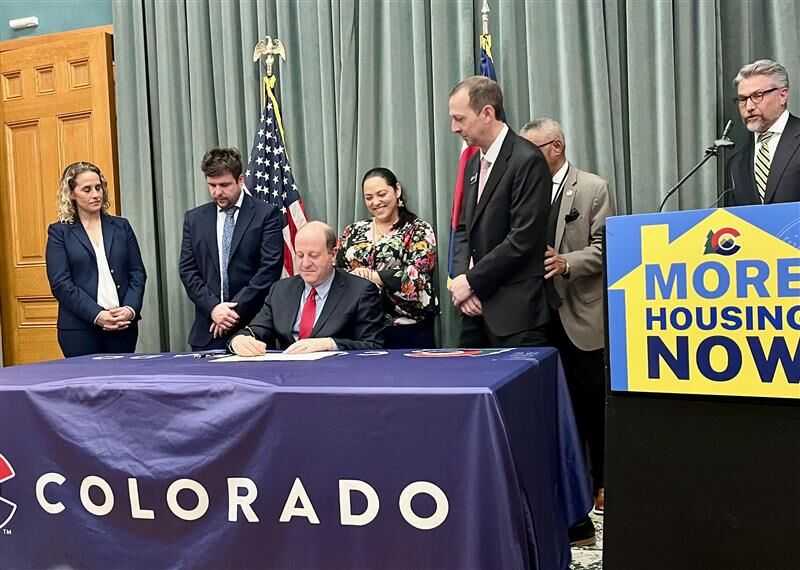
Gov. Jared Polis signs housing bills amid push for ‘affordability’
Marissa Ventrelli
marissa.ventrelli@coloradopolitics.com
Updated 9 hours ago
Gov. Jared Polis held the first public bill signing of the 2026 legislative session on Wednesday on a pair of housing measures that, sponsors said, are aimed at affordability. Part of Democrats’ “affordable” housing package this year, the bills —...
PREV
PREVIOUS

Attorney suing Douglas County school board asks judge to consider if district's lawyers violated ethics rules
The lawyer suing the Douglas County school board raised “serious ethical concerns” about the legal team representing the district in a court filing this week, and he asked the judge presiding over the lawsuit to consider if his counterparts had violated their ethical duties. Attorney Steve Zansberg told a Douglas County judge Tuesday that details […]

Jan Kulmann slams GOP primary rival Barb Kirkmeyer for declining to sign term limits pledge
One of the Republicans seeking the nomination in Colorado’s newly created 8th Congressional District on Thursday called out a primary opponent who hasn’t pledged to support a constitutional amendment to establish term congressional term limits. Thornton Mayor Jan Kulmann issued a statement urging state Sen. Barb Kirkmeyer, R-Brighton, to sign the pledge sponsored by the […]