

Colorado’s citizen legislature grapples with parental leaves
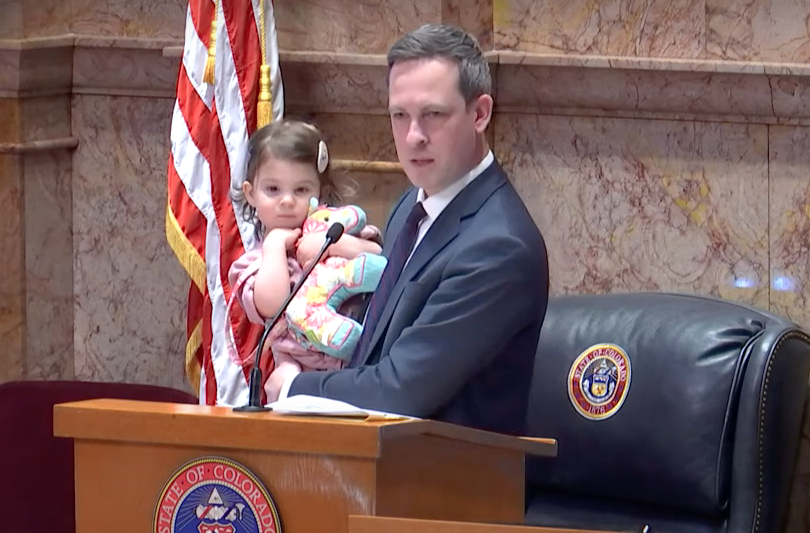
As Colorado’s legislature becomes younger, policymakers find themselves contending with how to tackle parental leaves, particularly because no specific rule governs such situations and it’s complicated to write rules for politicians, who are elected by the people and not hired by the state.
Decades ago, often the only times a baby or a young child was seen on the floor of the House or Senate was on the first day of session, when lawmakers brought in their grandchildren to witness proceedings. But Colorado’s General Assembly has gotten younger since then, and with a lot more women, including those of childbearing age, joining the policymaking body.
Indeed, the issue of how a citizen legislature that meets 120 days out of 365 every year handles parental leave will likely become more pronounced as the assembly attracts younger and younger policymakers – and more women. Currently, women are the majority in the House, and the majority in the Senate Democratic caucus.
In the past six years, at least a dozen of Colorado’s lawmakers have added babies to their families. That includes Senate President Steve Fenberg, House Speaker Alec Garnett, House Majority Leader Daneya Esgar, two Democratic senators, and six other members of the House on both sides of the aisle.
There are differences in how lawmakers have so far handled parental leaves, with some continuing to work and others taking full advantage of time away from the job to bond with their infant.
In 2020, Sen. Brittany Pettersen, D-Lakewood, became the first lawmaker in 37 years to give birth during a legislative session. Pettersen, whose son Davis was born Jan. 19, was excused from Jan. 21 to Feb. 27, a total of 36 days, in the 2020 session that was shortened to 84 days due to the COVID-19 pandemic.
Pettersen sponsored six Senate bills and eight House bills in that session, and served as vice chair of transportation and also sat on the Senate Finance Committee. Three of her six Senate bills were introduced prior to going on maternity leave; two more were introduced while she was on maternity leave.
More recently, House Majority Leader Daneya Esgar took maternity leave after giving birth to daughter Marlo last July. Although the legislature was not in session at the time, lawmakers in leadership have full-time duties.
“We’re tackling this responsibility the same way working parents have been doing this for years,” Esgar told Colorado Politics.
“My bosses are the folks who sent me here, the folks in my district, and making sure I really represent them,” she said, adding that “being a working mom” accomplishes that.
Even though her emails had a standard line that she was on maternity leave, Esgar said she still checked emails to make sure she didn’t miss anything important, such as a constituent who needed immediate attention, and held stakeholder meetings while she was on leave, which made Marlo famous on Zoom before people even knew about her.
It wasn’t always wonderful and great, Esgar said, adding she wished for more job-family boundaries during that time, but at the same time, “that’s my job, and I knew I would always be representing the folks who sent me here.”
Esgar also said she relied heavily on her staff to keep her up to date.
“If I missed an email … and there was a big issue, my staff alerted me,” she said, adding she would then figure out steps to take and the staff took the directive and handled it.
“When you sign up for this job, it’s a job you’re constantly doing, and for better or worse, a lot of us have tried to draw boundaries … Was it completely off work? No,” she said, adding she is “no different” than any other lawmaker who has a family. “We’re constantly juggling that balance and taking care of the work we’re here to do,” she said.
Colorado’s General Assembly has no policy on how parental or maternal leave is handled for its member lawmakers, and Colorado’s legislature is not alone. The National Conference on State Legislatures said only one legislative body, the Massachusetts Senate, has a rule addressing an absence due to childbirth.
Massachusetts Senate Rule 57 says if a member is prevented from voting in the Senate because “of disability or due to a condition related to pregnancy, childbirth or nursing a child,” the chamber’s president shall assign a “court officer to answer the roll call on behalf of the member so long as the disability continues.” That court officer will continue to answer the roll call as long as the condition continues, the rule says.
The absence of a clear policy applying to elected officials extends to the U.S. Congress.
In 2020, Congress passed a law granting 12 weeks of paid family leave to the federal workforce, including for congressional staffers. The law, however, doesn’t apply to lawmakers – it’s up to each individual lawmaker on whether to take paid parental leave. In recent years, U.S. Rep. Colin Allred, D-TX, took parental leave twice, while U.S. Sen. Tammy Duckworth, D-IL, the first sitting senator to give birth, took 12 weeks in 2018.
Colorado’s lone statute on the subject isn’t about maternity or parental leave; rather, it’s about compensation, tied to long-term illness, not family leave. CRS 2-2-307(2)(b) says that if a lawmaker is absent for one-third of the session for any purpose other than long-term illness, one-third of their compensation “shall be forfeited,” but that law also says it would be waived if the absence is approved by the presiding officer of the chamber.
The lack of a paternal leave policy means it’s up to individual legislators to negotiate their time away from work with presiding officers.
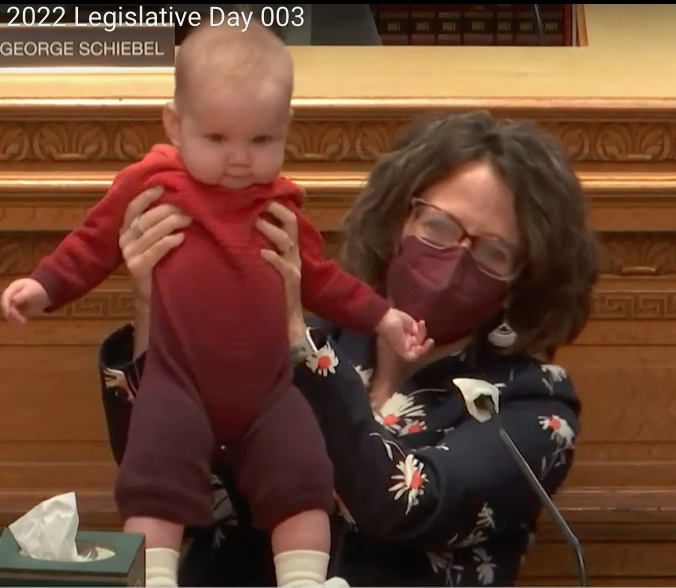
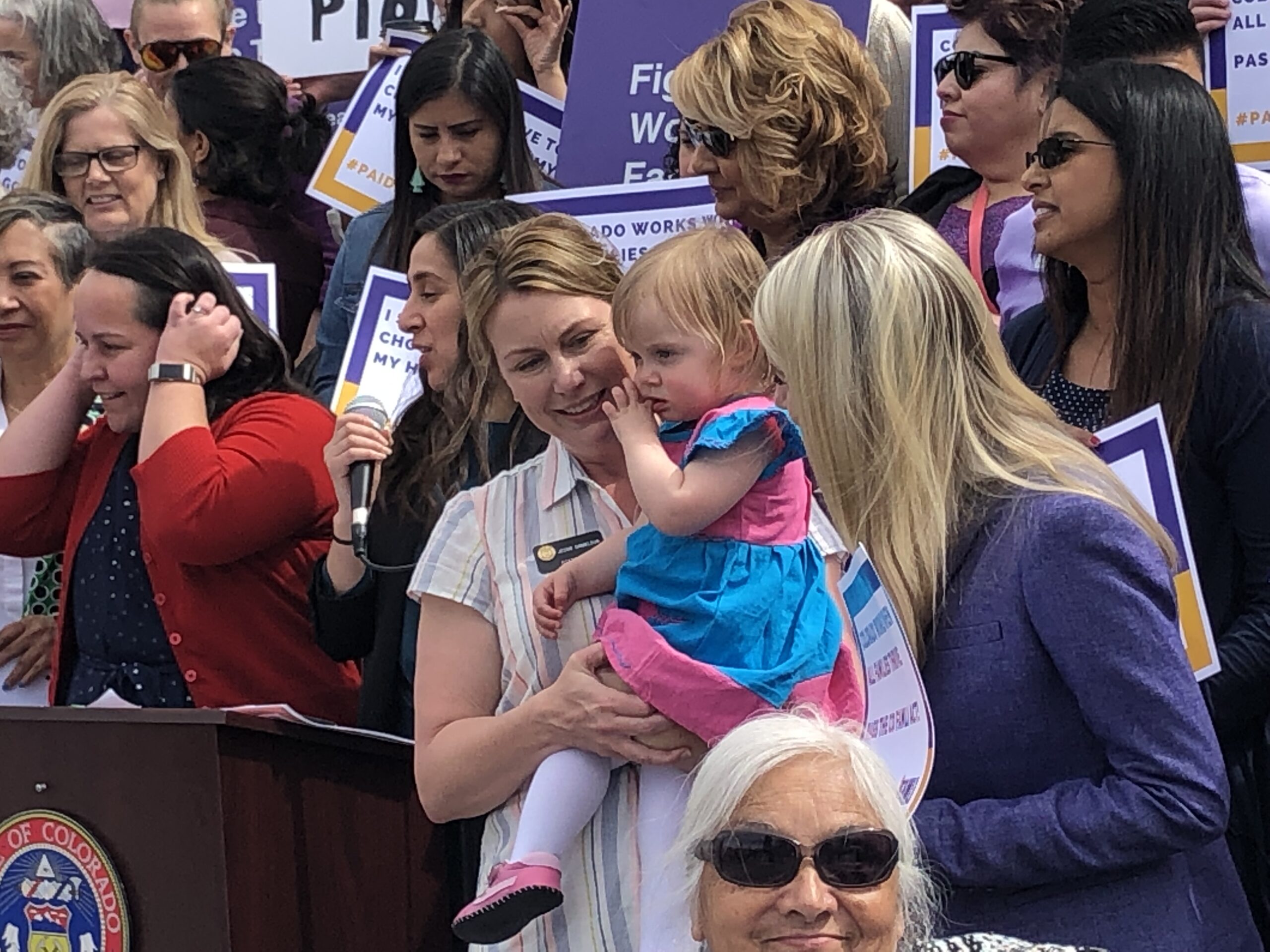
Sen. Jessie Danielson, D-Wheat Ridge, who has been on maternity leave since giving birth to a son on Dec. 7, decided to fully focus on caring for her infant for the first few months. With permission from her chamber, she has been excused for 50 out of the first 51 days as of March 3, thereby missing all but three votes she registered when she participated remotely on the first day of session. Danielson, who was removed from all committee assignments for the entire 2022 session, has yet to submit a single bill in the 2022 session.
The Wheat Ridge Democrat said she prepared for her eventual leave by ensuring she’s ready to hit the ground running once she’s back at the Capitol. She told Colorado Politics two weeks ago that, prior to giving birth and in anticipation of going on maternity leave, she spent months crafting legislation she intends to introduce this year.
That will include, she said, legislation to provide security for Colorado seniors, build safe wildlife passages to protect motorists and wildlife, combat wage theft for Colorado workers, and address the issue of missing and murdered indigenous relatives – measures she said she will introduce when she returns. Danielson also pointed out that her bill requests were all submitted well in advance of the deadlines set by the General Assembly.
As noted, Danielson isn’t the only one who’s recently been excused in the state Senate an extended amount of time after having a child. What’s clear is that state leaders recognize the importance of time away from work for new mothers and for parents to bond with infants.
That’s been the case for both Pettersen and Danielson – their maternity leave absences were both approved by then-Senate President Leroy Garcia, D-Pueblo.
Garcia, in a statement to Colorado Politics before he stepped down, said Danielson is “on maternity leave, a critically important time for new mothers to recover from childbirth and for families to bond during the first months of their child’s life. Senator Danielson will be returning to the Senate soon, and looks forward to continuing her work representing her constituents at the Capitol.”
“Senator Danielson is still a sitting Senator representing SD 20,” his statement added.
The lack of a policy for maternity or paternity leaves isn’t confined to American legislatures.
In Ireland, a member of that country’s version of the House has pushed for a bill in each of the last three years to allow elected officials to take maternity leave.
Holly Cairns, the House member, told the Irish Times when she was first elected to the Cork County Council that “female councilors spoke of the ‘trauma’ of giving birth while being an elected official.”
“They were working from their maternity beds, they had to take sick leave which is, quite frankly, insulting, and their wages were being docked. Of course, they felt like they were being judged by the electorate for not being at council meetings and it’s just ridiculous in 2020 that we’re even talking about this,” she said.
Cairns’ bill would not only provide a means for councilors to access family leave, but also to “contribute, I think, to a cultural shift. We need to normalize politicians taking maternity and parental leave,” she said.
Stella Creasy, a Member of Parliament in the United Kingdom, learned firsthand how maternal leave is different for politicians than it is for employees. Since they’re not legally classified as employees, MPs also aren’t entitled to that country’s statutory leave. Creasy met with government officials the day after she had a Cesarean and fought for the right to hire a stand-in, known as a locum, to take care of her duties, save for voting in the House of Commons.
Then there’s the issue of what happens to constituent needs when a lawmaker is gone. The Guardian reported “there is no official leave from dealing with constituents’ problems, an unsung but vital part of the job. So, MPs have traditionally fudged their way through, post-childbirth, trying to take some time off without letting voters down.”
Nine states have adopted paid parental or family leave laws in the past several years, including Colorado. But that law, passed by voters in 2020, applies only to the relationship between employers and employees.
That doesn’t apply to lawmakers, Fenberg said. Lawmakers are accountable to their voters and constituents – their bosses, not the Senate President or House Speaker, he explained.
The assumption has been, whether for maternity, illness or other issues, that, since lawmakers are elected by constituents, if voters have an issue with their absence, that’s what elections are for, Fenberg said.
“We’re a citizen legislature, which means we’re people and we have jobs. It’s a side-effect of a citizen legislature. It’s something we have to balance,” he said.
Has the time come for a formal policy? Not yet, although Fenberg said he went so far as to pull a bill title on the issue this year. But he hasn’t gone beyond that, he told Colorado Politics. He also questioned whether a law dictating how the General Assembly handles family leave would be constitutional.
“We’ve made sure people have the time we need, and the entire chamber respects that. Are there clarifications that can be made? Probably,” he said.
It’s complicated for legislatures to modernize and evolve with other workplaces because it isn’t a “normal” workplace, Fenberg said. The other issue is that the General Assembly cannot pass a law that binds future legislatures. The most that they could do is a rule change, which is done when a problem rises – and Fenberg doesn’t see it as a problem.
“I do think the experience of Sens. Pettersen and Danielson … is an example that shows you can serve in elected office, you can have a family, grow your family and still serve,” he said. “My hope is that over the next few years, we can change some policies. But at the end of the day, the best way to prove you can be young and serve in a legislature is by showing that it’s possible and we welcome it.”
Correction: An initial version of this caption erroneously attempted to use humor to describe this interaction between Fenberg and his daughter.



A summertime all-you-can-eat political buffet | SONDERMANN
Eric Sondermann
eric-sondermann@coloradopolitics.com
Updated 3 days ago
We find ourselves in the doldrums of August with a complete dearth of political news. Yeah, right. These days, that train never stops moving. It is a 24/7/365 express amplified by 24/7/365 media. Let me respond with one of my...
GOP worker pleads guilty to campaign funds embezzlement scheme | A LOOK BACK
Rachael Wright, Special to Colorado Politics
rachael.wright@coloradopolitics.com
Updated 3 days ago
Forty-five Years ago this week: After pleading not guilty to a Denver federal grand jury indictment of five counts of bank embezzlement, Eve Lynn Lincoln, a Colorado Republican Party employee, decided to plead guilty to one count: using bank credit...
Schoolchildren’s presence at child sex-related trial did not harm Arapahoe County defendant, appeals court says
Michael Karlik
michael.karlik@coloradopolitics.com
Updated 1 hour ago
Colorado’s second-highest court decided on Thursday that the presence of a group of schoolchildren on the first day of a child sexual exploitation trial did not violate an Arapahoe County defendant’s constitutional right to a fair trial. Prosecutors charged Jerry...
Appeals court cites week-old Colorado law to reinstate child neglect case at child, father’s request
Michael Karlik
michael.karlik@coloradopolitics.com
Updated 1 day ago
Colorado’s second-highest court invoked a new state law for the first time on Thursday and reinstated a child neglect case that both the child and her father wished to reopen. House Bill 1227 took effect on Aug. 12, reversing a...
Democratic candidate in Colorado’s 4th CD urges long-term water planning
Marianne Goodland
marianne.goodland@coloradopolitics.com
Updated 6 hours ago
The Democrat hoping to become the next representative of Colorado’s 4th Congressional District on Thursday made her case on the final day of Colorado Water Congress in Steamboat Springs. Eileen Laubacher, who spent 34 years in the U.S. Navy and...

Castle Rock council declines to censure member accused of misconduct
Nicholas Fogleman
nicholas.fogleman@denvergazette.com
Updated 1 day ago
A Castle Rock Town Council meeting Tuesday became consumed by allegations that a councilmember attempted to trade a town policy decision for the withdrawal of a recall effort against him. The allegations against Councilmember Mark Davis surfaced during public comment...

Proposal to cap Colorado income tax rate qualifies for November ballot
Thelma Grimes
thelma.grimes@coloradopolitics.com
Updated 1 day ago
Election officials on Thursday confirmed that the proposal to cap the state’s income tax at the current rate submitted signatures and voters will consequently decide its fate this November. The fight over tax rates is part of the tug and...

Trump reaches deal to halt tariffs on beef for 90 days in bid to lower prices
Rena Rowe
rena.rowe@washingtonexaminer.com
Updated 1 day ago
President Donald Trump announced Friday that he had reached a deal to temporarily ease tariffs on beef imports, saying the move would help lower prices for families as the United States faces a severe cattle shortage and record-high beef prices....

Budget red ink threatens to spike inflation and unemployment
Zach Halaschak
zach-halaschak@coloradopolitics.com
Updated 1 day ago
The ticking time bomb that is the national debt just crossed the $40 trillion mark and could spark a fiscal crisis that could throw the economy into disarray, spiking unemployment and exploding inflation. Republicans and some centrist Democrats have long...
Colorado Supreme Court names William Hood as next chief justice
Michael Karlik
michael.karlik@coloradopolitics.com
Updated 1 day ago
The Colorado Supreme Court has selected Justice William W. Hood III to be the next chief justice, the judicial branch announced on Friday. Hood will succeed Chief Justice Monica M. Márquez, who took over the role in July 2024. “I...
PREV
PREVIOUS
Colorado Politicking | All eyes on Ukraine
This week on Colorado Politicking, legislative reporters Marianne Goodland and Hannah Metzger join host Pat Poblete to discuss the response from public officials in Colorado to the Russian invasion of Ukraine.

Legal disputes mean a delay in Marshall fire cleanup as officials play blame game
Charred piles of furniture, cars, fenceposts and foundations destroyed by the Marshall fire will stay put for a while longer as disputes over the multimillion dollar debris cleanup contract are assessed. This means that Boulder County residents who had hoped to begin rebuilding by July 1, the original proposed date for completion of the Debris […]