

Denver’s ispace unveils new lunar lander on Space Symposium’s opening day
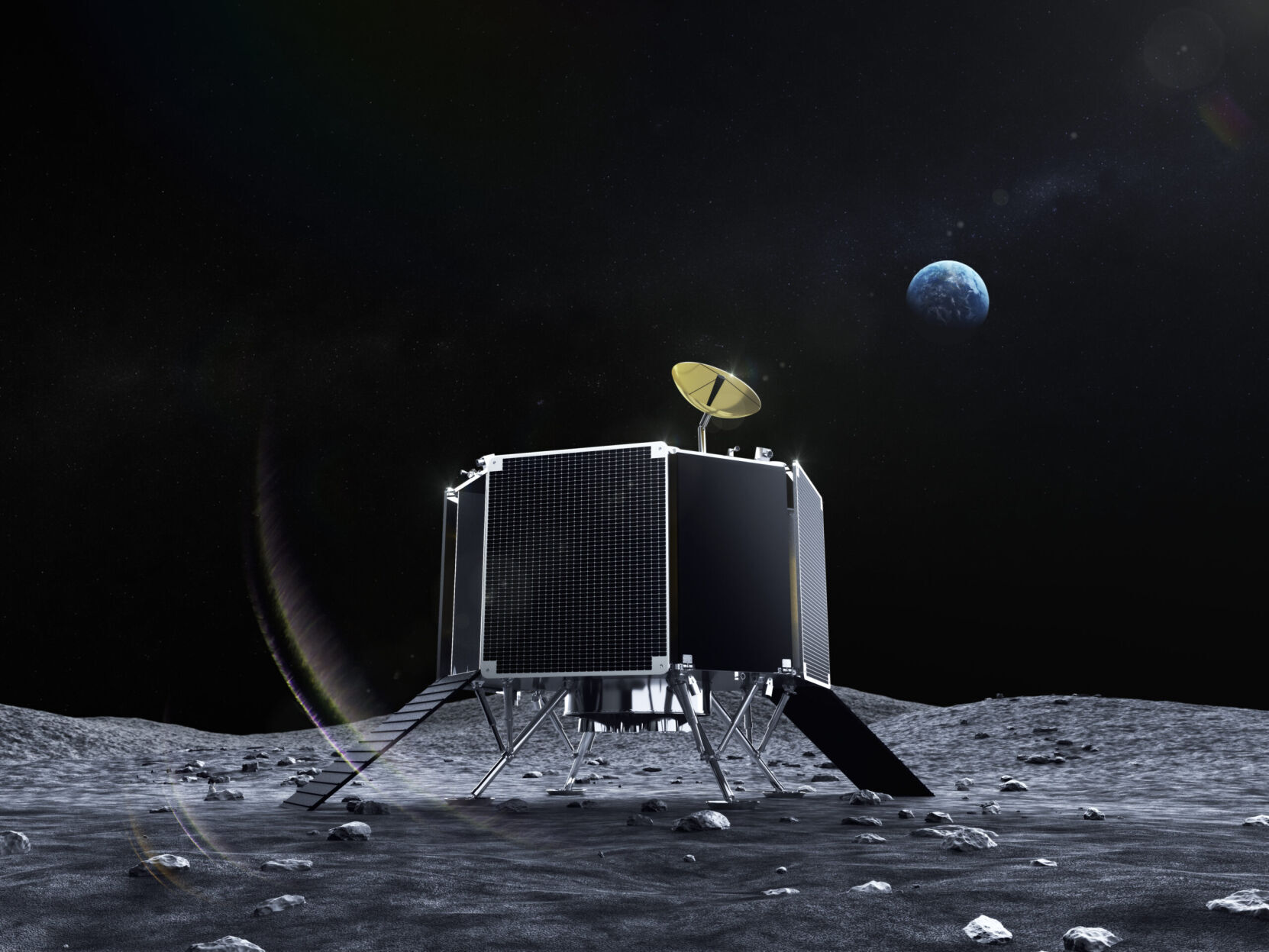
Denver-based ispace USA, a subsidiary of ispace Inc., designed the company’s “Series 2” lunar lander to carry bigger payloads, have the ability to land or orbit the moon, and survive a lunar night, officials announced Monday.
At a news conference on the opening day of the 36th Space Symposium in Colorado Springs, CEO Takeshi Hakamada said: “I’m excited at the progress we have made and today’s announcement is ispace’s next generation.”
The 10-year-old company started its U.S. division six years ago, he said, and the momentum for space exploration has reached new heights, including for “a sustainable human presence in space and a strong lunar economy.”
“Our aim for the Series 2 lander is to service NASA’s Commercial Lunar Payload Services program, as well as the broader Artemis program to land humans on the moon for the first time since Apollo,” said Kyle Acierno, CEO of ispace USA.
The company also plans additional commercial and government payload customers internationally, he said. It’s already worked for the Canadian Space Agency, the Japan Aerospace Exploration Agency, Mohammed bin Rashid Space Centre in the United Arab Emirates.
ArianeGroup in Germany hired ispace for its first mission, using the Series 1 lander, which is scheduled for launch on a SpaceX Falcon 9 in January. That mission includes one for NASA to collect regolith (space dirt).
U.S. Lander Program Director Kursten O’neill said the Series 2 lander was designed with improved power and thermal capabilities and the ability to “deploy a rover that would fit in your hand, or ones the size of cars.”
“In order for humans to live on the moon, they’re going to need to survive lunar nights with the capability we’re going to demonstrate in the next couple of years,” O’Neill said.
“Now landers can only survive one lunar day. But with new power capabilities, this lander is going to get to another day. … Ours will be 12 to 13 days and survive lunar nights. … That’s a lot more data that can be processed to learn about the lunar surface.”
Ispace also has a location in Luxembourg and raised funding totaling more than $195 million to develop the “high-frequency, low-cost delivery service to the moon,” according to the company.
“Over the last seven years, there’s been no shortage of ideas,” said Acierno, adding “there’s a lot of interest on the commercial side.”
The Series 2 will be able to land on the near and far side of the moon, O’Neill said, and will include “hazard avoidance” measures since each lander will be autonomous.
“We’re prepared and excited to execute,” she said.
The Series 2’s first mission could come in 2024.



Judge rules that Colorado law makes it too hard for parties to bar unaffiliated voters from primaries
Ernest Luning
ernest.luning@coloradopolitics.com
Updated 2 hours ago
A federal judge ruled in favor of the Colorado Republican Party late Tuesday, saying that a portion of the state law that allows unaffiliated voters to cast ballots in party primaries is unconstitutional because it imposes an unrealistic burden on...

10th Circuit upholds regulator’s methodology for Tri-State exit fees
Michael Karlik
michael.karlik@coloradopolitics.com
Updated 5 hours ago
The Denver-based federal appeals court upheld a regulatory agency’s methodology for calculating the fee owed by entities seeking to withdraw from Tri-State Generation and Transmission Association last week. Tri-State is a Westminster-based cooperative that provides and transmits electricity to member...
Federal judge proposes sanctions against Mike Lindell’s lawyers for continued fake citations
Michael Karlik
michael.karlik@coloradopolitics.com
Updated 6 hours ago
A federal judge is once again pursuing sanctions against lawyers for MyPillow CEO Mike Lindell for continuing to cite to court cases that do not exist, likely based on the faulty output of artificial intelligence tools. Last year, a jury...

Front Range cities oppose Democratic proposal to permit lot‑splitting as a path to affordable housing
Marianne Goodland
marianne.goodland@coloradopolitics.com
Updated 6 hours ago
Colorado lawmakers are pressing ahead with a plan to let homeowners split their lots to make room for smaller, more affordable houses. The proposal has drawn sharp opposition from Aurora, Colorado Springs, Denver and other Front Range cities that argue...

Susan Blanco signals views on role of appellate courts in first opinion as Colorado justice
Michael Karlik
michael.karlik@coloradopolitics.com
Updated 9 hours ago
Justice Susan Blanco’s first solo opinion as a new member of the Colorado Supreme Court made clear her view of the guardrails that keep the state’s highest court tethered to the issues it is asked to decide. On Monday, the...

Hegseth features Fort Carson soldiers after returning from Middle East, gives warning on Iran war
Reuters
reuters@gazette.com
Updated 9 hours ago
Defense Secretary Pete Hegseth said on Tuesday the next few days in the war against Iran would be decisive and warned Tehran that the conflict would intensify if it did not make a deal. Hegseth also highlighted his trip to the Middle...

Denver Council narrowly approves deal with Axon
Deborah Grigsby
deborah.smith@denvergazette.com
Updated 13 hours ago
After weeks of delay, the Denver City Council narrowly approved a one-year $150,000 contract with Axon for 50 automated license plate-reading cameras and the necessary system hardware, replacing the city’s former vendor, Flock. The 7-6 vote came during Tuesday’s regular...

Colorado leaders weigh next steps after Supreme Court rejects state ban on ‘conversion therapy’
Marissa Ventrelli
marissa.ventrelli@coloradopolitics.com
Updated 1 day ago
Colorado leaders said they are weighing next steps after the U.S. Supreme Court on Tuesday rejected the state’s ban on “conversion therapy” for children, as critics and supporters cheered or lambasted the ruling. The court’s near-unanimous decision called the Colorado...

Aurora homeless shelter opened too early, CEO says, as mold and plumbing issues emerge
Kyla Pearce
kyla.pearce@gazette.com
Updated 13 hours ago
Aurora’s largest homeless services project launched “way too early,” its CEO told city leaders Tuesday, saying the rushed opening left residents living amid mold, plumbing failures, and other issues inside the former hotel. During Tuesday’s Housing, Neighborhood Services and Redevelopment...

Gov. Polis declares April ‘dig safely month’ to mark 40th anniversary of Colorado 811
Scott Weiser
scott.weiser@gazette.com
Updated 13 hours ago
Gov. Jared Polis declared April 2026 as “Dig Safely Month” in Colorado, an annual observance that this year highlights the 40th anniversary of Colorado 811, the state’s One-Call Notification System. “Before everyone starts their warm weather projects around the house,...
PREV
PREVIOUS

Parents of Colorado students evenly divided over mask mandates in schools, poll finds
Colorado parents and guardians with school-age children are evenly split over whether students should be required to wear a mask for in-person learning at K-12 schools, according to a new poll that found views about a range of back-to-school topics divided sharply along partisan lines. By a slim margin, parents support requiring teachers and staff […]

Garfield County judge allowed biased juror to serve, appeals court rules in ordering new trial
Because a Garfield County judge allowed a juror to serve despite her repeated acknowledgements she could not be impartial, a defendant convicted of sexually assaulting a child will receive a new trial, the Court of Appeals ruled on Thursday. Fernando Zamora-Mendoza of Parachute allegedly molested two girls ages four and five. A jury in 2018 […]