

State audit finds Colorado’s prescription drug monitoring program failed to keep track of opioid use

The state’s Prescription Drug Monitoring Program has not done its job in setting the right systems in place to curtail drug abuse, opioid use in particular, state auditors told the Legislative Audit Committee on Monday.
The audit detailed failures in following standard practices and in enforcement, which have led to the program not operating as effectively as legislative statutes require, and it called for lawmakers to put more rules in place.
Nearly every state has a similar program, according to auditors, and they are believed to be an effective state-level tool to address opioid abuse, misuse and overdoses, largely because of their ability to limit “doctor shopping,” defined by federal agencies as when a patient visits multiple prescribers to obtain opioids.
Deputy state auditor Michelle Colin told the committee that under a 2014 state law, pharmacists were required to submit data on all dispensed controlled substances to the PDMP database, and prescribers and pharmacists are supposed to check the database to help monitor prescription drug use and look for indications of doctor shopping.
That’s not happening enough, and there are apparently no consequences for failing to do so, according to the audit.
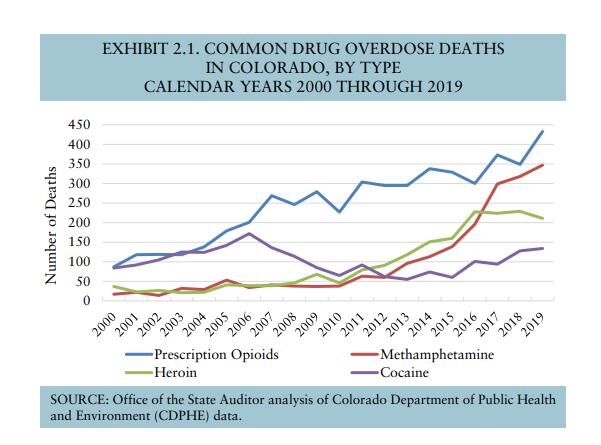
Deaths from opioid abuse have nearly quadrupled since 2000, when there were 2 deaths per 100,000 residents; in 2019 that had increased to 7.5 deaths per 100,000, according to the audit. That’s the definition of an opioid crisis, according to audit manager Jenny Page. Opioid deaths outpace deaths from heroin, cocaine and methamphetamine.
The audit report noted that the database provides prescribers and pharmacists monthly alerts to inform when a patient has been at risk for doctor shopping, and alerts were sent out on 345 patients in 2019.
Chief among the audit’s findings: PDMP data in 2018 and 2019 showed 8,700 patients in Colorado had prescription histories that indicated they were doctor shopping for opioids; evidence showed that some went to 10 or more prescribers and 1,200 patients went to 15 or more prescribers.
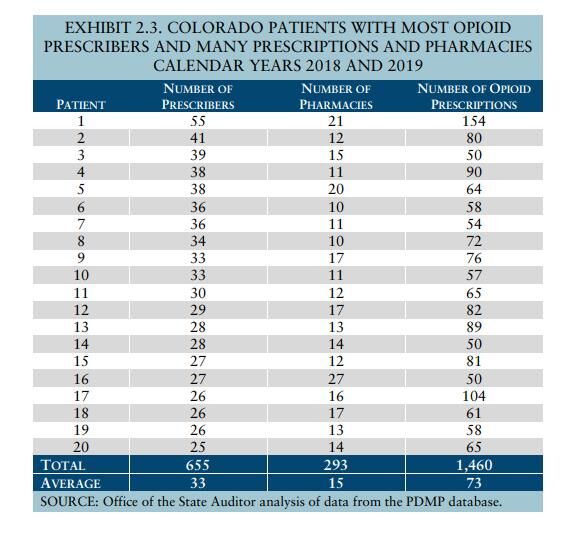
The data showed some patients getting a new opioid prescription every five days, audit team leader Kate Shiroff told the committee. Other data showed some patients receiving prescriptions for combinations of drugs that could be dangerous if used together, such as opioids and benzodiazepine (which can go by the brand name of Valium or Xanax).
But the state’s Department of Regulatory Agencies, which manages the PDMP, did not refer those patients to law enforcement, the audit reported. The state does not use the database to address overprescribing, despite evidence that 85 medical professionals had prescribed opioids more than 3,000 times in 2018 and 2019, 26 times the average. Most of the prescribers were in family medicine, internal medicine, with the most from nurse practitioners.
“Without a court order or subpoena, the Department does not provide regulatory boards or law enforcement any information from the PDMP database that would allow them to investigate potentially unlawful behavior by prescribers or patients,” the audit said. “Providing such information to regulatory boards and law enforcement would help them meet the statutory intent of identifying healthcare providers whose prescribing habits fall significantly outside of the norms for their specialty or patients who appear to be doctor shopping.”
Shiroff added that law enforcement has to have an active investigation and a subpoena to look at an individual in the PDMP.
Other audit findings showed that 18%, or 6,223, of the state’s 34,679 prescribers did not register with the PDMP database as required by law. The PDMP also does not track whether prescribers check the database before issuing a second opioid prescription to a patient, as statutes require, “so it is unclear whether prescribers comply.” That could constitute unprofessional conduct, Shiroff said.
She also pointed out that DORA has no process for ensuring that prescribers register and has had a “hands-off” view of the PDMP registration process. Registration could become a condition for a new or renewal of a license, Shiroff said.
The audit reported “1,427 unregistered prescribers who prescribed 15,822 opioid prescriptions to more than 8,800 patients in 2018 or 2019 after a different prescriber had already prescribed a benzodiazepine for the patient.”
A complaint from prescribers regarded the utility of the database, with reports that it takes too long to query the database, sometimes as many as 30 mouse clicks. The audit said DORA has not addressed this complaint.
The PDMP is merely a healthcare tool and not a way to identify bad actors, either prescribers or patients, Shiroff told the committee. Using the PDMP as a way to check for a second opioid prescription has led to fewer opioid deaths in other states. Shiroff said the Centers for Disease Control and Prevention views Colorado’s PDMP as insufficient in this area.
The audit also raised issues surrounding “pill mills,” the term used when prescribers provide more opioids than patients need and is believed to fuel the illicit drug trade. In a review of 6.7 million prescriptions, about 28,000 exceeded the statutory restriction of seven days for a first prescription, the audit found; more than 800 patients received prescriptions that provided enough for six to 18 months.
The General Assembly needs to step in and take action, the audit report said. That would include a legal requirement that a prescriber check the database before issuing any opioid or benzodiazepine prescription, and to put teeth into existing law that requires pharmacists and doctors to register with the PDMP and use it before issuing prescriptions. Statutory change also is needed to enforce limits on opioid prescriptions, the audit report said, and an enforcement mechanism is needed for those who refuse to comply, including referrals to law enforcement or regulatory boards.
DORA agreed with the audit findings, according to the report. Ronne Hines, director of the division of professions and occupations, said they are committed to improving the program as well as to patient confidentiality. They will work with the legislature on each of the areas, Hines told the committee, adding that the legislature also made progress on dealing with opioids in the most recently concluded session.
“We are committed to revisiting existing criteria” based on existing statutory authority, she said.
Hines also said that DORA is committed to looking at the issue of complaints around access to the database.
Lawmakers were far from satisfied with what they heard from the auditors, mostly around the lack of enforcement for prescribers.
Sen. Jim Smallwood, a Parker Republican, said what stood out for him was that prescribers did not register. Now that the database has identified people violating statutes, he asked, where’s the enforcement? Hines responded that it is up to the regulatory boards on whether there was a violation, but that ultimately, it’s the boards’ decisions, and she did not have information on outcomes. He called the one out of five who are not registering a “blatant” disregard for the statute.
Have prescribers been operating and prescribing opioids and doing so out of compliance with state law for the lifetime of the program, which dates back to 2008, asked Rep. Colin Larson, a Littleton Republican. Shiroff said it’s a mixed bag; some have been unregistered for a long time, others for shorter periods of time, she said.
Hines said the requirement to register has only existed since 2014. Shiroff added that there is no enforcement from the regulatory boards and no penalties for not registering with the PDMP. The dental board has a fine for not registering, but has never actually ever fined anyone for not doing so, she said. Fifteen percent of the medical professionals, or about 930, who failed to register are dentists.
Hines said they are committed to working with the regulatory boards to ensure that prescribers register. That includes an automated system which should be in place by 2023 that would ensure that prescribers register when they renew (every two years) or obtain a new license. Currently, prescribers self report and DORA doesn’t verify, according to the audit. That’s not soon enough, Smallwood said. The PDMP is not helpful, he said, and it’s clear it’s not helpful because no one is paying attention. He called for concrete steps immediately (calling it “yesterday.”)
The medical professional boards have taken this seriously, Hines insisted. She said she would also look at the online renewal system.
State audit of prescription drug monitoring program


Denver judge denies Gov. Polis request to dismiss ICE-related records case
Marianne Goodland
marianne.goodland@coloradopolitics.com
Updated 2 hours ago
A year after blocking the release of state records to federal immigration agents, a Denver judge has now denied Gov. Jared Polis’ effort to end the lawsuit at the center of the dispute. The lawsuit filed against the governor in...

Gov. Lamm challenges Congress to stop ‘decontrol’ of natural gas | A LOOK BACK
Rachael Wright, Special to Colorado Politics
rachael.wright@coloradopolitics.com
Updated 2 days ago
Forty-Five Years Ago This Week: In a memo to Colorado’s congressional delegation, Gov. Dick Lamm urged them to vote against the phased pricing deregulation provisions in the Natural Gas Policy Act, a measure introduced in Congress in 1978 and still...

Environmentalists and Colorado Springs Utilities split on retirement date for Ray Nixon coal power plant
Brennen Kauffman
brennen-kauffman@coloradopolitics.com
Updated 5 minutes ago
On Tuesday night, around 25 people gathered at Old Colorado City Brewing to celebrate Ray Nixon’s retirement. Nixon is only 46 years old, but the retirement has been expected for several years. The crowd delivered toasts and signed a poster-sized...

Colorado National Guard members deployed to the Middle East
The Gazette
the-gazette@coloradopolitics.com
Updated 8 minutes ago
The Colorado Army National Guard announced Thursday that more than 200 members are deploying to the Middle East. The members of the 1st Battalion, 157th Infantry Regiment (Mountain), a unit based at Fort Carson, are deploying to help support an...
Douglas County task force targets development regulations
Nicholas Fogleman
nicholas.fogleman@denvergazette.com
Updated 9 minutes ago
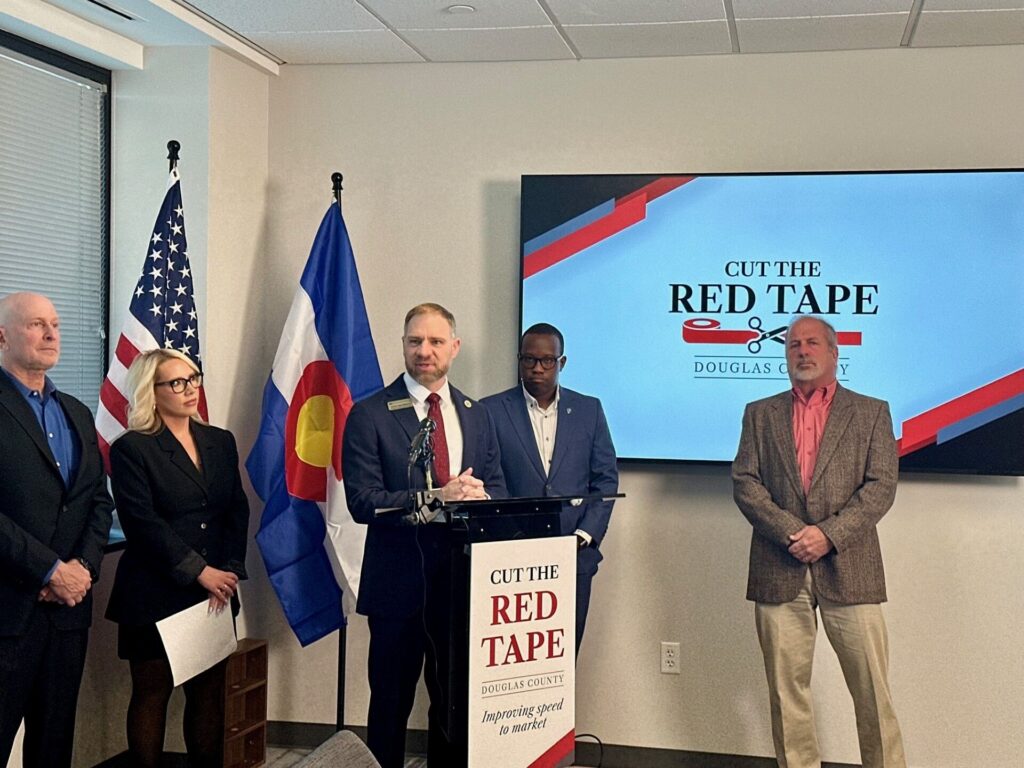
Douglas County kicked off its first Red Tape Reduction Task Force Thursday aimed at speeding up commercial and industrial development timelines in the county, a move leaders said is necessary to keep the county competitive with other regions nationwide. The...

Energy constraints loom larger than water for Colorado AI boom, experts say
Deborah Grigsby
deborah.smith@denvergazette.com
Updated 13 minutes ago
As artificial intelligence reshapes almost every sector of the economy, experts at this year’s Colorado Climate Week gathering in Boulder said it is also reshaping local physical infrastructure. From grid demand and water use to data center construction, scaling the...
Colorado justices accept appeals on Netflix taxation, children pursuing neglect cases
Michael Karlik
michael.karlik@coloradopolitics.com
Updated 18 hours ago
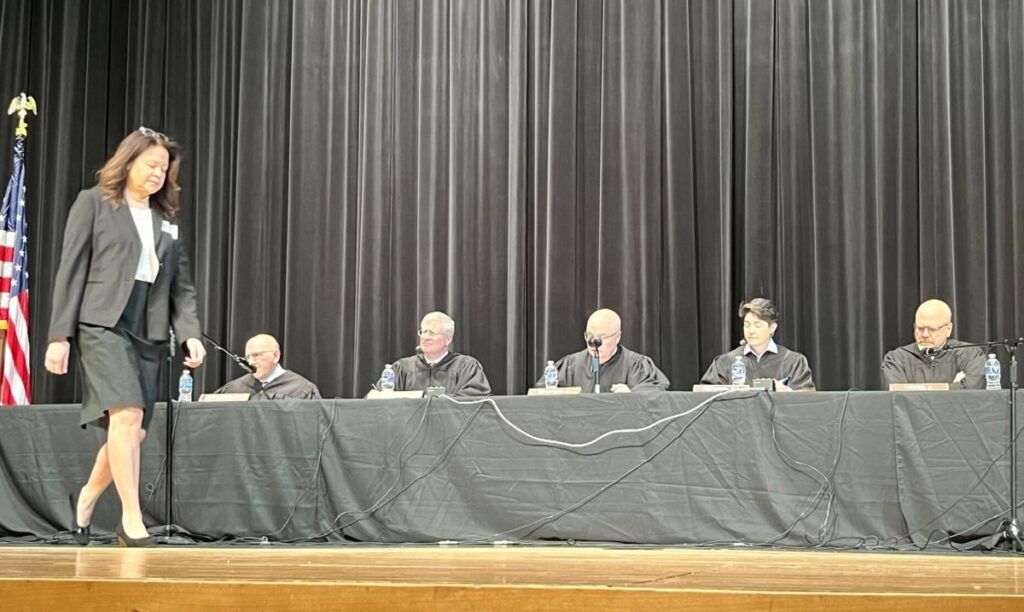
The Colorado Supreme Court announced on Monday that it will decide whether Netflix subscriptions are subject to the state’s sales tax as “tangible personal property.” At least three of the court’s seven members must agree to hear an appeal. The...

Proposal outlines $300M deal separating Pinnacol from Colorado state government
Marianne Goodland
marianne.goodland@coloradopolitics.com
Updated 18 hours ago
Colorado lawmakers are weighing a proposal that would allow Pinnacol Assurance to sever its remaining ties to the state in exchange for a $300 million payment, a long‑debated shift that supporters say could stabilize the insurer’s future and help plug...

Bill requiring employers to grant unpaid leave to Colorado lawmakers heads to governor’s desk
Marissa Ventrelli
marissa.ventrelli@coloradopolitics.com
Updated 17 hours ago
Colorado lawmakers are one step away from securing guaranteed unpaid leave from their day jobs during the legislative session after the House narrowly approved the proposal Thursday. Senate Bill 087 would require businesses to allow employees who are members of...

Redistricting fight escalates as Colorado Title Board clears competing ballot proposals
Marianne Goodland
marianne.goodland@coloradopolitics.com
Updated 17 hours ago
Colorado’s title board on Wednesday gave final approval to multiple ballot measures related to congressional redistricting, setting up a series of proposals that could alter how the state draws its U.S. House districts for the 2028 and 2030 elections. The...
PREV
PREVIOUS

Court reinstates man's lawsuit against corrections department for destroying property
The Court of Appeals reinstated a man’s lawsuit against the Colorado Department of Corrections for destroying his personal property while he was jailed on pending criminal charges. Although a lower court believed the state’s governmental immunity law blocked Jacob Patrick Ind from suing the department, a three-member appellate panel on Thursday found a clear exception […]

Michael Bennet helps drum up attention to expanded child tax credit
U.S. Sen. Michael Bennet was among those leading the charge Monday to increase awareness about the expanded child tax credit, a program the Colorado Democrat wrote and helped pass this year that starts delivering payments directly to families next month. The expanded credit increases the existing $2,000-per-child tax credit to $3,600 for children under six […]