

Arapahoe County judge violated speedy trial deadline, Supreme Court finds in tossing charges
An Arapahoe County judge was wrong to decide retroactively he had rescheduled a trial for COVID-19-related reasons, the Colorado Supreme Court declared on Monday in dismissing all charges against a defendant for that violation of his right to a speedy trial.
State law requires a defendant be tried within six months of their not-guilty plea, with certain exceptions. A mistrial is one of the acceptable reasons to extend the window. If the trial does not happen within the prescribed deadline, the legislature has provided one consequence: releasing the defendant from custody, dropping the charges and barring a re-prosecution for the same offense.
In the case of Alexander Carlos Nunez, which the justices heard directly — bypassing the Court of Appeals — Arapahoe County District Court Judge Michael Spear noted on April 30 of last year that the Supreme Court had recently changed the rules and allowed judges to declare a mistrial if jury pools could not be safely assembled during the pandemic.
“Frankly, due to the rule changes that have occurred over the course of the last 30 days permitting the Court to find a mistrial, and a public health crisis exists such as to make it unsafe for jurors to report to the courthouse, I can obviously make that particular finding at this time,” Spear said at the time.
There were series of other court dates in which Nunez did not attend because the county sheriff did not retrieve him from the Colorado Department of Corrections and the privately-run facility in which Nunez was incarcerated reportedly lacked the video technology to let him appear remotely. On May 28, Spear declined to rule on the prosecution’s motion to declare a mistrial because he wanted Nunez to be present.
Nunez was finally able to attend a hearing on July 29. That day, Spear heard the defense’s motion to dismiss the felony drug charges because the parties were past Nunez’s June 12, 2020 speedy trial deadline.
“[W]hen there was no appearance at the pretrial readiness conference, the Court obviously was a little reluctant to act without the defendant being present,” the judge explained on July 29, “but frankly, the April 30th pretrial readiness conference would have been the date by which the Court would have declared a mistrial.”
The 18th Judicial District Attorney’s Office argued Spear had “implicitly” declared a mistrial at the April 30 hearing.
“Admittedly, the district court did not expressly proclaim, ‘This court declares a mistrial,’” wrote Senior Deputy District Attorney Susan J. Trout to the Supreme Court. “But this is the obvious import of the court’s statements.”
The defense countered that Spear’s own word — including his July 29 musing of “Let’s just say that had I made such declaration on April 30th” — indicated the judge realized he had not declared a mistrial at the time prosecutors claimed he did.
“The statutory speedy trial case law is abundantly clear that a defendant bears little burden in securing his rights,” wrote Zack Tennant, deputy state public defender. “[T]he burden for seeking any such exception rested solely on the shoulders of the trial court and prosecution, not Petitioner Nunez.”
Justice Melissa Hart, writing for the Supreme Court, agreed with Nunez.
“While it seems entirely possible that the court could have declared a mistrial on April 30, these facts demonstrate that it did not,” she concluded. “A court may not declare a retroactive mistrial in order to get around the mandatory deadlines set by Colorado’s speedy trial statute.”
Hart also clarified that trial judges “must explicitly” declare mistrials. She acknowledged the logistical difficulties the pandemic had imposed on the justice system, but rejected the district attorney’s argument that the speedy trial deadline could be extended due to Nunez’s unavailability, as the law allows.
“While this statutory provision might have provided an avenue for extending Nunez’s speedy trial deadline, the People did not present this argument to the district court, and the court did not make any findings with regard to this issue,” Hart added.
Tim Lane, the legislative liaison and policy analyst with the Colorado District Attorneys’ Council, said the organization representing the state’s prosecutors supports giving courts flexibility to handle delays stemming from COVID-19.
“This decision emphasizes the importance of the legislature creating a clear statutory change to deal with the backlog of cases,” he said.
It would not be fair, said Denver-based criminal and civil attorney David C. Japha, to be overly critical of those in Nunez’s case for the speedy trial violation, as the first months of the COVID-19 pandemic created many uncertainties.
“There will be those who say it is a technicality. However, those technicalities are what protect all of us from the overreaching of government,” he explained.
The Court threw out the charges against Nunez. The 18th Judicial District Attorney’s Office declined to comment on the decision. Spear retired as a judge earlier this year.
The case is People v. Nunez.
This story has been updated with additional comments.

Federal judge hears arguments about Colorado’s 3-day gun purchase waiting period
Michael Karlik
michael.karlik@coloradopolitics.com
Updated 1 hour ago
A federal judge heard arguments on Monday about the constitutionality of a 2023 Colorado law that generally imposes a three-day waiting period on firearm purchases after the initiation of a background check. The test that the U.S. Supreme Court created...
Colorado Supreme Court intervenes in Weld County prosecution dismissed due to Missy Woods misconduct
Michael Karlik
michael.karlik@coloradopolitics.com
Updated 5 hours ago
The Colorado Supreme Court ordered a Weld County trial judge last week to respond to the district attorney’s claim that he improperly dismissed a criminal case because of “outrageous” conduct by the Colorado Bureau of Investigation. Daniel Lee Eatinger stood...
Schoolchildren’s presence at child sex-related trial did not harm Arapahoe County defendant, appeals court says
Michael Karlik
michael.karlik@coloradopolitics.com
Updated 2 days ago
Colorado’s second-highest court decided on Thursday that the presence of a group of schoolchildren on the first day of a child sexual exploitation trial did not violate an Arapahoe County defendant’s constitutional right to a fair trial. Prosecutors charged Jerry...
Appeals court cites week-old Colorado law to reinstate child neglect case at child, father’s request
Michael Karlik
michael.karlik@coloradopolitics.com
Updated 2 days ago
Colorado’s second-highest court invoked a new state law for the first time on Thursday and reinstated a child neglect case that both the child and her father wished to reopen. House Bill 1227 took effect on Aug. 12, reversing a...
Colorado Supreme Court names William Hood as next chief justice
Michael Karlik
michael.karlik@coloradopolitics.com
Updated 3 days ago
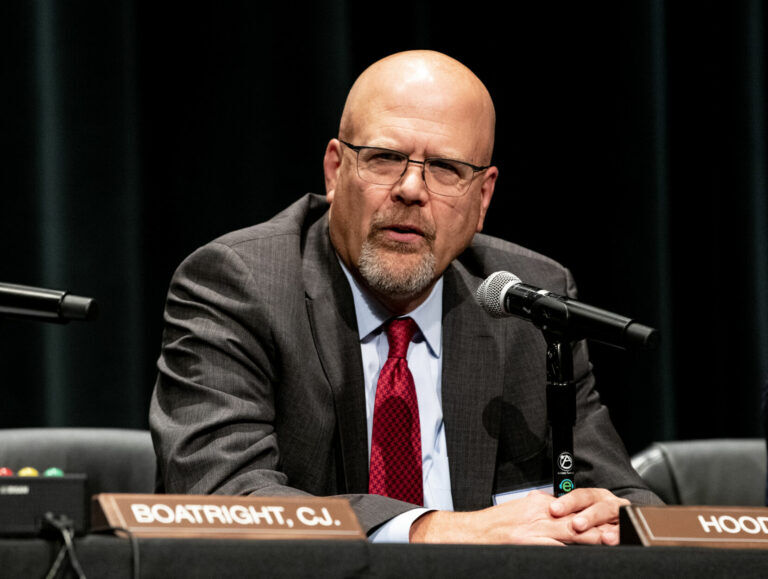
The Colorado Supreme Court has selected Justice William W. Hood III to be the next chief justice, the judicial branch announced on Friday. Hood will succeed Chief Justice Monica M. Márquez, who took over the role in July 2024. “I...
Family of slain Lakewood teacher releases statement as murder suspect makes first court appearance
Matt Kyle
matt.kyle@denvergazette.com
Updated 11 hours ago
Patrick Theodore Barnett, the Lakewood man accused of killing his wife, a Jeffco Public Schools art teacher, made his first court appearance Friday morning as his wife’s family looked on. The status conference hearing was held before District Court Judge...

Appeals court upholds Park County trophy hunting conviction
Michael Karlik
michael.karlik@coloradopolitics.com
Updated 3 days ago
Colorado’s second-highest court clarified on Thursday that a defendant may stand convicted under the state’s trophy hunting laws if he abandons a bear carcass but returns later to remove the meat. Under Colorado law, it is a felony to detach...

Judge grants partial injunction to GEO in fight against state health inspection law
Kyla Pearce
kyla.pearce@gazette.com
Updated 4 days ago
A judge ruled Thursday that The GEO Group does not have to follow parts of a new state law requiring more frequent health and safety inspections at the U.S. Immigration and Customs Enforcement processing center in Aurora. Under the order...

Parker man faces 20 years to life for serial sexual assaults
Nicholas Fogleman
nicholas.fogleman@denvergazette.com
Updated 4 days ago
A 25-year-old Parker man who sexually assaulted three women in 2025 pleaded guilty Wednesday and will serve 20 years to life in prison. Javier Rodriguez-Andrade pleaded guilty to charges stemming from three sexual assaults involving women ages 19 to 24. ...
Divided appeals court upholds warrantless DNA collection in Colorado cold case, cautions of government overreach
Michael Karlik
michael.karlik@coloradopolitics.com
Updated 4 days ago
Colorado’s second-highest court upheld the warrantless collection of a suspect’s DNA from a discarded soda can as constitutional on Thursday, while warning about potential abuse of DNA privacy in the absence of further guardrails. By 2-1, a three-judge Court of...
PREV
PREVIOUS

Colorado appeals court agrees double jeopardy not applicable to foreign countries
Prosecuting a man in Colorado after he was already prosecuted and acquitted in a foreign country does not run afoul of the legal prohibition on double jeopardy, the Court of Appeals ruled for the first time on Thursday. The three-judge appellate panel affirmed the 2017 murder conviction of Rafael Aguilar Garcia, following an unusual scenario […]

COURT CRAWL | Multiple Biden nominees in play, a second judge is censured
Welcome to Court Crawl, Colorado Politics’ roundup of news from the third branch of government. There are now two judicial nominees for Colorado before the U.S. Senate, and the state Supreme Court has now censured another state judge just one month after its last censure. Update on Biden nominees ? President Joe Biden has chosen public […]