

Former state Rep. Joe Salazar wins SLAPP motion against Public Trust Institute
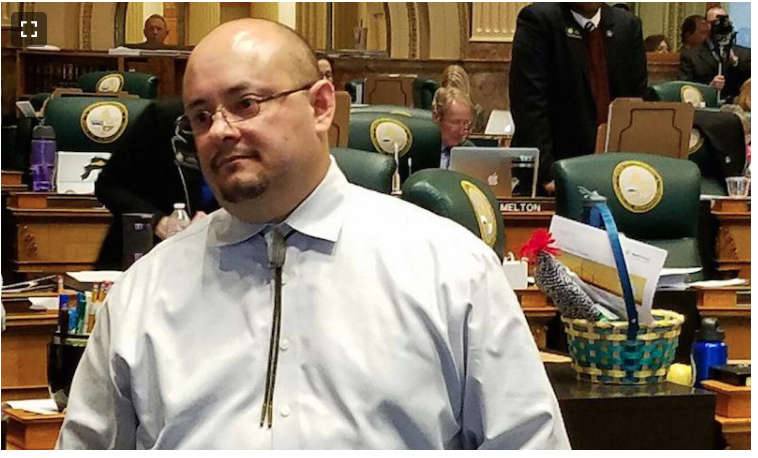
In what is the first application of a 2019 statute on SLAPPs, a Denver District Court judge has ruled in favor of former state Rep. Joe Salazar in a back-and-forth battle between him and the Public Trust Institute.
A SLAPP is a “strategic lawsuit against public participation,” a term coined by University of Denver professors George Pring and Penelope Canan in the 1980s. The intent is to prevent someone from exercising their First Amendment right to petition the government for a redress of grievances.
Salazar, in response to accusations of ethics violations filed by the institute and its attorney, Suzanne Staiert (now known as Suzanne Taheri), had sued for malicious prosecution. PTI and Staiert filed a “special motion to dismiss” and a request to apply the anti-SLAPP statute.
The complaints to the Independent Ethics Commission in December 2019 alleged that Salazar violated an Amendment 41 prohibition that bars former lawmakers from any lobbying activity for two years after their time in office ends. On the same day, PTI and Staiert filed a complaint with the Secretary of State’s office, alleging Salazar had failed to register as a lobbyist.
Both complaints were dismissed. In their dismissal, the ethics commission said PTI and Staiert “failed to state a claim upon which relief can be granted.” The order to dismiss was written by three of the five commissioners. The fourth, Commissioner Yeulin Willett, recused himself since he served with Salazar in the state House. The fifth, commissioner Debra Johnson, also did not participate.
Salazar then sued both PTI and Staiert. In an amended complaint filed with the Denver District Court the same week the ethics commission tossed the PTI complaint, Salazar said the complaints lodged by PTI and Staiert were “malicious, not made in good-faith, and intended to humiliate Mr. Salazar and harm his reputation.”
Under the SLAPP law, a special motion to dismiss was created as a way to expedite legal actions under House Bill 19-1324, sponsored by Rep. Lisa Cutter, D-Littleton. The action starts a 63-day clock for a decision by the court. In their filing, and according to the Court’s ruling, PTI and Staiert asked for a dismissal “because [Salazar] is unable to establish that there is a reasonable likelihood that he will prevail on the claim.” A hearing was held on Feb. 9 and both sides presented arguments on the interpretation and application of the anti-SLAPP statute.
The PTI/Staiert claim that the anti-SLAPP statute is actionable is based on the defendants’ claim that Salazar was retaliating against them for the complaints that they filed. Salazar said that the complaints themselves were SLAPPs “designed to stifle his participation in public life,” calling his lawsuit a “SLAPP-back” and claiming that the defendants misused the proceedings of both the Secretary of State’s office and the ethics commission.
The judge, Alex Myers, agreed, stating in his March 10 ruling that it is likely that Salazar will prevail on his claim of malicious prosecution.
Myers, in his ruling, said there is no previous case law on SLAPPs in Colorado, so he would have to use a ruling from a 1984 Colorado Supreme Court decision, as well as figure out how to interpret the statutory burden that Salazar had to meet to survive a special motion to dismiss.
Myers wrote that the statute applies to any cause of action against a person “arising from any act of that person in furtherance of the person’s right or petition or free speech … in connection with a public issue.”
The ruling also discussed the standard for bringing a claim for malicious prosecution. The plaintiff must prove that the defendant contributed to bringing a civil or criminal proceeding against the plaintiff, that the proceeding was decided in favor of the plaintiff, that there was no probable cause of the proceeding, that the defendant acted with malice and that the plaintiff incurred damages. Myers ruled in Salazar’s favor on all five standards.
Myers looked to evidence presented by Salazar about Staiert’s previous conduct while she was deputy Secretary of State, when she made decisions similar to the one at issue: grassroots lobbying. As was noted by the Secretary of State’s office in dismissing the PTI complaint, Staiert “personally issued administrative decisions in which she concluded similar conduct by others was not a violation” of the state’s lobbying laws. Based on her personal experience and decision on what is and what isn’t a violation, “the evidence gives support for the notion that Ms. Staiert did not subjectively believe Mr. Salazar violated” the state’s lobbying laws, but filed the complaint anyway.
A jury could then conclude that PTI and Staiert did not have a good-faith basis for the complaints, Myers wrote.
Myers also noted that PTI and Staiert advocated for a change in law as it relates to grassroots lobbying, despite Staiert’s previous advisory opinions on the same subject. He wrote that PTI and Staiert didn’t ask for a change in law in the complaints filed with the Secretary of State and the ethics commission. Instead, they repeatedly claimed Salazar had violated existing laws.
He also noted that when the Secretary of State’s office asked PTI and Staiert for a response on the SOS motion to dismiss, PTI and Staiert ignored it. They also conceded in the ethics commission complaint that three of the four instances of lobbying did not fit within the statutory definition.
But it was on the issue of malicious prosecution where Myers was most fervent in his ruling. Myers wrote that Salazar presented sufficient evidence to show that PTI and Staiert had initiated the two complaints to “embarrass, humiliate and discredit him.” Malice, Myers wrote, “is supported by evidence showing that the Defendants never responded when given the opportunity” to do so with the Secretary of State’s office and the acknowledgment with the ethics commission that three of the four complaints didn’t meet statutory muster.
In addition, while PTI and Staiert issued a press release “unequivocally” stating that Salazar had broken the law before either of the two agencies had made that ruling, they never issued a follow-up acknowledging they were wrong, Myers wrote.
“Mr. Salazar has established a reasonable likelihood that he will prevail on his claim in this case,” Myers concluded, in his preliminary finding. That finding allows the case to move forward on its merits, with the finding admissible as evidence.
The Public Trust Institute declined an opportunity to comment.


Colorado justices agree to review insurance question that has divided federal judges
Michael Karlik
michael.karlik@coloradopolitics.com
Updated 15 hours ago
The Colorado Supreme Court granted a federal judge’s request on Friday to address an issue that has produced conflicting answers in policyholders’ lawsuits against insurance companies over unpaid benefits. “Parties (and judges) regularly spend undue time and money fighting in...

Farmworker overtime bill advances after lengthy debate in Colorado Senate
Marianne Goodland
marianne.goodland@coloradopolitics.com
Updated 16 hours ago
The Colorado Senate on Tuesday narrowly advanced a bill to raise the overtime threshold for agricultural workers, defeating more than a dozen amendments from its leading opponent aimed at rewriting the measure. As introduced, Senate Bill 121 would raise the threshold for...

Colorado Agriculture Day: A feast for the ears, eyes and stomachs
Marianne Goodland
marianne.goodland@coloradopolitics.com
Updated 15 hours ago
Gov. Jared Polis, legislators and friends of agriculture gathered at the state Capitol on Tuesday to celebrate Colorado Agriculture Day. The annual recognition of the contributions of Colorado farmers, ranchers and agribusiness drew hundreds to the Capitol’s west foyer, where...

Pueblo man held in Afghanistan for more than a year released, Taliban says
The Associated Press
the-associated-press@coloradopolitics.com
Updated 14 hours ago
KABUL, Afghanistan — Afghanistan’s Taliban authorities on Tuesday released American academic Dennis Coyle after holding him for over a year, with the foreign ministry saying the release came on the occasion of Eid al-Fitr, the Muslim holiday that marks the end of the...

Mortgage rates rise in defiance of Trump’s $200 billion push, hurting GOP on affordability
Zach Halaschak, Washington Examiner
zach.halaschak.washington.examiner@gazetteedit.wpenginepowered.com
Updated 18 hours ago
After months of a gradual decline, mortgage rates are trending back up because of the war with Iran, defying President Donald Trump’s efforts to lower them and undercutting Republicans on the key issue of affordability. As of Monday, the average rate on a 30-year...

Federal judge dismisses background screeners’ challenge to Colorado law
Michael Karlik
michael.karlik@coloradopolitics.com
Updated 19 hours ago
A federal judge dismissed a challenge on Friday to a portion of Colorado law that prohibits certain information from being included in consumer reports, in what seemed to be a conflict with federal law. Congress originally enacted the Fair Credit...

Wildlife agency asks for $450,000 to bring more wolves to Colorado
Marianne Goodland
marianne.goodland@coloradopolitics.com
Updated 13 hours ago
The panel of legislators charged with crafting the budget on Monday rejected a proposal that proponents said would increase transparency around how much Colorado Parks and Wildlife spends to bring additional wolves into the state. At the same time, the...

Hickenlooper primary challenger Julie Gonzales endorsed by national progressive group Indivisible
Ernest Luning
ernest.luning@coloradopolitics.com
Updated 13 hours ago
State Sen. Julie Gonzales’ bid to challenge U.S. Sen. John Hickenlooper in Colorado’s Democratic primary got a boost Tuesday from Indivisible when the national arm of the progressive grassroots group endorsed the Denver lawmaker. The national group’s endorsement comes less...
10th Circuit rejects ‘penalty’ for children of naturalized citizens seeking visas
Michael Karlik
michael.karlik@coloradopolitics.com
Updated 13 hours ago
The Denver-based federal appeals court joined three of its peers earlier this month and determined the child of a newly naturalized U.S. citizen is not moved to a longer visa line as a result of his parent gaining citizenship, and...

Colorado lawmakers mull renaming César Chávez Day to Farm Workers Day
Marianne Goodland
marianne.goodland@coloradopolitics.com
Updated 22 hours ago
A Colorado House committee has voted to rename the March 31 state holiday from César Chávez Day to Farm Workers Day, following a national shift prompted by sexual abuse allegations against the labor leader. The State, Civic, Veterans, and Military...
PREV
PREVIOUS

Colorado, feds, team up on regenerative agriculture
When he first started farming in 1987, Curtis Sayles went through a new pair of cowboy work boots every year. These days, he’s still wearing a pair he bought three years ago. The difference? Sayles stopped using harsh fertilizers on his fields that ate through the leather of his boots. Sayles, a fourth-generation farmer with […]

INSIGHTS | Vaccine rollout is the latest, greatest Colorado flop
I do my best to report stories through the eyes of others. Sometimes, when I’m lucky, I get to see them with my own. I suppose it’s not news at this point that the COVID-19 vaccine rollout has been a confusing, chaotic work in progress. The one unbendable fact is that federal, state and county […]