

Q&A with Andrew Carpenter and Jared Gregorio | The reading clerks who keep the General Assembly moving

When it comes to being a reading clerk, there’s no such thing as a boring day.
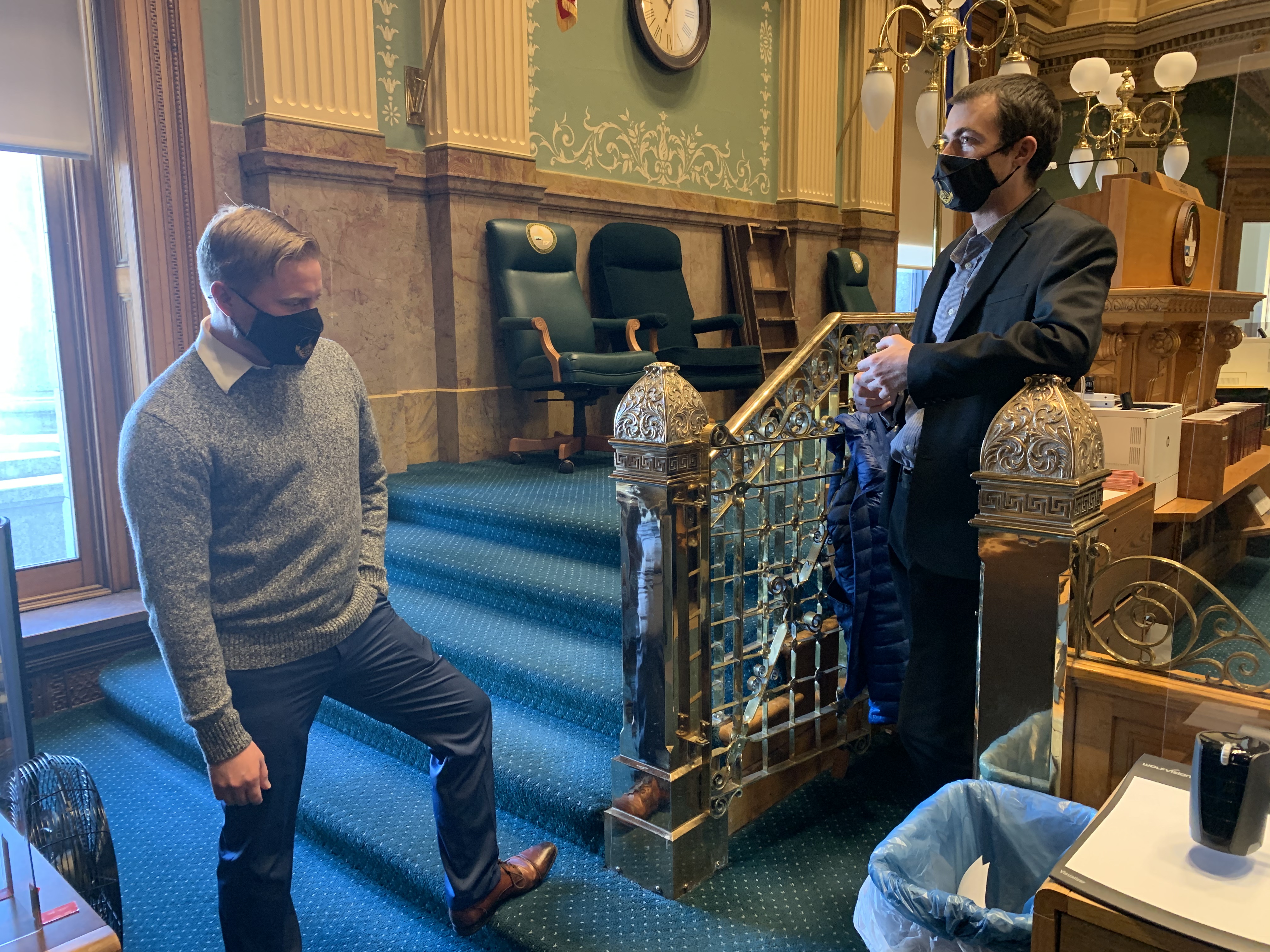
Colorado Politics probed the ins and outs of being a reading clerk with the two young men who, once the legislature comes back into session, will do it daily. reading clerks read the bill titles (a requirement of the Constitution) for the more than 600 bills that go through the General Assembly each year, often more than once for each bill as it moves through the process.
They also get the unenviable job of reading bills at length when requested; the Senate’s Andrew Carpenter was the reading clerk in the Senate in 2019 when Senate Republicans asked that a 2,023-page bill be read at length. Even at 350 words per minute – Carpenter’s fastest speed – it would have taken a week or more, so after a couple of hours the reading was continued by a bank of five computers, which led to a lawsuit now in front of the Colorado Supreme Court.
Carpenter is now in his fourth year as the Senate reading clerk. A native of Baton Rouge, Louisiana, he holds an undergraduate degree in political science from Southeastern University in Hammond, Louisiana, and attended law school at Loyola University of New Orleans. He moved to Colorado in 2014.
He and his wife are parents of a baby boy, born in November, so “spending as much time with both of them as I possibly can is what I’ve been focusing on outside of work.”
Jared Gregorio is entering his first full year as reading clerk in 2021, although he got his first taste of it in the 2020 session. He graduated from South High in Denver and got his undergraduate degree from Gonzaga, where he ran cross country and track. He holds a master’s degree from Regis.
“I love pretty much everything that Colorado offers; being outdoors during all seasons, trying my best to figure out what we’re calling a certain neighborhood in Denver this year, always believing the Broncos are just a few pieces away from the Super Bowl and that baseball truly is better at altitude,” he said.
Colorado Politics: Why did you want to be a reading clerk?
Andrew Carpenter: When I was an Assignable Clerk in 2016 I got to see the reader and the front desk staff operate from their side of the front desk and I thought the nonpartisan work they did to support the Senate was very interesting. It was fun to be a part of that team, and then when I heard there was an opening for the reader position for the next session, I jumped on the opportunity.
Jared Gregorio: I’d wager that might be the first time that question has ever been asked in Colorado history. More than anything I wanted to work in the realm of state government, being the reading clerk allows me to be able to do it in a nonpartisan role while still being a part of the utterly unique and amazing realm that is the House Floor. I love being a part of the Floor work process. Every day truly presents something different.
Colorado Politics: What’s the fastest you can read?
Carpenter: Just shy of 350 words per minute when I am reading legislative materials out loud.
Gregorio: Shockingly, I’ve yet to time myself. But if I had to guess I’d say it’s probably about 10 words faster per minute than Mr. Carpenter. (Joking – he’s definitely faster than I am.) He gives something for the rest of the reading clerks in the building something to aspire to.
Colorado Politics: Funniest or strangest (or both) experience in being a reading clerk?
Carpenter: Typically as the Reader you are reading a lot of materials very quickly, but there are times when we have a few documents to read before moving on with the day’s business, but we are still waiting on some final signatures or something to happen before we can actually proceed, so I will be asked to read at a slower pace than normal but some times without us having to go into a recess. So there will be times where I’m reading very slowly at just a couple of words per minute which is a stark contrast to the speed I am usually reading at, and I’m sure to the ordinary viewer it is quite interesting to see.
Gregorio: Without trying to sound like a cliché, every day on the Floor presents some form of funny experience. One experience I’ll never forget comes from when I had just started reading. It was my first time really helping run the Committee of the Whole (Second Reading), and I had almost made it to the end when my voice gave out on me as I was reading the report. I bullishly tried to power through, and all the members took great joy in applauding my efforts. Former Representative (Jovan) Melton even made the motion for adoption mimicking my voice, or lack thereof. It was a great lesson of just going with the flow during Floor work. (Gregorio’s reading starts at about 2:10 in this session. It’s worth the watch.)
Colorado Politics: Any tips for Jared, since he’s kind of new at this?
Carpenter: Best advice is don’t forget to breathe. It’s easy to get caught up in reading a lot of information very quickly, and if you aren’t paying attention, you can find yourself almost gasping for air after a couple of lines, which becomes very noticeable as you are situated right in front of a microphone broadcasting to the entire chamber.
Colorado Politics: Advice for someone considering this kind of experience?
Gregorio: To quote the two Chief Clerks I’ve served under so far (Marilyn Eddins and Robin Jones), learn the rules! Everything that you do in this building will be better for you and the people around you if you understand the basics of how our state legislature works. It’s something I’m still working on. Beyond that, be able to go with the flow; the House Floor moves fast.
Colorado Politics: What’s your plan for the future?
Carpenter: To continue performing the work of the Senate in a nonpartisan fashion as needed.
Gregorio: I hope to stay in the realm of state government. While I currently have no clear-cut plans, I’d love to eventually get more involved in research in some capacity. I’m open to all possibilities.
Colorado Politics: What word gets you tongue-tied?
Carpenter: “Perfluoroalkyl” and “Polyfluoroalkyl,” [the chemicals in firefighting foam that have been banned under legislation in the past couple of years] especially since those both have cropped up in the same line before only separated by the word “and” in previous years.
Gregorio: “Recodification.”
Thanks to Secretary of the Senate Cindi Markwell and House Chief Clerk Robin Jones for their assistance.

marianne.goodland@coloradopolitics.com


DeGette challenger Melat Kiros trounces 15-term Democratic incumbent in Denver delegate vote
Ernest Luning
ernest.luning@coloradopolitics.com
Updated 3 hours ago
The 28-year-old, first-time candidate challenging Democratic U.S. Rep. Diana DeGette in this year’s primary soundly defeated the 15-term incumbent in a delegate preference poll conducted Saturday at a county party assembly in Denver. Melat Kiros, the daughter of Ethiopian immigrants...

Army veterans Jessica Killin, Joe Reagan qualify for Democratic primary ballot in Colorado’s 5th CD
Ernest Luning
ernest.luning@coloradopolitics.com
Updated 37 minutes ago
Democratic congressional candidates Jessica Killin and Joe Reagan secured spots Saturday in Colorado’s June primary to decide who will run against Republican U.S. Rep. Jeff Crank in a district that’s only ever sent GOP lawmakers to Congress. The two Democrats,...

Who has the power to declare war? | Cronin and Loevy
Tom Cronin Bob Loevy
tom-cronin-bob-loevy@coloradopolitics.com
Updated 24 hours ago
Our constitutional framers boldly and ambitiously granted Congress the power to declare war yet granted the executive the responsibility, after war is declared, to supervise war as the commander-in-chief. That worked well until the Cold War began. The U.S. has been...

Latest death brings down wolves’ survival rate to 44% in Colorado
Marianne Goodland
marianne.goodland@coloradopolitics.com
Updated 1 day ago
The female wolf of the mating pair for the King Mountain pack has died, bringing total fatalities to 14 out of the 25 animals reintroduced in Colorado. The wolf, identified as No. 2310, was among the 10 wolves brought to...

The delicate, ever-changing dance between politics and religion | SONDERMANN
By Eric Sondermann
by-eric-sondermann@coloradopolitics.com
Updated 1 day ago
The dance, really a marathon that brings to mind the classic movie “They Shoot Horses, Don’t They?”, has been going on as long as there have been governments and organized religion. That is to say that this delicate tango has...
Roasts, get yer roasts, here: Capitol M | Week of March 14, 2026
Marianne Goodland
marianne.goodland@coloradopolitics.com
Updated 4 days ago
The lighter side of the Capitol, especially in the past week Apparently, the pending and eventual switch to daylight stupid time has put people in some pretty funny moods. And thank goodness! On March 4, the Senate approved the appointments...
Polly Baca elected to DNC | A LOOK BACK
Rachael Wright, Special to Colorado Politics
rachael.wright@coloradopolitics.com
Updated 4 days ago
Forty-Five Years Ago This Week: After her loss to Republican U.S. Rep. Hank Brown the previous year in the race for the 4th Congressional District, state. Sen Polly Baca-Barragan, D-Thortnon, was elected as one of the three vice-chairs of the...

Colorado Politics Calendar Mar. 16-22
Rachael Wright, Special to Colorado Politics
rachael.wright@coloradopolitics.com
Updated 4 days ago
CoPo’s weekly political calendar will help you find political and public-policy events throughout Colorado. It includes candidate and issue campaign events, public policy meetings, court hearings, state and local party conventions, assemblies, debates, rallies, parades, speaking engagements, traveling dignitary appearances,...

Boebert challenger Eileen Laubacher joins lawsuit aimed at blocking her from Democratic assembly
Ernest Luning
ernest.luning@coloradopolitics.com
Updated 2 days ago
A Denver District Court judge on Thursday permitted Democratic congressional candidate Eileen Laubacher to join a lawsuit filed by one of her primary opponents seeking to prevent Laubacher from participating in the party’s assembly process in a bid to qualify...
Colorado justices weigh fairness concerns after defendant prevailed despite ghosting case
Michael Karlik
michael.karlik@coloradopolitics.com
Updated 21 hours ago
Members of the Colorado Supreme Court struggled on Tuesday to balance the need for one defendant to shield itself against a plaintiff’s claim that its employee sexually assaulted her child, and the fact that the employee legally admitted the allegations...
PREV
PREVIOUS
'Crank up the volume': Messaging maven who opposed Trump's re-election mounts bid for Colorado GOP chair
A veteran Republican strategist and communications specialist who turned against President Donald Trump in the last election announced Monday that he’s running to chair the Colorado GOP. Jonathan Lockwood, the 32-year-old campaign consultant and former party spokesman whose brash messaging was once labeled “flat-out deranged” by a newspaper editorial board, said he has the experience […]
Safe gun storage campaign launches ahead of legislation from General Assembly
A new education campaign launched Monday to ask firearms owners to keep their weapons locked up when not in use, but Democrats at the state Capitol are going to push for more than an ask when they come back later this month. Attorney General Phil Weiser and law enforcement partners from around the state released […]